
Top 20 Updates from the Indian Stock Market on 21 November 2025
Below are the top 20 most important developments from the Indian stock market on 21 November 2025, each explained in a detailed paragraph (minimum 100 words each) in a human-toned, blog-ready style.
1. Markets Close Lower as Nifty and Sensex Face Broad Selling Pressure
The Indian stock market ended lower on 21 November 2025 as both Sensex and Nifty witnessed broad-based selling after two days of gains. The Nifty slipped back toward the 26,000 level while the Sensex shed several hundred points, reflecting a shift from optimism to caution among investors. The fall was not driven by a single event but by a combination of factors including weak global cues, a slide in the rupee, and heavy selling by foreign investors. Intraday volatility remained high, showing how traders preferred to unwind positions ahead of the weekend. Despite the fall, long-term market structure remains stable, but near-term pressure is clearly visible.
2. High Intraday Volatility as Traders Rotate Between Heavyweights and Cyclicals
One of the most noticeable trends of the day was high intraday volatility driven by rapid rotation between heavyweights and cyclical sectors. Traders shifted positions from banks to IT, from energy to FMCG, and back again as macro signals changed throughout the session. This created sharp movements even in index heavyweights like Reliance, HDFC Bank, and Infosys. Such rotational trends typically indicate that institutional investors are not committing strongly to any sector but are instead trying to balance risk due to external uncertainties. This was exactly the case as markets reacted to overseas signals throughout the day.
3. Rupee Weakness Adds Pressure and Triggers Cautious Sentiment
The Indian rupee’s depreciation against the US dollar played a crucial role in shaping market sentiment. A weaker rupee raises fears of higher import costs, inflationary pressure, and potential FII outflows — all of which are negative for equity markets. On 21 November, the significant movement in the rupee pushed traders to adopt a defensive stance. Sectors such as aviation, oil marketing, and consumer sectors felt the heat due to concerns over rising costs. The currency’s weakness also renewed discussions around RBI intervention, which added another layer of uncertainty to market expectations for the coming week.
4. RBI Intervention Speculation Grows as Rupee Tests New Lows
With the rupee testing fresh lows, market speculation about potential RBI intervention intensified. Forex dealers and equity analysts alike began discussing whether the central bank would step in with dollar sales or other liquidity measures to stabilize the currency. When such speculation grows, it tends to spill over into equity markets because any strong intervention affects liquidity, interest rates, and money markets. Investors therefore adopted a cautious stance, expecting that any aggressive move by the RBI could impact bond yields and banking sector performance. This shifting macro backdrop contributed to selling pressure across the market.
5. Metals, Realty and PSU Banks Slide as Sectoral Weakness Dominates
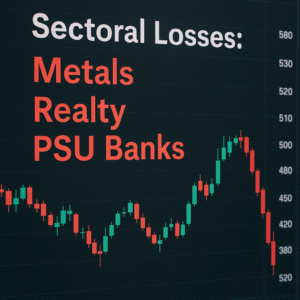
On the sectoral front, metals, realty, and PSU banks emerged as the biggest losers of the day. The metals sector was hit by weak global commodity cues and stock-specific negative news. Realty stocks witnessed profit-booking after a sharp rally earlier this month, while PSU banks lost ground due to concerns over bond yield movements and rising currency volatility. Sector rotation is common during volatile sessions, but on 21 November, these three sectors clearly dragged the broader market lower. Traders remained selective, focusing on sectors with stable earnings visibility.
6. Company-Specific News Drives Sharp Movements in Select Stocks
Apart from macro-driven moves, the day saw several stocks reacting sharply to company-specific developments. For example, reports regarding a fire incident at an overseas facility of a major metal company created sudden selling pressure. Similarly, updates from the energy and auto sectors influenced specific counters. When the broader market is nervous, such isolated corporate developments can amplify volatility because traders react quickly to any fresh information. This is why stock-specific activity remained unusually high on 21 November.
7. Reliance and HDFC Bank Influence Index Movements but Show Mixed Trend
Reliance Industries and HDFC Bank — the two biggest index movers — once again played a critical role in shaping market direction. While both stocks attempted to pull the market upward at different points in the session, they ultimately displayed mixed performance due to the prevailing risk-off sentiment. Their resilience prevented deeper correction in the indices, but the weakness in other sectors overpowered their positive contribution. Traders remained divided on whether these heavyweights can lead a December rally or whether more consolidation is likely before fresh highs.
8. Midcap and Smallcap Stocks Underperform as Risk-Off Mode Dominates
The midcap and smallcap segments saw steeper declines than large caps, indicating a clear drift toward safety among investors. When global markets are shaky and currency volatility rises, traders generally prefer large, liquid stocks over smaller names. This trend played out strongly on 21 November as midcap and smallcap indices fell more sharply. Analysts noted that this correction may provide long-term buying opportunities, but warned that further volatility cannot be ruled out in the near term.
9. FPI Outflows Add to Selling Pressure Across the Market
Foreign Portfolio Investors (FPIs) remained net sellers or low-participants on 21 November, contributing to the day’s weakness. FPIs have a significant influence on Indian markets due to their large share in trading volume. Even a small shift in their stance can impact index trends, especially in financials, IT, and metals. Concerns over global interest rates, geopolitical tensions, and the falling rupee contributed to their cautious approach. Domestic investors tried to counter the selling, but could not completely offset the FPI impact.
10. Options Market Signals Tight Trading Range and High Hedging Activity
The derivatives market provided clear signals of strong hedging behavior. Traders built sizable positions in both call and put options near key Nifty strikes, indicating expectations of limited upside as well as protection against further falls. Such positioning often leads to tightened trading ranges and amplified intraday swings because market makers aggressively hedge their books. On 21 November, this contributed to the sharp but contained movements in frontline indices.
11. Commodity Prices Weigh on Metal and Energy Stocks

Weak global commodity prices influenced several sectors, particularly metals and energy. The correction in international metal prices hit local producers, while fluctuating crude oil prices affected OMCs and transport-related stocks. Commodities often act as a macro indicator for equity markets, and their softness added to the pressure on the Indian market. As global demand signs remained mixed, traders trimmed positions in commodity-linked stocks.
12. Mixed Day for Banking and Financial Stocks
Banking stocks had a distinctly mixed session. While private banks showed relative strength due to stable quarterly numbers and loan-book performance, PSU banks faced selling pressure linked to bond market concerns and currency volatility. NBFCs also witnessed selective buying as investors preferred companies with strong capital buffers. Overall, the financial sector did not act as a clear market leader but continued to play a stabilizing role.
13. Earnings-Driven Moves Continue as Companies Announce Updates
Earnings season may be winding down, but its impact continues. Companies that posted strong results or issued positive commentary outperformed the broader market, showing that investors are still willing to reward fundamental strength. Stocks with weak earnings or cautious guidance witnessed sharper declines as traders used the volatile environment to exit weaker positions. This selective approach kept earnings-driven stocks in focus.
14. Key Technical Levels Tested on the Nifty and Sensex
Technical charts revealed that the indices tested crucial short-term support levels during the session. While some intraday supports were breached, long-term support zones remained intact. Technical traders noted that unless the lower support levels break decisively, the market remains in a sideways consolidation phase rather than a trend reversal. This led some traders to buy selectively near support zones, anticipating a technical bounce in coming sessions.
15. Global Weakness from US and Asian Markets Pressures Indian Equities
Weak trends in the US market and most Asian indices added to the pressure on domestic equities. Indian markets often mirror global sentiment, especially when foreign investors are already cautious. Concerns over slower global growth, tech stock corrections, and fresh macro data from the US influenced traders’ decisions in India. Early morning global weakness set the tone for a risk-off day domestically.
16. Bond Yield Movements Influence Rate-Sensitive Sectors
Fluctuations in Indian government bond yields affected banking, NBFC, auto, and real estate stocks. Higher yields typically lead to concerns over borrowing costs and valuation pressures. On 21 November, bond yield movements kept rate-sensitive sectors in check. Analysts highlighted that bond market signals will be crucial for December as investors look for hints about future RBI policy actions.
17. Profit-Booking Seen Across Sectors After Recent Gains
After a short rally earlier this week, traders engaged in widespread profit-booking. This is common when markets are near record levels or after a strong run-up. Many investors preferred to reduce exposure ahead of the weekend due to global uncertainties. This led to a broad but temporary correction as long-term trends remain unaffected.
18. Corporate Announcements Add to Stock-Specific Volatility

Corporate announcements — ranging from regulatory updates to operational alerts — kept individual stocks active. In volatile markets, such announcements tend to create outsized reactions as traders look for short-term cues. Some companies faced selling pressure after operational updates, while others gained on merger or expansion news. Overall, corporate announcements played a larger-than-usual role in influencing stock-specific movements.
19. Aftermarket Trades Signal Watchful Sentiment Ahead of Monday
Post-market trading patterns indicated a cautious mood among traders and institutions. Many preferred to lighten exposure in volatile sectors such as metals, PSU banks, and midcaps. Dealers also pointed out that overnight global cues will be critical for Monday’s opening trend. As a result, market positioning ahead of the weekend tilted toward safety.
20. Key Factors to Watch for the Next Market Trend
Looking ahead, analysts and investors are focused on three main triggers: the movement of the rupee, the trend in FPI flows, and cues from global central banks — especially the US Federal Reserve. These factors will likely determine the tone for the coming week. If the rupee stabilizes and FPI flows turn positive, the market could resume upward movement. But if uncertainty persists, further consolidation or mild correction cannot be ruled out.