
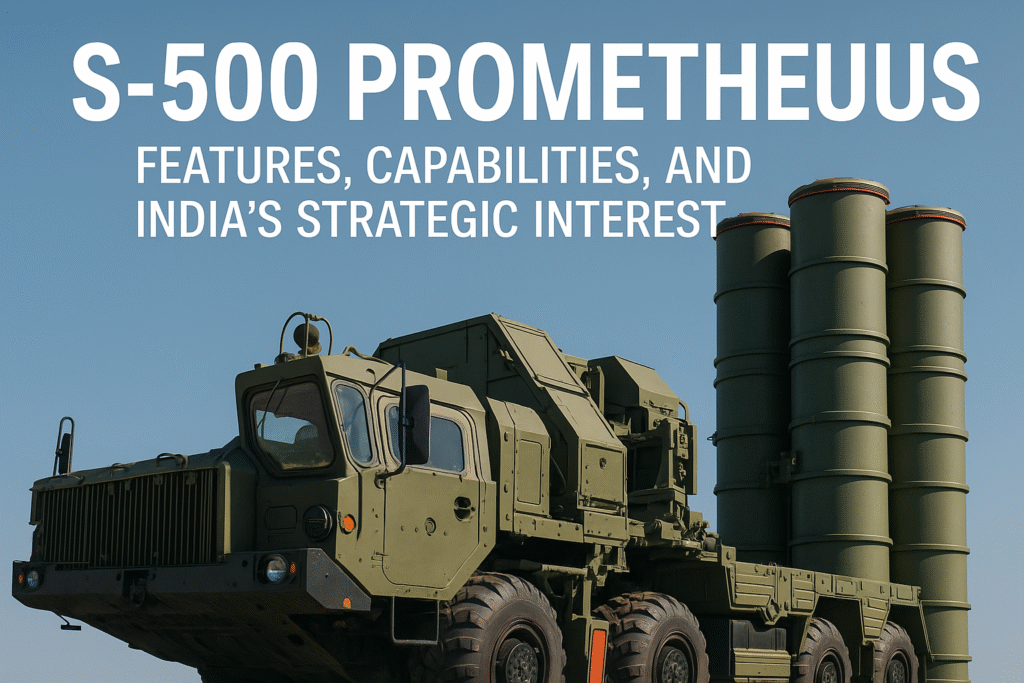
The Russian S-500 Prometheus Missile System: Features, Capabilities, and India’s Strategic Interest
The Russian S-500 Prometheus missile system has emerged as one of the most talked-about defence technologies in recent years, especially after the discussions held during Russian President Vladimir Putin’s visit to India. As the global defence landscape evolves rapidly, countries are focusing on systems that can counter next-generation threats such as hypersonic missiles, stealth aircraft, and advanced ballistic systems. In this environment, Russia’s S-500 stands out as a truly next-generation anti-air and anti-missile shield. India’s interest in the system reflects its broader plan to modernize national defence and strengthen its long-term deterrence capabilities.
Understanding the S-500 Prometheus: Russia’s New-Generation Missile Shield
The S-500 Prometheus is Russia’s latest air and missile defence system developed by Almaz-Antey, a state-owned defence giant known for strategic missile technologies. Unlike earlier systems built mainly to target aircraft or tactical missiles, the S-500 is designed as a national-level defence shield capable of engaging threats that operate in both the atmosphere and the near-space layer. This system represents a shift from traditional air defence to a more comprehensive, space-aware missile shield, capable of defeating ballistic missiles, stealth aircraft, hypersonic vehicles, and certain low-Earth orbit objects. Its role extends far beyond battlefield operations and is intended for the protection of large geographic areas, strategic infrastructures, and command centres.
How the S-500 Differs from the S-400: A Major Technological Leap
India already operates the Russian S-400 air defence system, which is considered one of the most advanced systems in the world. However, the S-500 Prometheus is not just an upgraded version—it is a completely different class of defence technology. The S-400 typically engages threats within an altitude of around 30 kilometres, focusing mainly on aircraft, drones, and cruise missiles. The S-500 expands this engagement envelope dramatically by targeting threats up to 180–200 kilometres in altitude, entering the near-space region where ballistic missiles and hypersonic glide vehicles operate.
Another significant difference lies in range. The S-400 can intercept targets at distances up to 400 kilometres, while the S-500 extends this capability to 500–600 kilometres. This larger protective radius makes the S-500 suitable for strategic city defence and national missile defence operations. Furthermore, the S-500 is built to counter high-speed ballistic missiles and hypersonic threats—targets that are too fast, too high, or too advanced for the S-400 to handle consistently. This qualitative leap is what places the S-500 in the category of next-generation missile defence systems.
To know more about india’s foreign policy Visit Here
Technical Features That Make the S-500 a Next-Generation System
The S-500 Prometheus is loaded with advanced features, many of which remain classified but enough open-source details are available to understand its significance. One of the most impressive features is its interception altitude of 180–200 kilometres, which places it in the near-space layer. This allows it to engage ballistic missiles during their mid-course or early terminal phases, long before they can re-enter the lower atmosphere and pose a greater threat. Its interception range of 500–600 kilometres further extends its defensive coverage, making it suitable for protecting critical national assets.
Another important feature of the S-500 is its use of specialized interceptors such as the 77N6-N and 77N6-N1 missiles. These are believed to feature “kinetic kill” technology, meaning they destroy incoming threats by direct physical impact instead of relying solely on explosive warheads. This approach is more effective in neutralizing ballistic missile warheads, especially those carrying high-risk payloads. Additionally, the system is engineered to detect, track, and engage hypersonic missiles—one of the most challenging categories of modern weapons. The S-500 also boasts a very fast reaction time, reportedly within just 3–4 seconds, which is significantly faster than many existing missile defence systems including the S-400.
Why India Is Interested in the S-500 Prometheus System
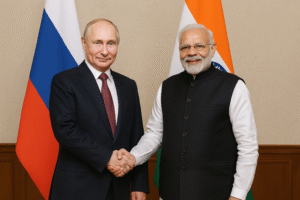
India’s interest in the S-500 is deeply connected to its long-term security environment, modernisation plans, and strategic ambitions. During President Putin’s India visit, defence discussions reportedly included the potential future acquisition or collaboration on the S-500 system. This aligns with India’s broader plan to build a layered missile defence shield capable of countering threats from advanced ballistic and hypersonic weapons being developed in the region.
One of the most attractive aspects for India is the possibility of co-production. Russia has reportedly expressed interest in manufacturing certain S-500 components in India under a joint production model. If finalized, this would not only lower costs but also expand India’s technological capabilities and deepen strategic defence ties between the two nations. Co-production also fits well with the Government of India’s “Make in India” and “Aatmanirbhar Bharat” programmes, which encourage domestic manufacturing of advanced defence systems.
Geopolitically, India faces evolving challenges from neighbouring countries that are rapidly modernising their missile arsenals. China’s investment in hypersonic weapons and long-range ballistic missiles makes it essential for India to look for systems that can counter such threats effectively. Pakistan’s missile developments also add to India’s need for a modern, multi-layered missile defence architecture. The S-500, if inducted, would serve as a top-tier defence layer above existing systems such as the S-400, MRSAM, Akash, and indigenous ballistic defence interceptors.
Challenges India Must Weigh Before Acquiring the S-500
Despite its unmatched capabilities, acquiring the S-500 would present several challenges for India. The first and most significant challenge is cost. The S-500 is significantly more expensive than the S-400, making it a major investment. With India’s defence budget already spread across several critical modernisation programs including fighter jets, submarines, drones, and indigenous missile projects, the financial decision must be carefully balanced.
Another challenge is logistical complexity. Operating an advanced system like the S-500 requires specialized infrastructure, highly trained personnel, and regular maintenance support. Given global sanctions on Russia, ensuring long-term supply chains for parts and upgrades may be difficult. Integration is also a concern. India uses multiple air defence and missile systems from different countries like Israel, Russia, and domestic manufacturers. Ensuring seamless integration of all these systems into a single command-and-control network is a technically demanding task.
Availability is another factor to consider. The S-500 is currently in limited production in Russia, with priority given to domestic defence needs. Export deliveries may take time, and negotiations could extend over several years. Moreover, India would have to carefully handle geopolitical implications, as Western partners have previously shown concern over India’s purchase of Russian systems, including the S-400.
To know more about more about policy and future plan of india on defence visit here
Conclusion: A Powerful Shield with Strategic Trade-Offs
The S-500 Prometheus missile system represents one of the most advanced air and missile defence technologies in the world. Its ability to operate in near-space, intercept hypersonic threats, and protect large territories gives it a strategic edge unlike any traditional air defence system. For India, the S-500 offers the promise of stronger national security, greater strategic deterrence, and deeper defence cooperation with Russia. However, it also brings significant challenges related to cost, logistics, integration, and geopolitics.
As India continues its military modernization and aims to build a comprehensive missile defence shield, the S-500 will remain an important subject of discussion. Whether India decides to acquire or co-produce the system will depend on long-term strategic planning, budget priorities, and global political dynamics. What is clear is that the S-500 marks a new chapter in the evolution of global defence technologies—one that India is watching closely.








1 thought on “S-500 Prometheus Missile System Explained: Features, Range, and India’s Strategic Interest”