
1️⃣ Introduction: Why the Rupee–Dollar Debate Is Dominating Finance Headlines in 2025
Until recently, discussions around the US dollar’s global dominance were limited to academic circles and central bank meetings. In 2025, that has changed. Today, “de-dollarisation,” “rupee trade,” and “currency diversification” are trending on Google Search and Google Discover in India—and for good reason.
Global geopolitics has entered an era of uncertainty. Wars in Europe and West Asia, aggressive sanctions, volatile capital flows, and repeated shocks to supply chains have forced countries to rethink how safe it is to depend too heavily on a single currency. The US dollar remains powerful, but it is also increasingly weaponised through sanctions and financial restrictions.
India, now the world’s fifth-largest economy in nominal GDP and third-largest in purchasing power parity, is responding carefully. Instead of confronting the dollar directly, India is quietly reshaping how much it depends on it—especially in trade, reserves, and payments.
This article explains what dollar dominance really means in 2025, why it is being questioned, and how India is slowly building currency resilience without destabilising markets or investor confidence.
2️⃣ Dollar Dominance in 2025: Still Strong, But No Longer Absolute
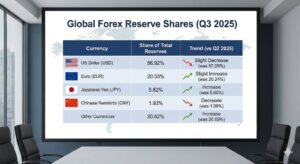
Despite all the talk of alternatives, the US dollar remains the backbone of the global financial system. According to the latest IMF COFER data for 2025, the dollar still accounts for around 56.9% of global foreign exchange reserves. This is lower than the nearly 70% share seen in the early 2000s, but it remains far ahead of any competitor.
The euro holds roughly 20.3%, the Japanese yen around 5.8%, and the Chinese yuan less than 3%. In foreign exchange markets, the dollar continues to appear in nearly nine out of every ten global currency trades.
This dominance gives the United States enormous advantages. It allows the US to borrow cheaply, finance large deficits, and impose sanctions by restricting access to dollar-based payment systems. However, it also creates global discomfort. When one currency becomes too central, it turns into a single point of failure.
That concern—not hostility toward the US—is driving change.
3️⃣ Why Countries Are Reducing Dollar Dependence Now
The turning point came after the freezing of roughly $300 billion of Russian foreign exchange reserves following the Ukraine war. For many countries, this was a wake-up call. Reserves held in “safe” currencies were no longer politically neutral.
At the same time, the US Federal Reserve’s aggressive rate hikes between 2022 and 2024 strengthened the dollar but hurt emerging markets by pulling capital away and raising borrowing costs. Add to this the US government’s ballooning debt—now above $34 trillion—and confidence in the long-term stability of the dollar system has weakened slightly.
Countries are not abandoning the dollar. Instead, they are doing something more subtle: diversifying risk.
4️⃣ India’s Strategy: Reduce Vulnerability, Not Replace the Dollar
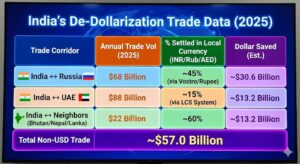
India’s approach stands out for its caution. Unlike some countries that openly talk about replacing the dollar, India’s policy is grounded in realism. The government and the Reserve Bank of India understand that sudden shifts can destabilise markets and scare investors.
India’s guiding principle is simple:
use the dollar where it is unavoidable, reduce dependence where alternatives make economic sense.
This philosophy explains why India has avoided dramatic announcements and instead focused on technical, incremental reforms—especially in trade settlement and reserve composition.
5️⃣ India’s Forex Reserves: The Foundation of Confidence
India’s ability to experiment with currency strategy rests on one key strength: its foreign exchange reserves.
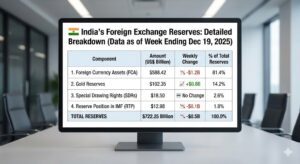
As of December 2025, India’s forex reserves stood at approximately $688.9 billion, after briefly crossing the $700 billion mark earlier in the year. This places India among the top five reserve-holding countries in the world.
These reserves are sufficient to cover around 10–11 months of imports, a level considered very comfortable by international standards. This buffer allows India to manage currency volatility, intervene in markets when needed, and withstand external shocks without panic.
Simply put, India can afford to be patient.
6️⃣ Gold Is Back: A Quiet Shift Inside India’s Reserves
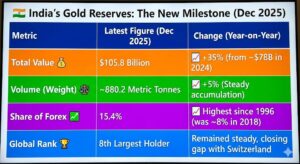
One of the most underreported trends in India’s currency strategy is the renewed importance of gold. In 2025, India’s gold reserves crossed $102 billion, the highest level on record.
Gold now forms a growing share of India’s reserve basket. This matters because gold is politically neutral—it cannot be frozen or sanctioned by another country. Central banks worldwide, including those in China and emerging markets, are increasing gold holdings for the same reason.
For India, gold is not about nostalgia. It is about insurance against geopolitical risk.
7️⃣ Rupee Trade Settlement: What Changed After 2022
In July 2022, the RBI introduced a framework allowing international trade to be settled in Indian rupees. This policy gained real momentum in the years that followed.
By 2025:
22+ countries have agreed to explore or use rupee-based trade
30+ Special Rupee Vostro Accounts (SRVAs) have been opened
Rupee-settled trade still accounts for less than 2% of India’s total trade
These numbers show both progress and limitation. The rupee is not replacing the dollar in global trade. Instead, it is being used selectively—especially where dollar payments are difficult, costly, or risky.
8️⃣ Real-World Impact: Russia Oil Trade and Currency Flexibility
The clearest example of India’s pragmatic approach came after Western sanctions on Russia. India sharply increased imports of discounted Russian crude, often at $20–30 per barrel below global benchmarks.
Payments were routed through a mix of rupees, dirhams, and other currencies, reducing immediate dollar demand. This strategy helped India save billions on its oil import bill while protecting its forex reserves.
This was not ideology. It was economics.
9️⃣ India’s Trade Structure Still Anchors the Dollar
Despite these initiatives, India remains deeply integrated into the dollar system. Around 85–90% of India’s trade invoicing is still dollar-denominated, especially for crude oil, shipping, insurance, and high-value commodities.
In FY 2024–25, India’s total exports of goods and services stood near $820 billion, but its share in global trade remains around 2%. This limited trade footprint constrains how far the rupee can internationalise.
History shows that currencies gain power after trade dominance, not before it.
🔟 Rupee Exchange Rate Reality in 2025
Currency resilience does not mean currency strength. In 2025, the rupee traded around ₹89–90 per US dollar, reflecting global dollar strength, capital flow volatility, and India’s trade deficit.
The RBI stepped in multiple times through liquidity operations, bond purchases, and dollar-rupee swaps—injecting nearly ₹2.9 trillion in liquidity at one point—to smooth volatility.
The message was clear: stability matters more than symbolism.
1️⃣1️⃣ BRICS and the Myth of a New Global Currency
Much attention has been paid to discussions within BRICS about a common currency. In reality, such a move remains highly unlikely in the near future.
The BRICS countries differ widely in inflation, fiscal discipline, capital controls, and political systems. India has wisely avoided endorsing any dramatic currency project, preferring flexibility over grand statements.
For India, optionality is more valuable than ambition.
1️⃣2️⃣ Why the Rupee Cannot Replace the Dollar Yet
There are hard structural reasons why the rupee cannot become a global reserve currency today:
It is not fully convertible on the capital account
India runs a structural current account deficit
Domestic bond markets, while improving, are not yet globally dominant
Acknowledging these limits is a strength, not a weakness. India is building capacity first, credibility second, and influence third.
1️⃣3️⃣ Lessons from History: Currency Power Takes Decades
The British pound dominated global finance for nearly a century, then declined over 30 years. The euro rose rapidly after 1999 but stalled due to political fragmentation. The Japanese yen peaked and faded amid deflation.
The lesson is consistent: currency dominance is earned slowly and lost slowly. India’s patient approach aligns perfectly with historical reality.
1️⃣4️⃣ What This Means for the Indian Economy and Citizens
For ordinary Indians, currency strategy may sound abstract—but its effects are real:
Lower vulnerability to external shocks
Reduced import price volatility
Stronger crisis management capacity
A stable currency environment supports growth, jobs, and inflation control—even if the rupee does not become “global.”
1️⃣5️⃣ Final Verdict: Is India Challenging Dollar Dominance?
Yes—but not loudly, not recklessly, and not ideologically.
India is reducing risk, not waging war. The dollar will remain dominant for years, possibly decades. But India is ensuring that its economy is never hostage to a single currency or a single power.
That is not de-dollarisation.
That is smart geoeconomic statecraft.
To visit World Gold Council click here
❓ Frequently Asked Questions (FAQ)
1. Is India really reducing its dependence on the US dollar?
Yes, but gradually and selectively. India is not abandoning the US dollar. Instead, it is reducing over-dependence by promoting rupee-based trade settlements, diversifying forex reserves, and increasing gold holdings. The dollar still dominates India’s trade and reserves, but its exclusive role is slowly shrinking.
2. Is India trying to replace the dollar with the rupee globally?
No. India is not trying to replace the dollar as the world’s reserve currency. Such dominance takes decades and requires massive trade influence. India’s strategy is focused on risk management, not global currency leadership.
3. What is rupee trade settlement and why does it matter?
Rupee trade settlement allows India to conduct bilateral trade without using the US dollar. Payments are made in Indian rupees through special bank accounts.
This reduces dollar demand, lowers transaction costs, and protects trade during sanctions or dollar shortages.
4. How many countries are using rupee trade settlement with India?
As of 2025:
22+ countries have agreed to explore or use rupee trade
30+ Special Rupee Vostro Accounts are operational
However, rupee-settled trade still accounts for less than 2% of India’s total trade, showing that the process is expanding but remains limited.
5. Why is India buying more gold instead of holding only dollars?
Gold is politically neutral and cannot be frozen through sanctions.
In 2025, India’s gold reserves crossed $102 billion, the highest ever. This helps India diversify its reserves and reduce excessive reliance on dollar-based assets.
6. Does reducing dollar dependence weaken the rupee?
No. In fact, the goal is the opposite. Reducing over-dependence improves stability, not weakness.
Rupee movements in 2025 (₹89–90 per dollar) were driven mainly by global dollar strength and capital flows, not by India’s rupee trade policy.
7. What role does the RBI play in India’s dollar–rupee strategy?
The Reserve Bank of India plays a central role by:
Managing forex reserves
Allowing rupee trade settlement
Intervening in currency markets to reduce volatility
Increasing gold reserves gradually
The RBI prioritises market stability over aggressive experimentation.
8. Is India part of the global “de-dollarisation” movement?
India prefers the term “diversification”, not de-dollarisation.
Unlike some countries, India avoids ideological positioning and focuses on practical economic benefits.
9. Can BRICS create a common currency to challenge the dollar?
Unlikely in the near future. BRICS countries have:
Different inflation levels
Different capital controls
No shared fiscal authority
India itself has taken a cautious stance, favouring flexible trade settlement over a single common currency.
10. How does this currency shift affect common Indian citizens?
Indirectly, but importantly:
Lower risk of import price shocks
Better protection during global crises
More stable inflation environment
Stronger economic resilience
A diversified currency strategy helps keep the economy steady during global turbulence.
11. Will the US dollar lose its dominance soon?
No. The dollar will remain dominant for many years, possibly decades.
However, its share is slowly declining, and countries like India are ensuring they are not overly exposed to one currency.
12. What is the biggest takeaway from India’s rupee–dollar strategy?
India is not fighting the dollar.
India is future-proofing its economy.
This is quiet, patient, and intelligent geoeconomic strategy—not a currency war.
To visit official website of RBI click here
🔎 People Also Ask (PAA) — Rupee vs Dollar (2025)
Is India de-dollarising its economy in 2025?
India is not fully de-dollarising. Instead, it is diversifying currency risk by promoting rupee trade settlement, increasing gold reserves, and reducing exclusive reliance on the US dollar in selected transactions.
Why does India depend so much on the US dollar?
India’s dependence on the dollar exists because:
Most global trade (oil, shipping, insurance) is dollar-priced
The dollar is the most liquid and trusted global currency
India imports nearly 85% of its crude oil, all priced in dollars
This makes gradual diversification more practical than sudden exit.
How is the RBI reducing dollar risk for India?
The Reserve Bank of India is reducing dollar risk by:
Allowing rupee-based trade settlement
Diversifying forex reserves with higher gold holdings
Intervening in currency markets to control volatility
Maintaining strong forex buffers (near $690 billion in 2025)
What is rupee trade settlement and how does it work?
Rupee trade settlement allows India to trade with partner countries using Indian rupees instead of US dollars, through special Vostro accounts held in Indian banks.
This helps during sanctions, dollar shortages, or high transaction costs.
How many countries are trading with India in rupees?
As of 2025:
22+ countries have agreed to use or explore rupee trade
30+ Special Rupee Vostro Accounts are operational
However, rupee trade still forms less than 2% of India’s total trade.
Does reducing dollar dependence weaken the rupee?
No. Reducing over-dependence actually improves stability.
Rupee weakness in 2025 (₹89–90 per dollar) was driven by global dollar strength and capital flows, not India’s rupee trade policy.
Why is India increasing gold reserves instead of holding more dollars?
Gold cannot be sanctioned or frozen.
In 2025, India’s gold reserves crossed $102 billion, helping:
Diversify forex reserves
Reduce political risk
Strengthen long-term financial security
Can the rupee ever replace the US dollar globally?
Not in the near future.
Global reserve currencies require:
Massive trade share
Full capital convertibility
Deep financial markets
India is building these foundations slowly, not forcing the outcome.
What is the role of BRICS in challenging the dollar?
BRICS discussions focus on trade settlement flexibility, not a single global currency.
A common BRICS currency is unlikely soon due to economic and policy differences among members.
How does dollar dominance affect Indian citizens?
Dollar dominance impacts:
Fuel prices
Import costs
Inflation
Interest rates
Reducing vulnerability helps protect Indian households from global shocks.
Is the US dollar losing its global power?
The dollar remains dominant, holding ~57% of global forex reserves in 2025.
However, its share is slowly declining, as countries diversify—not abandon—it.
What is India’s long-term currency strategy?
India’s long-term goal is currency resilience, not dominance:
Multiple settlement options
Strong forex reserves
Stable rupee
Reduced geopolitical exposure







1 thought on “Rupee vs Dollar Explained: How India Is Quietly Reducing Dollar Dependence in 2025”