1. The Great Trade Realignment
As 2026 begins, global trade no longer looks like the open, rules-based system many countries once relied on. Tariffs, sanctions, and strategic pressure have replaced free-flowing commerce. In this environment, India has quietly changed its trade playbook. While the US–India trade dialogue remains stuck under a heavy 50% tariff cloud, New Delhi has moved ahead on a different track—building a wide network of bilateral and regional Free Trade Agreements (FTAs).
Instead of waiting for slow and often stalled multilateral platforms like the WTO, India has focused on plurilateralism. In simple words, this means striking practical, targeted deals with selected partners who are ready to move fast. Over the last year, India has created what many experts now call a “Silk Road of Agreements”—stretching from the UK to the Gulf and into Oceania.
This strategy is already showing results. Despite global trade slowing in 2025, India’s services exports grew by about 13%, supported by smoother market access through new bilateral pathways. For Indian MSMEs, IT firms, and professionals, these FTAs act as a trade shield, reducing exposure to tariff wars while opening direct, duty-free corridors to stable markets.
Ministry of Commerce & Industry (India)
2. The UK CETA: The Crown Jewel of 2026
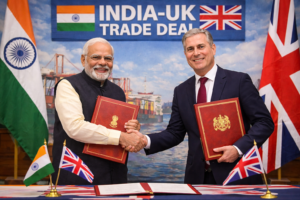
The most ambitious of India’s new trade deals is the Comprehensive Economic and Trade Agreement (CETA) with the United Kingdom. Set for implementation in H1 2026, this agreement is widely seen as the centerpiece of India’s new trade architecture.
The headline number is striking. Once implemented, 99% of Indian exports to the UK—covering textiles, leather, gems and jewellery, auto components, and IT-enabled services—will enjoy duty-free access. For exporters who have struggled with high compliance costs and tariffs in Europe, this is a game changer.
But the real ambition goes beyond goods. India and the UK have set a target to double bilateral trade to $112 billion by 2030. A key pillar of this growth is mobility, an area rarely emphasized in traditional trade agreements. Under CETA, the UK will offer annual quotas for around 1,800 Indian professionals, including yoga instructors, chefs, musicians, and artists. This move recognises services and cultural skills as economic assets, not side benefits.
For India, this is important. It allows the country to export skills and culture, not just products. For the UK, it helps fill labour gaps while strengthening ties with one of the world’s fastest-growing economies.
UK Department for Business & Trade
3. The “Oceania Pivot”: The India–New Zealand FTA
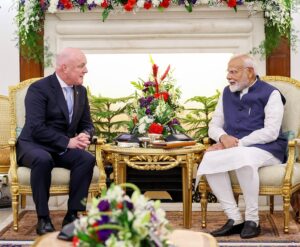
Another major shift in India’s trade strategy is its growing focus on Oceania. The India–New Zealand Free Trade Agreement, concluded in December 2025, stands out for both its speed and structure. Negotiations were wrapped up in just nine months, a rare achievement in global trade diplomacy.
The agreement provides zero-duty access on 100% of Indian exports to New Zealand. This immediately benefits Indian exporters of leather goods, pharmaceuticals, engineering products, and IT services. More importantly, New Zealand has committed $20 billion in foreign direct investment (FDI) over the next 15 years, directly supporting the Make in India program.
What makes this deal especially interesting is what it leaves out. Dairy products were excluded from tariff concessions. This was a deliberate decision to protect nearly 80 million Indian farmers, many of whom depend on small-scale dairy income. This approach reflects what policymakers describe as “pragmatic protectionism”—opening markets where India is competitive, while shielding sensitive domestic sectors.
The message is clear: India is no longer chasing trade deals at any cost. It is choosing balanced agreements that support growth without destabilising livelihoods.
New Zealand Ministry of Foreign Affairs & Trade (MFAT)
4. The Gulf Gateway: Oman CEPA (March 2026)

India’s engagement with the Gulf has traditionally focused on energy and remittances. In 2026, that relationship is becoming more structured through the Comprehensive Economic Partnership Agreement (CEPA) with Oman, expected to become operational by March 2026.
Oman plays a unique role in India’s West Asia strategy. It is politically stable, strategically located near key shipping lanes, and friendly to Indian businesses. Under the CEPA, Indian exporters gain faster and cheaper access for refined petroleum products, steel, aluminium, electronics, and engineering goods.
One of the most innovative features of this agreement is the inclusion of AYUSH products, especially Ayurveda, as a recognised trade category. For the first time, India has embedded traditional medicine into a modern trade pact. This turns Indian soft power into a commercial export, opening new markets for wellness, healthcare, and tourism-linked services.
For India, Oman acts as a gateway to the broader Gulf region, helping diversify export routes at a time when global shipping and energy markets remain volatile.
Oman Ministry of Commerce, Industry and Investment Promotion
5. The US Standoff: The “Russian Oil” Friction
While India has moved ahead with multiple FTAs, its trade relationship with the United States remains strained. By late 2025, trade talks were effectively stalled. Washington imposed 50% tariffs on select Indian exports and sanctioned several entities over India’s continued purchases of Russian oil.
From the US perspective, this is about geopolitical alignment. Washington wants India to reduce its dependence on Russian energy and defence supplies. New Delhi, however, views this as a red line. For India, affordable energy is not a political choice—it is an economic necessity.
This deadlock has real financial consequences. In 2025, Foreign Portfolio Investors (FPIs) pulled out nearly ₹2.4 lakh crore from Indian markets, partly reflecting this geopolitical tension. Yet, India’s response has not been to retreat. Instead, it has doubled down on trade diversification, reducing dependence on any single market.
This approach signals a clear principle: strategic autonomy over trade dependency.
6. Comparative Strategy Table: India’s New Trade Map
Here is how India’s major trade partnerships stand as of January 2026:
| Partner | Status (Jan 2026) | Key Export Gain | Strategic Benefit |
|---|---|---|---|
| UK | Implementation H1 2026 | Textiles, IT Services | Gateway to Europe |
| Oman | Operational March 2026 | Pharma, Engineering | Energy & Gulf stability |
| New Zealand | Signed Dec 2025 | Leather, STEM talent | $20 bn FDI commitment |
| EFTA | Effective since Oct 2025 | Industrial machinery | $100 bn investment goal |
| USA | Stalled | High-tech, defence | Strategic autonomy focus |
This table highlights a clear pattern. India is building multiple trade anchors, ensuring that no single geopolitical shock can derail its export growth.
7. Conclusion: The “Viksit Bharat” Playbook
By 2026, India has made one thing clear—it no longer needs to be a junior partner in any global trade bloc to grow. Through smart, targeted FTAs with the UK, Gulf nations, and Oceania, India has built a geoeconomic hedge against the volatility of US–China tensions and tariff wars.
This strategy fits neatly into the broader “Viksit Bharat” vision, where growth is driven by exports, services, skills, and strategic independence. India is trading on its own terms—opening markets where it gains, protecting sectors where it must, and refusing to compromise on energy sovereignty.
The final question is no longer whether India can thrive without US market concessions. The real question for 2026 is this: as India’s alternative markets begin to flourish, will Washington be forced to blink and rethink its tariff strategy?
❓ Frequently Asked Questions (FAQ)
1. What are Free Trade Agreements (FTAs) and why are they important for India?
Free Trade Agreements are trade deals between countries that reduce or remove import duties and simplify trade rules. For India, FTAs help exporters access foreign markets at lower cost, protect jobs, and reduce dependence on unstable global trade systems.
2. Why is India signing more FTAs in 2026?
India is signing more FTAs because global trade has become fragmented due to tariffs, sanctions, and geopolitical tensions. Instead of relying only on multilateral systems like the WTO, India is securing direct market access through bilateral and regional deals.
3. How do India’s new FTAs protect against tariff wars?
FTAs create duty-free or low-duty trade corridors. This shields Indian exporters from sudden tariff hikes imposed by major powers and ensures stable access to key markets like the UK, Gulf countries, and Oceania.
4. What is the UK–India CETA and why is it important?
The UK–India Comprehensive Economic and Trade Agreement (CETA) is a major trade deal set for implementation in 2026. It gives duty-free access to most Indian exports and includes mobility quotas for Indian professionals, making it one of India’s most ambitious FTAs.
5. How does the India–New Zealand FTA benefit India?
The India–New Zealand FTA provides zero-duty access for Indian exports and includes a long-term $20 billion FDI commitment. At the same time, it protects sensitive sectors like dairy, showing a balanced trade approach.
6. What is Oman CEPA and why does it matter?
The Oman CEPA is a comprehensive trade pact that strengthens India’s presence in the Gulf. It supports exports of petroleum products, engineering goods, and pharmaceuticals, and also integrates AYUSH products like Ayurveda into trade.
7. How do these FTAs help Indian MSMEs?
FTAs reduce tariffs, simplify customs rules, and open new markets. This allows MSMEs to export goods and services more easily, lowering costs and increasing competitiveness abroad.
8. Why are trade talks between India and the US stalled?
Trade talks are stalled mainly due to disagreements over tariffs and India’s continued purchases of Russian oil. India prioritises energy security, while the US links trade concessions to geopolitical alignment.
9. Did US–India trade tensions affect investments in India?
Yes. In 2025, foreign portfolio investors withdrew significant funds due to global uncertainty and trade friction. However, India’s diversified trade strategy and strong domestic demand helped absorb the impact.
10. How do FTAs support the “Viksit Bharat” vision?
FTAs support Viksit Bharat by boosting exports, attracting foreign investment, creating jobs, and strengthening India’s global economic position without compromising strategic autonomy.
11. Is India moving away from the WTO system?
India is not abandoning the WTO, but it is no longer relying on it alone. Bilateral and regional FTAs offer faster and more practical solutions in a world where multilateral negotiations are often stalled.
12. Can India grow without US trade concessions?
India’s recent FTAs show that growth is possible through diversification. While the US remains important, India is reducing dependence on any single market by expanding trade ties elsewhere.
🔍 People Also Ask (PAA)
What is India’s trade strategy in 2026?
India’s trade strategy in 2026 focuses on signing targeted FTAs with stable regions to protect exports, attract investment, and reduce exposure to tariff wars and geopolitical risks.
Why is India focusing on bilateral trade agreements?
Bilateral agreements are faster to negotiate and offer direct benefits. They help India bypass global trade gridlock and secure market access for its exporters.
How do FTAs affect Indian exporters?
FTAs lower export costs by reducing tariffs and improving market access. This helps Indian companies compete globally and expand into new regions.
What sectors benefit most from India’s new FTAs?
Key beneficiaries include textiles, IT services, pharmaceuticals, engineering goods, leather products, refined petroleum, and wellness products like Ayurveda.
How does Oman CEPA help India in the Gulf region?
Oman CEPA provides India with a stable trade and logistics hub in the Gulf, improving access to energy markets and regional export routes.
Why was dairy excluded from the India–New Zealand FTA?
Dairy was excluded to protect millions of Indian farmers. This shows India’s approach of opening markets without harming domestic livelihoods.
Do FTAs help reduce trade risks with the US and China?
Yes. By diversifying export destinations, India reduces vulnerability to trade pressure from any single major power.
What is plurilateralism in trade?
Plurilateralism involves selective trade agreements among a few willing partners, instead of large multilateral deals that require consensus from many countries.
Can FTAs increase foreign investment in India?
Yes. Clear trade rules and market access encourage long-term foreign investment, as seen in New Zealand’s FDI commitment to India.
Will India sign more FTAs after 2026?
Most experts expect India to continue expanding its FTA network with regions that offer strategic and economic stability.