INTRODUCTION
KOLKATA — Hindustan Copper Limited (NSE: HINDCOPPER, BSE: 513599), India’s sole vertically integrated copper producer and a key Central Public Sector Enterprise (CPSE) under the Ministry of Mines, released its unaudited standalone and consolidated financial results for the first quarter ended June 30, 2026 (Q1 FY27) on August 10, 2026. The Board of Directors approved the financial statements in a meeting that concluded at 1:15 PM IST.
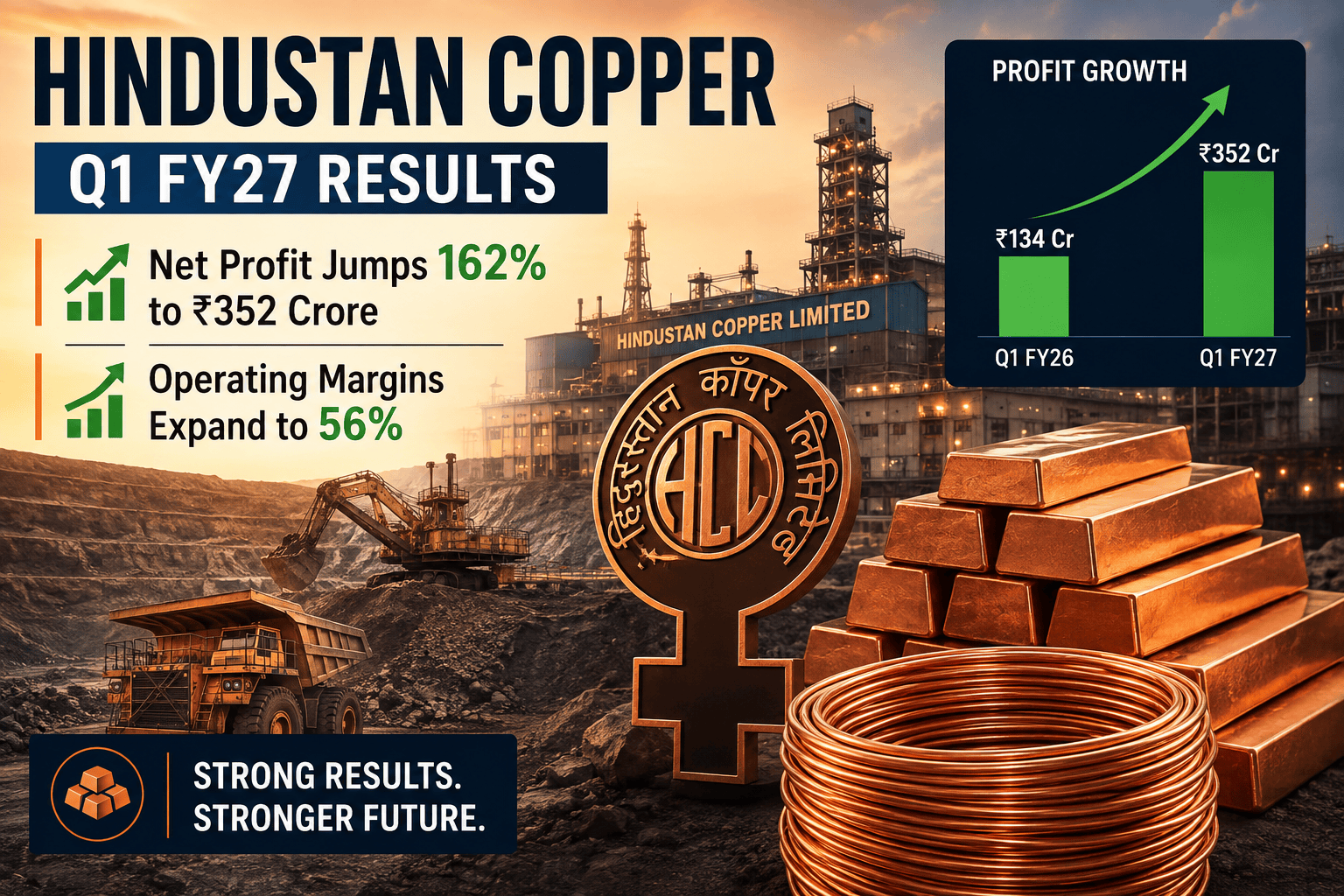
The quarterly performance shows strong financial expansion, characterized by a sharp year-on-year (YoY) increase in operational revenue and profitability. Consolidated revenue from operations reached ₹936.50 crore, marking an 81.36% YoY growth compared to ₹516.37 crore in Q1 FY26. Consolidated Profit After Tax (PAT) expanded even faster, jumping 162.47% YoY to ₹352.37 crore from ₹134.25 crore in the corresponding quarter of the previous financial year.
However, a sequential (QoQ) comparison reveals operational moderation. Consolidated revenue dipped 18.99% QoQ from ₹1,156.08 crore recorded in Q4 FY26, while net profit contracted 20.69% QoQ from ₹444.27 crore. This sequential drop reflects seasonal variations in mining activity during the monsoon ramp-up phase alongside shifts in quarterly sales realization schedules.
Hindustan Copper Q1 FY27 Result:
Hindustan Copper reported a strong first quarter for FY27, benefiting from high global copper realizations on the London Metal Exchange (LME) and steady domestic refined copper sales. The primary driver behind the financial expansion was the realization delta on copper concentrate and refined copper products.
At the standalone level, operational revenue was identical to the consolidated total at ₹936.50 crore, compared to ₹516.37 crore in Q1 FY26. Standalone PAT reached ₹352.61 crore, up 162.59% YoY from ₹134.28 crore. The minor difference between standalone and consolidated net profit is attributed to a ₹0.24 crore share of loss from its joint venture entity, Khanij Bidesh India Limited (KABIL), and a small share of loss in subsidiary Chhattisgarh Copper Limited (CCL).
Hindustan Copper Q1 FY27 Financial Performance
Revenue Growth
Operational top-line expansion was driven by a combination of firm commodity realizations and sales volume execution. Total consolidated income reached ₹953.60 crore in Q1 FY27, which includes ₹17.10 crore in other income (up from ₹10.28 crore in Q1 FY26). Revenue from operations alone grew by ₹420.13 crore in absolute terms YoY.
Consolidated Top-Line Trajectory (₹ in Crore)
├── Q1 FY26 Revenue: ₹516.37 Cr
├── YoY Increase: +₹420.13 Cr (+81.36%)
└── Q1 FY27 Revenue: ₹936.50 Cr
EBITDA and Margin Performance
Hindustan Copper demonstrated operating leverage as revenue growth significantly outpaced total cost expansion. Total expenses for Q1 FY27 rose 38.74% YoY to ₹481.83 crore from ₹347.29 crore in Q1 FY26. Because cost increments remained contained relative to top-line gains, operating earnings expanded rapidly.
Operating EBITDA (Profit before tax + Finance Costs + Depreciation – Other Income) stood at ₹524.62 crore in Q1 FY27, compared to ₹212.01 crore in Q1 FY26. This represents a 147.45% YoY surge in operating EBITDA. The EBITDA margin expanded by 1494 basis points (14.94 percentage points) YoY to 56.02%, up from 41.08% in Q1 FY26.
Operating EBITDA Calculation (Q1 FY27)
├── Profit Before Tax (PBT): ₹471.77 Cr
├── Plus: Finance Costs: ₹3.20 Cr
├── Plus: Depreciation & Amortization: ₹49.65 Cr
├── Less: Other Income: ₹17.10 Cr
└── Operating EBITDA: ₹524.62 Cr (56.02% Margin)
Profit After Tax
Profit Before Tax (PBT) for Q1 FY27 stood at ₹471.77 crore, up 163.03% YoY from ₹179.36 crore in Q1 FY26. Total tax expenses for the quarter came in at ₹119.16 crore (comprising current tax of ₹99.26 crore and deferred tax charge of ₹19.90 crore), resulting in an effective tax rate of 25.26%. Net consolidated profit after tax reached ₹352.37 crore, corresponding to a net profit margin of 37.63%.
EPS Performance
Basic and diluted Earnings Per Share (EPS) for the quarter rose to ₹3.64, compared to ₹1.39 in Q1 FY26 and ₹4.59 in the preceding quarter Q4 FY26.
Hindustan Copper Q1 FY27 vs Q1 FY26
The table below outlines the consolidated financial performance for Q1 FY27 compared with Q1 FY26 and Q4 FY26:
| Particulars (₹ in Crore) | Q1 FY27 (Unaudited) | Q4 FY26 (Audited) | Q1 FY26 (Unaudited) | YoY Change (%) | QoQ Change (%) |
| Revenue from Operations | 936.50 | 1,156.08 | 516.37 | +81.36% | -18.99% |
| Other Income | 17.10 | 32.68 | 10.28 | +66.34% | -47.67% |
| Total Income | 953.60 | 1,188.76 | 526.65 | +81.07% | -19.78% |
| Cost of Materials Consumed | 26.40 | 18.01 | 10.73 | +146.04% | +46.59% |
| Changes in Inventories | (37.21) | 16.22 | (30.72) | -21.13% | N/A |
| Employee Benefits Expense | 106.27 | 90.99 | 80.23 | +32.46% | +16.79% |
| Consumption of Power & Fuel | 39.34 | 36.07 | 36.20 | +8.67% | +9.06% |
| Finance Costs | 3.20 | 0.80 | 1.64 | +95.12% | +300.00% |
| Depreciation & Amortization | 49.65 | 67.25 | 41.29 | +20.25% | -26.17% |
| Other Expenses | 265.68 | 323.76 | 180.04 | +47.57% | -17.94% |
| Total Expenses | 481.83 | 596.55 | 347.29 | +38.74% | -19.23% |
| Operating EBITDA | 524.62 | 623.58 | 212.01 | +147.45% | -15.87% |
| EBITDA Margin (%) | 56.02% | 53.94% | 41.08% | +1494 bps | +208 bps |
| Profit Before Tax (PBT) | 471.77 | 592.21 | 179.36 | +163.03% | -20.34% |
| Tax Expense | 119.16 | 148.15 | 45.08 | +164.33% | -19.57% |
| Consolidated PAT | 352.37 | 444.27 | 134.25 | +162.47% | -20.69% |
| Basic & Diluted EPS (₹) | 3.64 | 4.59 | 1.39 | +161.87% | -20.70% |
Data compiled from Hindustan Copper Limited official BSE/NSE filing dated August 10, 2026.
Hindustan Copper Q1 FY27 vs Q4 FY26
Sequentially, Hindustan Copper saw a contraction across major top-line and bottom-line metrics compared to Q4 FY26:
Revenue from Operations: Fell from ₹1,156.08 crore in Q4 FY26 to ₹936.50 crore in Q1 FY27 (-18.99%).
Consolidated PAT: Declined from ₹444.27 crore to ₹352.37 crore (-20.69%).
Why Did Sequential Performance Dip?
Seasonality: Mining operations in open-cast and underground mines typically experience temporary output disruptions at the onset of monsoon rains during June.
Realization Timing: Q4 of any financial year historically sees higher liquidation of inventory and clearing of concentrate shipments compared to Q1.
Employee Costs: Employee benefit expenses increased 16.79% QoQ to ₹106.27 crore from ₹90.99 crore in Q4 FY26, adding modest sequential cost pressure.
Despite the QoQ decline in absolute revenue, operating EBITDA margin actually expanded sequentially by 208 basis points to 56.02% (up from 53.94% in Q4 FY26), supported by lower other expenses (which fell from ₹323.76 crore to ₹265.68 crore).
What Drove Hindustan Copper’s Q1 FY27 Performance?
The primary catalyst for Hindustan Copper’s financial performance in Q1 FY27 was the commodity price environment.
Operating cost elements rose YoY:
Cost of Materials Consumed: Up 146.04% YoY to ₹26.40 crore.
Power & Fuel Expenses: Rose 8.67% YoY to ₹39.34 crore.
Other Expenses: Up 47.57% YoY to ₹265.68 crore.
However, the surge in revenue (+81.36% YoY) far outstripped the total expenditure increase (+38.74% YoY). This operating leverage was unlocked because a significant portion of copper mining costs (such as employee expenses and underground mine maintenance) are fixed or semi-variable. When realized selling prices rise, incremental revenue translates directly into operating profit margin expansion.
Copper Prices: How Much Did the Commodity Cycle Matter?
As a primary pure-play copper miner, Hindustan Copper’s earnings are sensitive to global copper prices traded on the London Metal Exchange (LME).
Price Realization Engine
├── Global LME Copper Prices (Driven by Supply Tightness & Green Demand)
├── Realized Domestic Selling Price (Rupee-denominated benchmarks)
└── Operating Cost Structure (Fixed mining costs yield margin expansion)
During the period leading into Q1 FY27, global copper prices remained supported due to:
Global Supply Tightness: Disruptions in major South American copper mines and declining ore grades restricted global concentrate availability.
Green Energy Demand: Sustained demand from electric vehicle (EV) manufacturing, renewable energy grid integration, and power infrastructure projects.
Domestic Demand Premium: Strong domestic industrial activity in India allowed HCL to maintain high realizations on copper concentrate and continuous cast copper wire rods.
Hindustan Copper’s Expansion and Growth Strategy
To capitalize on long-term copper demand, Hindustan Copper is executing mine expansion plans aimed at increasing ore production capacity.
Key Mine Expansion Vectors:
Malanjkhand Copper Project (Madhya Pradesh): Expanding the flagship open-cast mine and transitioning into underground mining to boost ore output.
Khetri & Kolihan Mines (Rajasthan): Deepening shafts and modernizing underground mining infrastructure to enhance ore production efficiency.
Surda & Rakha Mines (Jharkhand): Reopening and expanding capacity through long-term operational leases and environmental approvals.
The company aims to increase its mine production capacity progressively from current levels toward 12.2 million tonnes per annum (MTPA) in phases.
Why Copper Matters to India’s Economy
Copper is a critical mineral vital to India’s industrial modernization and energy transition roadmap:
Power Grid Expansion: Copper is essential for transformers, generators, and high-voltage transmission lines.
Renewable Energy Integration: Solar and wind power generation systems require up to 4x to 6x more copper per megawatt installed capacity than conventional fossil-fuel plants.
Electric Mobility (EVs): An electric vehicle contains approximately 3x to 4x the amount of copper used in an internal combustion engine (ICE) vehicle.
Data Centers & AI Infrastructure: High-density computing facilities require substantial copper wiring and power supply infrastructure.
India remains a net importer of copper concentrate. As the country’s primary domestic copper ore producer, Hindustan Copper holds a strategic position in reducing import dependency.
Latest Developments Around Hindustan Copper
1. Joint Venture via KABIL
Hindustan Copper holds a 30% equity stake in Khanij Bidesh India Limited (KABIL), a joint venture with NALCO (40%) and MECL (30%) under the Ministry of Mines. KABIL is mandated to acquire strategic critical-mineral assets overseas, particularly lithium and copper blocks in South America (including Argentina and Chile). In Q1 FY27, HCL reported a consolidated share of loss of ₹0.24 crore from KABIL.
2. Governance Disclosures in Limited Review Report
The statutory auditors (P. A. & Associates) included specific regulatory notes in their Limited Review Report:
Independent Directors / Audit Committee: The company did not have Independent Directors as required under Section 149(4) and Section 177 of the Companies Act, 2013. Consequently, no formal Audit Committee meeting could be held, and results were directly approved by the Board of Directors. Non-compliance applies w.e.f. November 3, 2024.
Woman Director: The company lacked a Woman Director w.e.f. March 22, 2025, as required by Section 149(1) of the Companies Act, 2013.
Note: As a Central Public Sector Enterprise (CPSE), director appointments are processed through the Administrative Ministry (Ministry of Mines) and the Board Division of the Government of India.
Is Hindustan Copper’s Q1 FY27 Performance Sustainable?
The sustainability of Hindustan Copper’s earnings depends on two main factors:
Global LME Copper Realizations: A significant portion of Q1 FY27 profit expansion was realization-driven. If global copper prices correct sharply, earnings would face margin compression.
Physical Volume Ramp-Up: For growth to remain sustainable independent of price cycles, HCL must deliver consistent YoY increases in ore production and Metal-in-Concentrate (MIC) volume through its underground mine expansion projects.
Bull Case, Base Case and Bear Case
Strategic Trajectory Scenarios
├── Bull Case: Sustained High LME Prices + Accelerated Mine Ramp-Up
├── Base Case: Rangebound LME Prices + Steady Baseline Production
└── Bear Case: Volatile LME Correction + Mining Execution Delays
Bull Case
Global LME copper prices remain firm or rise due to global supply deficits.
Malanjkhand underground mine transitions smoothly, expanding physical ore volume.
EBITDA margins remain above 50%.
Base Case
Copper realizations stay range-bound around current averages.
YoY revenue growth remains positive, with net profit stabilizing between ₹300 crore and ₹380 crore per quarter.
Capex execution continues in line with statutory approvals.
Bear Case
Sharp downturn in global industrial demand drags LME copper prices down.
Unexpected operational disruptions or delays in underground mine development.
Cost inflation in power, fuel, and contracted labor squeezes operating margins below 40%.
Key Risks Investors Should Watch
Commodity Price Volatility: Direct top-line exposure to LME benchmark prices.
Project Execution Timelines: Delays in environmental/forest clearances or shaft-sinking contractors can defer output targets.
Single-Segment Concentration: HCL operates as a single-segment business focused entirely on copper mining and processing.
Input Cost Inflation: Rising power costs and mining consumable charges can affect profit margins.
What Should Investors Track in the Next Quarter?
LME Copper Price Trends: Track international benchmark price movements through Q2 FY27.
Q2 Monsoon Impact: Assess physical production output figures during the rainy season.
Progress on Board Appointments: Watch for administrative appointments of Independent Directors by the Ministry of Mines.
KABIL Overseas Progress: Track international lithium and copper block acquisition updates through the KABIL joint venture.
Hindustan Copper Q1 FY27 Result: Investor Takeaway
Hindustan Copper’s Q1 FY27 results highlight the company’s operating leverage during periods of firm copper prices. With consolidated PAT rising 162% YoY to ₹352.37 crore and EBITDA margins reaching 56.02%, operational cash flows remain supported.
While sequential metrics moderated due to quarterly operational timing, HCL’s debt-free balance sheet status, status as India’s primary copper miner, and exposure to long-term electrification trends make its physical volume execution a key monitorable for long-term investors.