1. Introduction
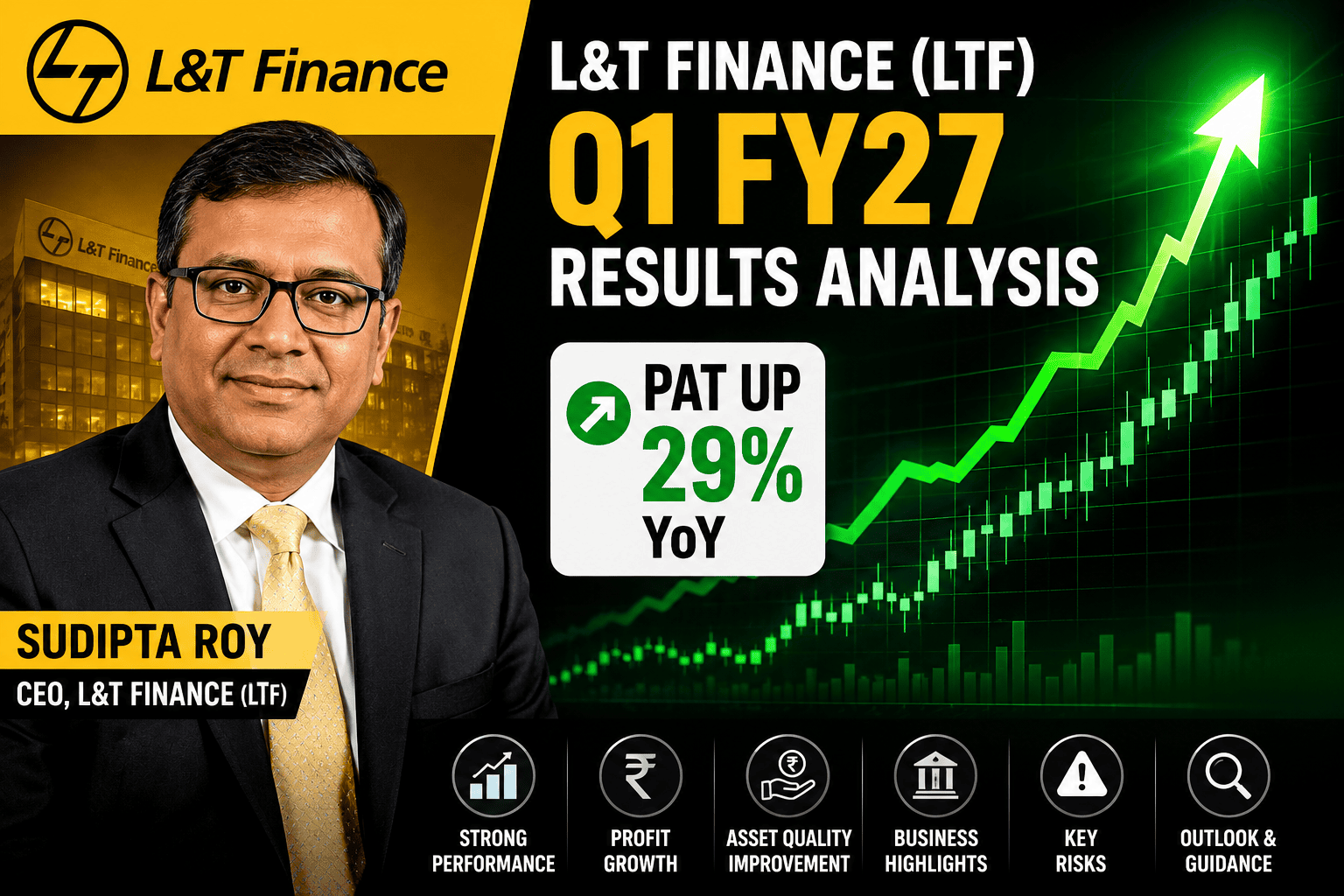
L&T Finance Ltd. (LTF) has set a brisk pace for the new financial year, delivering its highest-ever consolidated Profit After Tax (PAT) of ₹902 Crore for Q1 FY27. This represents a commanding 29% year-on-year (YoY) surge, heavily beating street estimates that had baked in tighter liquidity conditions and elevated borrowing costs. The market reaction has been one of robust validation, as the company’s pivot to a deeply retail, AI-native lender under its “Lakshya 2031” strategy begins to yield aggressive margin expansion and sharply lower credit costs. The key question for investors now shifts from whether LTF can pivot successfully, to how fast its proprietary technology stack can scale the high-yield retail book without compromising asset quality.
Key Takeaway: Q1 FY27 is a definitive validation of LTF’s retail-only, tech-first transformation, marking record profits amidst a challenging macro environment.
2. Executive Summary
The first quarter paints a picture of a well-oiled retail lending machine firing on all cylinders. Driven by staggering 182% YoY growth in Gold Finance and a 126% jump in Personal Loans, LTF’s consolidated book swelled to ₹1,29,634 Crore.
5 Key Numbers at a Glance
Consolidated PAT: ₹902 Crore (Up 29% YoY)
Retail Disbursements: ₹23,852 Crore (Up 36% YoY)
NIMs + Fees: 10.47% (Improved by 25 bps YoY)
Credit Cost: 2.54% (Down 89 bps YoY)
Return on Assets (RoA): 2.48% (Up 11 bps YoY)
While growth was exceptionally strong, the underlying quality of this growth is what stands out. Asset quality metrics improved across the board, proving that the aggressive push into high-yielding unsecured and secured segments is heavily risk-calibrated.
Key Takeaway: High-yield retail lending paired with falling credit costs resulted in a potent double-engine for profit growth.
3. Company Overview
L&T Finance Ltd. is an Upper-Layer Non-Banking Financial Company (NBFC) backed by the Larsen & Toubro conglomerate. Having successfully shed its legacy wholesale and infrastructure lending books over the past three years (under the Lakshya 2026 plan), LTF is now a pure-play retail financial services institution.
Its business model focuses on geographic depth—reaching over 2 lakh villages and 450 urban centers. The current growth phase, “Lakshya 2031”, is characterized by transitioning into an “AI-native” lender, utilizing deep tech (like Project Cyclops and Nostradamus) for underwriting, portfolio monitoring, and cross-selling across its 2.9 crore customer base.
Key Takeaway: LTF is no longer an infrastructure financier; it is a highly granular, tech-driven retail lending franchise.
4. Quarterly Financial Snapshot
The transition to retail is clearly reflected in the margin expansion and return ratios.
| Metric | Q1 FY27 | Q1 FY26 | YoY Change |
| Consolidated Book | ₹1,29,634 Cr | ₹1,02,314 Cr | +27% |
| Retail Book | ₹1,27,535 Cr | ₹99,816 Cr | +28% |
| Net Profit (PAT) | ₹902 Cr | ₹701 Cr | +29% |
| NIMs + Fees | 10.47% | 10.22% | +25 bps |
| WACB (Cost of Borrowing) | 7.20% | 7.68% | -48 bps |
| Gross Stage 3 (GS3) | 2.86% | 3.31% | -45 bps |
| Net Stage 3 (NS3) | 0.90% | 0.99% | -9 bps |
| RoA | 2.48% | 2.37% | +11 bps |
| RoE | 12.71% | 10.86% | +185 bps |
Note: WACB denotes Weighted Average Cost of Borrowing. Bps = Basis Points (100 bps = 1%).
Key Takeaway: LTF achieved the rare trifecta in banking: higher margins, lower cost of funds, and improved asset quality.
5. Segment-wise Performance
LTF’s retail book grew 28% YoY, outperforming its own 20%+ target.
Rural Business Finance: The anchor segment grew 22% to ₹32,493 Crore. Collection efficiencies remain pristine at ~99.8% (0DPD).
Gold Finance: The undeniable star of the quarter. The book exploded by 182% YoY to ₹3,829 Crore. Branch count reached 343, indicating aggressive on-ground execution.
Personal Loans: Witnessed a 126% YoY disbursement jump, taking the book to ₹16,917 Crore, heavily driven by Big Tech partnerships.
Two-Wheeler Finance: Disbursements jumped 41% YoY, powered directly by their proprietary AI credit engine, resulting in delinquency rates below industry averages.
Housing & LAP / SME: Steady, risk-calibrated growth of 20% and 28% respectively, providing secured balance to the aggressive unsecured growth.
Key Takeaway: Gold and Personal loans are acting as high-octane growth boosters, while Rural Finance provides steady baseload volume.
6. Management Commentary
Managing Director & CEO Sudipta Roy struck a confident yet measured tone, emphasizing “disciplined execution amidst an evolving macroeconomic environment.”
Highlights:
AI Integration: The management explicitly attributed superior credit selection and lower turnaround times (TAT) to proprietary AI models. Over 60% of their new Gold Loan Origination System (‘Project Canyon’) was generated using AI tools.
Rural Resurgence: Management noted that the rural vertical has decisively resumed its growth trajectory, backed by sustained consumption trends and government spending.
Cost Control: A strategic shift to an open-source private cloud is projected to reduce total cost of ownership by 70% over 5 years compared to hyperscale clouds.
Key Takeaway: Management is aggressively leveraging AI not just as a buzzword, but as a hard operational lever to reduce costs and defaults.
7. Fundamental Analysis
LTF’s Q1 results demonstrate exceptional Earnings Quality. The 29% PAT growth was not driven by one-off gains but by structural improvements in Net Interest Margins (NIMs) and a massive 89 bps reduction in Credit Costs (down to 2.54%).
Asset Liability Management (ALM): In an environment where the RBI has kept system liquidity tight, LTF managed to reduce its Weighted Average Cost of Borrowing (WACB) by 48 bps YoY to 7.20%. This implies strong bargaining power with lenders and a highly diversified liability mix.
Key Takeaway: The structural drop in credit costs indicates that LTF’s underwriting algorithms are effectively filtering out high-risk profiles despite rapid loan book growth.
8. Industry Analysis
The Indian NBFC sector in 2026 remains highly competitive, facing elevated borrowing costs. While peers are struggling with margin compression, LTF’s margin expansion (10.47%) showcases a distinct competitive advantage. Their pivot to Gold Loans pits them directly against Muthoot and Manappuram, but LTF’s rapid 182% growth suggests they are successfully capturing market share through aggressive cross-selling via the PLANET app (2.5 Crore+ downloads).
Key Takeaway: LTF is outperforming the broader NBFC industry average on both growth and asset quality metrics.
9. Macroeconomic Analysis
The broader economic backdrop includes geopolitical uncertainties and stubborn interest rates. However, India’s domestic consumption remains robust. LTF’s results reflect this dichotomy: they acknowledged “elevated borrowing costs” in the macro environment but countered it through efficient ALM. The rural recovery narrative is directly supported by LTF’s 24% growth in rural disbursements and near-perfect collection efficiencies, signaling that the rural economy is absorbing credit healthily.
Key Takeaway: A recovering rural economy and sustained infrastructure spending are directly feeding into LTF’s core target demographics.
10. Valuation Analysis
Note: Since this is an educational framework, specific live market prices are illustrative. Investors must check real-time exchange data.
P/B (Price to Book): As a pure-play retail NBFC with an RoA of 2.48% and RoE of 12.71%, LTF commands a premium over traditional wholesale lenders. A sustained RoA above 2.2% typically justifies a P/B multiple of 2.0x – 2.5x in the Indian context.
Asset Quality Premium: With Net Stage 3 (equivalent to Net NPA) falling below 1% (0.90%), the “risk discount” previously applied to LTF’s stock during its infrastructure days is fully eroding.
Key Takeaway: Continued execution of RoA > 2.4% could lead to a structural re-rating of the stock multiple.
11. Bull Case vs Bear Case
| 🐂 The Bull Case | 🐻 The Bear Case |
| AI Advantage: Proprietary tech (Cyclops, Helios) is provably lowering credit costs (down 89 bps). | Unsecured Risk: Hyper-growth in Personal Loans (up 126%) can become toxic if the macro cycle turns. |
| Margin Expansion: Borrowing costs fell while high-yield product share increased. | Execution Fatigue: Managing 343 new Gold branches and rural scale requires intense on-ground oversight. |
| Rural Recovery: 99.8% collection efficiency proves rural stress is firmly in the rearview mirror. | Regulatory Shifts: RBI’s strict stance on consumer credit growth could force a slowdown in retail disbursements. |
12. Risk Analysis
Credit Risk: The 126% YoY growth in Personal Loans is the elephant in the room. While AI models currently show low delinquencies, unsecured retail credit is highly susceptible to sudden economic shocks.
Technology Risk: As LTF transitions to an “AI-native” framework, over-reliance on algorithmic underwriting could pose hidden risks if the models are trained on limited, benign economic cycles without factoring in severe black-swan stress events.
Key Takeaway: Investors must closely monitor the Personal Loan portfolio’s delinquency rates in the coming quarters.
13. Financial Glossary
Net Interest Margin (NIM): The difference between the interest income generated and the amount of interest paid out to lenders, relative to the amount of interest-earning assets.
Gross Stage 3 (GS3): Equivalent to Gross Non-Performing Assets (NPA). Loans overdue by more than 90 days.
0DPD (Zero Days Past Due): A collection efficiency metric showing the percentage of borrowers who paid exactly on or before the due date without a single day’s delay.
14. Future Outlook
Going into Q2 FY27 and beyond, LTF’s trajectory will be defined by “Lakshya 2031.” The physical expansion of the Gold Finance business and the digital expansion via the PLANET app are expected to maintain aggressive top-line growth. Management’s guidance heavily leans on keeping credit costs suppressed through ‘Project Nostradamus’ (portfolio monitoring). If the RBI pivots to rate cuts in late FY27, LTF’s margins could see further, albeit marginal, tailwinds.
Key Takeaway: Expect sustained 20%+ retail book growth, provided macro conditions remain stable.
15. Investor Takeaways & Checklist
For Long-Term Investors: The structural pivot is complete. LTF is now a high-RoE, retail-focused NBFC. If management sustains an RoA of ~2.5%, long-term wealth creation is highly probable.
For Swing Traders: The 29% PAT beat and 10 bps QoQ credit cost reduction provide strong fundamental momentum, likely acting as a catalyst for near-term price action.
Investor Checklist for Next Quarter:
[ ] Monitor Personal Loan growth (Is it cooling off or accelerating?)
[ ] Track Cost of Borrowing (Can they maintain 7.20%?)
[ ] Watch Gold Finance AUM (Speed of scaling new branches)
16. Conclusion
L&T Finance’s Q1 FY27 results are a masterclass in strategic execution. By leveraging deep technology to lower credit costs and aggressively expanding into high-margin retail segments, they have posted record profits. The biggest positive is the simultaneous improvement in growth (Retail book +28%) and asset quality (GS3 down to 2.86%). The primary concern remains the systemic risk associated with triple-digit growth in unsecured personal loans. However, for now, the AI-native machinery at LTF is operating flawlessly.
Sources & Further Reading
L&T Finance Ltd. Q1 FY27 Press Release & Financial Results (July 10, 2026)
LTF Q1 FY27 Investor Presentation & Earnings Call Transcript
RBI Financial Stability Report (Macroeconomic Context)
Disclaimer: This article is for informational and educational purposes only. It does not constitute personalized investment advice. Equity investments are subject to market risks. Readers should conduct their own research or consult a SEBI-registered investment adviser before making any investment decisions.