

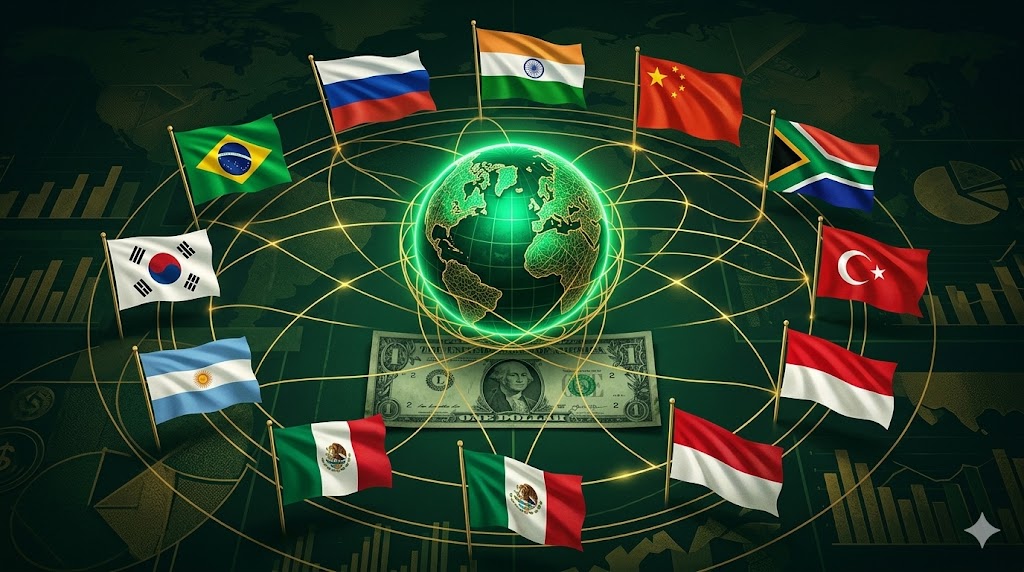
You’ve probably heard the word “BRICS” more and more in the news lately. Maybe you’ve seen headlines like “BRICS threatens the dollar” or “Trump threatens BRICS with 100% tariffs.” But what on earth is BRICS? Is it a country? A currency? A threat? A bluff?
The honest answer is: it’s one of the most important — and most misunderstood — geopolitical stories of our time. And once you understand it, you’ll see global news through a completely different lens.
Let’s break it all down. No jargon. Just plain facts.
What Does BRICS Stand For? The Simple Answer
BRICS is an acronym — each letter stands for a country:
B = Brazil | R = Russia | I = India | C = China | S = South Africa
These five countries formed the original group. But since 2024, the alliance has expanded significantly. Today, people sometimes call it “BRICS+” or “BRICS 10” to reflect its new, larger membership.
The first formal BRICS summit was held in 2009 in Yekaterinburg, Russia. South Africa joined in 2010. And for the next decade, BRICS was a group of five. Then, in 2023 and 2024, everything changed.
The Council on Foreign Relations (CFR)
Who Are the BRICS Members in 2025? (Full List)
Here is every full BRICS member as of 2025, along with why each country matters:
Beyond full members, nine additional countries hold partner status: Algeria, Nigeria, Uganda, Kazakhstan, Malaysia, Thailand, Uzbekistan, Belarus, and Bolivia — with Nigeria added in January 2025.
A Quick History: How Did BRICS Start and Why?
Goldman Sachs economist Jim O’Neill coins the term “BRIC” in a research paper, predicting that Brazil, Russia, India, and China would become the four dominant economies of the 21st century. The idea captures global attention — and the four governments themselves.
The BRIC foreign ministers hold their first informal meeting on the sidelines of the UN General Assembly in New York. The idea starts transitioning from an analyst’s report to a real political grouping.
The first official BRIC Summit is held in Yekaterinburg, Russia. The founding premise is clear: Western-dominated institutions like the IMF and World Bank no longer serve developing countries fairly. These nations want a seat at the table.
South Africa is invited to join, completing the “S” in BRICS. The group officially becomes BRICS and holds its first five-member summit in 2011 in Sanya, China.
BRICS launches its own bank — the New Development Bank (NDB) — as a direct alternative to the IMF and World Bank. With equal voting power for all five founding members, it offers loans without the policy conditions that the IMF typically imposes.
When the US and Europe freeze $300 billion of Russia’s dollar reserves and cut Russia off from SWIFT, every BRICS country (and many others) takes notice. The message is unmistakable: the dollar can be weaponized against any country. De-dollarization efforts accelerate sharply across the board.
At the Johannesburg summit, BRICS invites six new nations: Argentina, Egypt, Ethiopia, Iran, Saudi Arabia, and UAE. It’s the biggest expansion in the group’s history and signals a new level of global ambition.
Egypt, Ethiopia, Iran, and UAE officially join as full members. Argentina pulls out under its new dollar-friendly president, Javier Milei. Saudi Arabia remains on the fence.
Russia hosts the landmark Kazan summit. BRICS Pay — a proposed alternative payment system — is discussed. Over 30 countries have now applied for membership. US President-elect Trump threatens 100% tariffs on BRICS countries that abandon the dollar.
Indonesia officially becomes the first Southeast Asian BRICS member. Nine partner countries are added. The group now touches nearly every major region on Earth.
Brazil hosts the annual summit. Despite earlier ambitions, the final declaration makes no mention of a common currency or aggressive de-dollarization. The focus shifts to local currency trade and Global South cooperation. Trump’s tariff threats have clearly had a moderating effect.
Stimson Center
What Does BRICS Actually Want? The 3 Core Goals
Strip away all the politics and headlines, and BRICS has three clear, consistent objectives that have driven the group since day one.
Goal 1 — Reform Global Governance
BRICS nations believe the current international system — led by institutions like the IMF, World Bank, and UN Security Council — is heavily tilted toward Western countries, especially the US and Europe. They want more voting power, more representation, and more influence in decisions that affect the entire world.
Consider this: the US alone holds about 17% of IMF voting power. China, with a larger GDP, holds just 6%. India, with 1.4 billion people, holds about 2.7%. BRICS argues this is fundamentally unfair — and they’re right that the numbers don’t match the modern global economy.
Goal 2 — Reduce Dollar Dependence
This is the goal that makes Western governments most nervous. BRICS nations want to trade more with each other — and with the world — using their own currencies instead of the US dollar. Not to destroy the dollar overnight. But to reduce their vulnerability to US sanctions, US monetary policy decisions, and the “dollar weaponization” that became so vivid when Russia’s reserves were frozen in 2022.
Concrete steps already taken include China and Russia conducting most bilateral trade in yuan and rubles, Brazil and China signing a yuan-real trade settlement agreement in 2023, and India buying Russian oil in Indian rupees.
Goal 3 — Build Alternative Financial Infrastructure
BRICS is quietly building the plumbing of an alternative financial world. This includes the New Development Bank, China’s CIPS payment system (which already links 4,800 banks in 185 countries), the proposed BRICS Pay messaging system, and discussions about a digital multi-currency platform backed by several central banks.
New Development Bank official site
What Has BRICS Actually Built? The Real Institutions
New Development Bank (NDB)
Founded 2014. Alternative to IMF/World Bank. Loans for infrastructure with equal voting power. No harsh policy conditions. Based in Shanghai.
Contingent Reserve Arrangement (CRA)
A $100 billion financial safety net. Helps member countries facing short-term balance of payments crises — an alternative to IMF emergency loans.
BRICS Pay
Proposed decentralized payment messaging system discussed at the 2024 Kazan summit. Aims to enable transactions in local currencies without SWIFT. Still in development as of 2025.
China’s CIPS System
Cross-Border Interbank Payment System. Links 4,800 banks across 185 countries. Processes average 9.6 trillion yuan daily. A real, functioning SWIFT alternative.
Local Currency Trade Deals
China-Russia (yuan/ruble), China-Brazil (yuan/real), India-Russia (rupee/ruble). Bypassing the dollar entirely for bilateral trade between major economies.
BRICS Statistical Publication
Joint data platform tracking economic indicators across BRICS nations — building the analytical foundation for deeper economic coordination.
Is BRICS Really a Threat to the US Dollar?
This is the question everyone is asking. And the honest answer requires looking at both sides fairly.
✅ Ways BRICS IS Challenging the Dollar
- Central banks bought 1,045 tonnes of gold in 2024 — 3rd year over 1,000 tonnes
- China-Russia bilateral trade now mostly in yuan and rubles
- CIPS growing at 65% year-over-year in transaction volume
- Dollar’s reserve share fell from 71% (1999) to 57.7% (2025)
- 30+ countries seeking BRICS membership signals broad anti-dollar sentiment
- Iran selling 100% of oil to China in yuan since 2018
⚠️ Why the Dollar Is NOT Being Replaced
- Chinese yuan is only ~2% of global reserves — far too small
- BRICS has no common currency and July 2025 summit dropped the idea
- Dollar still used in 80%+ of global oil transactions
- BRICS nations have deep internal disagreements (China-India tensions)
- Trump’s 100% tariff threat has moderated BRICS de-dollarization push
- India’s central bank governor called de-dollarization only “derisking”
The Internal Tensions Nobody Talks About
Here’s the part that most news coverage misses: BRICS is far from a unified, harmonious bloc. It is filled with real contradictions, rivalries, and disagreements that limit what it can actually achieve.
China vs India: The Elephant in the Room
China and India are the two biggest BRICS economies — and they don’t really get along. They share a disputed Himalayan border where soldiers have clashed and died in recent years. They compete fiercely for influence across Asia and Africa. India is simultaneously a BRICS member and a member of the US-led Quad security alliance (with the US, Japan, and Australia). India’s central bank governor has publicly described de-dollarization as merely “derisking” — a much weaker commitment than China wants.
Russia’s Isolation Problem
Russia joined BRICS partly as a way to break out of its diplomatic isolation following the Ukraine invasion. But Russia’s presence makes Western countries view BRICS with deep suspicion, and it creates awkward positions for members like India and Brazil who want good relations with both sides.
The Common Currency Fantasy
At the July 2025 Rio de Janeiro summit, the final declaration made absolutely no mention of a BRICS currency. Only Brazil’s President Lula still occasionally raises the idea — and increasingly less so. Russia’s Putin publicly abandoned the proposal in 2024. The simple reason: creating a shared currency among 10 wildly different economies spread across four continents, with no geographic proximity and very different monetary systems, is extraordinarily difficult. The euro — which did succeed — took decades of careful preparation among neighboring countries with deep economic ties. BRICS has none of those advantages.
Trump vs BRICS: The Confrontation Defining 2025
No discussion of BRICS in 2025 is complete without talking about Donald Trump’s extremely aggressive response to the group’s rise.
In November 2024, even before returning to office, Trump threatened 100% tariffs on any BRICS country that pursued a common currency or took steps to “replace the mighty US dollar.” On his first day back in the White House, he repeated the threat. In February 2025, he declared: “BRICS is dead.”
The confrontation highlights a fundamental tension: BRICS members like Brazil, India, and South Africa genuinely want to reduce dollar dependence — but they also want to maintain trade access to the US market, the world’s largest. Trump’s tariff threats force them to choose very carefully how fast and how publicly they pursue that goal.
US tariffs may actually backfire over the long term, as the Stimson Center analysis noted — by hardening BRICS resolve and accelerating alternative economic infrastructure building, even if members do it more quietly.
What BRICS Means for the World — And for You
You might still be wondering: okay, but what does BRICS actually mean for me — for my money, my job, my daily life?
The honest answer is that BRICS’s impact on your everyday life is mostly indirect right now — but it could become very direct over the next decade or two.
For Americans: If BRICS successfully reduces global demand for dollars — even gradually — the US government loses some of its ability to borrow cheaply. That means higher interest rates over time, which means more expensive mortgages, car loans, and credit cards. It also means the US government would have less ability to fund its military and social programs without raising taxes.
For people in emerging markets: A more multi-currency world where BRICS has more influence could actually be positive. It could mean cheaper infrastructure loans without harsh IMF conditions, more trade using local currencies (which reduces vulnerability to dollar fluctuations), and greater political independence from Washington’s financial pressure.
For global investors: BRICS’s rise has contributed to record central bank gold buying, the gradual rise of the yuan in global trade, and increasing interest in commodity-backed assets. Understanding these trends is increasingly important for any investment strategy.
For the global order: Perhaps most importantly, BRICS represents a genuine challenge to the idea that the world has one dominant power center. Whether you think that’s good or bad probably depends on where you live and what your relationship with that power center has been.
The Bottom Line: A Powerful Idea, a Complicated Reality
BRICS started as an economist’s thought experiment. It became a political alliance. Now it is a genuine geopolitical force that spans 10 countries, 3.5 billion people, and more than a quarter of the world’s economic output.
But it is also a group with deep internal tensions, an ambitious agenda that keeps running into practical obstacles, and members who often want very different things. The common currency idea has been quietly shelved. The 2025 Rio summit was notably mild. Trump’s threats have forced a more cautious public posture.
What BRICS IS doing — slowly, quietly, persistently — is building an alternative financial infrastructure. CIPS is real and growing. Local currency trade deals are multiplying. Gold reserves are rising. The New Development Bank is lending. These aren’t headlines. But they are structural changes that will compound over decades.
The most accurate way to describe BRICS in 2025 is this: it is not the dollar-killing monster that alarmist headlines suggest. But it is also not the impotent talking shop that dismissive analysts claim. It is something more nuanced — a long, patient, sometimes contradictory project to reshape the world’s financial architecture. And it is worth understanding.
BRICS vs G7: How Do They Compare? (2025 Data)
| Metric | BRICS (10 members) | G7 |
|---|---|---|
| Share of world population | ~45% | ~10% |
| Share of global GDP (PPP) | >35% | ~30% |
| Share of global GDP (nominal) | ~25% | ~45% |
| Global oil production share | ~44% | ~25% |
| Countries seeking to join | 30+ applications | By invitation only |
| Combined gold reserves | Rising rapidly | Stable/declining |
| Own development bank? | Yes (NDB, since 2014) | World Bank (US-led) |
| Own payment system? | CIPS + BRICS Pay (in dev) | SWIFT (US-influenced) |
One thought on “What Is BRICS? Members, Goals & Dollar Challenge (2026”