1. Executive Summary: The Macro View Behind the Numbers
After three decades of navigating the volatile corridors of Indian pharmaceuticals, I have learned one thing: headline profit numbers rarely tell the full story. The Q3 FY26 results of Zydus Lifesciences, released on February 9, 2026, are a classic case where surface-level reading can be misleading.
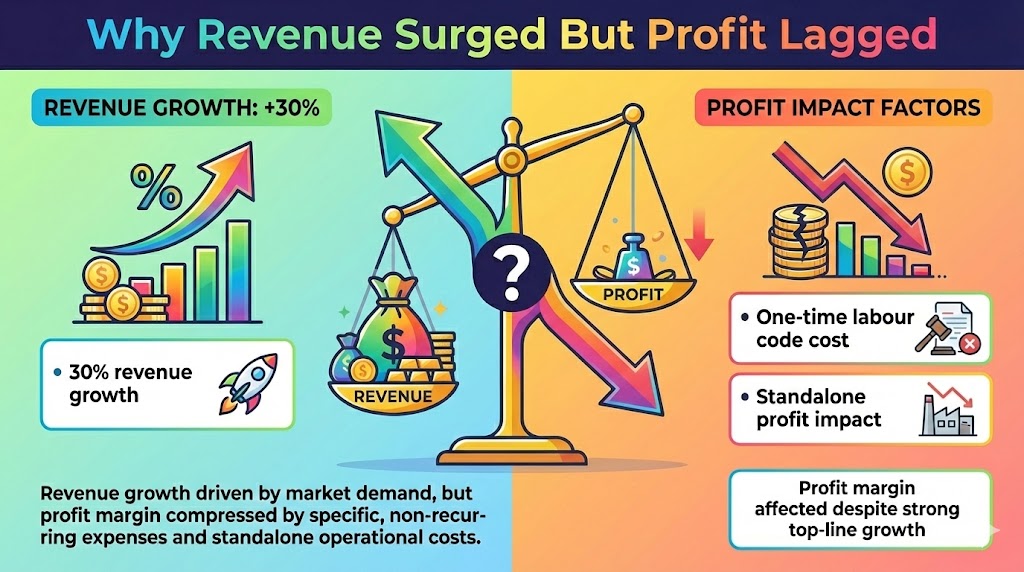 The standout headline is impossible to ignore. Consolidated revenue surged 30.3% year-on-year to ₹6,864.5 crore, significantly beating market expectations. This is not incremental growth; it is a step-change that signals a company operating at a very different scale compared to just a few years ago.
Yet, profits tell a more nuanced story. Consolidated net profit grew marginally to ₹1,042 crore, while standalone profit declined sharply. At first glance, this divergence raises questions. Is profitability under pressure? Is the core business weakening?
The answer, once again, lies beneath the surface. The standalone profit was hit by a one-time ₹601 million liability linked to India’s new Labour Codes implemented in 2025, covering gratuity and leave encashment obligations. This is not a business weakness; it is a policy-driven accounting adjustment that almost every large Indian manufacturing company is grappling with this year.
The bigger picture is far more encouraging. Q3 FY26 marks Zydus’ clear transition from a traditional generics company to a complex generics, biosimilars, and research-led multinational. Strategic acquisitions, a favourable trade environment, and a strong R&D pipeline are now offsetting the structural pricing pressure in simple generics. For long-term investors and industry watchers, this quarter is less about temporary profit noise and more about strategic direction.
Zydus Lifesciences – Official Financial Results (PRIMARY SOURCE)
2. Financial Scorecard: Understanding Growth vs. Profitability
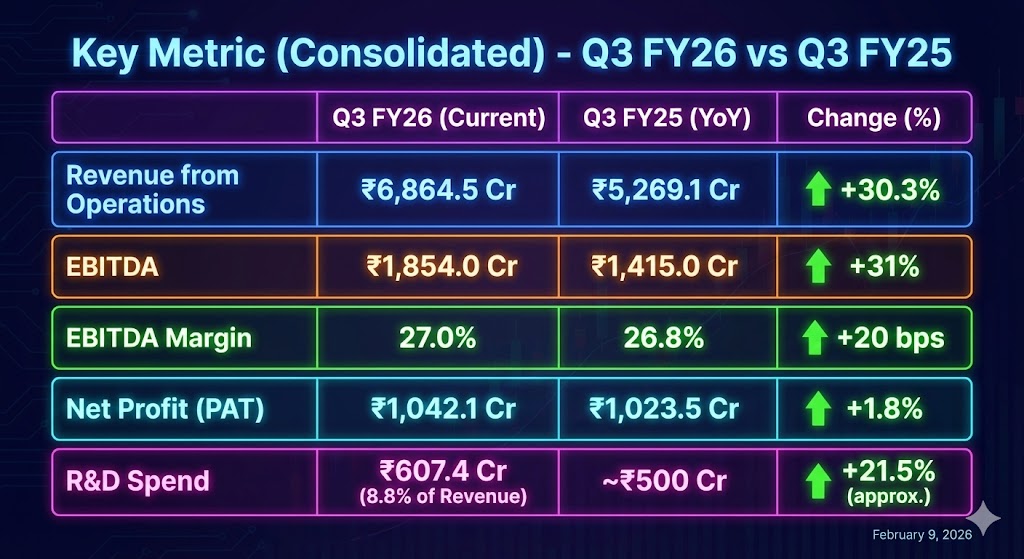
To appreciate what is really happening, it helps to look at the numbers side by side.
On a consolidated basis, Zydus Lifesciences reported revenue from operations of ₹6,864.5 crore, compared to ₹5,269.1 crore in Q3 FY25, translating into a robust 30.3% year-on-year growth. This growth was broad-based, driven by the US, India, and contributions from recent overseas acquisitions.
EBITDA rose to ₹1,854 crore, up from ₹1,415 crore a year ago, an increase of 31%. Importantly, EBITDA margins held steady at around 27%, improving slightly by 20 basis points despite integration costs and global pricing pressures. Margin stability at this growth rate is a strong indicator of operational control.
At the bottom line, net profit came in at ₹1,042.1 crore, marginally higher than ₹1,023.5 crore last year. This modest growth contrasts sharply with revenue expansion, but the reason is clear when we factor in one-time labour-related costs.
Another critical data point is R&D spending, which rose to ₹607.4 crore, accounting for 8.8% of revenue. In an industry where long-term competitiveness is defined by pipeline strength rather than quarterly margins, this level of sustained R&D investment is a positive signal.
In simple words, Zydus is choosing to invest through the cycle, even if that means short-term pressure on reported profits.
3. Fundamental Breakdown: The Engines Driving Growth
A fundamental analyst always asks: where is growth really coming from, and is it sustainable? In Zydus’ case, three engines stand out.
A. US Formulations: The Trade Deal Catalyst
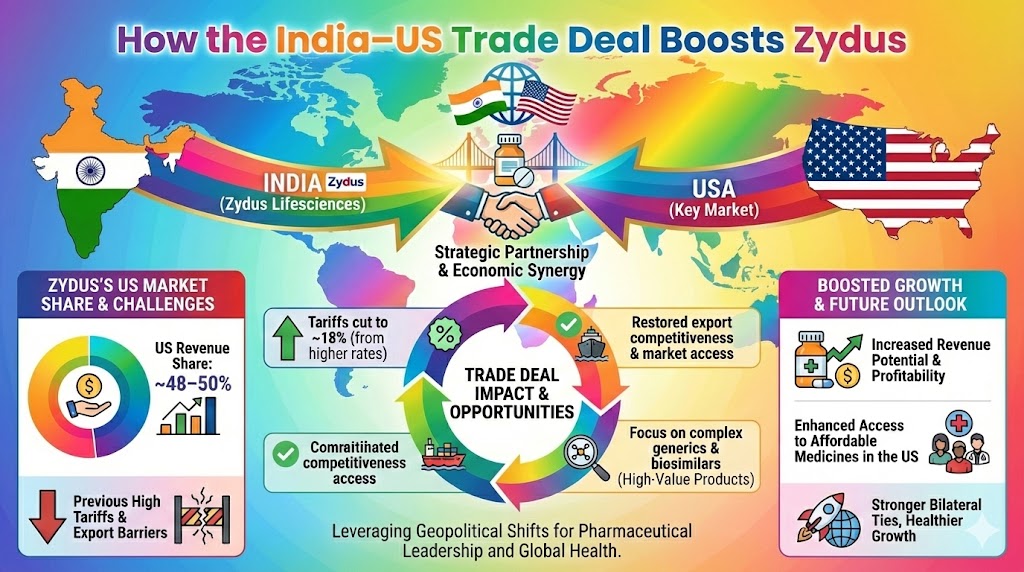
The United States remains Zydus’ most important market, contributing nearly 48–50% of consolidated revenue. Q3 FY26 saw a sharp improvement in US performance, helped by both product momentum and a favourable policy environment.
A key tailwind is the February 2026 India–US Trade Deal, which reduced effective reciprocal tariffs to around 18%, down from punitive levels approaching 50% in 2025. This change has restored competitiveness for Indian pharma exporters, including Zydus, especially in complex generics and injectables.
On the product front, Zydus secured tentative USFDA approval for Dapagliflozin, a widely used diabetes drug, strengthening its presence in the metabolic segment. More importantly, the launch of a Nivolumab biosimilar in oncology has begun to contribute meaningfully to margins. Biosimilars are not volume-driven products; they are science-driven, high-entry-barrier therapies that can sustain profitability even in competitive markets.
While base generics in the US continue to face mid-single-digit price erosion, Zydus’ increasing tilt towards complex formulations and biosimilars is cushioning this pressure. This is a deliberate and necessary shift for survival in the US market.
USFDA – Biosimilars & Regulatory Approvals
B. The India Branded Business: A Stable Moat
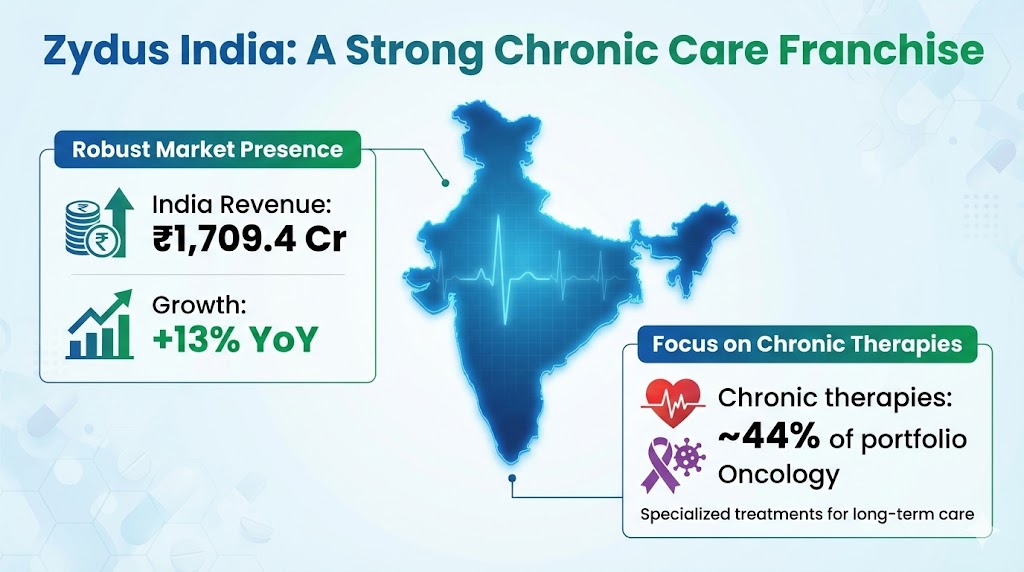
Zydus’ India formulations business delivered revenue of ₹1,709.4 crore, up 13% year-on-year. This performance is particularly impressive when compared to the broader Indian Pharmaceutical Market (IPM), which grew at a slower pace during the same period.
The reason lies in Zydus’ portfolio mix. Nearly 44% of its India revenues now come from chronic and super-specialty therapies, including cardiology, diabetes, oncology, and respiratory segments. Chronic therapies offer higher prescription stickiness, better pricing power, and more predictable cash flows.
For example, in oncology, Zydus has steadily expanded its branded presence, leveraging both domestic manufacturing and global research. This strategy not only supports margins but also reduces dependence on volatile acute therapy segments.
The India business, therefore, acts as a stabilising anchor, providing steady growth and cash generation even when global markets turn volatile.
C. Inorganic Growth: Acquisitions as Strategic Hedges
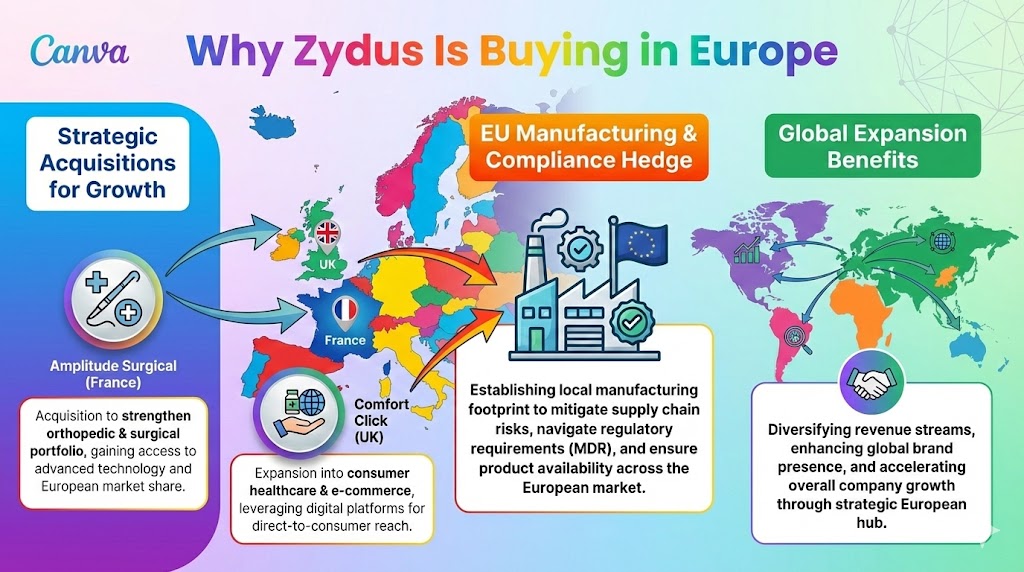
One of the less discussed but most important aspects of Zydus’ Q3 FY26 results is the contribution from recent acquisitions, notably Amplitude Surgical in France and Comfort Click in the UK.
These acquisitions are not random. They serve two strategic purposes. First, they give Zydus direct exposure to regulated European markets, diversifying revenue streams beyond the US and India. Second, they provide manufacturing and R&D footprints within the EU, reducing over-reliance on Indian plants.
In an era of increasing USFDA scrutiny and geopolitical uncertainty, having a diversified manufacturing base is a strategic hedge. It also improves Zydus’ ESG and compliance profile, which is becoming increasingly important for institutional investors.
4. Technical and Strategic Risks: What Could Go Wrong
No balanced analysis is complete without addressing risks, and Zydus is no exception.
One area of concern is the standalone business, where revenue declined 9.2% year-on-year. This suggests that cost pressures and restructuring expenses within Indian manufacturing operations are weighing on standalone performance. While this does not threaten the group’s overall health, it is a metric worth monitoring.
The Labour Code impact, amounting to ₹849 million on a consolidated basis, is another key factor. While this is a one-time adjustment, it highlights a broader reality: regulatory and policy changes can materially affect reported earnings, even for well-managed companies.
In the US, price erosion in base generics remains a structural challenge. Zydus’ strategy of moving up the complexity curve mitigates this risk, but it does not eliminate it entirely. Execution in biosimilars and specialty products will be critical over the next two to three years.
USFDA – Orphan Drug Designation (ODD)
5. Geopolitical Angle: Beyond the Pill
Pharmaceuticals today are as much about geopolitics and supply chains as they are about chemistry.
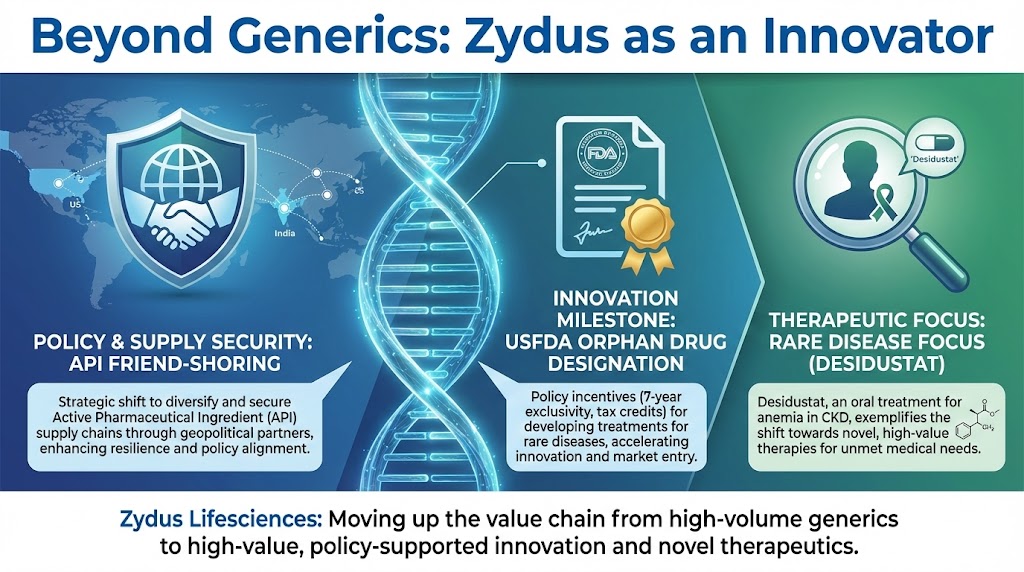
Under the 2026 trade framework, Zydus is benefiting from a global shift towards “friend-shoring”. Governments and healthcare systems are actively encouraging diversification of Active Pharmaceutical Ingredient (API) sourcing away from overdependence on China. Zydus, with its integrated manufacturing and R&D capabilities, stands to gain from this trend.
Another significant development is the USFDA Orphan Drug Designation (ODD) for Desidustat, targeted at sickle cell disease. This designation is more than a regulatory badge. It positions Zydus as an innovator in rare diseases, opening doors to premium pricing, market exclusivity, and global collaborations.
This shift—from volume-driven generics to innovation-backed specialty therapies—is what differentiates future pharma leaders from survivors.
NSE India – Zydus Lifesciences Stock & Valuation
6. Conclusion: The “Buy on Dips” Logic
At a current market price of around ₹917, with the stock up about 3% on the results day, Zydus Lifesciences is trading at a reasonable valuation relative to peers like Sun Pharma, especially when adjusted for growth visibility and pipeline strength.
The market will likely focus on the 30% revenue jump and gradually look past the muted profit growth, recognising that the latter was distorted by one-time labour-related expenses. For a fundamental investor, this quarter reinforces a familiar but powerful idea: temporary costs should not be confused with permanent damage.
Zydus today is a compounding machine in transition—investing heavily in research, building global manufacturing optionality, and aligning itself with favourable geopolitical and trade trends. With management openly targeting $5 billion in revenue by 2028, the roadmap is ambitious but increasingly credible.
For investors who understand that pharmaceuticals are a long-cycle, research-driven business, Q3 FY26 is not a warning sign. It is a reminder that resilience, not quarter-to-quarter perfection, is what ultimately creates value.