
What Is De-Dollarization? Simple Explanation with Real 2026 Examples

You’ve probably heard the word “de-dollarization” tossed around in headlines. Maybe paired with phrases like “dollar collapse” or “end of American power.” It sounds alarming — and sometimes it’s presented as if the dollar is about to disappear overnight.
The truth is more nuanced, more interesting, and more important than the headlines suggest. De-dollarization is real. It’s measurable. It’s documented in IMF data, J.P. Morgan research, and academic journals. But it is not what most people think it is.
Let’s break it down — simply, honestly, and with real examples from countries that are actually doing it right now.
What Is De-Dollarization? The Simple Definition
De-dollarization is the process by which countries, businesses, and financial institutions gradually reduce their dependence on the US dollar for international trade, reserves, debt, and transactions.
Goldman Sachs and the IMF define de-dollarization as “a significant reduction in the use of dollars in world trade and financial transactions, and a decrease in national, institutional, and corporate demand for the greenback.”
Crucially, de-dollarization comes in two flavors:
Voluntary de-dollarization: Countries that deliberately choose to diversify their reserves, reduce dollar exposure, or trade in local currencies for strategic, economic, or sovereignty reasons. Think India signing local currency trade agreements, or central banks buying gold instead of Treasury bonds. These transitions typically take 15–20 years.
Forced de-dollarization: Countries that face US sanctions and are compelled to find dollar alternatives immediately — or lose access to international trade. Russia is the most dramatic recent example. These transitions can happen in months rather than decades.
Is De-Dollarization Actually Happening? What the Real Data Shows
Let’s look at the hard numbers — because this is where a lot of confusion exists. Some people say de-dollarization is a myth. Others say the dollar is about to collapse. Both are wrong. The truth is in the data.
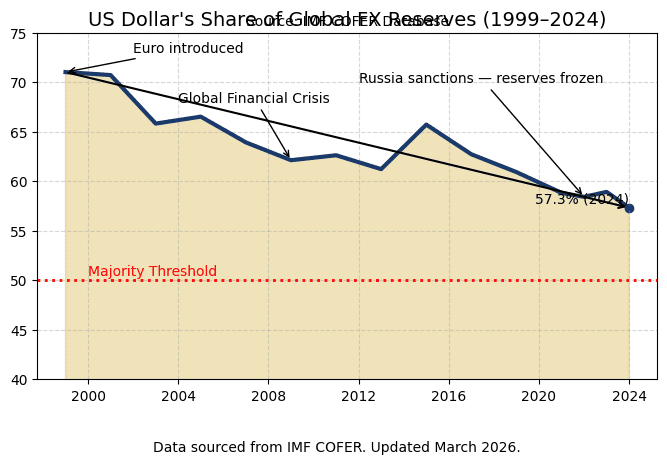
De-dollarization is unfolding in central bank FX reserves, where the share of USD has slid to a two-decade low. De-dollarization is most visible in commodity markets, where a large and growing proportion of energy is being priced in non-dollar-denominated contracts. However, the dollar’s transactional dominance is still evident in areas including FX volumes and trade invoicing.
— Luis Oganes, Head of Global Macro Research, J.P. Morgan
The honest summary: de-dollarization is real and measurable in reserves and commodity markets. It is NOT happening in the dollar’s transactional role — FX trading, debt issuance, and most trade invoicing still overwhelmingly use dollars. The CEPR (Centre for Economic Policy Research) puts it bluntly: “A decline is not a collapse.”
Why Is De-Dollarization Happening Now? The 5 Root Causes
Cause 1 — The Weaponization of the Dollar
This is the most important driver — and the one that accelerated de-dollarization from a slow trend into an urgent policy priority for dozens of countries simultaneously. The US has dramatically expanded its use of financial sanctions: from 120 countries and entities targeted in 2001 to over 900 designations by 2024. When the US can cut any country off from the global financial system, holding dollars becomes a strategic vulnerability for every nation that has complicated relations with Washington.
The moment that changed everything: In February 2022, the US and allies froze approximately $300 billion of Russia’s dollar-denominated central bank reserves — assets Russia thought were safely stored in Western financial institutions. This was unprecedented. Every central bank in the world took note: dollars held abroad could be frozen by US government action. That single event accelerated de-dollarization globally more than the previous two decades combined.
Cause 2 — Growing Alternatives
De-dollarization requires viable alternatives — and those alternatives are becoming more real. China’s Cross-Border Interbank Payment System (CIPS) processes 9.6 trillion yuan daily and connects 4,800+ institutions across 185 countries. India’s Unified Payments Interface (UPI) links with multiple countries’ payment systems. Project mBridge provides cross-border CBDC settlement. Gold is rising as a reserve asset. None of these can replace the dollar system — but they provide enough infrastructure for bilateral trade to happen outside it.
Cause 3 — US Debt and Fiscal Concerns
Foreign ownership of US Treasuries — the primary instrument through which countries hold dollar reserves — has fallen from over 50% of the market at the time of the global financial crisis to just 30% in early 2025, according to J.P. Morgan. As the US national debt surpassed $35 trillion and annual deficits run at 5–6% of GDP, some foreign investors are questioning whether US government debt offers the risk-free, reliable return it once did. J.P. Morgan explicitly warns that “more aggressive action could mean” significant dollar demand disruption.
Cause 4 — The Rise of the Global South
Countries across Asia, Africa, and Latin America have long chafed under what French Finance Minister Valéry Giscard d’Estaing famously called America’s “exorbitant privilege.” When the Fed raises interest rates to fight US inflation, it strengthens the dollar — making dollar-denominated debt more expensive for emerging markets regardless of their own economic conditions. De-dollarization is partly a sovereignty move: countries want monetary policy to reflect their own economic reality, not American decisions.
Cause 5 — China’s Deliberate Yuan Promotion
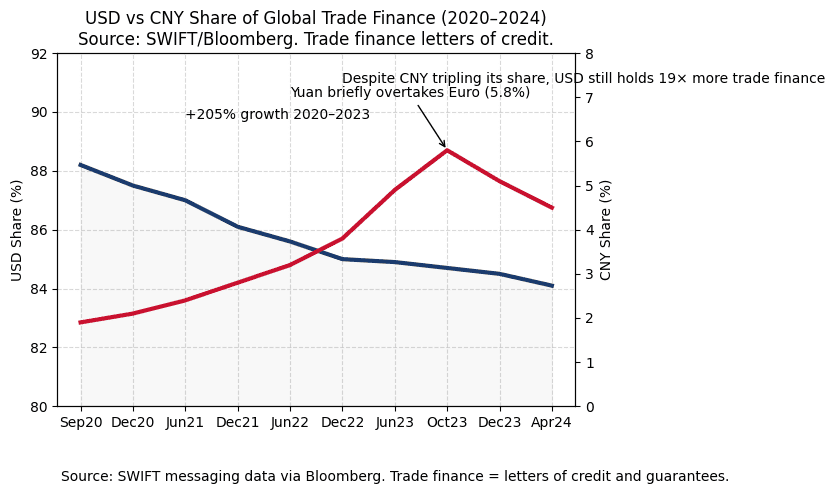
China is the world’s largest goods trader and has been systematically building yuan-based infrastructure for over a decade. The Belt and Road Initiative denominated $121.8 billion in deals in 2024 — a 31% increase from 2023. China’s CIPS payment system grew 65%+ year-over-year. The yuan’s share of global trade finance nearly tripled from September 2020 to 2023. This is a deliberate, coordinated strategy — not spontaneous market behavior.
Real Examples: Countries Actually De-Dollarizing Right Now
Russia — The Most Dramatic Case
Since Western sanctions in 2022, Russia has undergone forced de-dollarization at unprecedented speed. Its central bank dollar holdings fell from $383 billion in January 2022 to $130 billion by late 2023 — a 66% decline in less than two years. Russia now mandates ruble payments for gas exports to “unfriendly” countries. Gold reserves reached 2,350 tonnes — the highest since March 2000. Non-dollar assets make up 23.61% of total reserves.
90% of BRICS trade in local currencies (2024)
China — The Strategic Leader
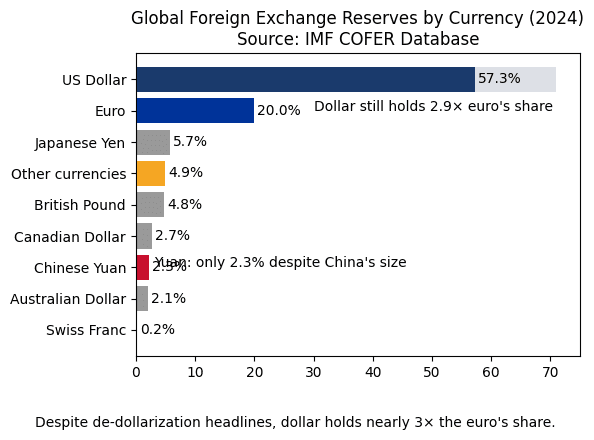
China’s yuan overtook the euro in trade finance in 2023, reaching nearly 6% of global settlement — a near-tripling from September 2020. China’s foreign exchange reserves shifted from 40% USD Treasury holdings circa 2010 to less than 1% by 2025. In 2023, yuan-denominated transactions accounted for 48.4% of China’s own cross-border payments — surpassing the dollar for the first time. BRI deals reached $121.8 billion in 2024 — up 31% year-over-year.
Yuan trade finance: 2% (2020) → 6% (2023)
India — The Rupee Expansion
India has Local Currency Settlement Agreements (LCSA) with at least 7 countries and Special Rupee Vostro Account (SRVA) arrangements with at least 26 countries as of 2024. Indian refineries buy discounted Russian oil in rubles. The Reserve Bank of India simplified SRVA in August 2025, allowing banks to open accounts without prior RBI approval. India also links its UPI payment system with partner nations’ platforms to enable direct bilateral settlement.
26 countries in SRVA rupee arrangement
Brazil — The Real Deal
Brazil and China signed a bilateral trade settlement agreement in March 2013 and expanded it significantly in 2023 — worth $150 billion — to trade in Brazilian real and Chinese yuan instead of dollars. Argentina used its bilateral credit line with China to pay IMF debt service in yuan in August 2024 — the first time a country used yuan to settle IMF obligations. Brazil is using its real for BRICS intra-bloc trade and hosted the 2025 BRICS summit with de-dollarization high on the agenda.
$150B Brazil-China yuan-real deal (2023)
Saudi Arabia — The Pivotal Player
Saudi Arabia, the world’s largest oil exporter, let its 50-year petrodollar arrangement with the US expire in June 2024. The Kingdom is now open to accepting yuan, euros, and other currencies for oil sales. Saudi Arabia joined BRICS and is a partner in Project mBridge — the cross-border CBDC payment network. The UAE (also a mBridge partner) made a historic $13.6 million payment to China in digital yuan in January 2024, bypassing the dollar entirely.
Petrodollar deal expired June 2024
ASEAN & SCO — Regional Networks
At the ASEAN summit in May 2025 in Indonesia, member nations agreed to develop a framework for settling external transactions in local currencies. The Shanghai Cooperation Organisation (SCO) — 10 full members including India, Russia, China, Iran, Pakistan, Kazakhstan — settled 97% of intra-bloc trade in local currencies in 2025. India facilitates bilateral trade with Nigeria, Tanzania, Indonesia, Bhutan, Malaysia, Nepal, and UAE through Local Currency Settlement Agreements.
97% of SCO trade in local currencies (2025)
The 5 Channels of De-Dollarization — Where It’s Happening
Channel 1 — Central Bank Reserves
Most documented channel. Dollar’s share fell from 71% (1999) to 57.3% (2024) — about 0.6 percentage points per year. The 2025 IMF COFER report confirms this is a real, sustained trend. Non-US central banks held $6.47 trillion in dollar-denominated assets at end-2024, down from proportional peaks. The IMF notes that gains have gone to “non-traditional reserve currencies” — Australian dollar, Canadian dollar, Swiss franc — rather than primarily the yuan or euro.
📊 De-dollarization intensity: HIGH ↕️ Slow pace
Channel 2 — Commodity Markets (Most Visible)
J.P. Morgan identifies commodity markets as the most visible de-dollarization channel. While approximately 90% of oil trades are still denominated in dollars, a growing proportion of energy is being priced in non-dollar contracts — particularly Russian oil sold to India, China, and other Asian buyers. If Saudi Arabia accelerates yuan-priced oil sales (it has the option now that the petrodollar arrangement expired), this channel could accelerate dramatically. A shift in oil pricing would raise exchange rate volatility and increase trade costs by an estimated 2–3% for non-dollar transactions.
📊 De-dollarization intensity: MEDIUM-HIGH ↕️ Accelerating
Channel 3 — Trade Finance and Bilateral Trade
The RMB’s share of global trade finance nearly tripled from less than 2% (February 2022) to nearly 6% (2023), overtaking the euro temporarily before switching back in 2024. The dollar’s share of global trade finance was 84.1% in April 2024 — still overwhelming, but the yuan’s rise is notable. China’s CIPS processes 9.6 trillion yuan daily with 65%+ year-over-year growth. The 97% local currency settlement in SCO trade is the most dramatic real-world example.
📊 De-dollarization intensity: MEDIUM ↕️ Growing
 Channel 4 — Bond Markets and Treasury Holdings
Foreign ownership of US Treasuries fell from over 50% of the market at the time of the global financial crisis to just 30% in early 2025, according to J.P. Morgan. This means foreign investors — including central banks — are holding proportionally fewer US government bonds. Russia’s holdings specifically collapsed from $383 billion to $130 billion after sanctions. China shifted from 40% USD Treasury holdings circa 2010 to less than 1% by 2025. Total foreign official holdings remain at record dollar levels — $6.47 trillion — but their share of the growing market has shrunk.
📊 De-dollarization intensity: MEDIUM ↕️ Steady decline
Channel 5 — Gold Accumulation
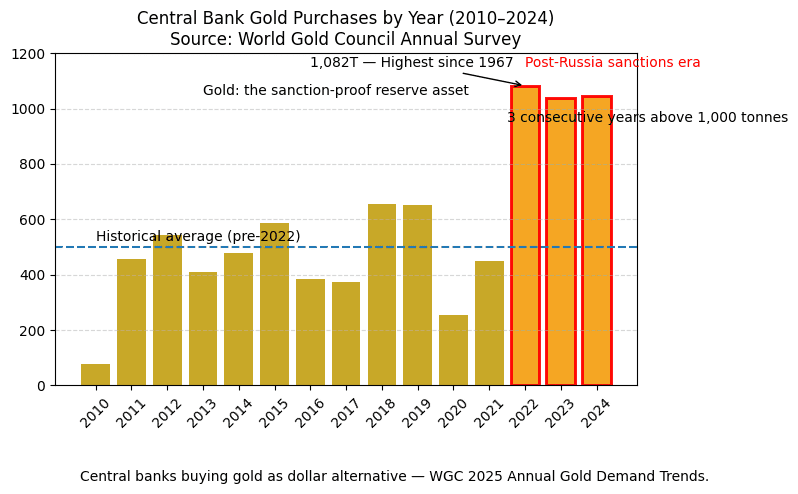
Central banks bought 1,045 tonnes of gold in 2024 — the third consecutive year above 1,000 tonnes, and the fastest pace of central bank gold accumulation since WWII. Russia’s gold reserves reached 2,350 tonnes — the highest since March 2000. South Africa increased gold reserves to $11.315 billion by January 2025. China has been on an extended gold-buying program. The World Gold Council notes that gold now represents nearly 20% of global central bank reserves. Gold pays no interest and cannot be sanctioned — making it the perfect sanction-proof alternative to dollar reserves.
📊 De-dollarization intensity: HIGH ↕️ Accelerating fast
Myth Busting: What De-Dollarization Is NOT
“The dollar is about to collapse”
A viral video in 2023 claimed “de-dollarization is happening fast” and that the dollar share “went from 55% to 47%” since Russia sanctions — catching Elon Musk’s attention. The CEPR fact-checked this immediately: the IMF COFER data showed 58.4% — not 47%. The dollar’s decline is real but gradual — about 0.6 percentage points per year on average. “A decline is not a collapse,” the CEPR stated bluntly.
✅ FACT
“The Chinese yuan is replacing the dollar”
The yuan’s rise is real but severely limited. Despite massive Chinese government promotion, the yuan accounts for just 2% of global SWIFT payments and roughly 2–3% of global reserve holdings. Capital controls prevent free yuan movement. After briefly overtaking the euro in trade finance in 2023, the yuan fell back in 2024. China’s 2015 currency devaluation triggered capital flight and forced draconian capital controls that significantly set back yuan internationalization.
✅ FACT
“BRICS is creating a single currency to replace the dollar”
Despite repeated media speculation, BRICS has explicitly not created and is unlikely to create a common currency. Russia’s Putin abandoned the proposal publicly. Brazil’s Lula still occasionally raises it. The July 2025 Rio summit’s final declaration made no mention of a common BRICS currency. Creating a single currency for 10 economically diverse nations across 4 continents with conflicting interests is extraordinarily difficult — as the euro’s troubled history demonstrates even among neighboring nations.
✅ FACT
A Historical Perspective: This Has Happened Before
The British pound held 65–70% of global reserves. Britain was the world’s largest economy and the pound was the undisputed global reserve currency. The British Empire connected trade routes across every continent. The pound seemed untouchable.
Two world wars devastated Britain’s economic position. The US emerged as the world’s dominant economic and military power. The dollar gradually replaced the pound in international trade and reserves. It took approximately 30–40 years for the transition to complete fully — even with the catastrophic shock of two world wars accelerating the process.
The international community formally adopts the dollar as the world’s reserve currency. The pound’s share had already fallen to negligible levels. The transition took 40+ years even under extreme historical circumstances.
The euro launches to much excitement about displacing the dollar. At its peak, the euro reached about 28% of global reserves. By 2024, it had settled back to around 20% — far from displacing dollar dominance.
The freezing of Russia’s reserves is the most important de-dollarization accelerant since the Bretton Woods system was established. Every major economy — friend and foe alike — recalculated the risks of holding dollar reserves abroad.
Dollar reserve share: 57.3%. Down from 71% in 1999. Declining at ~0.6 percentage points per year on average — with occasional faster drops. Transactional dollar dominance (FX, debt, invoicing) largely intact. Commodity and bilateral trade de-dollarization accelerating. The transition is real but measured in decades, not years.
What De-Dollarization Means for You — Practically
For Americans
Gradual de-dollarization means slowly rising borrowing costs as global demand for dollar-denominated assets — particularly US Treasury bonds — falls. Foreign ownership of Treasuries fell from 50% to 30% in 15 years. As that continues, the US government must offer higher yields to attract buyers — which flows through to higher mortgage rates, higher car loan rates, and higher credit card rates over time. It also means reduced global influence for US sanctions as an alternative financial architecture builds around the dollar’s edges.
For Emerging Market Countries
De-dollarization is often welcome news for emerging markets. When the Federal Reserve raises interest rates to fight US inflation, it strengthens the dollar — making dollar-denominated debt more expensive for developing nations regardless of their own economic situation. RMB trade financing in Asia grew 30% when the Fed hiked rates in 2023–2024, specifically because yuan-based financing was cheaper. More local currency trade means less exposure to dollar volatility.
For Investors
Central banks buying record amounts of gold is the clearest investment signal from de-dollarization. Gold hit all-time highs above $4,000 per ounce in 2025. Currency diversification — holding some portion of savings in multiple currencies or inflation-protected assets — becomes increasingly rational as the dollar’s structural advantages gradually erode. A $150 billion Brazil-China yuan-real deal, 97% SCO local currency trade, and 1,045 tonnes of central bank gold purchases all point in the same direction.
The Bottom Line: Real, Gradual, and Irreversible — But Not a Dollar Collapse
De-dollarization is one of the most important financial trends of our generation — and also one of the most misunderstood. Here’s what the evidence actually shows:
What’s clearly real: The dollar’s reserve share fell 12 percentage points in 25 years. Russia’s dollar holdings collapsed 66% in two years. Central banks bought 1,045 tonnes of gold in 2024. 97% of SCO trade is in local currencies. China’s yuan tripled its trade finance share. Project mBridge processes $55 billion in non-dollar settlements. These are documented, verifiable facts.
What’s clearly not happening: A dollar collapse. An imminent yuan takeover. A BRICS currency replacing the dollar. The dollar still dominates 88% of FX transactions, 84.1% of trade finance, and 70% of foreign currency debt issuance. Its transactional dominance is intact.
The honest assessment: De-dollarization is a structural, multi-decade process that has meaningfully accelerated since 2022 but remains far from threatening dollar dominance in the near term. J.P. Morgan describes it as real but partial — happening in reserves and commodities while the transactional role remains strong. CEPR, IMF, and academic research all confirm the gradual nature. The most accurate description of the current moment: “diversification, not replacement.”
Understanding this distinction puts you ahead of both the alarmists predicting imminent dollar collapse and the dismissers claiming de-dollarization is pure myth. The truth is more nuanced — and more instructive — than either extreme.

About Anant Jha
Anant Jha is the Editor-in-Chief of SRVISHWA.com, where he writes on geopolitics, geoeconomics, and global financial trends. As a geopolitical and geoeconomic analyst (and continuous learner), he focuses on decoding global power shifts, currency dynamics, and economic strategies shaping the modern world.He is also a stock market fundamental analyst and learner, exploring how macroeconomic events influence businesses and long-term investment opportunities. Through his work, he aims to simplify complex global issues and connect them with real-world economic impact for readers.
[…] What Is De-Dollarization? Simple Explanation with Real Examples […]