What Happens When the US Prints More Money? QE Explained Simply

Every time there’s a financial crisis, you hear the same phrase: “The government is printing money.” During COVID, the US created $5 trillion. During the 2008 financial crisis, it created another $3.7 trillion. And now — in December 2025 — the Federal Reserve has officially announced it’s restarting money creation again.
But what does “printing money” actually mean? What happens when the US does it? Does it cause inflation? Does it make you richer or poorer? And why do governments keep doing it if it causes problems?
This article answers all of it — in plain, simple language, with real data from the Congressional Budget Office, Congressional Research Service, CEPR, and the Federal Reserve itself.
First: What Does “Printing Money” Actually Mean?
When people say the government is “printing money,” they rarely mean physical bank notes rolling off a press. The reality is both simpler and more complex.
The technical name for this process is Quantitative Easing — or QE for short. The term was coined by economist Richard Werner in 1995, first applied in Japan in the 1990s, and became the Federal Reserve’s emergency tool of choice after the 2008 financial crisis.
Here’s why it works the way it does: The Fed’s normal tool for stimulating the economy is to lower interest rates. But interest rates can only go as low as zero (or slightly negative). When the economy still needs more stimulus after rates hit zero, the Fed needs another option. That’s where QE comes in — it creates new money and injects it directly into the financial system, bypassing the interest rate mechanism entirely.
How QE Works: Step by Step
🔄 The Complete QE Mechanics — Step by Step
The 4 Rounds of US QE — The Full History
QE 1 — NOVEMBER 2008
🏚️ QE1: Saving the Financial System
The Global Financial Crisis had pushed Lehman Brothers into bankruptcy and the entire US financial system to the edge of collapse. The Fed cut rates to zero — and it wasn’t enough. On November 25, 2008, it launched the first-ever US QE program, announcing purchases of $600 billion in mortgage-backed securities. This was expanded repeatedly as the crisis deepened.
The result was dramatic and immediate. After the QE1 announcement, the 10-year Treasury yield dropped 107 basis points in just two days — one of the largest single-event moves in bond market history. Conforming mortgage origination increased by 170% during QE1, according to the National Bureau of Economic Research. The financial system stabilized. The economy began recovering — slowly.
QE 2 — NOVEMBER 2010
💊 QE2: When Recovery Wasn’t Enough
After QE1 ended, the recovery was real but sluggish. Business output and employment remained below the Fed’s targets. The fed funds rate was still at zero. On November 3, 2010, the Fed announced it would purchase $600 billion of long-term Treasury securities at $75 billion per month through mid-2011.
QE2 was more controversial than QE1. Critics (including several foreign finance ministers) argued it was deliberately weakening the dollar to boost US exports — a form of “currency war.” German Finance Minister Wolfgang Schäuble called US monetary policy “clueless.” Despite the controversy, QE2 helped sustain the recovery, lower unemployment, and support rising stock prices — while inflation remained subdued.
QE 3 — SEPTEMBER 2012
🔄 QE3: Open-Ended and “Whatever It Takes”
QE3 was different from its predecessors in one crucial way: it had no fixed end date or total amount. On September 13, 2012, the Fed announced monthly purchases of $40 billion in MBS — with no predetermined end point, only a commitment to continue “until the outlook for the labor market has improved substantially.” It was later expanded to $85 billion per month by adding Treasury purchases.
This “open-ended” approach sent a powerful market signal: the Fed would keep buying bonds until the economy recovered, no matter how long it took. Markets surged. The S&P 500 doubled from 2012 to 2014. Then in June 2013, Fed Chair Bernanke hinted at “tapering” — and markets crashed 4.3% in three days in what became known as the “Taper Tantrum.” Emerging markets particularly suffered as capital rushed back to higher-yielding US assets.
QE 4 — MARCH 2020 (COVID)
💉 QE4: The Largest in History — $5 Trillion in 2 Years
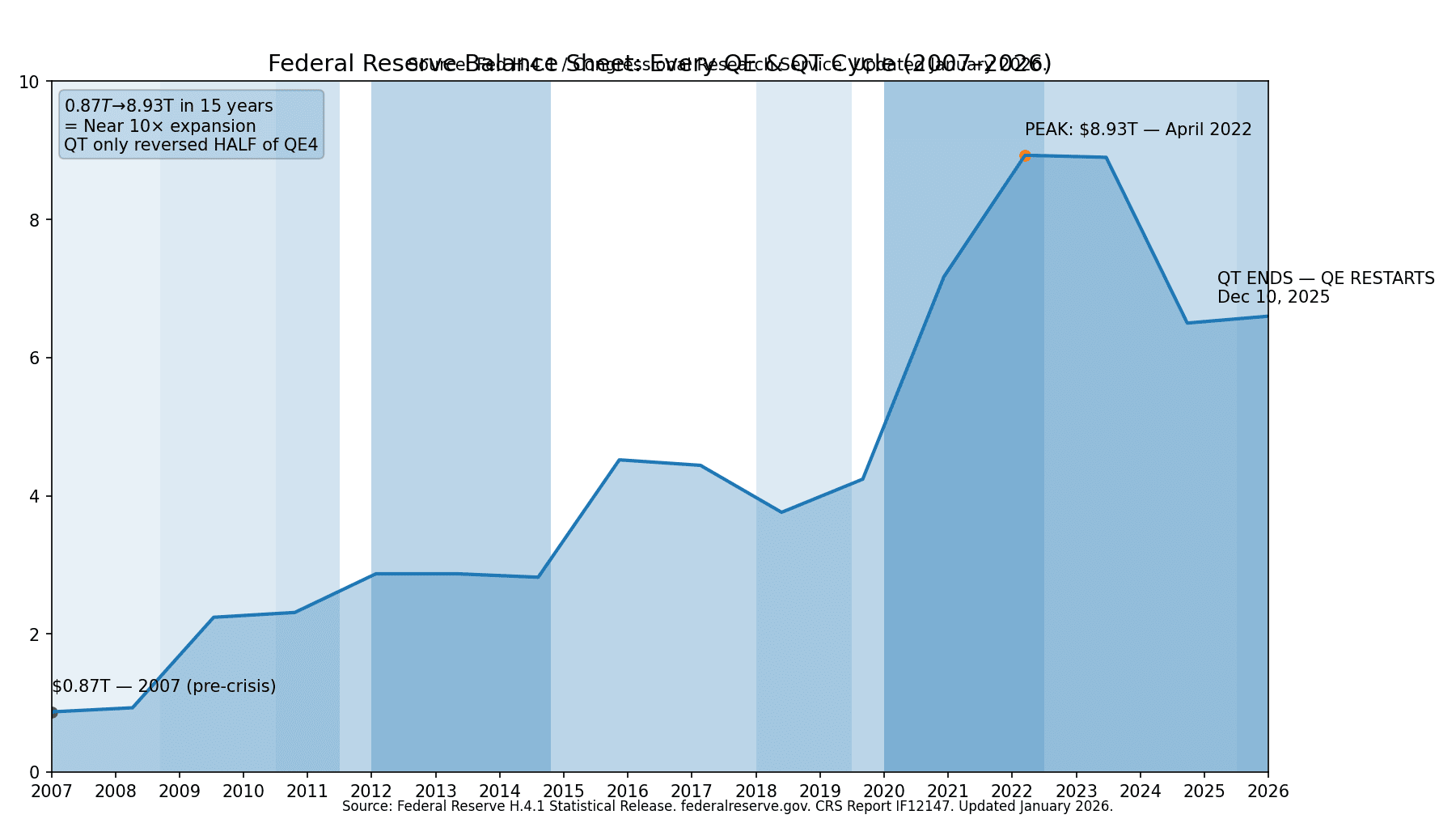
On March 23, 2020, the Federal Reserve announced unlimited QE — an unprecedented declaration that it would buy as many bonds as needed to stabilize financial markets during the COVID-19 pandemic. In the subsequent two years, the Fed created approximately $5 trillion — more than all previous QE programs combined.
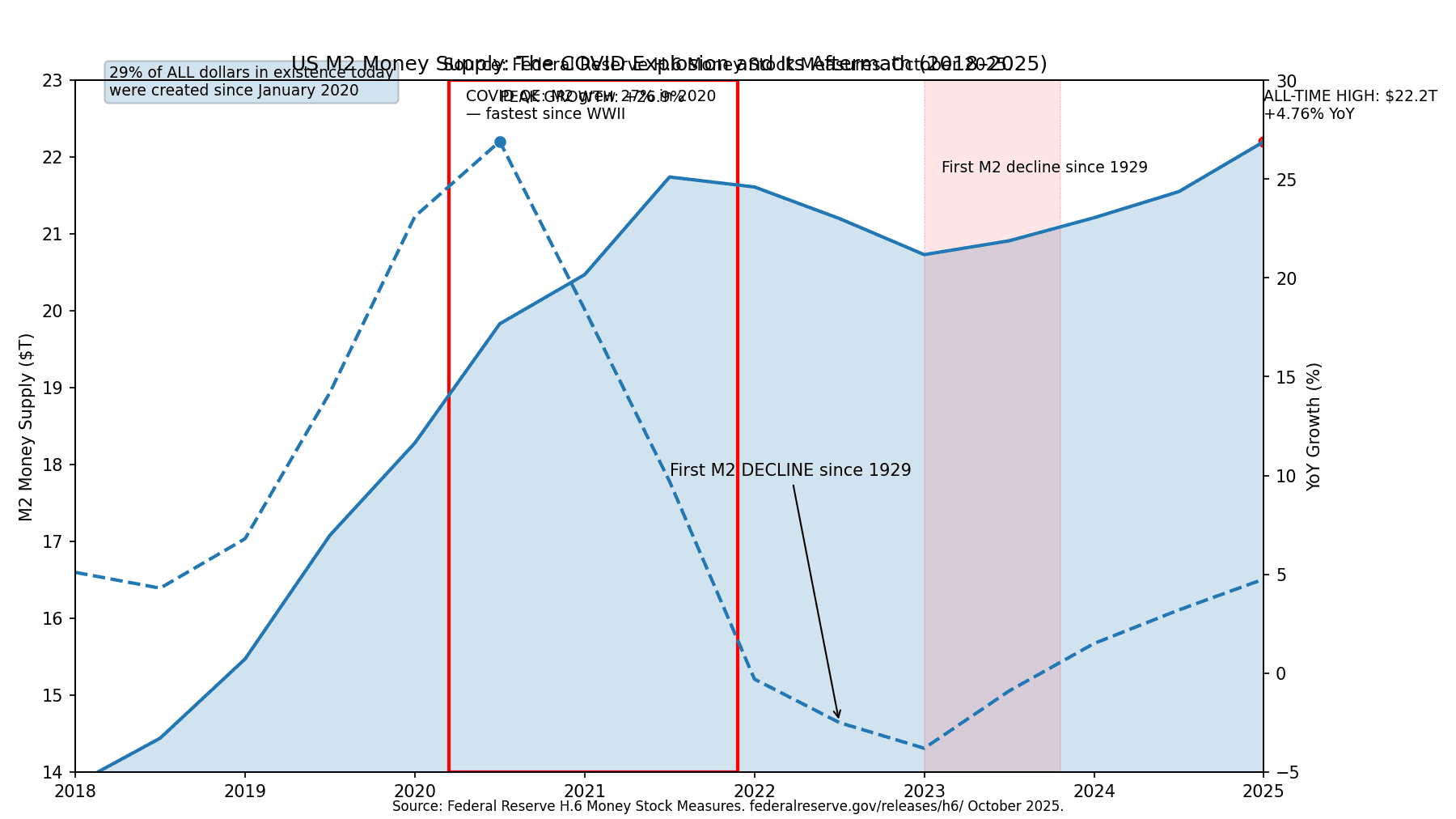
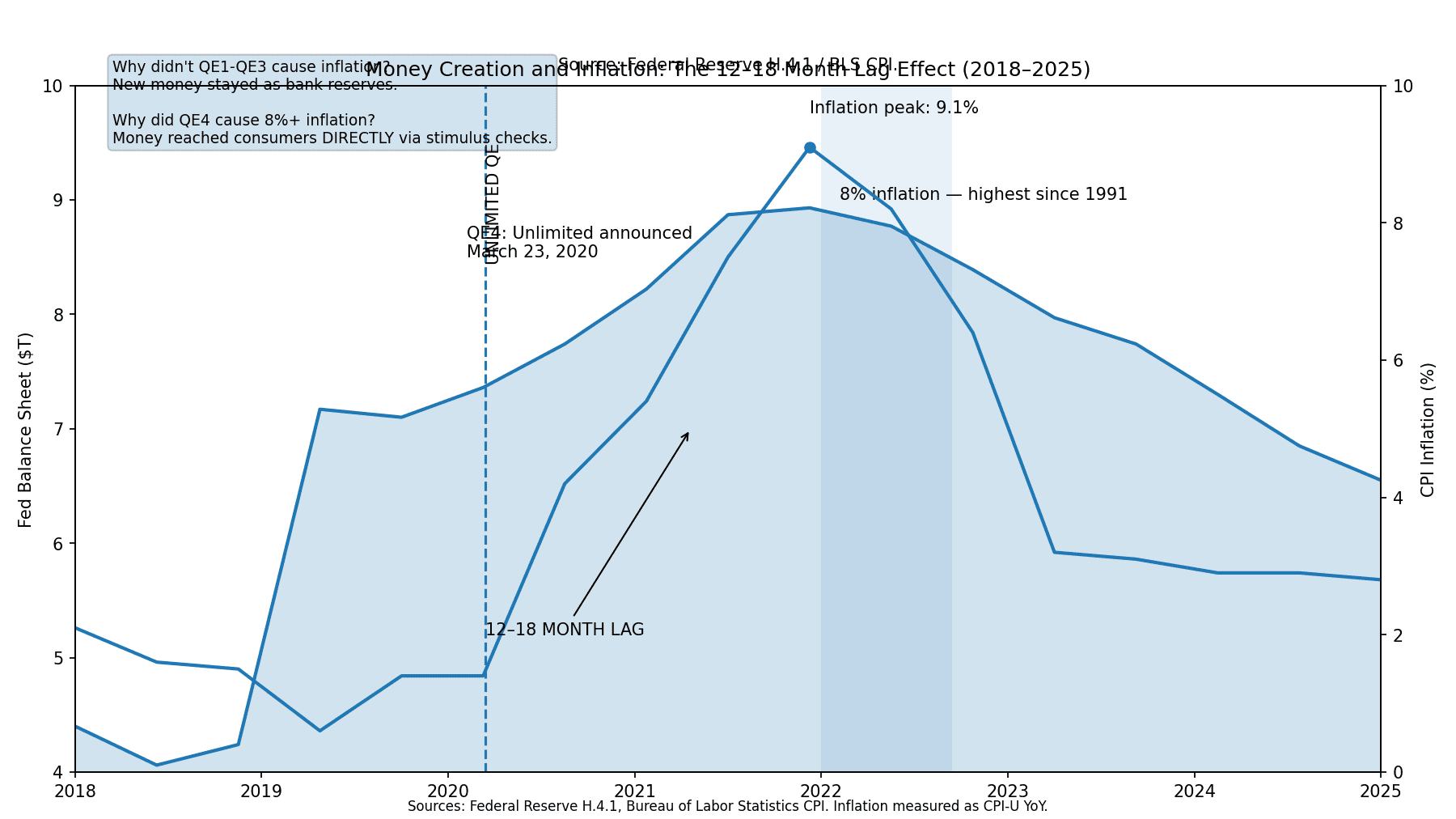
The balance sheet exploded from $4 trillion (spring 2020) to approximately $8.93 trillion (spring 2022). M2 money supply grew nearly 27% in 2020 alone — the fastest single-year expansion since World War II. But unlike previous QE rounds, this money rapidly reached consumers: through $1,200 stimulus checks, $600/week enhanced unemployment benefits, $1,400 additional stimulus, child tax credits, and PPP loans that became grants. The result was the strongest consumer spending surge in decades — and ultimately, 8% inflation, the highest since 1991.
QT — JUNE 2022 TO DECEMBER 2025
🔻 Quantitative Tightening: Running QE in Reverse
To fight the inflation its own stimulus created, the Fed launched its largest-ever quantitative tightening (QT) program in June 2022 — allowing up to $95 billion per month in bonds to mature without reinvestment. This removed money from the financial system at unprecedented speed, deliberately shrinking the balance sheet from $8.93 trillion to approximately $6.5 trillion by December 2025.
But on December 10, 2025, Fed Chair Powell announced the FOMC has decided it must begin expanding its balance sheet again — the official end of QT and the start of new QE. The reason: maintaining “ample reserves” to prevent the kind of money market disruptions that occurred in 2019 when reserves became too scarce. Critics note this new QE begins despite inflation still running at or above 3%, and some see it as capitulation to political pressure from the Trump administration.
What QE Actually Does: The 8 Real Effects — Good and Bad
Effect 1 — Lower Interest Rates
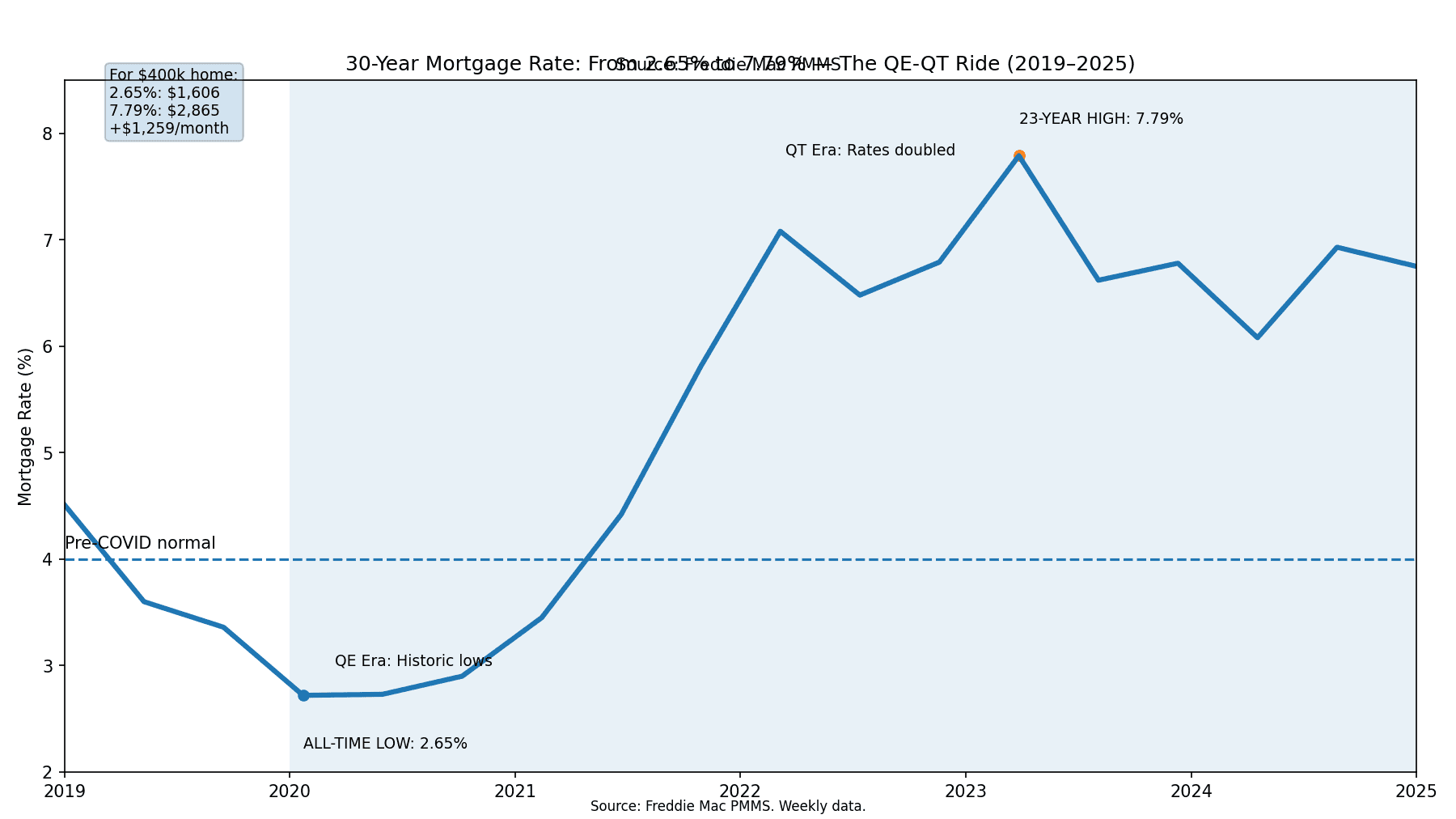
By buying bonds and driving prices up, QE pushes yields (interest rates) down. This makes mortgages, car loans, business loans, and credit cards cheaper. During QE4, 30-year mortgage rates fell to historic lows below 3%. The flip side: when QE ends and QT begins, rates rise sharply — mortgages hit 8% in 2023.
📊 30yr mortgage: 4.5% → 2.65% (QE) → 8% (QT)
Effect 2 — Rising Stock Prices
QE creates a powerful “portfolio rebalancing” effect. When bonds yield nearly nothing, investors move money into stocks seeking higher returns. Plus, cheap corporate borrowing boosts profits. A 2017 BIS study found QE boosted equities tenfold more than real economic output. The S&P 500 rose over 100% from its March 2020 low to early 2022 during QE4.
📊 S&P 500: 2,200 (Mar 2020) → 4,800 (Jan 2022) = +118%
Effect 3 — Rising Real Estate Prices
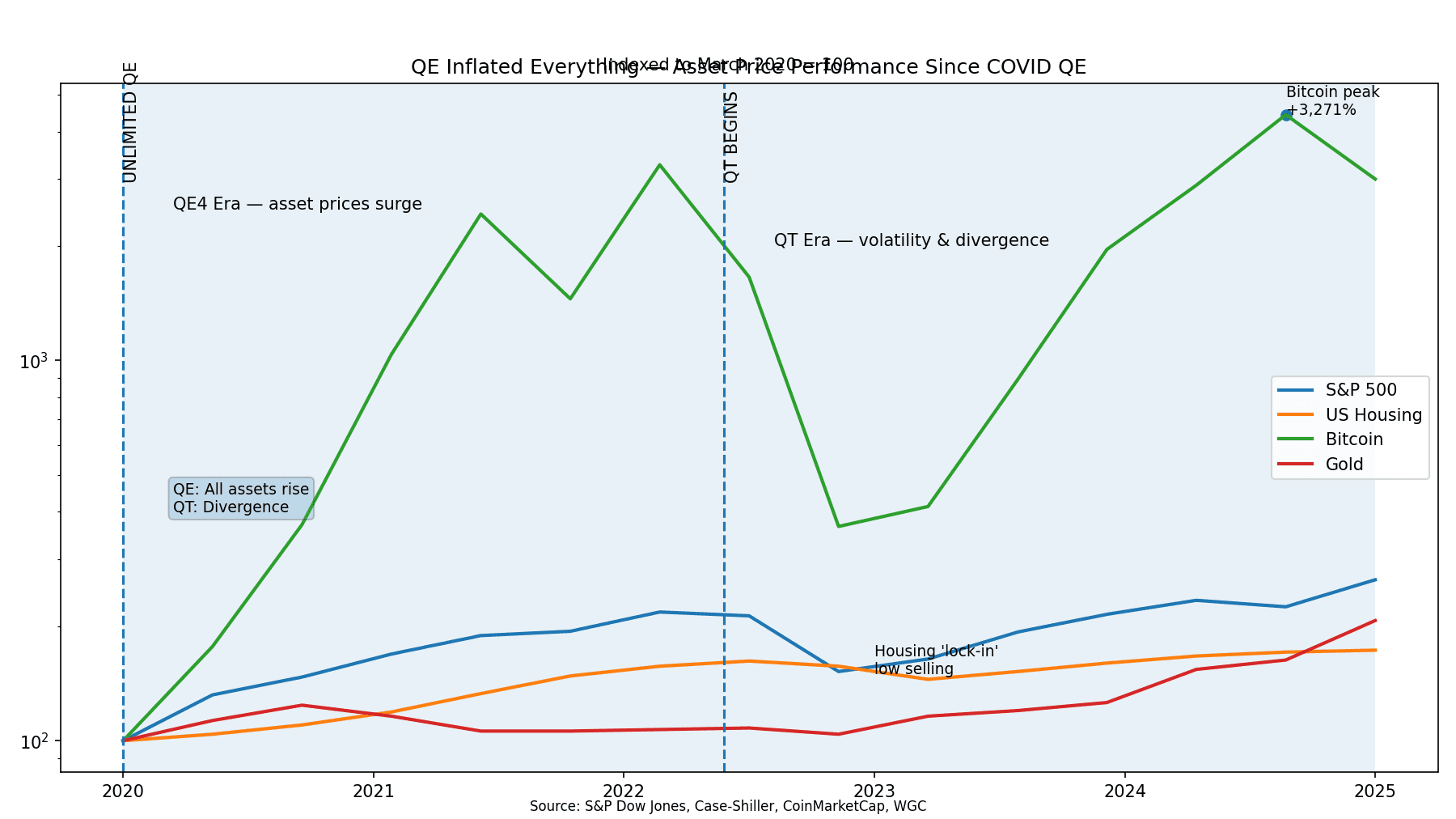
Lower mortgage rates during QE dramatically expand who can afford to buy a home. QE1 increased conforming mortgage origination by 170%, per NBER. COVID QE pushed housing prices up over 40% in two years. Then when QT began and rates rose to 8%, the “lock-in effect” caused sales to fall by 1.7 million units — homeowners with 3% mortgages refused to sell and take on 7%+ new mortgages.
📊 QE4 housing prices: +40% in 2 years; sales fell 1.7M units during QT
Effect 4 — Inflation Risk (Context-Dependent)
QE1-QE3 caused little inflation because new money stayed in bank reserves rather than circulating. COVID QE caused 8% inflation because the money reached consumers directly through stimulus payments. The CEPR found QE can actually be mildly disinflationary when it primarily boosts investment (supply expansion reduces costs). The inflationary effect depends entirely on how rapidly the new money circulates.
📊 2008–2019 QE: inflation stayed 1–3%; 2020–2022 QE: inflation hit 8%
Effect 5 — Wealth Inequality Increases
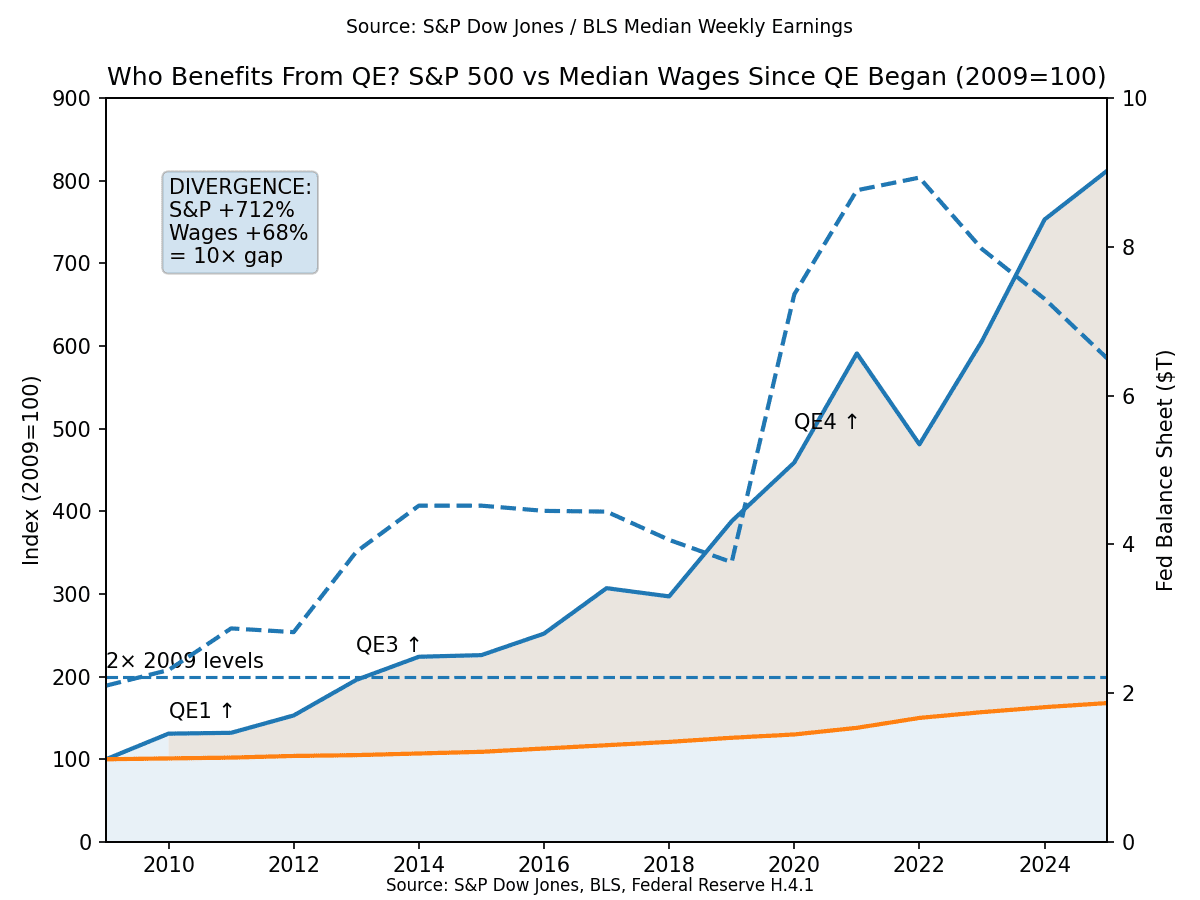
QE disproportionately benefits asset owners — the wealthy. Stock and real estate price increases enrich those who own these assets, while people who rent and have no investments see little benefit from asset appreciation. The same inflation that erodes purchasing power hits lower-income families hardest as food, energy, and rent costs rise. The Fed pays banks $110 billion annually in interest on excess reserves — directly subsidizing financial institutions.
📊 BIS: QE boosted equities 10× more than real output — primarily benefiting wealthy
Effect 6 — Asset Bubbles
By flooding markets with cheap money and near-zero rates, QE encourages investors to take increasing risks seeking any return — from tech stocks to junk bonds to cryptocurrencies to speculative real estate. Critics call this the “reach for yield” problem. COVID QE helped fuel the 2020-2021 crypto bubble ($60,000 Bitcoin), the meme stock phenomenon (GameStop), and SPAC mania before QT began deflating these in 2022.
📊 Bitcoin: $7,000 (Mar 2020) → $67,000 (Nov 2021) = +857% during QE4
Effect 7 — Global Capital Flows
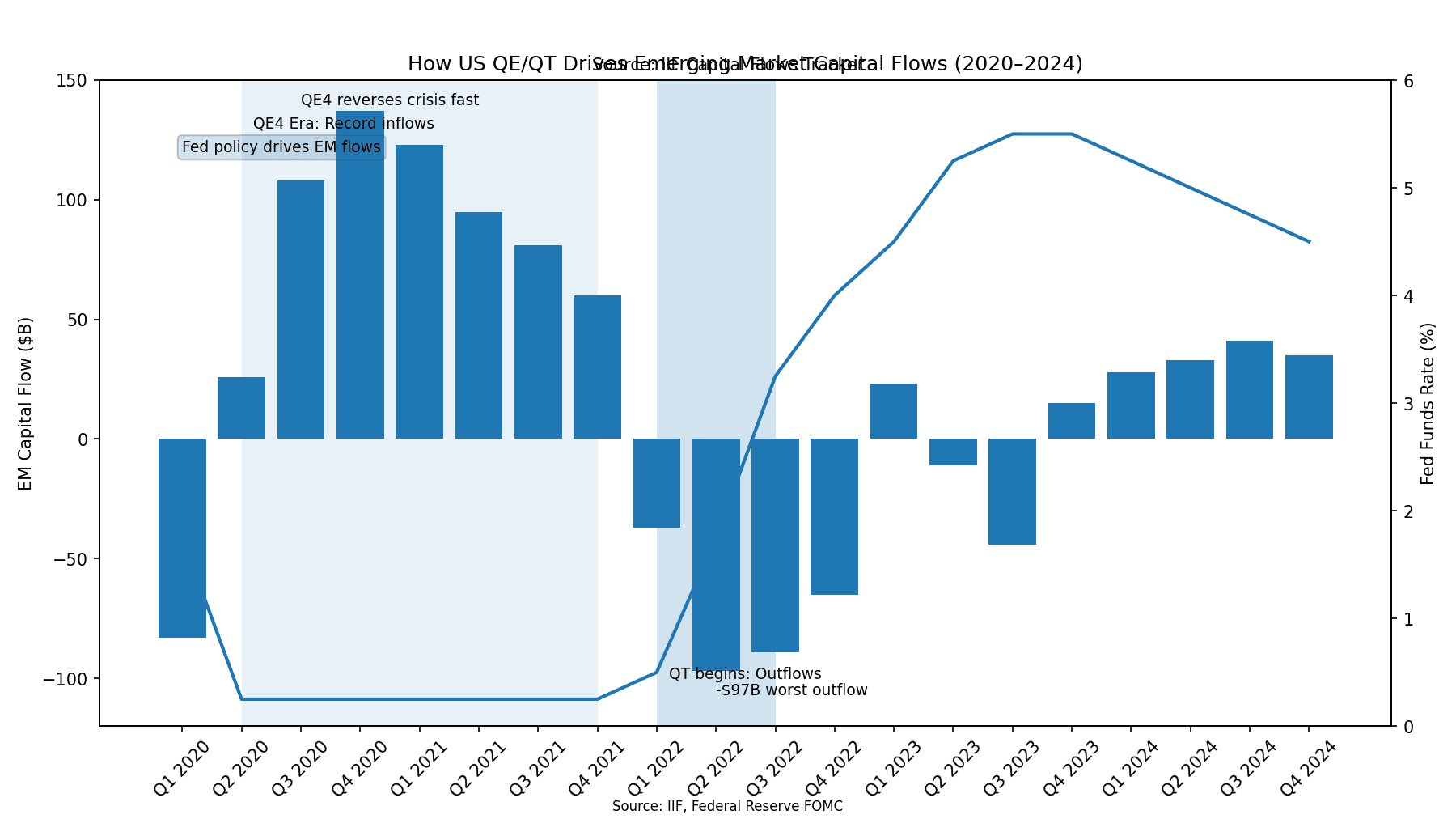
US QE floods global markets with cheap dollars, causing capital to flow into emerging market assets (EM stocks, bonds, real estate) seeking higher returns. This initially benefits EM economies. But when QE ends and QT begins, capital flows reverse — causing EM currency crashes, rising borrowing costs, and financial stress. The 2013 “Taper Tantrum” and 2022-2024 QT cycle both caused significant EM financial stress.
📊 EM capital inflows during QE; capital flight and currency crisis during QT
Effect 8 — Economic Growth (The Goal)
Despite all the side effects, QE generally achieves its primary goal: preventing economic collapse and stimulating recovery. After QE1, the US economy recovered from the worst crisis since the Great Depression. After QE4, the US economy bounced back to pre-pandemic GDP within just 18 months — faster than after any previous recession. QE works — the question is always whether its side effects are worth the cost.
📊 US GDP returned to pre-COVID trend in 18 months — fastest post-recession recovery
The Complete QE vs QT Comparison
| Feature | QE (Quantitative Easing) | QT (Quantitative Tightening) |
|---|---|---|
| What happens | Fed buys bonds → creates money | Fed holds bonds to maturity → destroys money |
| Balance sheet | Grows (more assets held) | Shrinks (assets mature, not replaced) |
| Money supply | Increases | Decreases |
| Interest rates | Fall (especially long-term) | Rise (long-term rates under upward pressure) |
| Stock market | Generally rises | Under downward pressure |
| Housing market | Prices rise, sales increase | “Lock-in” effect — sales collapsed 1.7M units |
| Inflation | Risk of rise (context-dependent) | Reduces inflation pressure |
| Dollar value | Weakens (more dollars = less value) | Strengthens |
| Emerging markets | Capital inflows, currencies strengthen | Capital outflows, currency weakness |
| Wealth inequality | Increases (asset owners benefit) | May slightly reduce (asset prices fall) |
| Goal | Stimulate economy, prevent deflation | Cool economy, fight inflation |
| US Example | 2008–2014, 2020–2021 | 2017–2019, 2022–December 2025 |
December 2025: QE Is Restarting — What It Means
The most important development for understanding QE right now happened in December 2025: December 2025 marks the official end of the largest cycle of quantitative tightening the Federal Reserve has ever undertaken. From a peak of $8.93 trillion in June 2022, the Fed allowed $2.4 trillion in maturing assets to roll off its balance sheet. But Chair Powell announced on December 10 that the Federal Open Market Committee (FOMC) has decided it must begin expanding its balance sheet again to maintain “ample reserves.”
Powell also faces defections from both sides of the committee. Board member Stephen Miran favored a half-point cut, while Austan Goolsbee and Jeff Schmid voted to maintain the current target. Reigniting QE appears to serve the purpose of allowing the Fed to ease policy while preserving at least a modicum of institutional self-respect rather than resorting to outright capitulation to political pressure.
— Paul Mueller, Senior Research Fellow, American Institute for Economic Research, December 2025
QT ended in December 2025, with only half of the pandemic balance sheet growth reversed. Going forward, the Fed intends to buy and sell enough Treasuries to match trend growth in demand for bank reserves. It plans to roll over maturing Treasury securities and MBS into new Treasury securities, causing its MBS holdings to gradually decline.
What does this mean for you? In simple terms: more money is entering the financial system again. Long-term rates may face downward pressure. Asset prices may receive a new tailwind. And if the new QE money circulates broadly (rather than staying in bank reserves), there is a risk of reigniting inflation — particularly concerning given that tariffs imposed in 2025 are already raising consumer prices.
Why Does the Government Keep “Printing Money” If It Causes Problems?
This is the most important question — and the answer reveals something fundamental about how modern economies work.
The Alternative Is Often Worse
In 2008, without QE, the US financial system would likely have collapsed completely — not just a recession, but a second Great Depression. Unemployment might have hit 25%+ rather than 10%. Millions more would have lost their homes, savings, and livelihoods. QE prevented that. The side effects (mild inflation in 2010-2011, wealth inequality) were genuinely bad — but far better than the alternative of systemic financial collapse.
Modern Economies Run on Credit
The modern financial system is built on debt — governments, businesses, and households all borrow constantly. When credit collapses (as it did in 2008), economic activity collapses with it. QE maintains credit flow when private lending seizes up. It is, in a sense, the emergency generator that keeps the system running when the main power fails.
The Trade-Off Is Real — But Manageable
The Congressional Budget Office’s analysis of QE found it initially reduced federal budget deficits (by lowering interest rates and allowing the government to borrow cheaply), supported economic growth, and prevented deflation. If the economy was at or above potential output when QE was conducted, the stimulative effect would more likely result in higher inflation rather than higher real output. The key is timing — QE during crisis is largely beneficial; QE during normal economic conditions creates more risks than rewards.
The Long-Term Problem: Balance Sheet Normalization Is Hard
Once QE is used extensively, reversing it (QT) is genuinely difficult and risky. It is beginning to appear as though the Fed has no intention of fully normalizing the balance sheet back to a pre-financial crisis level. The balance sheet has increased to counter past crises and peaked at 10 times its size before the 2008 financial crisis. Each crisis adds a new floor below which the balance sheet doesn’t fully return — creating a permanent expansion of money in the system over time.
What QE Means for Your Money — Practical Guide
During QE (money being created)
For savers: Bad news — savings account rates fall toward zero. Keeping money in cash means slowly losing purchasing power as inflation may rise. The Fed’s low-rate environment punishes traditional saving. Strategy: Consider inflation-protected assets — I Bonds, TIPS, dividend stocks, real estate.
For borrowers: Good news — mortgages, car loans, and business loans all become cheaper. If you’ve been considering refinancing or taking out a loan for productive investment, QE periods offer historically cheap borrowing. Strategy: Lock in low fixed rates when QE drives them down — they won’t stay low forever.
For investors: Generally good in the short term — stock prices typically rise during QE as money seeks returns. Real estate values tend to rise. However, these gains are partly illusory (asset price inflation rather than real value creation) and can reverse sharply when QT begins. Strategy: Don’t confuse rising asset prices during QE with fundamental value creation. Maintain diversification.
During QT (money being removed)
For savers: Better news — savings account rates rise. High-yield savings accounts paying 4–5% become available. Strategy: Move idle cash to high-yield savings or short-term CDs while rates are high.
For borrowers: More expensive — mortgages, car loans, business credit all cost more. Strategy: Reduce floating-rate debt exposure and lock in fixed rates before QT fully impacts rates.
For investors: More challenging environment — stocks face headwinds, growth stocks particularly. Real assets may hold value better. Strategy: More defensive positioning, shorter-duration bonds, value over growth.
The Bottom Line: “Printing Money” Is Complicated — Here’s What Actually Matters
When someone says “the US is printing money,” here’s the simple truth behind the complex reality:
The Federal Reserve creates new electronic money and uses it to buy bonds — injecting dollars into the financial system. This lowers interest rates, stimulates borrowing and investment, boosts asset prices, and prevents financial collapse during crises. The US has done this four times (and is now doing it again), creating trillions of dollars each time.
Does it work? Yes — QE1 helped prevent a second Great Depression. QE4 helped the US economy recover from COVID faster than any previous recession. The CEPR found it can actually be mildly disinflationary when it primarily boosts investment rather than consumer spending.
Does it have costs? Yes — it increases wealth inequality (asset owners benefit most), can cause inflation when money reaches consumers rapidly (8% in 2022), creates asset bubbles (crypto, housing, growth stocks), and makes balance sheet normalization increasingly difficult over time.
What’s happening now? After several years of quantitative tightening, the Fed is restarting QE amid persistent market and policy pressures. December 2025 marks the official end of the largest cycle of quantitative tightening the Federal Reserve has ever undertaken. New QE begins — meaning more money is entering the financial system right now, with all the asset price, inequality, and inflation risks that entails.
Understanding QE doesn’t just help you follow the news. It tells you what’s likely to happen to your mortgage rate, your stock portfolio, your savings account, and your purchasing power. In a world where central banks regularly reshape the financial landscape, knowing what “printing money” really means is genuinely essential financial literacy.

Related Articles