Wakefit IPO Analysis & Market Comparison: Benchmarking Against Sheela Foam and Meesho
Updated on December 10, 2025
The Indian IPO market is witnessing an interesting contrast this week, with Wakefit’s subscription numbers coming in softer than expected while Meesho is preparing for a power-packed listing. At the same time, Sheela Foam continues to be the benchmark for evaluating where Wakefit stands in terms of financial strength, scale, and profitability. This article breaks down everything in clear, simple language — from revenue and valuations to IPO subscription trends — so readers can understand these businesses without financial jargon.
Wakefit vs Sheela Foam: Understanding the Revenue Gap
When it comes to revenue size, Sheela Foam remains the market leader by a huge margin. Wakefit’s FY25 revenue stands at around ₹1,274 crore, which is approximately one-third of Sheela Foam’s ₹3,439 crore revenue in the same year. This scale difference matters because Sheela Foam has been in the industry for decades, giving it a strong nationwide presence. Meanwhile, Wakefit is still in a high-growth phase as a new-age D2C (direct-to-consumer) brand. However, Wakefit’s faster growth rate shows that the company is expanding aggressively, even though it is still much smaller in comparison.
Profitability Comparison: Stable Veteran vs Emerging Challenger
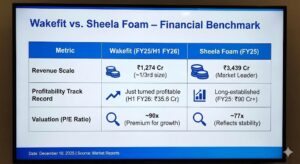
Profitability is a crucial part of any IPO evaluation. Wakefit struggled with losses for three consecutive years — FY23, FY24, and FY25 — but finally turned profitable in the first half of FY26, reporting around ₹35.6 crore profit. This marks an important shift in the company’s financial health. On the other hand, Sheela Foam has a long and stable track record of profitability, earning over ₹90 crore profit in FY25. While its margins have softened slightly due to rising costs and competition, Sheela Foam still offers stability, whereas Wakefit is only beginning to build a consistent profit trend.
Valuation Analysis: Why Wakefit Commands a Higher Multiple
Wakefit’s IPO is attracting attention because of its high valuation. The company is valued at about 90x forward P/E, which reflects investor expectations for future growth. Such high valuations are typically given to companies that are expected to expand rapidly. In comparison, Sheela Foam trades at around 77x P/E. Although this is also high, it is considered more reasonable for a mature and established company. Wakefit’s valuation premium is mainly due to its growth potential, but it also increases the risk if the company fails to deliver strong profitability in the coming years.
Distribution Model: Wakefit’s D2C Approach vs Sheela Foam’s Dealer Network
The two companies have very different business models. Wakefit relies heavily on a D2C approach, operating 125 COCO (Company Owned, Company Operated) stores and generating around 60% of its revenue online. This gives Wakefit better control over pricing, customer experience, and brand communication. In contrast, Sheela Foam uses a widespread dealer-based network with over 11,300 touchpoints across India, ensuring deeper market reach and availability even in smaller towns. This traditional model gives Sheela Foam a strong physical presence but also increases inventory costs.
Working Capital Efficiency: Wakefit Leads with a Leaner Model
Working capital is a key measure of efficiency, and Wakefit performs exceptionally well in this area. The company’s working capital cycle is only around 4 days, which means money moves quickly through the business and does not get stuck in inventory for long. Sheela Foam, with its large dealer network and inventory-heavy model, has a working capital cycle of about 40 days. This is significantly higher and shows how Wakefit benefits from its leaner D2C strategy.
Growth Trajectory: Wakefit Growing Faster Than Sheela Foam
Wakefit’s revenue has grown at an impressive CAGR of around 25%. This growth rate is much higher than Sheela Foam’s low single-digit organic growth. The difference highlights Wakefit’s ability to scale quickly due to its digital-first approach and young consumer base. Meanwhile, Sheela Foam’s growth is stable but slow, which is typical for companies that have already reached a mature market position.
Wakefit IPO Day 2 Update: A Muted Market Response So Far
Despite its strong brand presence and growth potential, the Wakefit IPO has received a relatively mild response in overall terms. On the retail front, the IPO has been fully subscribed with figures between 1.05x and 1.23x, showing decent interest from small investors. However, the overall subscription is still between 0.22x and 0.26x, indicating low demand from institutional investors. The QIB portion remains almost untouched at 0.00x, which is a concern because institutional interest often sets the tone for a stock’s long-term market performance.
NSE official website click here
Grey Market Premium Shows Mixed Sentiment
The Grey Market Premium (GMP) for Wakefit has been unstable, ranging between ₹5 and ₹36 depending on the source. Based on this, analysts expect the listing price to fall between ₹200 and ₹230 per share, translating to modest listing gains of around 2% to 18%. This indicates that traders are cautious and are not expecting a large pop on the listing day.
Key Dates to Remember
IPO Closing Date: December 10, 2025
Listing Date: December 15, 2025
Meesho IPO Listing Update: A High-Demand Debut
While Wakefit’s IPO faces a lukewarm response, Meesho is capturing the market’s attention with its strong listing buzz. The Meesho IPO has been massively oversubscribed, with total subscription at 79.03x. The QIB portion alone was subscribed over 120 times, showing tremendous confidence from institutional investors. The retail category also showed impressive participation with 19x subscription.
Meesho Expected Listing Gains Look Strong
The Grey Market Premium for Meesho is in the range of ₹40 to ₹49. With an issue price of ₹111, Meesho is expected to list between ₹150 and ₹160, offering investors a potential gain of 36% to 45%. This makes Meesho one of the most anticipated listings of the month and stands in sharp contrast to Wakefit’s cautious investor response.
Meesho Listing Date
Today, December 10, 2025
Why the Market Is Favoring Meesho Over Wakefit
The clear difference in response shows that the market is currently favoring tech-enabled, scalable platform businesses like Meesho over physical product-based D2C companies like Wakefit. Meesho’s business model has strong network effects, faster scalability, and lower inventory risk, which naturally attract institutional investors. Wakefit, although promising, requires heavy capital, physical operations, and inventory, which come with slower scalability and higher risk.
Official website of Wakefit click here
Conclusion: A Tale of Growth vs Stability in the Indian IPO Market
As of December 10, 2025, Wakefit and Meesho represent two very different investment stories. Wakefit is a fast-growing D2C brand that has just turned profitable and is still proving its long-term sustainability. Sheela Foam remains the benchmark for stability and scale. Meesho, meanwhile, has captured the market with its powerful subscription numbers and is set for a strong listing.
For investors, this week’s IPO activity is a reminder that valuation, business model, and growth visibility continue to play a significant role in how the market reacts. Wakefit may deliver long-term growth, but Meesho’s listing shows that the market currently prefers high-scale, tech-driven companies with clear profitability potential.