
U.S. vs China Economy: Who Will Dominate by 2030? Full Analysis

There is no rivalry in the world today more consequential, more complex, and more misunderstood than the economic competition between the United States and China. It shapes trade policy, technology investment, military strategy, currency markets, and the daily lives of billions of people on every continent. Whether you are a small business owner in Mumbai, a pension fund manager in Frankfurt, or a factory worker in Ohio, the outcome of this rivalry will determine your economic future more directly than almost any other global force.
The question of who dominates the global economy by 2030 is not a simple one. It cannot be answered by looking at GDP figures alone. It requires a careful examination of where each country stands on technology, innovation, debt sustainability, demographic trends, military power, currency credibility, and global trade relationships. Some of these metrics favor the United States. Others — perhaps more than Washington is comfortable admitting — favor China. And some paint a picture of a world that will not be dominated by either nation alone, but fundamentally reorganized around two competing economic blocs.
In this analysis, we cover all the angles, strip away the propaganda from both sides, and give you the clearest picture available of where this rivalry stands and where it is heading. Read every section carefully — because by the end, you will understand this competition in a way that most economists, journalists, and politicians do not publicly discuss.
The GDP Battle — Nominal vs. Reality
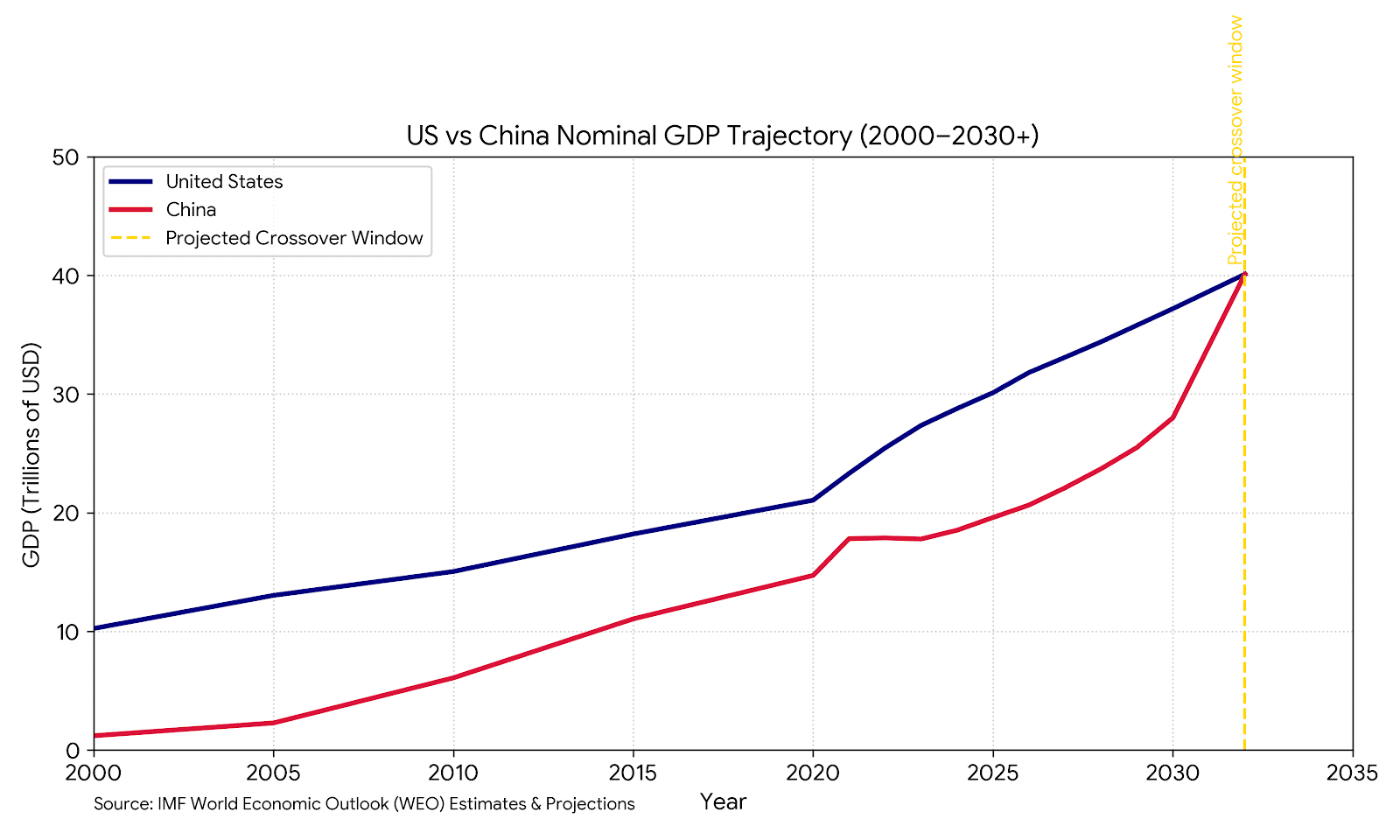
On paper, the United States still leads the world by nominal GDP — approximately $29 trillion in 2025 compared to China’s $18–19 trillion. That is a gap of roughly $10 trillion, and it is real. American consumers spend more, American corporations earn more globally, and the US financial system remains the deepest and most liquid in the world. For investors and multinationals, that nominal number matters enormously because contracts, loans, and valuations are settled in dollars at market exchange rates.
But nominal GDP tells only half the story. When economists measure economic output by Purchasing Power Parity — adjusting for the fact that a haircut in Beijing costs a fraction of one in New York, and that Chinese factory workers produce goods at a fraction of American labor costs — China has already overtaken the United States. The IMF and World Bank both confirmed that China’s PPP-adjusted GDP surpassed America’s in 2016, and the gap has widened since. By PPP, China today produces more real economic output than any nation in history.
What does this mean practically? It means China can sustain its military, its infrastructure programs, its domestic social spending, and its Belt and Road investments at a far lower dollar cost than America can. It means Chinese workers and companies can be globally competitive even at lower nominal wage levels. And it means that the “China is still far behind” narrative — repeated endlessly in Western media — is accurate in only one narrow sense and misleading in every other.
The US leads in the currency in which the world measures wealth. China leads in the reality of what that wealth actually buys. Both things are true. And by 2030, the gap between them will determine who sets the rules.
The trajectory matters as much as the current position. China’s average annual GDP growth rate of 5–6% significantly outpaces America’s 2–2.5% trend growth. At those differential rates, the nominal gap narrows by roughly $500–700 billion per year. Most major forecasting institutions — Goldman Sachs, Morgan Stanley, the IMF, and the OECD — project that China’s nominal GDP will approach or exceed America’s somewhere between 2030 and 2035, assuming no major structural rupture derails Chinese growth. That window is narrower than most Western commentators acknowledge.
| Metric (2024–25) | 🇺🇸 United States | 🇨🇳 China |
|---|---|---|
| Nominal GDP | ~$29 Trillion | ~$19 Trillion |
| GDP by PPP | ~$27T | ~$35T (World #1) |
| GDP Growth Rate | ~2.5% | ~5.2% |
| Share of Global Mfg. | ~16% | ~32% |
| National Debt | $34T+ (123% GDP) | ~$16T (88% GDP) |
| Currency Reserve Share | ~58% (USD) | ~3% (Yuan) |
| R&D Spending | $680B+ | $550B+ |
| Patent Filings (annual) | ~350,000 | ~1.6 Million |
| Military Budget | $886B | ~$225B |
| Population Growth | Moderate | Declining (–ve) |
| EV Production | Growing | World #1 |
| Solar Panel Output | Minimal | >80% of global supply |
| Semiconductor Design | World Leader | Advancing rapidly |
The Technology Race — Chips, AI, and the Future of Power
Technology is the single most important battleground of the US-China rivalry — more important than trade, more decisive than military spending, and more consequential for 2030 economic dominance than any other factor. Whoever leads in artificial intelligence, semiconductor manufacturing, quantum computing, and green energy technology will effectively set the terms of the global economy for the next half-century.
The United States currently holds a meaningful lead in the most advanced segments of semiconductor design and chip manufacturing. American companies — Nvidia, Qualcomm, Intel, and AMD — produce the world’s most powerful chips for AI applications. And through the CHIPS Act of 2022 and aggressive export controls on advanced semiconductors to China, Washington has attempted to preserve that advantage by cutting off Chinese access to the most powerful chips and the machinery needed to make them.
But China’s response has been remarkable. Huawei’s surprise release of the Mate 60 Pro — containing a domestically produced 7-nanometer chip despite Western sanctions supposedly making such production impossible — sent a shock through Washington’s strategic community. China has poured over $150 billion into domestic semiconductor development through state subsidies, national champions like SMIC, and a vast network of university research programs. The gap is not closing as slowly as American policymakers hoped.
In artificial intelligence, China files more AI-related patents annually than the United States. Its AI application ecosystem — powering everything from facial recognition and financial services to agricultural automation and drone warfare — is the most comprehensively deployed in the world. Chinese tech giants like Alibaba, Tencent, Baidu, and ByteDance have built AI infrastructure at a scale that has no equivalent in the West. In areas like AI-driven manufacturing, smart city infrastructure, and surveillance technology, China is not catching up — it has already arrived.
- World’s best semiconductor design (Nvidia, AMD, Qualcomm)
- Dominant in cloud computing (AWS, Azure, Google Cloud)
- Leader in foundational AI research (OpenAI, Anthropic, Google DeepMind)
- Controls key chokepoints: EUV lithography, TSMC alliance
- Strongest venture capital ecosystem globally
- World’s largest patent filer (1.6M+ annually)
- Dominates EV, battery, and solar supply chains
- 5G infrastructure deployed at unmatched scale
- AI application deployment fastest globally
- State-directed R&D at unprecedented funding levels
The green energy technology race deserves special mention because it will define both economic competitiveness and geopolitical leverage through 2030 and beyond. China currently produces over 80% of the world’s solar panels, over 60% of all electric vehicle batteries, and dominates the refining of rare earth minerals that every green technology depends on. While America debates the Inflation Reduction Act’s effectiveness, Chinese factories are scaling production of the technologies that will power the next century. This is not a lead that can be easily or quickly overcome, and it has profound implications for who controls the energy economy of 2030.
Debt, Demographics, and the Hidden Time Bombs
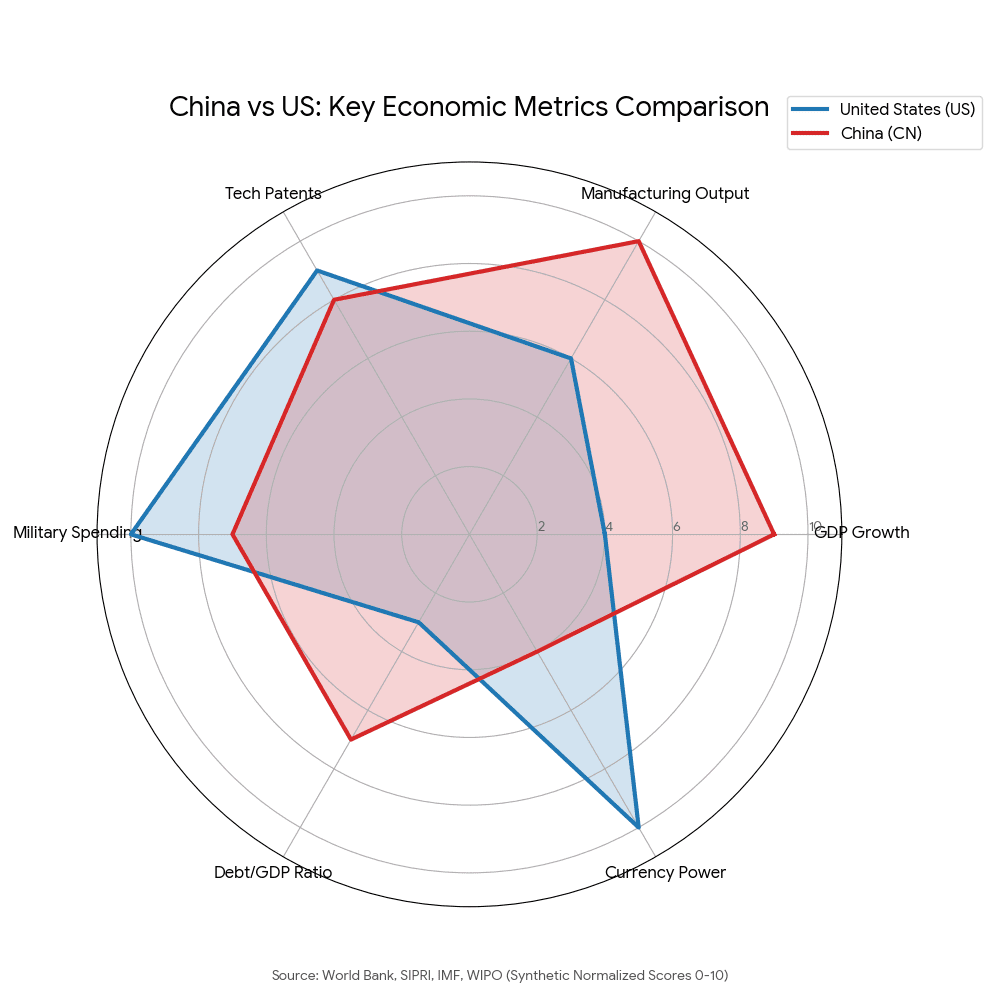
Every economic analysis of US-China competition must grapple honestly with the structural vulnerabilities of both nations, because the country that manages its internal weaknesses better will likely emerge stronger by 2030 — regardless of who has the larger nominal GDP. And both nations, frankly, are sitting on significant time bombs.
The United States is carrying a national debt that has now exceeded $34 trillion — approximately 123% of GDP. Annual interest payments on that debt have crossed $1 trillion for the first time in history, meaning that interest alone now exceeds the entire US defense budget. Every dollar spent servicing that debt is a dollar not invested in infrastructure, education, research, or social programs. The US government runs a structural deficit of $1.5–2 trillion per year, and there is no credible political path to fiscal consolidation in either party’s platform. This is not a crisis today — the dollar’s reserve currency status gives America enormous room to borrow — but it is a compounding problem that will constrain American economic and military power over the decade ahead.
China’s debt problem is different in character but equally serious in scale. China’s total debt — government, corporate, and household combined — exceeds $50 trillion, or roughly 280% of GDP. Its property sector, which at its peak represented nearly 30% of economic activity, is in a prolonged crisis following the collapse of Evergrande and dozens of other major developers. Local government financing vehicles — opaque entities used to fund infrastructure projects — are under severe stress. Youth unemployment, officially reported above 21% before the government stopped publishing the data, reflects a structural mismatch between China’s educational output and its labor market demand.
Demographics may be China’s single most dangerous long-term vulnerability. China’s population peaked in 2022 and is now declining. Its workforce is aging rapidly — a direct consequence of the one-child policy maintained from 1980 to 2015. By 2035, China will have more people over 60 than under 20. The social and fiscal cost of supporting an elderly population without a fully developed welfare state, and without the immigration that allows the United States to continually refresh its working-age population, is an enormous structural drag on long-term growth. America’s demographic outlook, while not perfect, is significantly more favorable.
Trade Wars, Supply Chains, and the Great Decoupling
The trade relationship between the United States and China was once the engine of global economic growth. American consumers bought Chinese-manufactured goods at low prices. Chinese exporters accumulated dollars and recycled them into US Treasury bonds, keeping American interest rates low. The system worked beautifully for corporate profits on both sides — and devastatingly for American manufacturing workers and Chinese labor rights. That era is definitively over.
Since the Trump-era tariffs of 2018 — continued and expanded under the Biden administration — the United States has imposed tariffs averaging 19% on Chinese goods, and China has retaliated symmetrically. Both nations are actively pursuing supply chain diversification: America through nearshoring to Mexico and friend-shoring to India, Vietnam, and Southeast Asia; China through domestic substitution and expanding South-South trade with the Global South. The World Trade Organization calls this “geoeconomic fragmentation” — the polite term for what is effectively a managed economic divorce.
But the decoupling is proving far harder and more expensive than political rhetoric suggests. Despite years of tariffs, the US-China bilateral trade deficit remains stubbornly large — over $280 billion in 2024. American retailers, manufacturers, and consumers remain deeply dependent on Chinese production across hundreds of categories, from electronics and pharmaceuticals to furniture and clothing. China, meanwhile, has built such dominance in green energy manufacturing, rare earth processing, and industrial inputs that a clean decoupling would cost Western economies trillions of dollars and years of disruption.
The world is not decoupling from China. It is building a parallel supply chain alongside China — at enormous cost — while remaining dependent on China for the inputs that supply chain requires.
By 2030, the most likely outcome is not a clean separation but a bifurcated global trading system: one sphere centered on the dollar, American technology standards, and Western financial institutions; another centered on Chinese manufacturing, the yuan, and BRICS trade architecture. Most countries in Asia, Africa, Latin America, and the Middle East will participate in both — and their ability to play both sides will itself become a source of economic and geopolitical leverage.
The Currency War — Dollar Dominance vs. Yuan Ambition
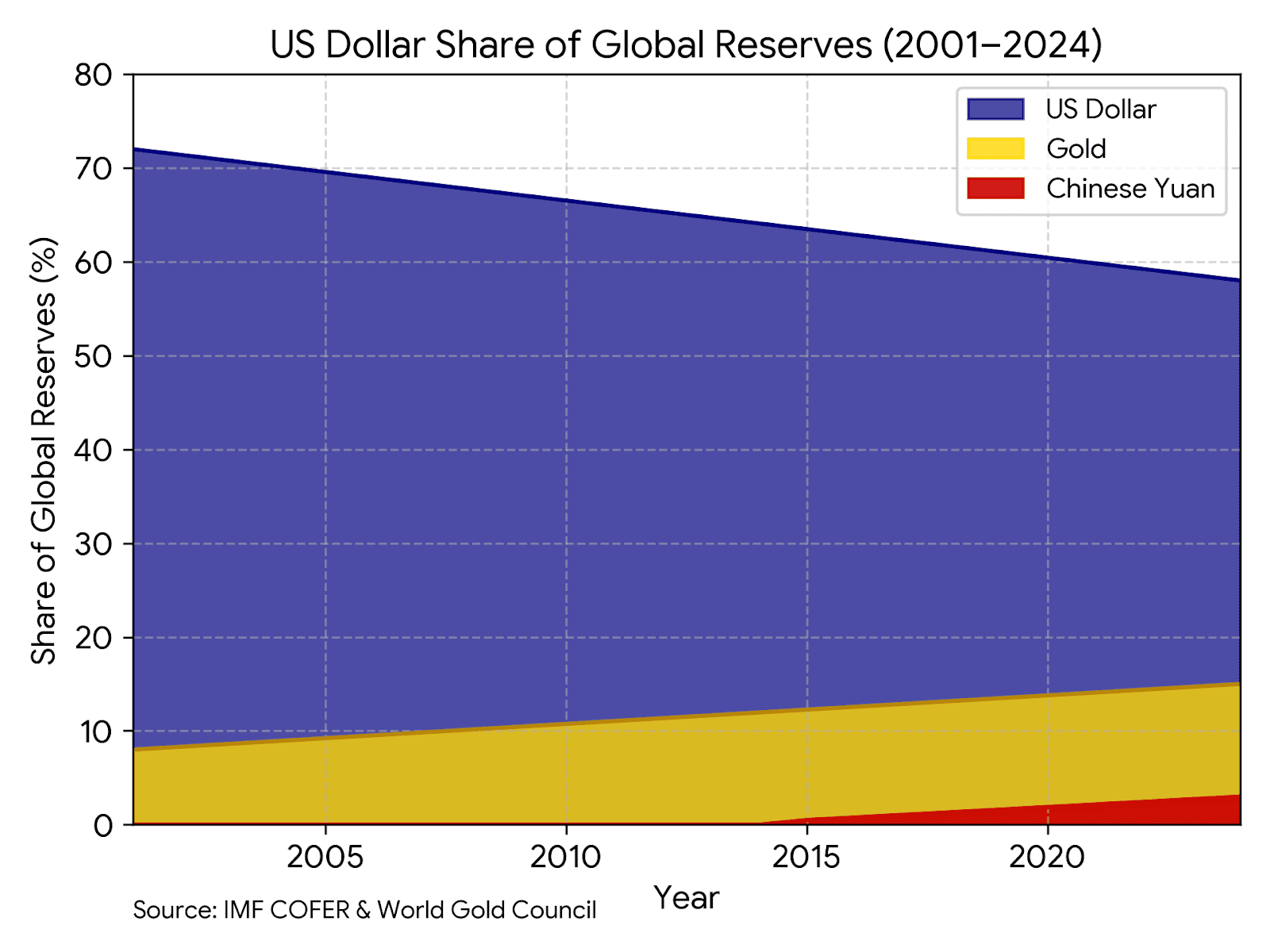
The United States’ most durable and least discussable economic advantage is not its GDP, its military, or its technology. It is the dollar’s status as the world’s primary reserve currency. Approximately 58% of global foreign exchange reserves are held in dollars. Nearly 80% of global trade financing is conducted in dollars. The SWIFT interbank messaging system — through which trillions of dollars of global transactions flow daily — is effectively an American-controlled financial infrastructure. This “exorbitant privilege,” as French Finance Minister Valéry Giscard d’Estaing famously called it in the 1960s, allows America to run permanent deficits, finance wars, and impose economic sanctions in ways that no other country can.
China wants to change this. The yuan’s internationalization is a decades-long strategic project, and it is making steady if unspectacular progress. The yuan now accounts for approximately 3% of global reserves — up from near-zero a decade ago, though still dwarfed by the dollar. China has signed bilateral currency swap agreements with over 40 nations. It has built CIPS — the Cross-Border Interbank Payment System — as an alternative to SWIFT, now processing trillions of yuan in annual transactions. It has convinced Saudi Arabia to accept yuan payments for some oil sales — a historic crack in the petrodollar architecture that was unthinkable just five years ago.
But the yuan faces structural barriers to reserve currency status that cannot be overcome by political will or bilateral deals alone. A reserve currency requires free capital flows — but China maintains strict capital controls to manage its exchange rate and prevent destabilizing outflows. It requires deep, transparent financial markets — but China’s bond and equity markets are still significantly less accessible and trustworthy than America’s. It requires rule of law and contract enforcement independent of political authority — and here, the Chinese Communist Party’s ultimate authority over all economic decisions remains a fundamental credibility problem for foreign reserve managers.
By 2030, the realistic outcome is not yuan supremacy but meaningful dollar erosion. The dollar will remain the world’s most important reserve currency, but its share will likely fall from 58% toward 50% or below, as central banks diversify into euros, gold, yuan, and other currencies. That erosion of reserve status is not catastrophic for America — but it does mean higher interest rates, reduced ability to finance deficits cheaply, and diminished leverage to impose economic sanctions. It is a slow, structural weakening that will accumulate into a significant constraint on American power over the decade ahead. For a deeper understanding, read our dedicated article on De-Dollarization: What It Means and Why It Matters.
Key Economic Milestones: The Road to 2030
📊 The 2030 Verdict
Neither Winner. A Restructured World.
By 2030, the honest answer to “who dominates” is that neither country will dominate in the way that the United States dominated between 1991 and 2015. That era of unipolar American economic supremacy is already over — not because America has collapsed, but because China has risen to a scale where unipolar dominance by any single nation is no longer structurally possible.
The United States will remain the world’s most powerful single economy by nominal GDP, the most dominant military power by far, and the issuer of the world’s primary reserve currency. These are enormous, durable advantages. American innovation culture, entrepreneurial dynamism, and university research ecosystem remain without equal globally.
China will be the world’s largest economy by PPP by a widening margin, the world’s dominant manufacturing power, the leader in green energy technology deployment, and the anchor of an expanding alternative financial and trade architecture covering much of Asia, Africa, and Latin America. Its economic ecosystem is formidable, state-directed, and operating at a speed and scale that democratic systems struggle to match.
The world by 2030 will be organized around two competing economic blocs — not the Cold War model of ideological separation, but a complex, interconnected rivalry where most nations participate in both systems and leverage that participation for their own benefit. For investors, businesses, and policymakers, understanding which bloc is gaining and which is losing ground in each specific domain — technology, energy, finance, trade — will be the most important analytical skill of the decade.
 Related Articles in This Series
 Related Articles in This Series
About Anant Jha
Anant Jha is the Editor-in-Chief of SRVISHWA.com, where he writes on geopolitics, geoeconomics, and global financial trends. As a geopolitical and geoeconomic analyst (and continuous learner), he focuses on decoding global power shifts, currency dynamics, and economic strategies shaping the modern world.He is also a stock market fundamental analyst and learner, exploring how macroeconomic events influence businesses and long-term investment opportunities. Through his work, he aims to simplify complex global issues and connect them with real-world economic impact for readers.