
How the US National Debt Impacts the Global Economy — The Complete 2026 Guide

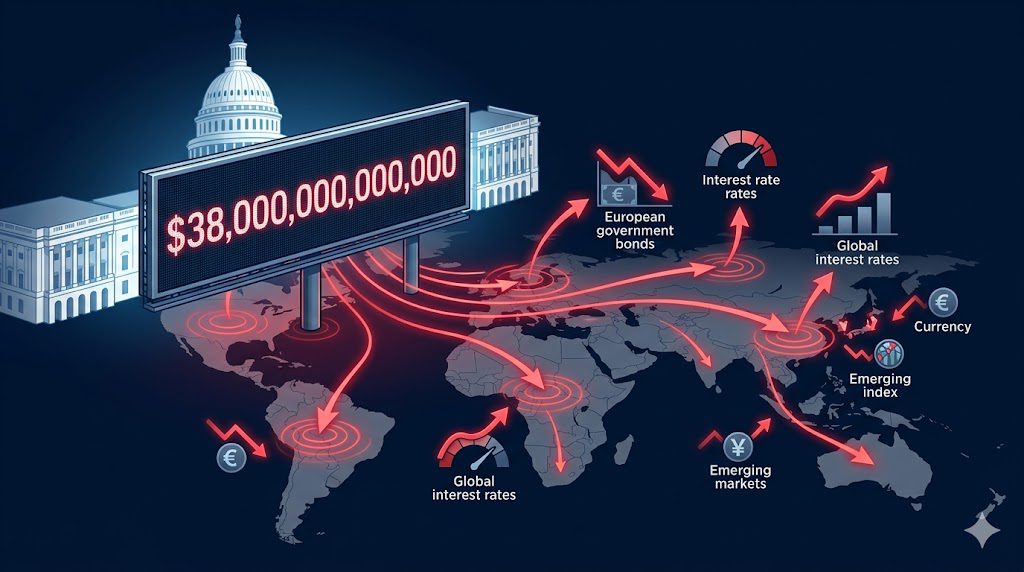
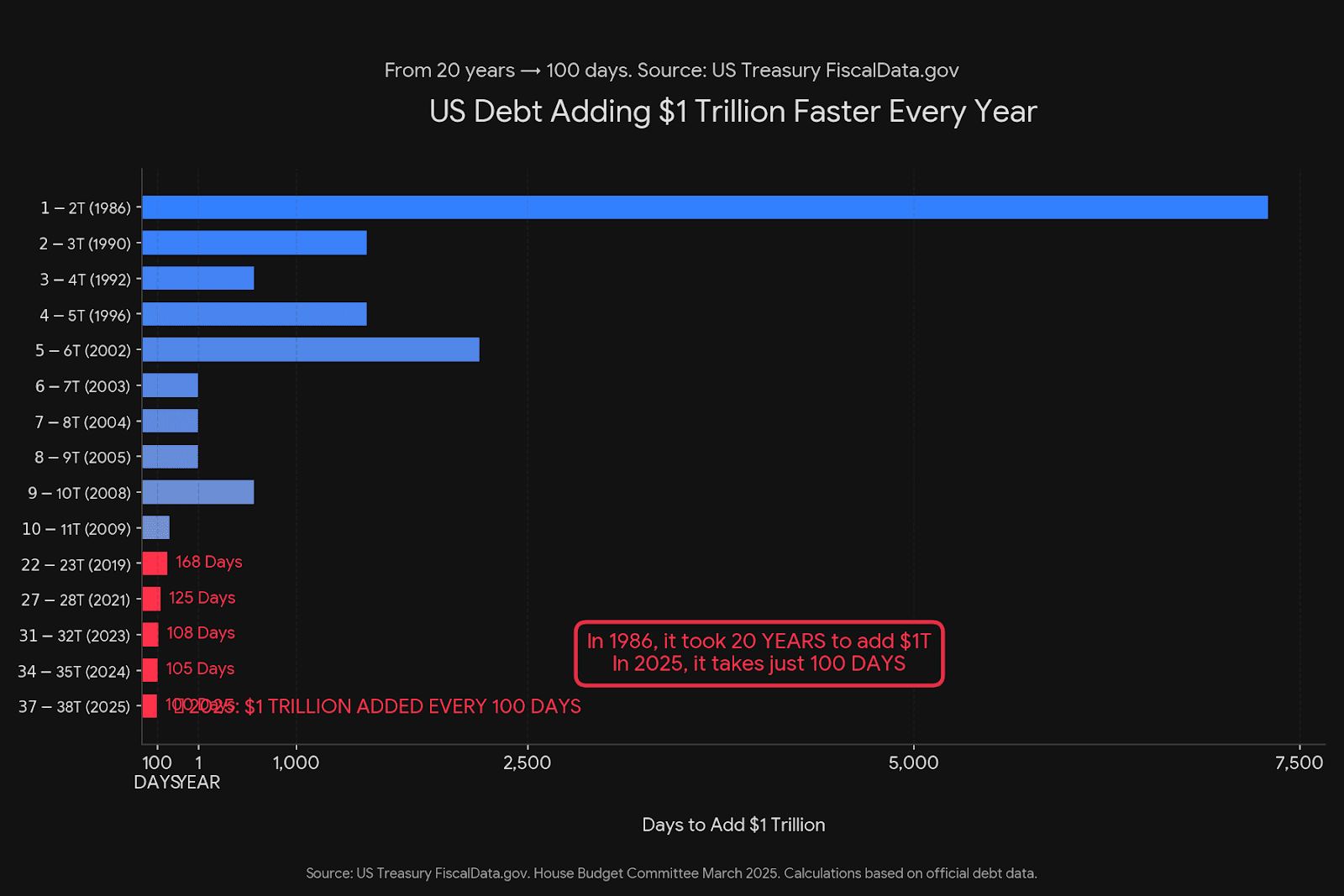
There is a number so large most people can’t truly comprehend it. A number that has grown by more than $1 trillion every 100 days. A number that now exceeds the entire annual output of the American economy. A number that is quietly but powerfully shaping interest rates, currency values, investment flows, and financial stability in every country on the planet.
That number is the United States national debt — and as of October 23, 2025, it crossed $38 trillion for the first time in history.
You might be thinking: “That’s America’s problem.” But here is the critical reality that most people miss: because the US dollar is the world’s reserve currency and US Treasury bonds are the world’s benchmark safe asset, America’s debt problem is genuinely everyone’s problem. When the US borrows, the entire world feels the effects.
Let’s explain exactly how — simply, clearly, and with real 2025 data from the Congressional Budget Office, GAO, Pew Research, Deloitte, and EY.
What Is the US National Debt? The Simple Explanation
Before we talk about global impacts, let’s make sure we understand exactly what the US national debt is — because there’s a lot of confusion about this.
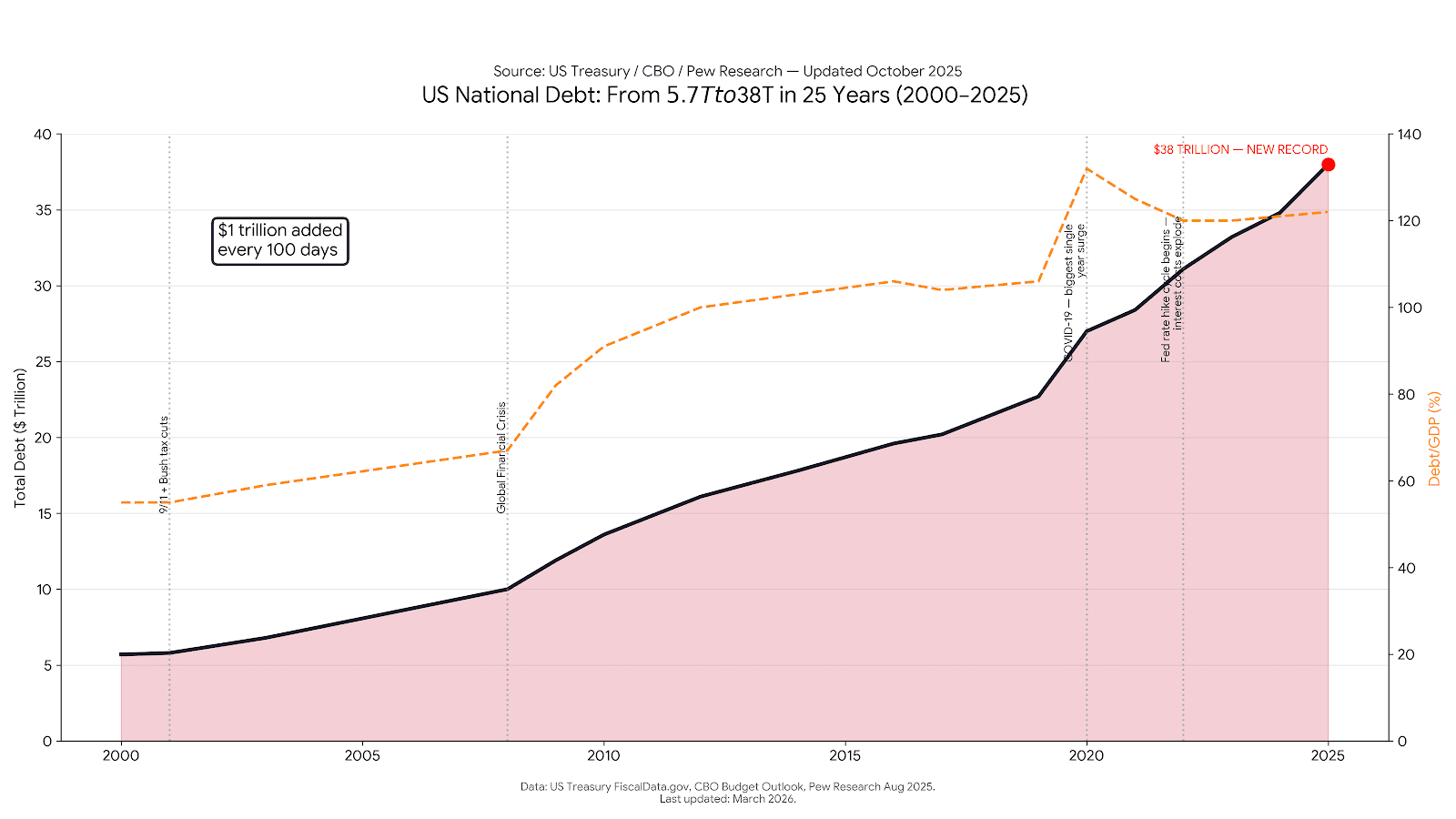
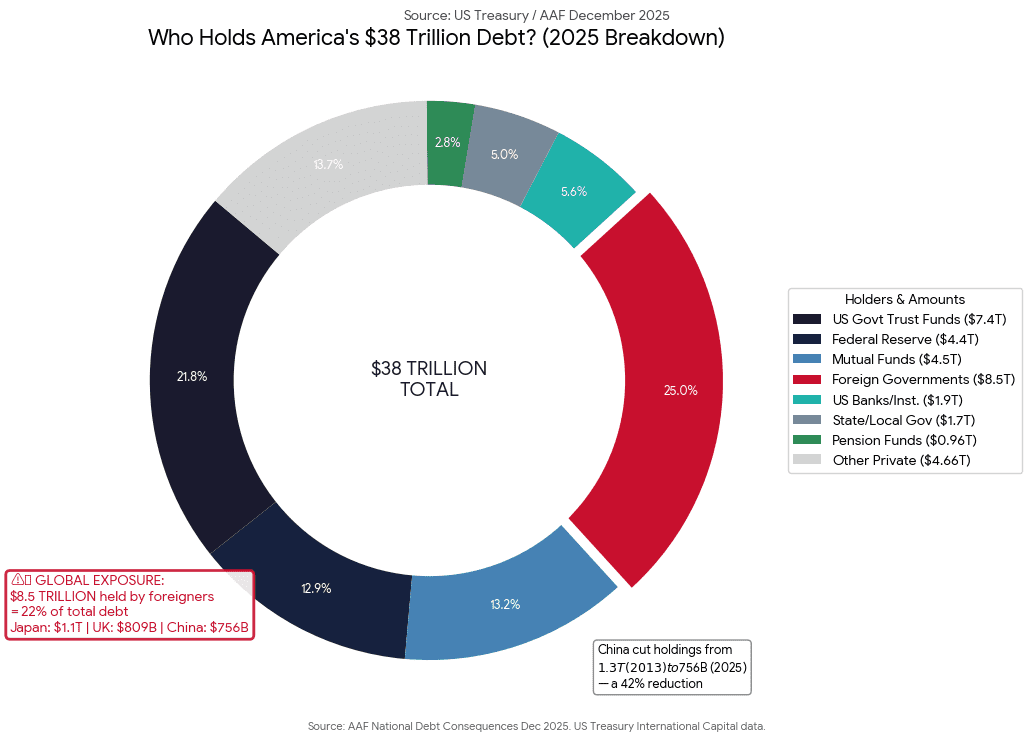
The debt has two components. Debt held by the public ($30.3 trillion as of end-FY2025) is owed to external investors — individuals, mutual funds, foreign governments, the Federal Reserve. Intragovernmental debt ($7.4 trillion) is money the government owes to its own trust funds, primarily Social Security and Medicare.
The debt reached $38 trillion on October 23, 2025 — a milestone achieved during a 23-day government shutdown. To understand how extraordinary this is: in 2000, total US government debt was $5.7 trillion. It has grown more than sixfold in 25 years, at an average annual rate of 8% — nearly double the 4.6% average growth of the US economy over the same period, according to Deloitte’s September 2025 analysis.
How Did America Get Here? A Brief History
US debt was substantial but manageable — 55% of GDP. Interest rates were moderate and the Clinton administration had achieved brief budget surpluses. The debt seemed controllable.
The Bush tax cuts (2001, 2003) significantly reduced revenue. The wars in Afghanistan and Iraq added trillions in military spending. Debt rose from $5.7T to $10T. The seeds of structural deficit were planted — the government was cutting revenue while raising spending permanently.
The global financial crisis triggered the largest peacetime government spending expansion in US history — bank bailouts, stimulus packages, and automatic stabilizers. Debt rose by 15% annually from 2008–2010 and jumped from $10T to $16T in four years. The structural deficit worsened as tax revenues collapsed during the recession.
The Tax Cuts and Jobs Act (2017) reduced corporate taxes by 31% and cut individual rates. The CBO estimated it would add $1.9T to deficits over 10 years. Revenue fell sharply. Annual deficits rose from $587B (2016) to nearly $1T by 2019 even during an economic expansion — highly unusual. Debt reached $23T.
COVID-19 triggered the largest and fastest peacetime spending surge in US history. The CARES Act ($2.2T), PPP loans, stimulus checks, enhanced unemployment, vaccine programs — total COVID spending exceeded $6T. Debt spiked to a then-record of 132.8% of GDP in Q2 2020. Debt hit $27T by year-end.
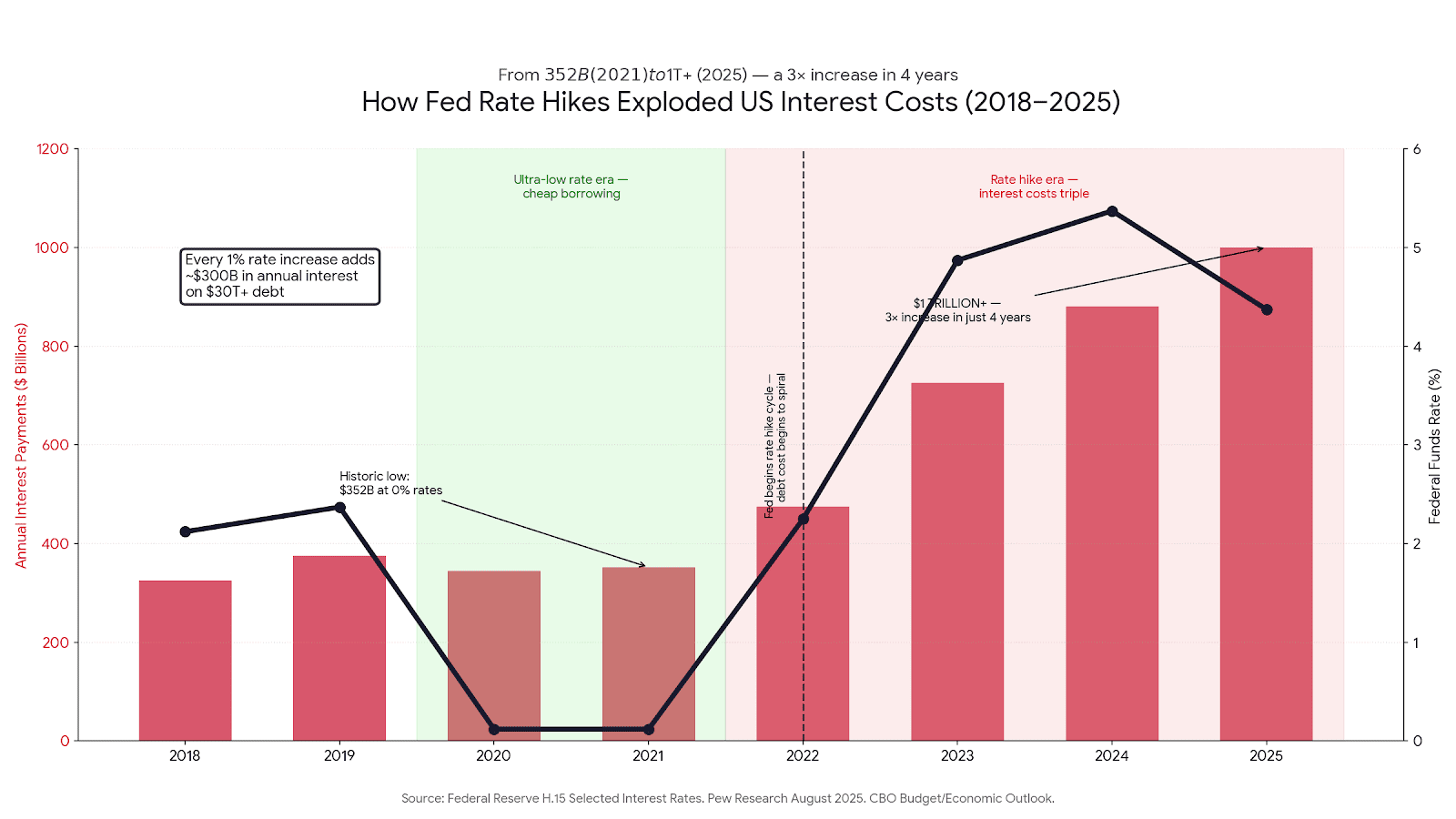
The Fed raised interest rates from near-zero to 5.25–5.5% to fight post-COVID inflation. With $30+ trillion in debt, higher rates meant dramatically higher interest bills. Annual interest payments surged from $352B (2021) to $882B (2024) — more than doubling in three years. The debt became self-accelerating: high debt → high interest → even higher debt.
During a 23-day government shutdown, the US national debt crosses $38 trillion — a new historic record. Annual interest payments exceed $1 trillion for the first time. The “megabill” signed by Trump adds an estimated $3.4 trillion in deficit spending over the next decade per CBO. The GAO warns of an “unsustainable fiscal path.”
Who Owns America’s $38 Trillion Debt?
Understanding who holds US debt helps explain why its problems are global problems. The debt is spread across domestic and international holders in ways that create financial interconnections across the entire world.
The Interest Bill: $1 Trillion a Year and Rising Fast
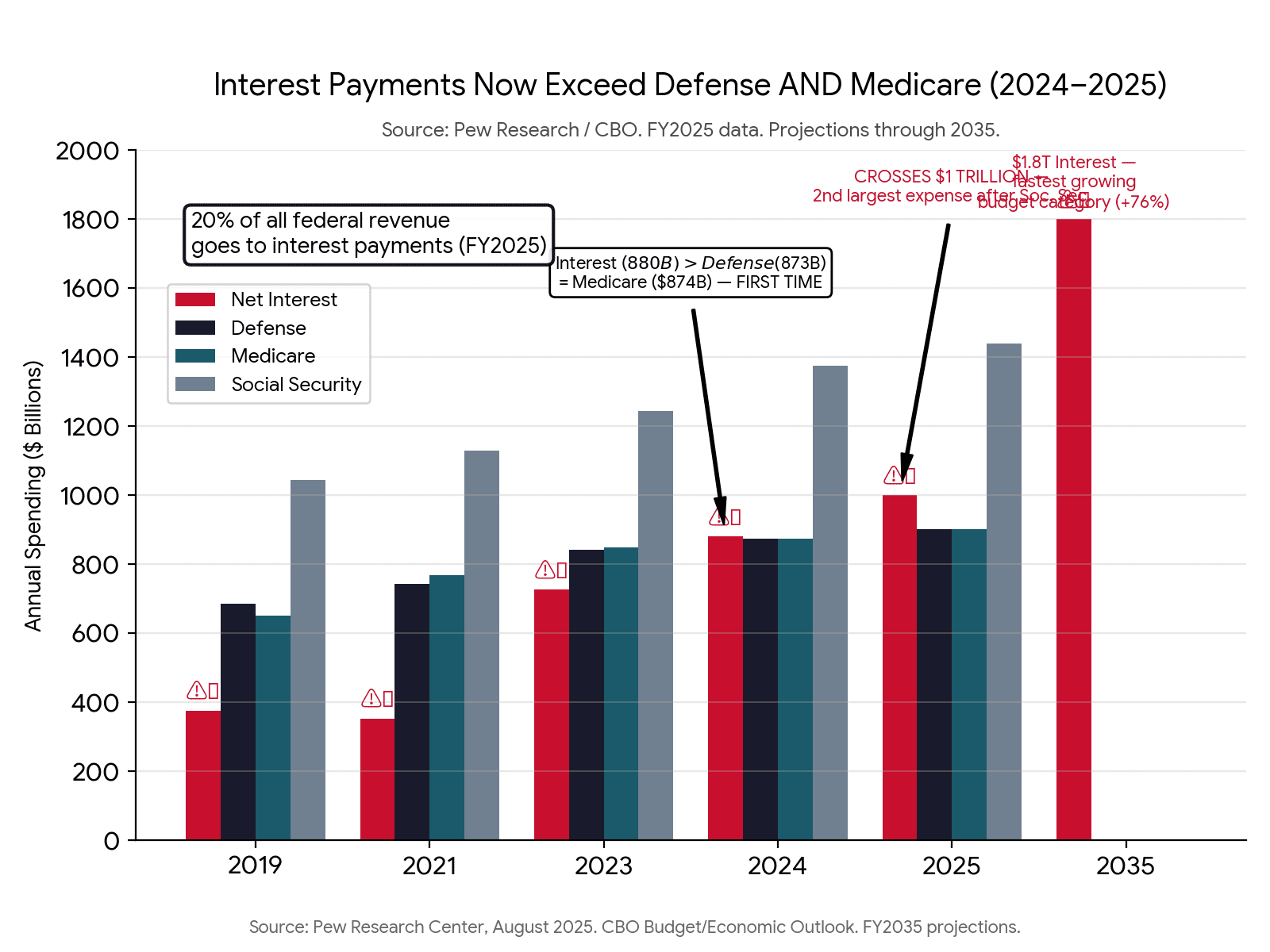
Perhaps the most alarming single fact about the US national debt is what it now costs just to service — to pay the interest on what’s already been borrowed.
| Year | Net Interest Paid | Compared To | As % of Revenue |
|---|---|---|---|
| 2019 | $375 billion | Less than defense | ~9% |
| 2021 | $352 billion | Near historic low (low rates) | ~8% |
| 2023 | $726 billion | Growing fast | ~14% |
| 2024 | $879.9 billion | More than Medicare OR Defense | ~13% |
| 2025 (FY) | $1+ trillion (first time ever) | 2nd largest expense after Social Security | ~20% |
| 2026 (projected) | $1.0 trillion (3.2% GDP) | Growing 76% by 2035 | Rising |
| 2035 (projected) | $1.8 trillion (4.1% GDP) | Fastest-growing budget category | Rising |
Let that sink in: the federal government spent $1 trillion on interest payments in FY 2025, which was $79 billion more than the $949 billion it spent in FY 2024. Net interest was the second-largest government expenditure in FY 2025, behind only Social Security, and totaled nearly one-fifth of all federal revenue collections.
The government currently spends more on interest payments than on Medicare, national defense, Medicaid, veterans’ benefits, food assistance, transportation, and science combined. Over the FY 2026 to FY 2035 budget window, CBO estimates interest payments will grow faster than any other major budgetary category — rising 76% from $1.0 trillion to $1.8 trillion.
How US Debt Affects the ENTIRE World: 6 Global Impact Channels
Impact 1 — Global Interest Rates: The World’s Benchmark
The US 10-year Treasury bond is the most important financial instrument in the world. It serves as the global benchmark interest rate — the rate against which every other bond, loan, and investment on the planet is priced. When the US government must pay higher rates to attract buyers for its enormous debt, rates rise everywhere. Mortgages in Australia, corporate loans in Germany, sovereign bonds in Brazil — all become more expensive when US Treasury rates rise. Each percentage point increase in the debt-to-GDP ratio increases interest rates by an estimated 2 basis points, and as debt-to-GDP approaches 156%, the cumulative effect on global rates is substantial.
📊 EY estimates rising debt raises global interest rates through this benchmark effect
Impact 2 — Dollar Confidence and Reserve Currency Status
The dollar’s status as the world’s reserve currency depends partly on confidence in US fiscal management. When that confidence erodes — as it has when the US reached $38 trillion in debt with $1 trillion annual interest bills — countries start diversifying away from dollars. A lack of fiscal consolidation in the United States, widespread tariff hikes, and uncertainty about the final tariff framework have raised risks for foreign investors. Foreign ownership of US Treasuries fell from 50%+ at the time of the Global Financial Crisis to just 29% by 2024. China cut its holdings from $1.3T (2013) to $756B (2025) — nearly halving its exposure. J.P. Morgan explicitly links US fiscal concerns to the dollar’s declining reserve share.
📊 Foreign Treasury ownership: 50%+ → 29% (2008 to 2024)
Impact 3 — Emerging Market Pain: Dollar Strengthening
When the Federal Reserve raises interest rates to manage inflation that is partly driven by deficit spending, the dollar strengthens. A stronger dollar makes things extremely difficult for emerging market countries that have borrowed in dollars. Their debt — expressed in a foreign currency that just got more expensive — becomes harder to service. Capital flows out of emerging markets toward higher-yielding US Treasuries. This “dollar dominance trap” means that US fiscal decisions directly cause financial stress in countries from Brazil to Turkey to Argentina that have no say in US budget policy. When the US sneezes fiscally, the global south catches a cold.
📊 Effective US tariff rate rose to 18.6% in mid-2025 — highest in 90 years — adding to global uncertainty
Impact 4 — Crowding Out Global Investment
When the US government borrows $1 trillion+ every 100 days, it competes with private businesses and other governments for global investment capital. This “crowding out” effect means less money flows to productive private investment — factories, infrastructure, innovation — in both the US and globally. CBO’s baseline assumes that for every new dollar of government borrowing, private investment falls by 33 cents. Over decades, this reduces global economic growth. EY analysis commissioned by the Peter G. Peterson Foundation found rising US debt will reduce the size of the US economy by $340 billion in 2035 and $1.1 trillion in 2055 — with knock-on effects for every country that trades with or invests in America.
📊 Every $1 of US govt borrowing reduces private investment by $0.33 (CBO)
Impact 5 — Risk of a US Fiscal Crisis: The Tail Risk
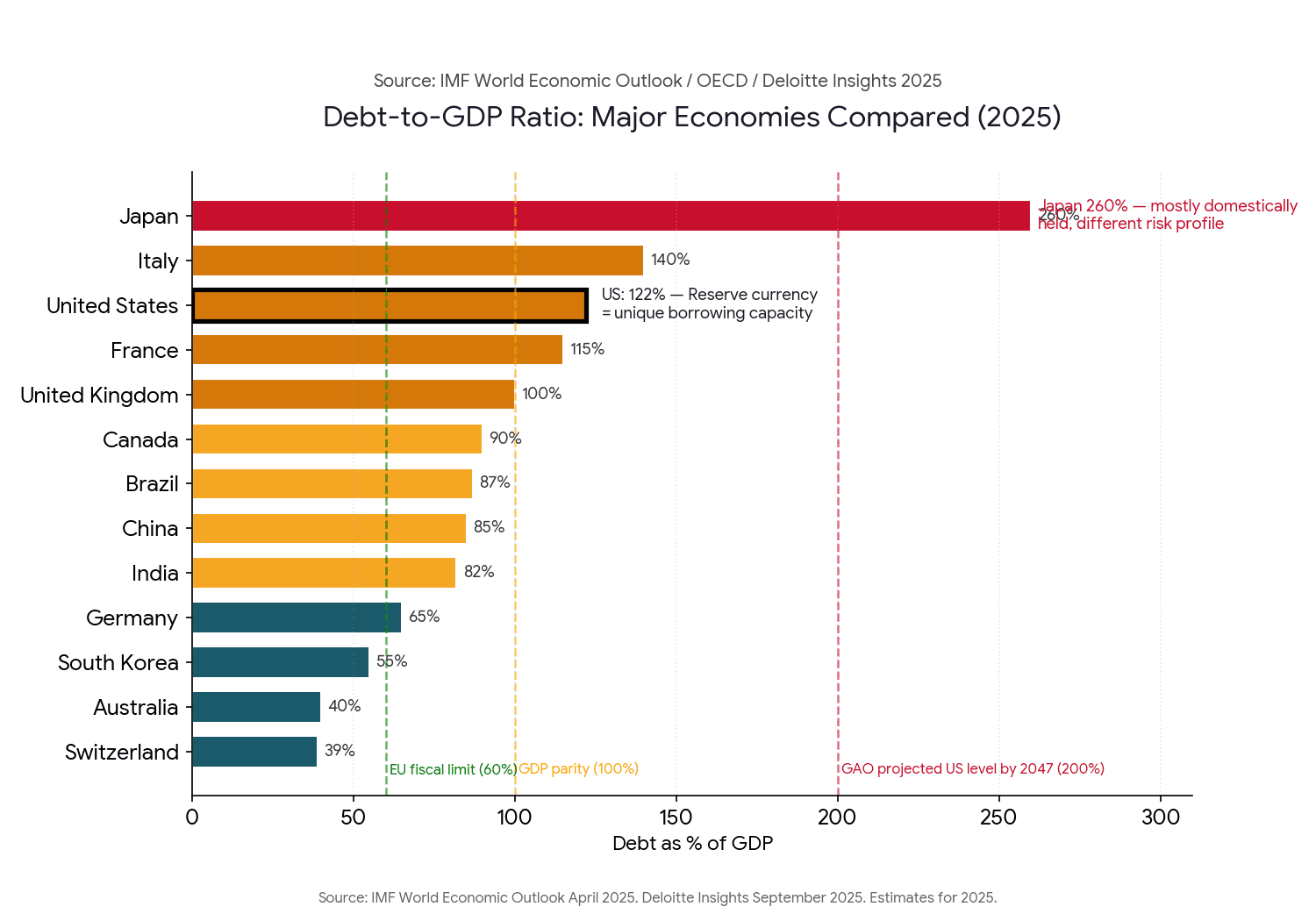
Most economists do not predict an imminent US fiscal crisis. But the GAO’s February 2025 report was explicit: the federal government is on an “unsustainable fiscal path” that poses serious economic, security, and social challenges. The GAO projects publicly held debt will reach 200% of GDP by 2047 — three years earlier than previous projections. If a US fiscal crisis were to materialize — a sudden loss of confidence in US Treasuries, a spike in yields, or a debt ceiling breach — it would trigger the most severe global financial crisis in modern history. US Treasuries underpin virtually every financial system, every pension fund, and every foreign reserve portfolio on Earth. Their instability would be catastrophic on a scale that makes 2008 look mild.
📊 GAO: Debt held by public projected to reach 200% of GDP by 2047
Impact 6 — Geopolitical Power and Sanctions Effectiveness
America’s ability to use financial sanctions as a geopolitical tool depends partly on dollar dominance, which depends partly on confidence in US fiscal management. As the debt grows and dollar confidence erodes even slightly, the effectiveness of dollar-based sanctions diminishes. Countries that fear US sanctions are more motivated to build dollar alternatives precisely because they are watching US fiscal sustainability deteriorate. Russia’s dollar reserve collapse, China’s Treasury selloff, and the BRICS de-dollarization push are all partly motivated by the same calculation: a country running $1.8 trillion annual deficits with $38 trillion in debt may not maintain fiscal dominance indefinitely.
📊 US sanctions effectiveness tied directly to dollar dominance confidence
The Projections: Where Is This Heading?
| Year | Projected Debt (Public) | Debt/GDP | Annual Interest | Source |
|---|---|---|---|---|
| 2025 (actual) | $30.3 trillion | ~100% | $1.0 trillion | CBO / AAF |
| 2026 | $31.9 trillion | 102% | $1.0 trillion | CBO |
| 2029 | $35.0 trillion | 107% | Growing | CBO |
| 2034 | Approx $44T | 116% | Rising fast | CBO (Feb 2024) |
| 2035 | $52.1 trillion | 119% | $1.8 trillion | AAF / CBO |
| 2047 | Rising sharply | 200% | Dominant share | GAO (Feb 2025) |
| 2054 | Approaching $172T | 172% | Major crisis risk | CBO (Feb 2024) |
| 2055 | $138.2 trillion | 156% | $1.8T+ (2035 est.) | AAF / CBO |
The United States faces a litany of fiscal challenges, the most consequential of which is the unsustainable growth of the national debt. The current U.S. debt path will reduce the size of the U.S. economy by $340 billion in 2035 and $1.1 trillion in 2055. Rising debt will also lower U.S. jobs relative to the baseline by 1.2 million jobs in 10 years, 2.7 million in 30 years, and 3.6 million in 50 years.
— EY Analysis commissioned by Peter G. Peterson Foundation, May 2025
The Megabill Factor: Trump’s 2025 Legislation Adds $3.4 Trillion More
Just as the 2025 fiscal picture was becoming clear, Congress passed and Trump signed what observers dubbed the “megabill” — a sweeping package of tax cuts and spending changes. The CBO now projects that the recently signed “megabill,” as it’s been dubbed, will add nearly $3.4 trillion more in deficit spending over the next decade.
This single piece of legislation significantly worsened the already alarming CBO baseline projections. It adds to a situation where, even before Congress passed President Donald Trump’s major tax and domestic policy legislation, the federal government was on track to spend $1.9 trillion more this fiscal year than it collected in revenue, according to the nonpartisan Congressional Budget Office.
How Does the US Compare to Other Indebted Countries?
| Country | Debt/GDP (2025) | Assessment | Key Difference |
|---|---|---|---|
| 🇺🇸 United States | ~119-122% | Unsustainable trajectory (GAO) | Reserve currency = unique borrowing power |
| 🇯🇵 Japan | ~260% | Highest in developed world | Mostly domestic debt — less crisis risk |
| 🇮🇹 Italy | ~140% | EU fiscal constraints | No independent monetary policy |
| 🇫🇷 France | ~115% | EU fiscal pressure | No independent monetary policy |
| 🇬🇧 United Kingdom | ~100% | Concerning but managed | Independent monetary policy |
| 🇨🇳 China | ~85% | Rising rapidly | Mostly internal, state-controlled |
| 🇩🇪 Germany | ~65% | Fiscal conservative | Constitutional debt brake |
| 🇦🇺 Australia | ~40% | Well managed | Commodity export revenue buffer |
The US debt-to-GDP ratio of 122.6 percent positions America in the middle range among advanced economies, significantly higher than fiscally conservative nations like Germany at 65 percent, but well below Japan’s extraordinary 260 percent. However, the key difference is that the US must attract substantial foreign capital to finance its deficits, making it more vulnerable to shifts in global investor sentiment. Japan’s debt is mostly held domestically — its government can manage refinancing internally. The US depends on global investor confidence to roll over trillions in debt.
What Does This Mean for Ordinary People?
For Americans
Rising US debt affects Americans most directly through four channels. First, higher interest rates — as the government competes for capital, mortgage rates, car loans, and credit cards all become more expensive. Second, reduced government services — as interest payments consume an ever-larger share of the federal budget, there is less money for roads, education, healthcare, and research. Third, potential future tax increases — the debt must eventually be addressed either through spending cuts, tax rises, or inflation. Fourth, slower wage growth — EY analysis found rising debt will reduce average income by approximately 6% by 2055 and eliminate 3.6 million jobs compared to a debt-stabilization scenario.
For People Outside America
For the rest of the world, US debt matters through global interest rate effects, dollar volatility, and the risk of US fiscal disruption rippling through global markets. Emerging market countries face particular vulnerability — their dollar-denominated debt becomes more expensive when US rates rise. Countries holding US Treasuries as reserves face balance sheet risk if Treasury yields spike. And the gradual erosion of US fiscal credibility is one of the drivers behind de-dollarization, which is reshaping global trade and financial flows as we’ve covered in detail in this series.
For Investors Everywhere
The US 10-year Treasury yield serves as the global benchmark for investment returns. When it rises due to fiscal concerns, it raises the “hurdle rate” for all investments worldwide — meaning businesses need higher expected returns to justify investment, which slows global economic growth. US Treasuries also serve as the primary safe-haven asset in global portfolios — a sudden loss of confidence in them would force a global portfolio reallocation of unprecedented scale.
The Bottom Line: America’s Debt Is Everyone’s Concern
The US national debt is not just America’s fiscal problem. Because of the dollar’s reserve currency status, the centrality of US Treasuries to global finance, and the interconnectedness of global capital markets, the trajectory of American debt has genuine consequences for interest rates, investment, currency stability, and economic growth in every country on Earth.
The numbers are unambiguous: the US national debt is growing by $1 trillion every 100 days and roughly $3.6 trillion per year — the fastest rate of increase of any developed country. Interest payments crossed $1 trillion annually for the first time in 2025. The GAO projects the debt will hit 200% of GDP by 2047 without policy changes. The megabill adds $3.4 trillion more over the next decade.
Is this an imminent crisis? Most economists say no. The dollar’s reserve status, the depth of US financial markets, and the global demand for safe assets give America a unique borrowing capacity that other nations simply do not have. Japan has managed 260% debt-to-GDP without a crisis for decades.
Is it a long-term structural threat? The GAO, CBO, IMF, and virtually every serious fiscal institution says yes. The trajectory is unsustainable. The question is not whether it matters — it clearly does. The question is whether policymakers will act before market forces force a reckoning.
That answer will determine not just America’s fiscal future — but the stability of the entire global financial system that was built on the foundation of US dollar dominance and US Treasury reliability. Understanding it is not optional for anyone who wants to understand the world’s money.

Related Articles


1 Comment on “How the US National Debt Impacts the Global Economy — The Complete 2026 Guide”