
1. Introduction: The Sovereign Balance Sheet Is Flashing Red
For decades, investors have focused on company earnings, quarterly growth numbers, and sector rotation themes. But in 2026, the most important balance sheet in the world does not belong to Apple, Nvidia, or any major bank. It belongs to the United States Treasury.
The US national debt crossed approximately $38.5 trillion in early 2026. That number alone is massive. But the real concern is not just the size of the debt — it is the maturity schedule. Roughly $10 trillion of this debt is set to mature in 2026 and must be refinanced.
Think of it like a household loan. If you borrowed money at 1% interest five years ago and now need to refinance at 4%, your monthly burden increases sharply. The US government is facing exactly that situation — but at a scale that affects the entire global financial system.
This refinancing wave will determine refinancing rates, influence bond yields, and shape the global economic outlook 2026. The world is watching not because America might default — it won’t — but because the cost of rolling over this debt could ripple across every market on Earth.
US Treasury debt statistics
2. The Math Problem: High Rates Meet Massive Refinancing
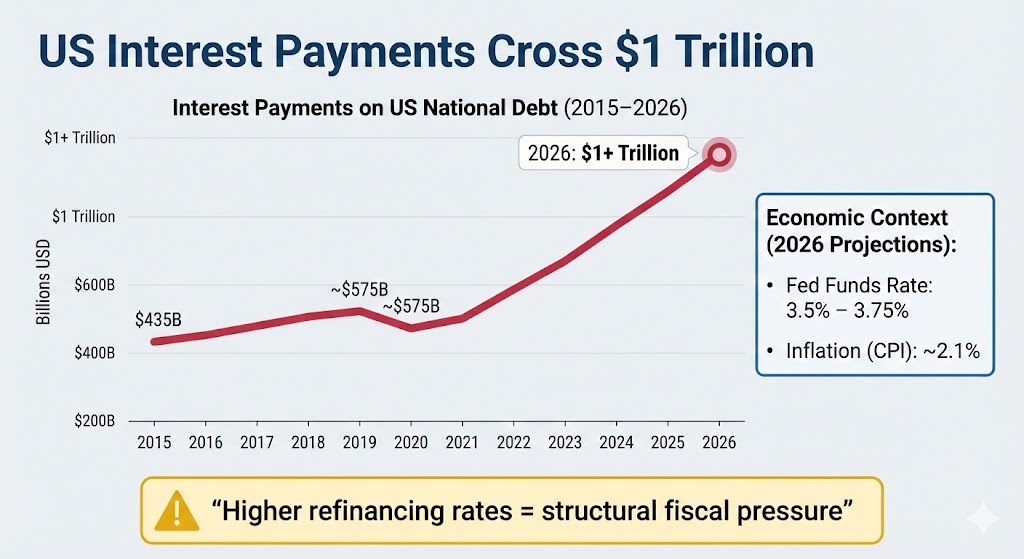
The US government’s annual interest payments have now crossed $1 trillion. That makes interest one of the fastest-growing items in the federal budget — larger than many social and defense programs.
During the pandemic years, the US borrowed aggressively at ultra-low interest rates, often below 1%. That era is over. In January 2026, the Federal Reserve paused its rate-cutting cycle and kept benchmark rates around 3.5% to 3.75%, citing sticky inflation around 2.7% and trade-related pressures.
Now comes the difficult part. As older, cheaper bonds mature, they must be replaced with new bonds issued at these higher rates. If $10 trillion is refinanced even 2–3 percentage points higher than previous rates, the long-term interest burden explodes.
There is also the “crowding out” effect. When the US Treasury issues massive amounts of bonds, global investors must choose where to allocate their money. If they buy more US Treasuries, they may buy fewer emerging market bonds or equities.
If demand for US Treasuries weakens, yields must rise further to attract buyers. Higher yields then increase refinancing costs again. It becomes a cycle.
The US will pay its bills. But the price of stability may be permanently higher baseline interest rates for the world.
Federal Reserve interest rate policy
3. Geoeconomics: The Foreign Buyer Exodus and “Dedollarization”
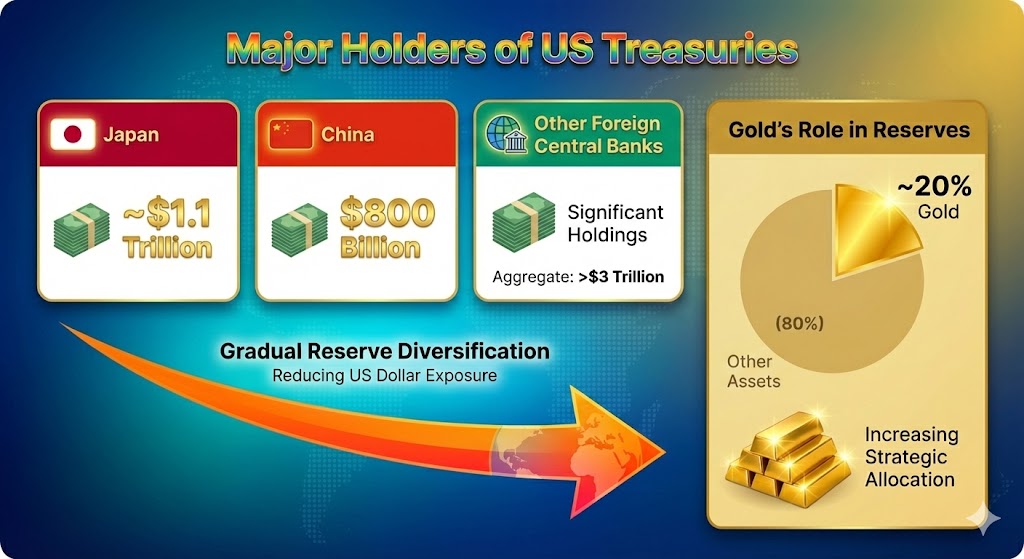
For decades, foreign central banks were major buyers of US debt. Countries like Japan and China recycled their trade surpluses into US Treasury bonds.
In 2026, that landscape looks different.
Japan still holds roughly $1.1 trillion in US Treasuries. China’s holdings have declined toward the $800 billion range. Both countries are diversifying reserves due to geopolitical tensions and currency considerations.
Recent trade tensions and tariff adjustments have reduced global confidence in predictable US trade policy. Meanwhile, the US dollar has shown increased volatility. At one point recently, it declined nearly 13% against the euro compared to earlier highs.
This does not mean the dollar is collapsing. It remains the world’s dominant reserve currency. But central banks are gradually diversifying into gold and other assets.
At the same time, emerging markets like India are attracting capital. The Reserve Bank of India (RBI) has eased External Commercial Borrowing (ECB) norms, enabling Indian companies to potentially raise around $100 billion in 2026–27.
This is a subtle shift. While the US government seeks buyers for sovereign debt, global investors are also hunting for growth. India’s GDP growth remains near 6–7%, compared to slower expansion in developed economies.
Capital does not move based on emotion. It moves toward yield and growth.
Congressional Budget Office debt outlook
4. Impact on the Global Economic Outlook 2026
If US Treasury yields rise significantly to absorb the refinancing wave, global liquidity tightens.
Higher US bond yields act like a magnet. Pension funds, sovereign funds, and large institutions may shift allocations toward “risk-free” Treasuries offering attractive yields.
This can create what some analysts call a “sucking sound” of capital — money flowing out of equities and emerging markets.
Corporate borrowing costs also rise. When US Treasury yields increase, corporate bond yields typically increase as well. That means companies face higher financing expenses.
Consider the technology sector. Global hyperscalers are projected to spend roughly $600 billion in AI-related capital expenditure in 2026. These projects are long-term and often debt-funded. If bond yields spike, future profits are discounted at higher rates, compressing valuations.
For emerging markets, currency volatility becomes a concern. If US yields rise sharply, capital may temporarily leave emerging economies, putting pressure on currencies like the Indian Rupee.
A weaker currency increases import costs, particularly for oil. That can feed domestic inflation.
The refinancing wave in Washington does not stay in Washington. It touches Mumbai, Frankfurt, Tokyo, and São Paulo.
IMF global economic outlook
5. Where to Hide? Identifying Secure Investments 2026
In periods of sovereign refinancing stress, investors look for stability.
One clear beneficiary in recent years has been gold. Central banks have been net buyers of gold at record levels. Gold’s share in global reserve assets has risen to around 20%, second only to the US dollar.
Gold is not tied to any one country’s debt. When sovereign balance sheets expand rapidly, gold becomes a hedge against currency dilution.
Another interesting opportunity lies in Indian Government Bonds (IGBs). After inclusion in major global bond indices like JP Morgan’s emerging market bond index, foreign inflows into Indian debt have accelerated.
India’s fiscal deficit has been gradually reduced toward the 4.5% of GDP range for FY 2025–26. Compared to many developed nations, India’s debt trajectory appears more controlled.
With 10-year Indian government bond yields around 7.2%, investors see a rare mix of relatively high yield and improving fiscal discipline.
Private credit is another area attracting attention. In India, domestic corporate credit deals are being priced between 12% and 20% yields, especially in infrastructure and real estate-linked lending. These returns are largely insulated from US Treasury volatility because they are based on domestic economic activity.
The theme for secure investments 2026 is diversification — not abandoning the dollar, but reducing overconcentration in long-duration US assets.
6. The Structural Question: Will the US Default?
Let us address the fear directly.
The United States will not default on its debt under normal circumstances. It has the world’s deepest capital markets and the ability to issue currency.
The real risk is not default. The real risk is persistently higher interest rates.
If refinancing occurs at elevated yields for several years, the US fiscal deficit widens structurally. Interest becomes a permanent drag on public finances.
To manage this, policymakers may tolerate slightly higher inflation or gradual currency depreciation over time. These are indirect ways of reducing real debt burden.
That is how sovereign balance sheets adjust — slowly, not suddenly.
7. The Emerging Market Counterweight
While the US navigates refinancing pressures, emerging markets like India are positioned differently.
India’s corporate sector is deleveraged compared to the pre-2013 cycle. Bank balance sheets are stronger. Non-performing assets have declined significantly from double-digit peaks to more manageable levels.
India’s demographic profile is also younger, supporting long-term consumption growth.
Foreign investors are increasingly treating India as a structural allocation rather than a tactical trade.
This does not mean India is immune to global volatility. It means relative positioning matters.
When global capital reallocates, it seeks both safety and growth. Emerging markets with improving fiscal and monetary discipline become beneficiaries.
8. Conclusion: The Cost of Stability
The $10 trillion refinancing wall in 2026 is not a headline crisis. It is a structural adjustment phase.
The US will refinance its debt. There will be auctions, yield fluctuations, and debates about fiscal discipline. But the system will continue to function.
The deeper consequence is this: global baseline interest rates may remain higher for longer.
That affects housing markets, technology valuations, emerging market currencies, and sovereign bond portfolios.
Navigating the global economic outlook 2026 requires discipline. Portfolios that were heavily tilted toward long-duration US assets may need rebalancing. Exposure to real assets, diversified emerging market debt, and selective corporate credit can provide stability.
The world is not ending. But the era of ultra-cheap money is clearly behind us.
Now the question shifts from “How low can rates go?” to “How high must they stay?”
And that is the real $10 trillion question.
✅ FAQ
1. What is the US debt refinancing crisis in 2026?
The US must refinance nearly $10 trillion of maturing debt in 2026 at higher interest rates, increasing borrowing costs.
2. Will the US default on its debt?
A default is highly unlikely. The main risk is higher long-term interest rates and increased fiscal pressure.
3. How do rising Treasury yields affect global markets?
Higher yields attract global capital, reduce liquidity in equities, and increase corporate borrowing costs.
4. What are secure investments in 2026?
Gold, high-quality government bonds, and diversified emerging market debt are considered safer options.
5. How does US debt impact India?
Higher US yields can cause capital outflows from emerging markets, affecting currency and bond markets.
6. Why are central banks buying gold?
Gold acts as a hedge against currency risk and sovereign debt expansion.
7. What is the crowding out effect?
It occurs when government borrowing absorbs capital, leaving less available for private sector investment.