US–China Strategic Rivalry Is Reshaping India’s Economic Future
Why the World’s Biggest Power Struggle May Become India’s Biggest Growth Opportunity
1. Introduction: Why India Is at the Center of This Rivalry
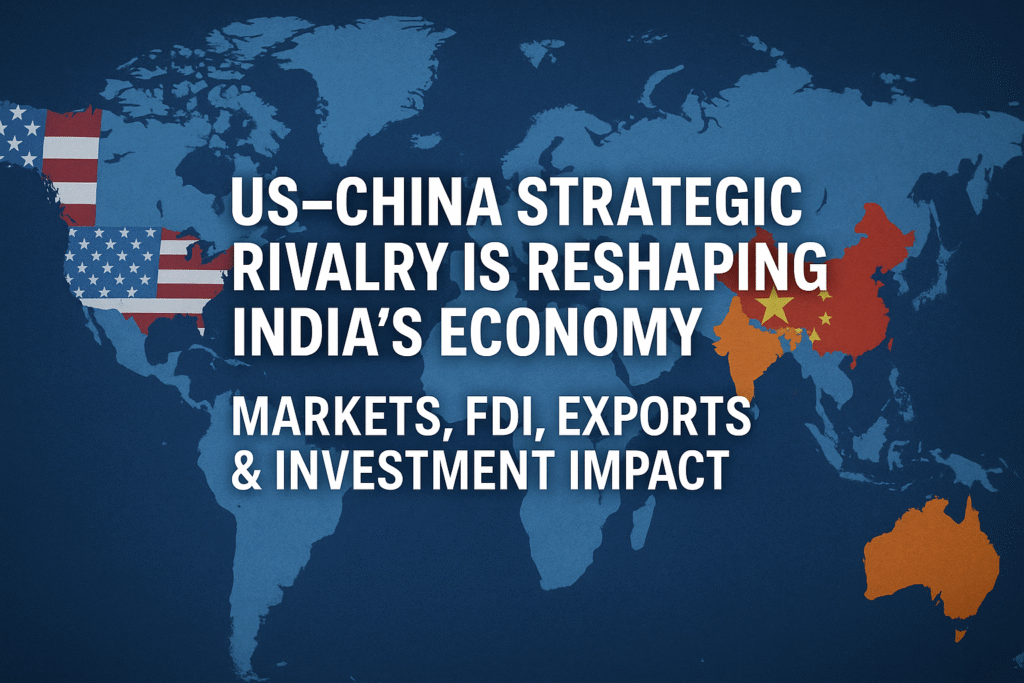
The strategic rivalry between the United States and China is no longer limited to military posturing or diplomatic disputes. It has evolved into a full-scale economic, technological, and supply-chain confrontation that is reshaping global trade patterns. At the heart of this transformation stands India — not as a passive observer, but as a critical pivot economy.
With a GDP of nearly $3.7 trillion, India is now the world’s fifth-largest economy, projected to become the third-largest by 2030. Unlike smaller economies caught between Washington and Beijing, India has scale, demographic strength, and political leverage. Both the US and China need India — the US as a trusted democratic manufacturing partner, and China as a neighboring market and supply-chain participant.
For Indian investors and policymakers, this rivalry is not just geopolitics; it is about capital flows, stock valuations, exports, currency stability, and long-term growth visibility. Decisions taken in Washington and Beijing increasingly shape factory investments in Tamil Nadu, semiconductor plans in Gujarat, and stock market sentiment in Mumbai. Understanding this shift is now essential for anyone tracking India’s economic future.
2. India’s Strategic Position Between US and China: Non-Alignment 2.0 and Economic Pragmatism
India’s current foreign-economic strategy can best be described as “Non-Alignment 2.0” — not ideological neutrality, but calculated economic pragmatism. Unlike the Cold War era, today’s non-alignment is driven by supply chains, capital access, and technology flows rather than military blocs.
India maintains strong strategic ties with the US through platforms like the Quad, defence agreements, and technology cooperation, while simultaneously managing a complex trade relationship with China, which remains India’s largest goods trading partner. In FY2024, bilateral trade between India and China crossed $118 billion, despite border tensions.
This balancing act allows India to extract value from both sides. The US views India as a long-term counterweight to China in Asia, while China sees India as too large a market to ignore. For policymakers, this positioning maximizes leverage. For investors, it reduces binary risk — India is not fully dependent on either power, making its growth story more resilient compared to export-dependent economies like Vietnam or South Korea.
3. Manufacturing & FDI Opportunities: China+1, Electronics, Defence, and Pharma
One of the most visible economic outcomes of the US–China rivalry is the China+1 strategy, where global companies diversify manufacturing away from China. India has emerged as one of the biggest beneficiaries of this shift.
Manufacturing Share Index (2015 = 100)
China | ██████████████████████ 100 → 92
India | ██████████████████████████████ 100 → 168
Vietnam | ████████████████████████ 100 → 142
Between 2020 and 2024, India attracted over $280 billion in FDI, with a sharp rise in manufacturing-led investments. Electronics manufacturing alone has crossed $120 billion in output, up from just $37 billion in 2015. Companies like Apple now assemble over 14% of their global iPhones in India, a figure expected to reach 25% by 2027.
FDI Inflows (USD Billion)
2016–2018 avg | ██████████ 45
2019–2021 avg | ███████████████ 62
2022–2024 avg | ██████████████████ 70+
Defence manufacturing has also gained momentum, with exports crossing ₹21,000 crore in FY2024, driven by policy reforms and geopolitical realignment. Pharmaceuticals remain another strong pillar, as India supplies nearly 20% of the world’s generic medicines.
For investors, this is not a short-term story. The relocation of supply chains requires decade-long capital commitments, ensuring sustained demand for industrials, logistics, power, chemicals, and infrastructure stocks.
4. Impact on Indian Stock Markets: Sectors in Focus and Long-Term Valuation Benefits
Indian stock markets are increasingly reflecting the geopolitical premium attached to India’s position. While global markets remain volatile due to trade wars and interest-rate cycles, Indian equities continue to command valuation premiums over peers.
High Impact Sectors (Relative Benefit Score)
Electronics Manufacturing | ████████████████████
Defence & Aerospace | ██████████████████
Capital Goods & Infra | █████████████████
Pharma & APIs | ███████████████
Logistics & Ports | ██████████████
IT & Tech Services | ████████████
Key beneficiary sectors include capital goods, electronics manufacturing services (EMS), defence, specialty chemicals, logistics, and renewable energy. The Nifty Capital Goods index has delivered over 35% CAGR returns between 2020 and 2024, driven by domestic capex and global diversification trends.
Foreign investors now view India as a structural growth market, not a tactical trade. Even during global risk-off phases, India has seen quicker FII return cycles compared to other emerging markets. Long-term earnings visibility, political stability, and demographic consumption provide downside protection.
Currency Depreciation vs USD (Approx.)
Indian Rupee (INR) | ████ 12%
Chinese Yuan (CNY)| ██████ 15%
Korean Won (KRW) | █████████ 22%
Brazil Real (BRL) | ████████████ 28%
The US–China rivalry indirectly strengthens India’s equity narrative by reducing over-dependence on a single global manufacturing hub, which lowers systemic risk and supports higher valuation multiples over time.
5. Trade and Export Growth: New Destinations and Global Supply Chain Participation
India’s export profile is undergoing a structural transformation. Traditionally focused on services and low-value goods, India is now integrating into high-value global supply chains.
Merchandise exports crossed $437 billion in FY2024, while services exports touched $341 billion, a record high. The US has become India’s largest export destination, accounting for nearly 18% of total exports, overtaking China.
New trade corridors are emerging with Europe, the Middle East, and Africa. Initiatives like the India-Middle East-Europe Economic Corridor (IMEC) aim to position India as a logistics and manufacturing hub connecting Asia with Western markets.
This shift reduces vulnerability to Chinese trade retaliation while expanding India’s influence in global production networks. For exporters and investors alike, diversified export exposure improves earnings stability and long-term competitiveness.

6. Geopolitical Risks for India: Border Tensions and Trade Retaliation
While opportunities are significant, risks cannot be ignored. Border tensions with China remain unresolved, and periodic escalations can disrupt sentiment, particularly in sensitive sectors like telecom, power equipment, and APIs.
There is also the risk of trade retaliation if India is perceived as moving too closely into the US strategic orbit. China has previously used non-tariff barriers, customs delays, and regulatory scrutiny as economic tools.
However, India has responded by strengthening domestic manufacturing and diversifying import sources. The reduction in Chinese share of critical imports such as electronics components and APIs is gradual but visible.
For investors, these risks highlight the importance of sectoral diversification rather than undermining India’s overall growth story.
7. Currency and Capital Flows: Rupee Stability and FII Behaviour

The US–China rivalry has also influenced global capital flows, indirectly supporting rupee stability. While the Indian rupee has depreciated gradually, it has remained far more stable than many emerging market currencies.
India’s forex reserves remain above $640 billion, providing a strong buffer against external shocks. At the same time, long-term FDI inflows have offset volatile portfolio flows.
FIIs increasingly view India as a relative safe haven within emerging markets, especially during periods of US-China trade escalation. This structural shift supports bond markets, equity inflows, and long-term currency stability.
To visit official websit of CSO CLICK HERE
8. What Indian Businesses Should Prepare For: Compliance, Tech Alignment, and Global Standards
Indian companies must adapt to a world shaped by competing regulatory and technology blocs. Compliance with US and EU standards, supply-chain transparency, ESG norms, and data protection rules will become critical.
Businesses aligned with global standards will gain access to cheaper capital, export markets, and strategic partnerships. Those that fail to adapt risk exclusion from global value chains.
For MSMEs and large corporates alike, investment in technology, compliance systems, and global certifications is no longer optional — it is a survival requirement in a polarized global economy.
To visit official website of RBI CLICK HERE
9. Expert Views from Economists and Industry Leaders
Leading economists view the US–China rivalry as a once-in-a-generation opportunity for India. Industry leaders consistently point out that global firms are no longer asking if they should invest in India, but how fast they can scale operations.
Policy experts argue that India’s success will depend on execution — infrastructure speed, policy stability, and ease of doing business. If managed well, India could replicate the manufacturing-led growth seen in East Asia, but on a much larger scale.
10. Conclusion: Why This Rivalry Could Be India’s Biggest Economic Opportunity
The US–China strategic rivalry is often portrayed as a global risk. For India, it may turn out to be a historic advantage. Few nations have the scale, talent, market depth, and geopolitical flexibility to benefit from this shift — India does.
For investors, this rivalry strengthens India’s long-term growth visibility. For policymakers, it offers leverage and strategic autonomy. And for businesses, it opens doors to global markets once dominated by a single manufacturing powerhouse.
If India plays its cards right, this geopolitical contest could define not just the next decade — but the next era of India’s economic rise.
📌 FAQ: US–China Strategic Rivalry & India’s Economic Future
Q1. How does the US–China strategic rivalry benefit India economically?
The US–China rivalry is forcing global companies and investors to reduce dependence on China and diversify supply chains. India is emerging as a key alternative due to its large domestic market, skilled workforce, improving infrastructure, and political stability. This shift has already resulted in higher foreign direct investment (FDI), growth in manufacturing, rising exports, and stronger long-term prospects for Indian stock markets.
Q2. Which Indian sectors gain the most from US–China tensions?
Sectors that benefit the most include electronics manufacturing, defence production, pharmaceuticals, capital goods, logistics, ports, renewable energy, and specialty chemicals. These industries are directly linked to global supply chain diversification and long-term industrial investment, making them attractive for investors seeking structural growth themes.
Q3. What is the China+1 strategy and why is India a major beneficiary?
The China+1 strategy refers to multinational companies moving part of their manufacturing and sourcing away from China to another country to reduce geopolitical and supply-chain risks. India is a major beneficiary because it offers scale, cost competitiveness, policy incentives, and access to global markets, unlike smaller alternatives that cannot absorb large-scale manufacturing shifts.
Q4. How does the US–China rivalry affect Indian stock markets?
Indian stock markets benefit from increased foreign investment, stronger earnings visibility in manufacturing-led sectors, and improved long-term growth confidence. While short-term volatility may occur due to global events, India’s equity markets are increasingly seen as a structural investment destination rather than a cyclical emerging market trade.
Q5. Is India choosing sides between the US and China?
No. India is following a strategy often described as “Non-Alignment 2.0.” It maintains strong strategic ties with the United States while continuing economic engagement with China. This balanced approach allows India to attract global capital without becoming overly dependent on any single geopolitical bloc.
Q6. Does the US–China rivalry pose risks for India?
Yes, there are risks such as border tensions with China, potential trade retaliation, and global economic slowdowns. However, India’s large domestic market, strong forex reserves, diversified exports, and steady FDI inflows help absorb these shocks and reduce long-term vulnerability.
To Read Can China Challenge the US Dollar? De-Dollarization, BRICS Strategy and Global Currency Shift Explained click here
Q7. How does this rivalry impact the Indian rupee and capital flows?
India has managed to maintain relative rupee stability compared to many emerging markets. Strong forex reserves, consistent FDI inflows, and India’s growing role in global supply chains support currency stability and make India attractive to long-term global investors.
Q8. What should Indian businesses do to benefit from this global shift?
Indian businesses should align with global regulatory standards, improve supply-chain transparency, invest in technology, comply with ESG norms, and meet US and EU compliance requirements. Companies that adapt early will gain better access to global markets, cheaper capital, and long-term contracts.
🔍 People Also Ask (PAA): US–China Rivalry, IT Sector & India
🖥️ IT & TECHNOLOGY–FOCUSED PAA QUESTIONS
How does the US–China rivalry impact India’s IT sector?
The US–China rivalry is benefiting India’s IT sector as global companies shift technology services, software development, and digital transformation work away from China. Indian IT firms are gaining more contracts in cloud migration, cybersecurity, AI services, and enterprise software due to trust, compliance, and data security concerns.
Why are global tech companies moving IT operations to India?
Global tech companies prefer India because of its large English-speaking talent pool, cost efficiency, strong IP protection, and alignment with US and European regulatory standards. As geopolitical risks rise in China, India is seen as a safer long-term destination for IT services and R&D.
Will US–China tech tensions boost Indian IT stocks?
Yes, US–China tech tensions improve long-term prospects for Indian IT stocks by increasing demand for outsourcing, cloud services, AI integration, and compliance-related IT spending. While short-term currency or demand cycles affect earnings, structurally the opportunity base is expanding.
How does the China+1 strategy affect Indian IT services?
The China+1 strategy increases demand for Indian IT services as companies relocating manufacturing also need ERP systems, cybersecurity, supply-chain software, automation, and digital twins. Indian IT firms often become long-term partners during these relocations.
Is India replacing China as a global technology hub?
India is not fully replacing China in hardware manufacturing, but it is emerging as a dominant hub for software, IT services, global capability centers (GCCs), and digital engineering. In technology services, India already holds a clear global leadership position.
Which IT segments in India benefit the most from US–China rivalry?
The biggest beneficiaries include cloud computing, cybersecurity, data analytics, AI & machine learning, enterprise SaaS, semiconductor design services, and digital transformation consulting.
How does US–China rivalry impact semiconductor and chip design in India?
As chip supply chains diversify, India is gaining importance in semiconductor design, testing, and backend services. Global firms are setting up design centers and partnering with Indian engineers to reduce dependence on China-centric ecosystems.
Does geopolitics increase demand for cybersecurity services in India?
Yes. Rising geopolitical tensions increase cybersecurity threats, data protection requirements, and regulatory compliance needs. Indian IT firms are seeing higher demand for security audits, cloud security, and zero-trust architecture solutions.
Will visa policies and geopolitics affect Indian IT exports?
While visa policies can affect on-site staffing, most IT work is increasingly delivered remotely or through offshore centers. Geopolitical trust in India as a democratic and stable partner offsets visa-related challenges in the long term.
How does US–China rivalry affect Global Capability Centers (GCCs) in India?
The rivalry is accelerating the shift of GCCs to India. Multinational companies are expanding captive tech centers in Bengaluru, Hyderabad, Pune, and Gurugram to handle core engineering, analytics, finance, and cybersecurity functions.
What should Indian IT companies do to stay competitive globally?
Indian IT companies should invest in AI, cloud-native platforms, cybersecurity, ESG tech, and industry-specific digital solutions while aligning with global compliance standards such as data privacy, export controls, and IP protection.