India, Russia & the 500% Tariff Threat: Why Oil Is Testing Strategic Autonomy

1. The Opening Narrative: Beyond “Fence-Sitting”
For many outside observers, India’s current position in the growing US-India-Russia tension is often reduced to a lazy phrase: “India is fence-sitting.” That description misses the real story. What is unfolding in early 2026 is not hesitation or indecision. It is a deliberate test of India’s long-standing doctrine of strategic autonomy, applied under extreme pressure.
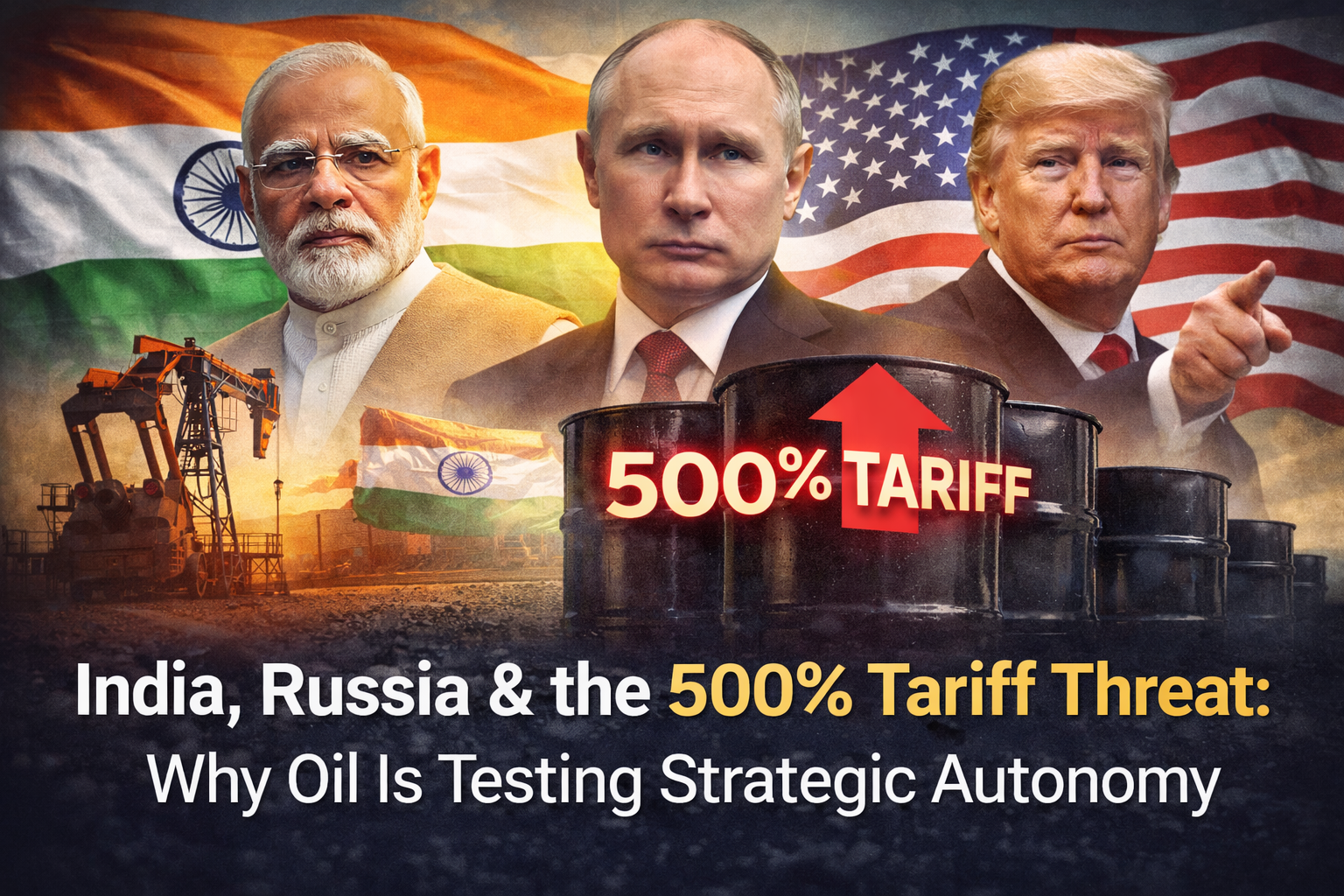
On January 12, 2026, the arrival of US ambassadorial envoy Sergio Gor in New Delhi carried a very narrow message: reduce Russian oil purchases to zero. This demand came immediately after the Trump administration signalled its intent to fully operationalise the Sanctioning Russia Act of 2025, which includes a dramatic clause—a 500% tariff on goods from countries sourcing Russian energy.
From the outside, this looks like a foreign-policy confrontation. From India’s perspective, it is something far more basic. It is about economic survival, price stability, and energy security for a country of 1.4 billion people. India’s refusal to instantly comply is not driven by sympathy for Moscow or hostility toward Washington. It is driven by what policymakers quietly call “sovereign solvency.”

For a $4-trillion economy still in its catch-up phase, energy is not just another input. It is the master variable that decides inflation, interest rates, industrial competitiveness, and household stability. Accepting a precedent where external tariff threats dictate domestic energy policy would weaken India’s fiscal independence for decades. That is why this moment matters far beyond oil.
2. The Fiscal Math: Why India Can’t “Just Switch”
One of the most common suggestions made in Western policy circles is that India can simply replace Russian crude with supplies from the Middle East or the United States. On paper, that sounds easy. In reality, the numbers tell a very different story.
Even in January 2026, Russian Urals crude continues to land in India at a meaningful discount compared to Brent-linked Middle Eastern oil. After accounting for shipping, insurance, and processing adjustments, refiners still save several dollars per barrel. In a country that imports over 85% of its crude oil, that price difference is not marginal—it is decisive.
History provides a clear inflation lesson here. In India, every $10 per barrel increase in crude oil prices has historically added around 40–50 basis points to wholesale price inflation (WPI). That inflation then flows into transport costs, food prices, manufacturing inputs, and electricity tariffs. By late 2025, India had achieved something rare: its inflation rate fell to a 12-year low, giving households relief and allowing the Reserve Bank of India to support growth.

Walking away from discounted oil overnight would reverse that achievement. It would trigger cost-push inflation, forcing the RBI to tighten monetary policy again. Higher interest rates would hit housing, MSME borrowing, and job creation. For an economy growing at roughly 6.6%, this is not a risk India can casually take.
This is why “just switch suppliers” is not a serious policy option. It ignores scale, timing, and second-order consequences.
India’s Crude Oil Imports & Russian Oil Share
3. The Geoeconomic Lever: Understanding the 500% Tariff Shock

The Sanctioning Russia Act of 2025 is not a symbolic threat. A 500% tariff is effectively a trade blockade, even if it avoids using the word “sanction.” No exporter can survive that level of cost escalation in the US market.
India exports roughly $120 billion worth of goods to the United States each year, making the US its largest single trading partner. Sectors like textiles, pharmaceuticals, engineering goods, and gems and jewellery are deeply dependent on American demand. Since August 2025, many of these sectors have already been absorbing tariffs of up to 50%, squeezing margins and threatening employment in export-heavy clusters.
If a 500% tariff were enforced broadly, it would not merely hurt profits—it would shut Indian goods out of the US market entirely. That would ripple through supply chains, reduce factory utilisation, and place pressure on the rupee. This is why Indian policymakers view the threat as geoeconomic coercion rather than normal trade negotiation.

At the same time, India is not ignoring the risk. Major refiners such as Reliance Industries have temporarily paused or delayed some Russian cargoes, not because they accept the US position, but as a tactical step. This recalibration helps manage short-term exposure while giving diplomats space to negotiate a wider trade understanding. It is caution, not capitulation.
Impact of Oil Prices on Inflation (India WPI/CPI)
4. The Policy Conflict: Strategic Autonomy vs. Transactionalism
At the heart of this standoff is a clash between two policy philosophies. The Trump administration operates on transactional nationalism—every relationship is evaluated through immediate economic gain or loss. India, by contrast, has spent decades building a doctrine of strategic autonomy, where long-term independence outweighs short-term alignment.
This contrast becomes clear when one examines the double standards embedded in the global sanctions regime. The United States continues to import Russian uranium for nuclear reactors and palladium for industrial use, classifying them as “essential.” Yet India is criticised for importing Russian crude oil—also essential for transportation, fertilisers, and manufacturing.
India’s position is simple: energy security is non-negotiable. However, this does not mean dependency. Over the last two years, India has actively diversified its oil basket. Imports from Guyana, Brazil, and West Asia have risen, and long-term contracts are being structured to reduce over-reliance on any single source. The aim is to keep Russian oil below a threshold that triggers maximum sanctions risk, without destabilising domestic prices.
This approach reflects maturity, not defiance. It balances geopolitical realities with domestic responsibilities.
5. The Domestic Stakes: Inflation, Jobs, and Political Stability
Foreign policy debates often forget the domestic dimension. In India’s case, energy prices directly affect the daily lives of millions. Diesel fuels trucks that move food across states. LPG cylinders determine kitchen budgets. Fertiliser costs shape farm incomes and food inflation.
A sharp rise in fuel prices would immediately strain lower-income households, erode consumption, and slow job creation. For a country where political stability is closely linked to price stability, this is not a theoretical risk. It is a lived experience remembered vividly from past oil shocks.
Moreover, manufacturing hubs in Tamil Nadu, Gujarat, Maharashtra, and Uttar Pradesh depend on predictable energy costs to remain competitive. If production costs rise sharply, exports become unviable not just to the US, but globally. That would undermine India’s broader ambition to become a manufacturing alternative to China.
Seen through this lens, India’s stance is not ideological. It is pragmatic governance.
Global Crude Oil Prices (Brent, Urals)
6. The Fundamental Analyst’s Verdict: India as a Global “Swing State”
From a fundamental, geoeconomic perspective, India today occupies a unique position. It is neither a junior partner nor a passive observer. It is what analysts increasingly call a global swing state—large enough to matter, flexible enough to negotiate, and essential enough to resist ultimatums.
India is now the world’s third-largest oil consumer, and that demand gives it leverage. Suppliers want access to the Indian market. Trade partners want access to Indian consumers. This creates room for negotiation, even in hostile conditions.
The risks are real. A full-scale trade breakdown with the United States would hurt growth and investor sentiment. But the rewards are equally significant. Standing firm now increases the chance of securing a broader trade framework—one that addresses energy security, tariff relief for MSMEs, and long-term supply diversification.
The most likely outcome is not confrontation, but compromise. India may agree to a calibrated reduction in Russian oil imports, timed to global price conditions, in exchange for rollback of punitive tariffs and clearer exemptions. This preserves autonomy while avoiding escalation.
7. The Global Context: Why 2026 Is Different
What makes this moment unique is timing. The global economy in 2026 is fragile. Energy markets remain sensitive due to geopolitical unrest in West Asia. Supply chains are still adjusting after years of disruption. Inflation, though easing, remains politically explosive in many democracies.
In this environment, aggressive trade weapons like 500% tariffs carry unintended consequences. They can push countries to re-route trade, create parallel systems, and accelerate de-dollarisation in energy transactions. India understands this risk, and so do many US allies, even if they do not say it publicly.
This is why India’s calm, data-driven response matters. It signals that economic diplomacy cannot be reduced to threats alone.
8. Closing Thought: The “Sankranti” Transition
January marks Makar Sankranti, a symbolic transition in the Indian calendar when the sun begins its northward journey. The metaphor fits India’s current position in global affairs.
India is moving from a reactive power—adjusting to decisions made elsewhere—to an active one, shaping outcomes based on its own priorities. This does not mean rejecting partnerships. It means redefining them on more equal terms.
As one senior policymaker privately summarised the situation:
“India is not choosing a side. It is choosing its citizens.”
In 2026, ensuring affordable energy for homes in Bihar and uninterrupted factory output in Tamil Nadu matters more than symbolic approval from any foreign capital. That is not defiance. That is statecraft.
And in a world increasingly driven by economic pressure rather than ideology, India’s oil pragmatism may well become the template for how emerging powers protect sovereignty without isolation.
Final Takeaway
The 500% tariff threat is a gamble—but not India’s. It is a test of whether economic coercion can override domestic realities. India’s answer so far suggests that strategic autonomy, when backed by data and discipline, is not weakness—it is leverage.
❓ FAQs
1. Why is India still buying Russian oil despite US pressure?
India continues buying Russian oil because discounted crude helps control inflation, protect growth, and ensure energy security for its economy.
2. What is the US 500% tariff threat against India?
The Sanctioning Russia Act of 2025 allows the US to impose up to 500% tariffs on countries sourcing Russian energy, effectively blocking trade.
3. How would higher oil prices affect India’s economy?
A $10 rise in crude prices can raise inflation by nearly 0.5%, forcing higher interest rates and slowing economic growth.
4. Can India easily replace Russian oil supplies?
No. Switching suppliers would significantly increase costs, raise inflation, and disrupt refining economics at scale.
5. Is India supporting Russia geopolitically?
India’s stance is driven by economic pragmatism, not geopolitical alignment. Energy security outweighs diplomatic symbolism.
6. Which Indian sectors face the biggest risk from US tariffs?
Textiles, gems and jewellery, MSMEs, and export-oriented manufacturing would be hardest hit by extreme tariffs.
7. Will India reduce Russian oil imports eventually?
India is likely to pursue a calibrated reduction linked to price stability and trade negotiations, not an abrupt exit.
🔍 PEOPLE ALSO ASK (PAA)
(Use as sub-headings or FAQ schema)
What happens if the US imposes 500% tariffs on India?
Such tariffs would effectively shut Indian exports out of the US market and disrupt global supply chains.
Why is oil so important to India’s inflation control?
Fuel prices influence transport, food, fertilisers, and manufacturing costs, making oil the key inflation driver.
Is India risking relations with the US over oil?
India is balancing relations by negotiating trade terms while protecting domestic economic stability.
Does the US still buy Russian energy products?
Yes. The US continues importing Russian uranium and palladium, highlighting selective enforcement of sanctions.
Is this a test of India’s strategic autonomy?
Yes. India’s response reflects its long-term goal of making sovereign economic decisions independent of external pressure.

Related Articles