
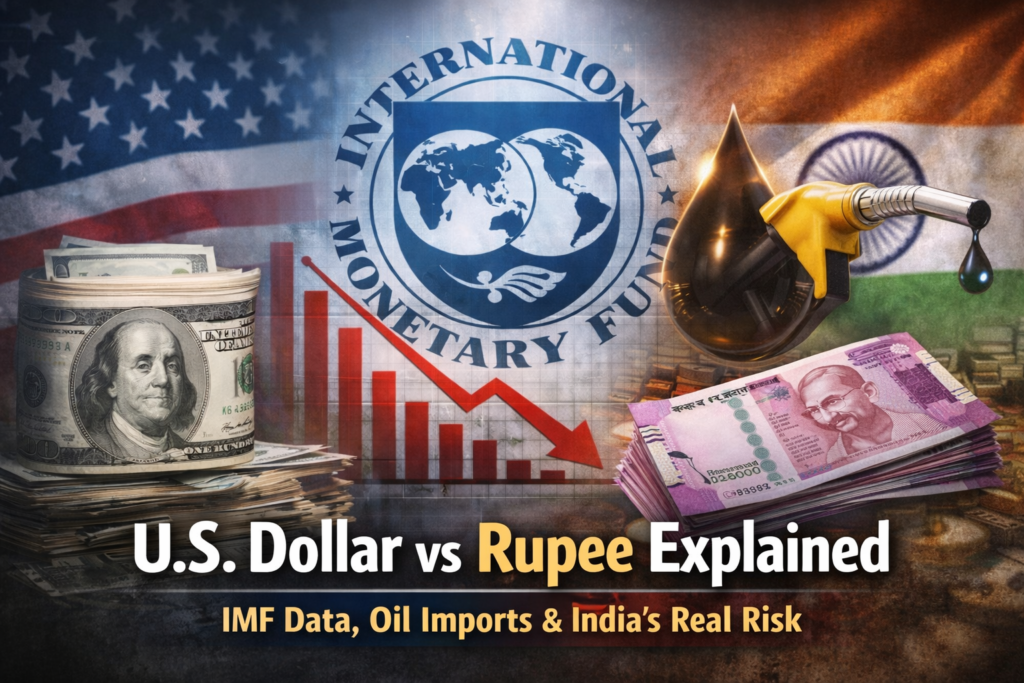
💥 The U.S. Dollar’s Dominance Is Being Challenged: What It Means for India, the Rupee, and the Global Economy
For more than seven decades, the U.S. dollar has been the most powerful currency in the world. It is used to buy oil, pay for international trade, store foreign exchange reserves, and protect economies during crises. When global uncertainty rises, money usually flows into the dollar.
But in recent years, a serious discussion has returned to global policy circles, markets, and governments:
Is the world slowly moving away from over-dependence on the U.S. dollar?
This debate matters deeply for India. A large part of India’s oil imports, trade payments, inflation trends, and foreign exchange reserves are linked to the dollar. Any structural change in the global currency system directly affects the Indian rupee, RBI policy, and household costs.
This article explains what is really changing, what is not changing, and how India fits into this shifting global monetary order — using real data, historical examples, and simple language.
1️⃣ Why the U.S. dollar became so dominant in the first place
The U.S. dollar did not become dominant by accident. Its rise began after the Second World War, when the U.S. economy was the strongest in the world. Under the Bretton Woods system, many currencies were linked to the dollar, and the dollar itself was linked to gold.
Even after the gold link ended in the 1970s, the dollar kept its power because the U.S. offered something no other country could:
a large, open, liquid, and trusted financial system.
Over time, oil started being priced in dollars, global trade contracts were written in dollars, and U.S. government bonds became the safest parking place for global savings. This created a powerful network effect — everyone used dollars because everyone else already did.
2️⃣ What “dollar dominance” actually means in simple terms
Dollar dominance means the dollar plays a central role in three areas.
First, it is the main reserve currency. Central banks keep dollars as savings to protect their economies during crises.
Second, it is the main trade and payment currency. Oil, gas, coal, metals, aircraft, and shipping are largely priced in dollars.
Third, it dominates global finance. During crises, investors rush into U.S. Treasury bonds because they trust the U.S. system to honour its debts.
As long as the dollar remains strong in these three areas, it stays dominant.
3️⃣ What real-time data tells us about the dollar today
| Currency | Share of Global Forex Reserves (%) | What This Means |
|---|---|---|
| U.S. Dollar (USD) | 56–57% | Still the world’s main reserve currency |
| Euro (EUR) | ~20% | Second most trusted reserve currency |
| Japanese Yen (JPY) | ~5% | Used mainly in Asia |
| British Pound (GBP) | ~4% | Limited global role |
| Chinese Yuan (CNY) | ~2–3% | Growing, but still small |
Despite growing debate, data shows the dollar is still very strong.
According to the International Monetary Fund, the U.S. dollar made up around 56–57% of global foreign exchange reserves in 2024–2025. In the early 2000s, this share was above 70%.
This shows a slow decline, not a collapse.
The euro stands at about 20%. Other currencies like the Japanese yen, British pound, and Chinese yuan remain in low single digits.
In global payments, data from SWIFT shows the dollar is still the most used currency. The Chinese yuan’s share has grown, but it remains below 5% of global payments.
So the reality is clear:
the dollar is losing some share, but no other currency is close to replacing it.
4️⃣ Why countries are trying to reduce over-dependence on the dollar
The push away from dollar dependence is driven by practical risks, not ideology.
One major reason is sanctions. When trade is done in dollars, payments pass through Western banks. This gives the U.S. and its allies strong control. After Russia’s foreign exchange reserves were frozen in 2022, many countries realised how vulnerable this system can be.
Another reason is cost and speed. Dollar-based cross-border payments often involve several banks, high fees, and delays.
A third reason is currency risk. When local currencies fall against the dollar, imports become expensive, leading to inflation. Many emerging economies have experienced this pain.
Finally, growing geopolitical tension makes governments want backup systems so trade does not stop during political disputes.
5️⃣ Local-currency trade: growing interest, real limitations
| Indicator | Latest Figure | Why Readers Should Care |
|---|---|---|
| India’s Oil Import Dependence | ~85–87% | India buys most oil from abroad |
| Oil Trade Currency | Mostly USD | Strong dollar = higher import bill |
| Avg Daily Oil Imports | ~4.6–4.8 million barrels/day | Direct impact on inflation |
| Major Suppliers | Russia, Iraq, Saudi Arabia | Pricing linked to dollar |
Many countries are now trying to settle trade in their own currencies.
After 2022, Russia sharply increased trade with China using non-dollar currencies. Some ASEAN countries have local-currency settlement frameworks. India has also tested rupee-based trade settlement with select partners.
However, local-currency trade has clear limits.
It works well only when:
Trade volumes are large and balanced
Currency markets are deep and stable
Businesses can hedge exchange-rate risk
Without these conditions, exporters and importers still prefer dollars because they are easier, safer, and more liquid.
This is why local-currency trade is expanding slowly, not replacing the dollar system.
6️⃣ Payment systems: why SWIFT still dominates
| Period | Dollar Share of Global Reserves | Global Context |
|---|---|---|
| 2000–02 | ~70% | US at peak economic power |
| 2010–12 | ~62% | Post-2008 crisis adjustments |
| 2020–21 | ~59% | COVID shock |
| 2024–25 | ~56–57% | Slow diversification, not collapse |
There is often confusion about SWIFT. SWIFT does not move money. It only sends secure payment messages between banks.
Some countries are developing alternative payment systems to reduce reliance on Western infrastructure. These systems aim to keep trade running even during sanctions.
However, global trade needs common standards. Too many systems increase confusion and costs. Banks and companies prefer one reliable network over many fragmented ones.
This is why SWIFT remains dominant, even as alternatives grow at the margins.
7️⃣ Central Bank Digital Currencies (CBDCs): useful, but not game-changers
Many central banks, including India’s, are testing CBDCs — digital versions of national currencies.
CBDCs can improve payment speed, reduce costs, and help with cross-border settlement in the future. India’s digital rupee experiments are part of this global trend.
But digital form alone does not make a currency global. A global currency needs trust, open capital markets, legal safety, and deep investment options.
CBDCs improve efficiency, but they do not automatically weaken the dollar.
8️⃣ Stablecoins: the biggest irony in the de-dollarisation debate
Stablecoins are digital tokens, many of which are linked to the U.S. dollar.
Here is the irony:
While countries talk about reducing dollar use, stablecoins are spreading digital dollar usage globally.
People and businesses trust dollar-linked stablecoins more than many local currencies. As a result, technology may actually strengthen dollar influence in digital form.
This has led some experts to call it “digital dollarisation.”
9️⃣ Why replacing the dollar is extremely difficult
Replacing the dollar is not just about finding another currency.
The U.S. offers:
The deepest government bond market in the world
Strong legal protections
Free movement of capital
Massive liquidity during crises
During the 2008 financial crisis, COVID-19, and the Ukraine war, global investors rushed into dollars, not away from them.
This behaviour shows that trust and market depth matter more than political statements.
🔟 What this global shift means for India
For India, the dollar remains extremely important.
India imports more than 85% of its crude oil, mostly priced in dollars. When oil prices rise or the dollar strengthens, India’s import bill increases and inflation rises.
India’s foreign exchange reserves — managed by the Reserve Bank of India — are still largely held in dollars because they offer safety and liquidity.
India wants to internationalise the rupee, but this requires:
Deeper bond markets
Wider global use of the rupee
Long-term trust from investors
India’s strategy is gradual diversification, not confrontation with the dollar system.
1️⃣1️⃣ RBI’s approach: caution over speed
| Component | Value (USD Billion) | Why It Matters |
|---|---|---|
| Total Forex Reserves | $640–650 bn | Acts as India’s economic safety buffer |
| Foreign Currency Assets (mostly USD) | ~88–90% | Shows dollar remains core for India |
| Gold Reserves | ~$55–60 bn | Hedge against global uncertainty |
| IMF SDRs & Others | Small share | Liquidity support |
The RBI understands that reserve currency transitions are slow. Sudden shifts can create instability.
That is why India:
Experiments with rupee trade cautiously
Builds digital payment infrastructure step by step
Maintains strong dollar reserves as insurance
This balanced approach protects India from shocks while preparing for future changes.
1️⃣2️⃣ What the future global currency system is likely to look like
The most realistic future is not a post-dollar world.
Instead, the world is moving toward:
A still-dominant dollar
Stronger regional currencies
Multiple payment systems
Greater use of digital settlement
The dollar may lose some share, but it will remain the main anchor of the global system.
1️⃣3️⃣ Final takeaway for Indian readers
The U.S. dollar is not collapsing.
It is sharing space.
Countries are building options to reduce risk, not to destroy the system. For India, stability, flexibility, and gradual reform matter more than bold slogans.
The key lesson is simple:
Watch data, history, and behaviour — not just headlines.
That is where real economic power lies.
To visit official website of IMF click here
❓ Frequently Asked Questions (FAQ)
1️⃣ Is the U.S. dollar really losing its global dominance?
No, the U.S. dollar is not losing dominance suddenly. It is still the world’s most used reserve, trade, and payment currency. However, its share is slowly declining as countries diversify their reserves and explore alternatives. This is a gradual shift, not a collapse.
2️⃣ What does IMF data say about the dollar’s position today?
According to IMF data, the U.S. dollar still makes up around 56–57% of global foreign exchange reserves. This is lower than earlier decades but still far higher than any other currency like the euro or yuan.
3️⃣ Why are countries trying to reduce dependence on the dollar?
Countries want to reduce risk. Heavy reliance on the dollar exposes them to sanctions, payment blockages, exchange-rate volatility, and geopolitical pressure. Reducing dependence gives them more flexibility, not independence from the dollar.
4️⃣ Is de-dollarisation actually happening?
Partial de-dollarisation is happening in specific areas, such as local-currency trade between certain countries. But globally, the dollar still dominates trade, finance, and reserves. What we are seeing is diversification, not replacement.
5️⃣ How does a strong U.S. dollar affect India?
A strong dollar makes oil imports more expensive, increases inflation, widens the trade deficit, and puts pressure on the rupee. Since India imports over 85% of its crude oil, dollar movements directly affect household fuel and food prices.
6️⃣ Why does the Reserve Bank of India still hold most reserves in dollars?
The RBI holds most reserves in dollars because U.S. assets are safe, liquid, and easily usable during crises. Even countries discussing diversification continue to rely on the dollar for stability and emergency support.
7️⃣ Can the Indian rupee become a global currency?
The rupee can become more internationally used, but becoming a global reserve currency takes decades. It requires deep bond markets, full capital convertibility, strong investor trust, and global demand for rupee assets.
8️⃣ Does trading oil in non-dollar currencies reduce India’s risk?
It can help in limited cases, but most global oil contracts are still priced in dollars. Local-currency oil trade works only when both countries agree and currency risks are manageable. It is a supplement, not a full solution.
9️⃣ Do stablecoins weaken the U.S. dollar?
Surprisingly, many stablecoins actually strengthen dollar usage because they are pegged to the U.S. dollar. This spreads dollar influence digitally, even outside traditional banking systems.
🔟 Will digital currencies (CBDCs) replace the dollar?
No. CBDCs can improve payment speed and efficiency, but they do not replace the need for trust, deep markets, and global acceptance. Technology alone cannot replace the dollar’s institutional strength.
1️⃣1️⃣ What is the biggest risk if the dollar’s role declines too fast?
A rapid decline would increase global financial instability, raise transaction costs, and disrupt trade. That is why most countries prefer slow, controlled diversification, not sudden change.
1️⃣2️⃣ What should Indian readers watch going forward?
Key indicators include:
IMF reserve data
RBI forex reserve trends
Oil prices and import bills
Rupee-dollar exchange rate
Growth of non-dollar trade deals
These signals show real change — not headlines.
To visit official website of RBI click here
🔍 People Also Ask (PAA)
🔹 Is the U.S. dollar going to lose its global reserve status?
No. The U.S. dollar is still the world’s main reserve currency. Its share has declined slowly over many years, but no other currency currently has the trust, liquidity, and market depth needed to replace it.
🔹 Why is the IMF data important in the dollar dominance debate?
IMF data shows how central banks actually behave, not what governments say. It tracks real reserve holdings. This data confirms that the dollar remains dominant despite gradual diversification.
🔹 What happens to India when the dollar becomes stronger?
A stronger dollar makes oil imports costlier, increases inflation, weakens the rupee, and raises the trade deficit. This directly affects fuel prices, transport costs, and daily expenses in India.
🔹 Can India reduce its dependence on the U.S. dollar?
India can reduce some dependence through local-currency trade and diversification, but it cannot fully avoid the dollar because oil, global trade, and financial markets still rely heavily on it.
🔹 Is the Chinese yuan replacing the U.S. dollar?
No. The yuan’s global usage has increased, but it still accounts for only a small share of reserves and payments. Capital controls and limited convertibility restrict its global role.
🔹 Why do countries still trust the U.S. dollar during crises?
Because the U.S. offers deep financial markets, legal protection, free capital movement, and crisis-time liquidity. During global shocks, investors prefer safety over politics.
🔹 Does oil trade still depend on the U.S. dollar?
Yes. Most global oil trade is still priced and settled in U.S. dollars. Some countries experiment with non-dollar payments, but these are limited and not yet mainstream.
🔹 What role does RBI play in managing dollar risk?
The Reserve Bank of India uses foreign exchange reserves to manage volatility, protect the rupee, and ensure stability during global shocks. This is why RBI holds large dollar reserves.
🔹 Are stablecoins a threat to the dollar?
In many cases, stablecoins actually support the dollar because they are pegged to it. This spreads dollar usage into digital finance rather than reducing it.
🔹 Will digital rupee reduce India’s reliance on the dollar?
The digital rupee can improve payment efficiency, but it does not remove the need for dollars in trade, oil imports, or reserves. Structural changes take decades.
🔹 What is the biggest myth about de-dollarisation?
The biggest myth is that the dollar will suddenly collapse. In reality, global currency systems change slowly over decades, not years.
🔹 What should readers track instead of headlines?
Readers should track:
IMF reserve data
RBI forex reserve trends
Oil prices and import bills
Dollar–rupee exchange rate
These show real change, not speculation.






Alright gamers, who’s got the inside scoop on dudoanxsmbkubet? Seen this one floating around. Curious to hear your experiences. Here’s the link dudoanxsmbkubet.