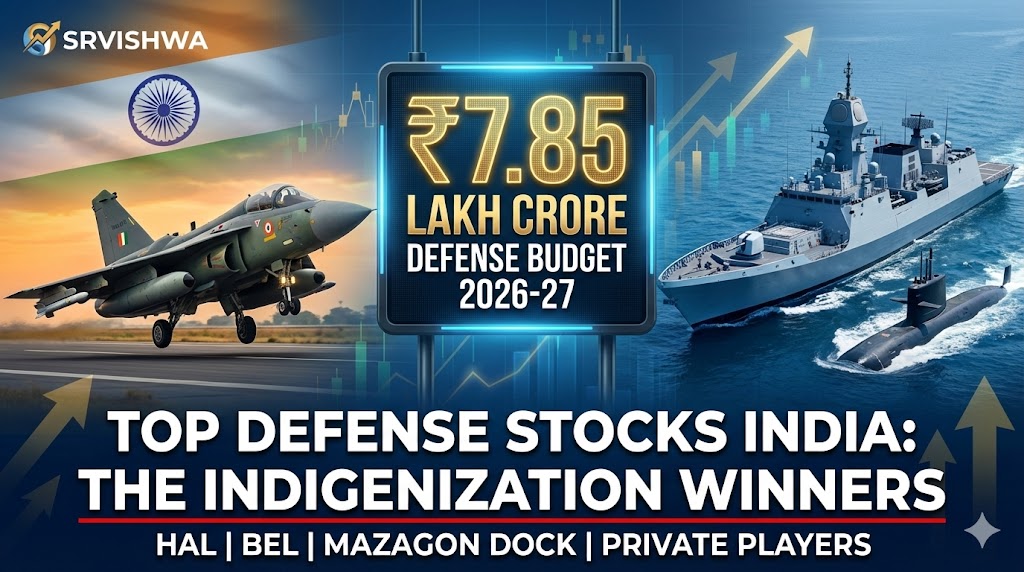
1. Introduction: The ₹7.85 Lakh Crore Message to the Markets
The 2026–27 Union Budget has sent one clear message to the markets: defense is no longer just about national security. It is now one of India’s biggest manufacturing growth engines. The government has allocated a record ₹7.85 lakh crore to the Ministry of Defence. This represents a 15.19% increase over the previous year and accounts for nearly 14.7% of the total Union Budget. That is not a routine increment. That is a structural commitment.
To understand how big this is, consider that India’s total defense allocation was around ₹5.25 lakh crore just five years ago. The steady rise since then shows that this is not a one-time reaction to global tensions. It is a long-term shift in policy. India is modernizing its forces while simultaneously building its own manufacturing capacity.
Recent geopolitical tensions and lessons from conflicts around the world have forced governments to rethink supply chain dependence. India has experienced this reality firsthand in the past when spare parts and weapons systems were delayed due to foreign dependencies. The push for self-reliance under the “Aatmanirbhar Bharat” initiative has now fully merged with defense strategy.
For investors, this budget is not just about missiles and fighter jets. It is about multi-year government defense contracts, long-term order books, and stable cash flows for domestic companies. In simple terms, the government has created visibility for the next decade.
Ministry of Defence official budget allocation
2. The Fundamental Shift: The 75% Domestic Mandate
The headline number of ₹7.85 lakh crore is impressive. But the real story lies in where the money will go. Approximately ₹1.39 lakh crore of the capital acquisition budget has been earmarked specifically for procurement from domestic defense industries. This means around 75% of the capital procurement budget is locked for Indian companies.
This is a game-changer.
In earlier decades, large portions of India’s defense capital spending went to foreign suppliers. Fighter jets from Europe, submarines from Russia, and artillery from Israel meant that much of the capital outflow left the country. Today, the policy is different. Even when India partners with foreign players, the emphasis is on technology transfer and local manufacturing.
This domestic procurement mandate creates a multiplier effect. When a defense company receives a large contract, it does not work alone. It depends on hundreds of suppliers — steel manufacturers, electronics firms, component makers, software providers, and logistics companies. Every ₹1 spent on defense manufacturing can generate multiple rupees in economic activity.
According to government estimates, defense exports have grown from around ₹1,500 crore in 2016 to over ₹21,000 crore in FY2025. The target is to reach ₹35,000 crore in exports by 2026–27. This shows that indigenization is not just replacing imports. It is building an export industry.
For investors searching for top defense stocks in India, this policy creates long-term predictability. And in investing, predictability is gold.
Union Budget 2026–27 documents
3. The PSU Heavyweights: Who is Securing the Bag?
Hindustan Aeronautics Limited (HAL)
Hindustan Aeronautics Limited remains the backbone of India’s aerospace manufacturing. HAL is currently executing large orders for the Tejas Mk-1A fighter jets, with over 83 aircraft already contracted and additional orders expected. The company also plays a central role in the development of the Tejas Mk-II and the Advanced Medium Combat Aircraft (AMCA).
HAL’s order book has crossed ₹80,000 crore, giving it multi-year revenue visibility. It is also manufacturing helicopters like the Light Combat Helicopter (LCH) and the Light Utility Helicopter (LUH). With India aiming to reduce imports of fighter aircraft, HAL’s production lines are likely to stay busy for years.
Financially, HAL has shown stable revenue growth and healthy margins. It has also maintained consistent dividend payouts, making it attractive to both growth and income-focused investors.
HAL official order book details
Bharat Electronics Limited (BEL)
Bharat Electronics Limited is India’s leading defense electronics company. Modern warfare is no longer only about tanks and guns. It is about radar systems, electronic warfare, communication networks, and battlefield management systems. BEL sits at the center of this transformation.
BEL’s order book has crossed ₹60,000 crore in recent updates, driven by contracts for radar systems, missile control systems, and naval electronics. What makes BEL attractive is its diversification across Army, Navy, and Air Force requirements.
The company also has a strong balance sheet and a long dividend history of more than 20 consecutive years. In a volatile stock market, companies with strong government defense contracts and steady cash flow often offer relative stability.
Mazagon Dock Shipbuilders
Mazagon Dock Shipbuilders holds a unique position. It is one of the few Indian shipyards capable of building complex submarines. The upcoming P75(I) submarine project alone is estimated to be worth over ₹1 trillion over the next decade.
India’s Navy modernization plan includes aircraft carriers, destroyers, frigates, and submarines. With rising maritime tensions in the Indo-Pacific region, naval capacity is critical.
Mazagon Dock’s revenue visibility extends for years because naval projects typically take long development cycles. This creates long-term earnings stability, although execution risks must always be monitored.
4. The Private Sector & “Deep-Tech” Challengers
The defense indigenization story is not limited to public sector units. Private companies are increasingly becoming serious players.
Solar Industries, known for explosives and ammunition manufacturing, has benefited from increased domestic production of defense-grade explosives. With ammunition demand rising globally due to ongoing conflicts in various regions, this segment has seen strong export opportunities.
Data Patterns is another example. It specializes in defense electronics and integrated systems. As India moves toward advanced systems such as drones, surveillance equipment, and communication technology, niche electronics firms are gaining importance.
The government has also allocated ₹17,250 crore toward defense research and development. This funding supports innovation in unmanned systems, artificial intelligence, cyber defense, and space technology.
In modern defense, software matters as much as hardware. Companies working in deep-tech areas like drones, missile guidance systems, and space surveillance could see strong growth in the coming decade.
For investors, private defense companies offer higher growth potential but also higher volatility compared to PSUs. The key is to evaluate order book visibility, debt levels, and execution capacity.
5. The Export Story: From Importer to Supplier
India was once one of the largest importers of defense equipment in the world. That narrative is slowly changing.
Defense exports crossed ₹21,000 crore recently, with exports going to over 85 countries. Items include patrol boats, radar systems, artillery, and aerospace components.
The global defense market is expanding. According to SIPRI, global military spending crossed $2.4 trillion in recent estimates. Even a small share of this global pie can significantly benefit Indian companies.
The push toward exports also improves profitability. Export contracts often carry better margins compared to domestic contracts.
For long-term investors, export diversification reduces dependence on a single buyer — in this case, the Indian government.
6. Risks Investors Should Not Ignore
While the defense sector looks strong, investors should remain realistic.
First, defense contracts often face delays. Large projects can be delayed due to regulatory approvals, technical challenges, or budget revisions.
Second, valuation risk is real. Many defense stocks have already seen strong rallies over the past two years. If earnings growth does not match expectations, corrections can occur.
Third, geopolitical shifts can alter procurement priorities. Although India’s defense budget trend is upward, future governments may rebalance spending.
Therefore, while the structural story is strong, disciplined investing remains important.
7. Strategy for the 2026 Investor
For investors in 2026, defense is not a short-term theme. It is a structural trend aligned with government policy, geopolitical shifts, and manufacturing growth.
One strategy is to balance PSU heavyweights like HAL and BEL with selective private sector exposure. This reduces risk while maintaining growth potential.
Another approach is through infrastructure investment funds or thematic mutual funds focused on defense and manufacturing.
Investors should also watch quarterly order inflows carefully. Order book growth is often the earliest indicator of future revenue expansion.
India’s defense modernization plan extends beyond 2032. Aircraft programs, naval expansion, and indigenous engine development are multi-decade projects.
In simple terms, this is not a one-year story. It is a long runway.
global military spending data
Conclusion: A Structural Growth Phase, Not a Bubble
India’s ₹7.85 lakh crore defense budget is not just about national security. It is about building a manufacturing base, reducing import dependence, increasing exports, and creating skilled jobs.
The 75% domestic procurement mandate ensures that Indian companies will capture the bulk of new contracts. PSU leaders like HAL, BEL, and Mazagon Dock offer stability and order visibility. Private players provide innovation and faster growth.
Global defense spending is rising. India is positioning itself not only as a buyer but as a supplier.
For investors, the key question is not whether defense will grow. It is how to position portfolios intelligently to benefit from this structural shift while managing valuation risks.
As we move deeper into 2026, defense indigenization stands out as one of India’s most powerful economic stories — a rare intersection of geopolitics, manufacturing, exports, and capital markets.
Now the real question for you as an investor is simple:
Are you watching this transformation from the sidelines…
or are you preparing your portfolio for India’s defense supercycle?