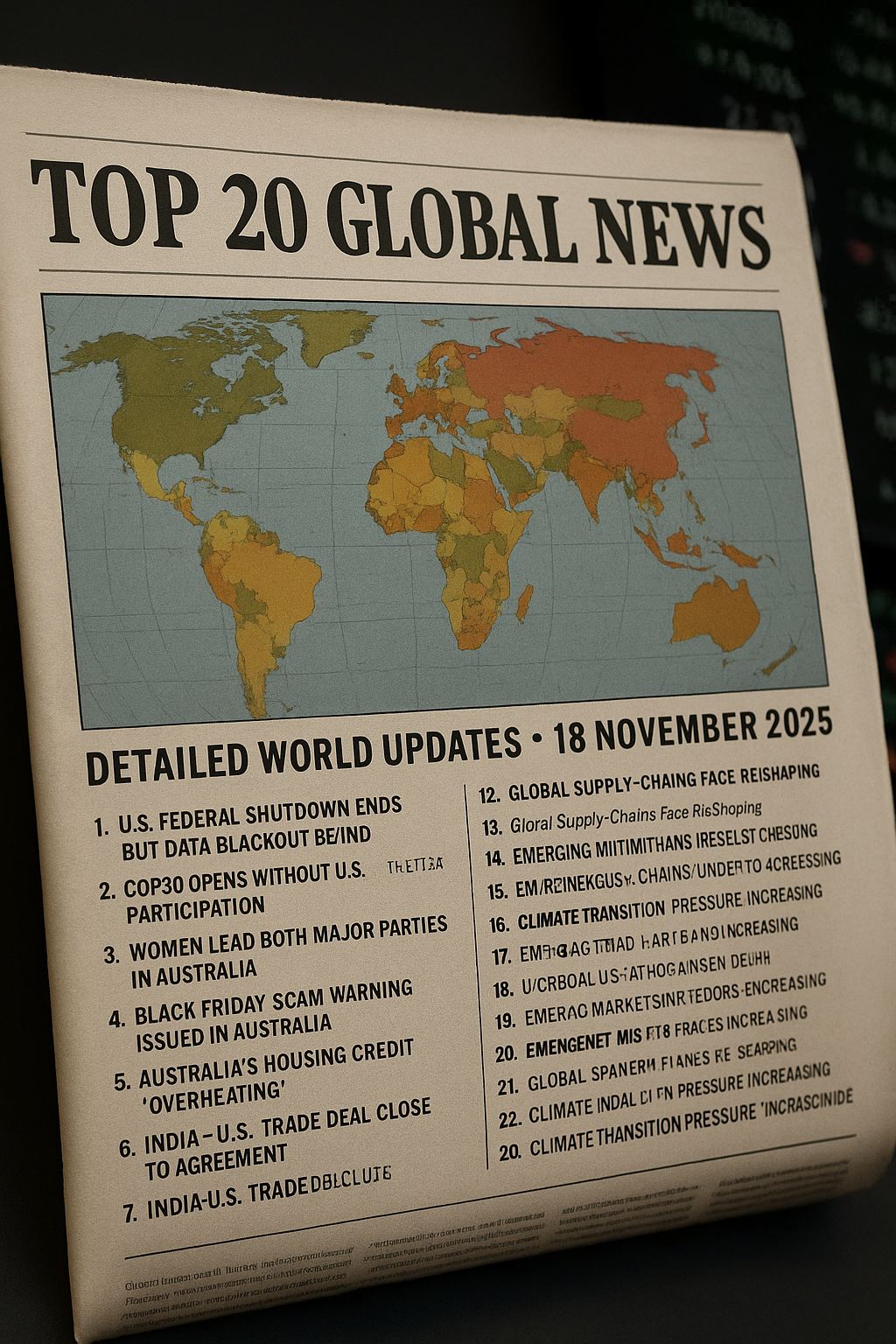
Top 20 Global News in Detail for 18 November 2025 – Full Breakdown & Analysis
The global landscape on 18 November 2025 is filled with major political shifts, economic uncertainties, climate negotiations, and social transformations. From the United States struggling with a data blackout to Australia making history in politics, to rising geopolitical re-alignments across Asia and Europe — the world is witnessing a remarkable moment of transition.
1. U.S. Federal Shutdown Ends but Leaves Data Blackout Behind
The United States has finally ended its longest federal shutdown in history. However, critical economic data — including inflation, retail sales, and labor updates — remains disrupted.
Why this matters globally:
World markets rely on U.S. economic data for forecasting.
Central banks across Europe, Asia, and Africa react to U.S. numbers when shaping their interest-rate policies.
Likely global impact:More volatility in emerging markets.
Risk-off sentiment among international investors.
2. COP30 Opens Without U.S. Participation
The international climate conference COP30 begins in Belém, Brazil — but the U.S. is noticeably absent, sparking concerns among climate activists and developing nations.
Why this matters:
The U.S. is one of the world’s largest polluters.
Its absence weakens global climate negotiation power.
Possible outcomes:Slower progress on climate finance.
Increased pressure on EU, China, India to lead.
3. Australia Makes History: Women Lead Both Major Parties
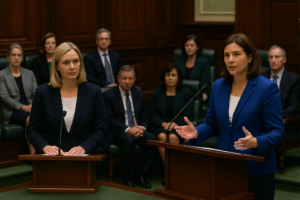
The state of Victoria witnesses a historic moment: for the first time, both major political parties are led by women.
Why this matters:
Signals positive change in political representation.
Could influence policy direction on health, education, and welfare.
4. Black Friday Scam Warning Issued in Australia
The Australian competition regulator ACCC issues a warning to consumers about a surge in scams ahead of the Black Friday shopping season.
Global significance:
Scam networks usually operate across borders.
Online retailers and global brands may face reputational challenges.
5. Australia’s Housing Credit “Overheating”
A senior executive at Commonwealth Bank warns that Australia’s housing credit is rising too fast due to immigration pressure and low supply.
Global impact:
Housing bubbles in one developed country often send shockwaves across global banking systems.
Could influence interest-rate decisions in Australia and New Zealand.
6. India–U.S. Trade Deal Close to Agreement
Reports suggest Phase-1 of the India–U.S. trade deal is close to completion.
Why this matters globally:
A major shift in global supply-chain routes.
Could reduce China’s dominance in several export categories.
7. Ex-Bangladesh Prime Minister Sentenced to Death
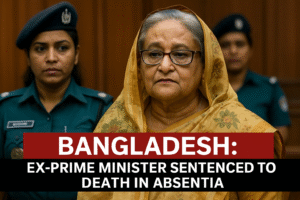
A special tribunal in Dhaka sentences former prime minister Sheikh Hasina to death in absentia.
Why this matters:
Major political instability in South Asia.
Could disrupt trade routes, especially garments and textiles.
Raises serious concerns regarding human rights.
8. Russia Requests High-Level Meeting with the U.S.
Russia expresses interest in a summit with U.S. President Donald Trump.
Why this matters:
Could thaw tensions after years of sanctions.
May reshape global energy and security policies.
9. U.S. Retailers See Pressure on Low-Income Consumers
Major American retail companies report declining sales among low-income groups.
Why it’s important:
The U.S. consumer drives global demand for goods like electronics, apparel, and commodities.
Weakness suggests a global economic slowdown may be looming.
10. Global Inflation Trends Under Scrutiny
With missing U.S. data, investors turn to inflation numbers from Japan, Germany, China, and the EU.
Why it matters:
Inflation determines interest rates.
Affects global currencies, stock markets, and bond yields.
11. Global Supply-Chains Face Re-Shaping
The combination of geopolitical tensions, climate commitments, and trade agreements is reshaping global supply chains.
Examples:
Companies shifting from China to India, Vietnam, Mexico.
EU focusing on green and digital trade regulations.
12. Emerging Markets Face Rising Risk Premiums
With U.S. uncertainty and global inflation pressures, investors view emerging markets as riskier.
Impact:
Higher borrowing costs for countries like Turkey, Brazil, and South Africa.
Possible withdrawal of foreign investment.
13. Energy Markets Remain Highly Volatile
Oil and gas markets react to tensions involving Russia, U.S. climate absence, and Middle-East uncertainties.
Why it matters:
Oil influences global inflation.
Energy prices drive stock markets and exchange rates.
14. Global Governance Challenges Intensify
From toy safety failures in Australia to political instability in Bangladesh, governance issues remain front-and-center.
Global significance:
Governance affects FDI inflows, investor confidence, and country ratings.
15. Developed Nations Face Migration Pressure
Australia highlights infrastructure strain due to rapid immigration.
Why it matters globally:
Europe and North America are facing similar challenges.
Migration affects labor markets, wages, inflation, and housing.
16. Youth Unrest and Legal Reforms Gain Global Attention

Protests in Bangladesh and youth-related legal reforms in Australia reflect a growing global trend of younger populations demanding justice and accountability.
Importance:
Youth movements often signal deeper socio-economic issues.
Can influence elections and policymaking.
17. Global Tech Sector Faces Dual Challenges
Even without a major tech headline today, implications from economic data and governance concerns are visible:
Talent shortages due to migration rules.
Investment slowdown due to inflation fears.
18. Financial Market Infrastructure Shows Signs of Strain
The U.S. data blackout, inflation uncertainties, and volatile bonds suggest markets are becoming more fragile.
Why this matters:
Weak financial infrastructure can trigger global sell-offs.
19. Geopolitical Realignments Are Accelerating
The world is witnessing a shift in power centers:
Russia seeking U.S. talks.
India gaining prominence in trade.
Europe focusing on green transition.
20. Climate Transition Pressure Increasing Worldwide
COP30’s opening amid U.S. absence highlights the urgent need for climate commitment.
Why it matters:
Climate change impacts supply chains, agriculture, energy prices, and global health outcomes.
Countries that fail to transition may face economic isolation.
Conclusion: The Global Mood on 18 November 2025
The top global news stories today paint a picture of a world in transformation:
Economically uncertain, due to U.S. data gaps and slowing consumer demand.
Politically shifting, with new alliances emerging.
Socially restless, driven by youth protests and migration stress.
Environmentally divided, with big emitters missing from climate negotiations.
Technologically vulnerable, as talent shortages and governance gaps challenge innovation.
Yet beneath the turbulence lies opportunity: nations that adapt quickly — through green investment, strong governance, tech leadership, and diplomatic agility — stand to benefit most.