For anyone who has followed India’s consumption story over the last three decades, one lesson stands out clearly: when uncertainty rises, Indian consumers do not stop spending—they change how they spend. Titan Company’s Q3 FY26 results, released on February 10, 2026, are a textbook example of this shift. At a time when gold prices were hovering near historic highs of ₹85,000 per 10 grams, many expected jewellery demand to cool. Titan proved the opposite. The company did not just defend growth; it expanded margins, strengthened its brand moat, and reinforced why trust-driven consumption still commands a premium in India.
What makes this quarter important is not just the headline numbers. It is the story behind those numbers—how Titan converted inflation into opportunity, how it used design and brand equity to protect margins, and how India’s wedding economy continues to act as a shock absorber against macro volatility.
Executive Summary: When Inflation Meets Trust, Trust Wins
Titan reported a 16% year-on-year growth in consolidated revenue, reaching ₹16,482 crore, despite operating in one of the most challenging input-cost environments in recent memory. Gold prices remained elevated throughout the quarter, raising fears of demand destruction. Instead, Titan saw strong footfalls, robust ticket sizes, and—most importantly—stable profitability.
The biggest surprise for analysts was margin resilience. Jewellery EBIT margins came in at 12.2%, higher than market expectations of around 11.5%. This margin strength was not accidental. It was driven by a deliberate shift toward higher-value studded jewellery, premium wedding collections, and better inventory discipline. The results reaffirm a crucial insight: Titan is not a commodity seller; it is a brand-led retailer that sells assurance, design, and social legitimacy.
Gold Price Reference (India – MCX / RBI context)
Financial Performance Dashboard: Quality Growth, Not Just Growth
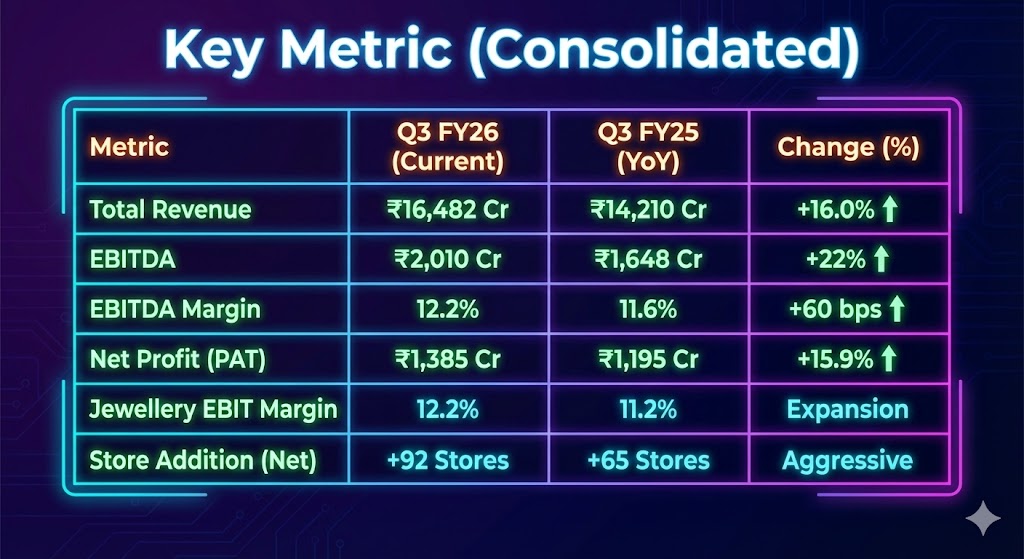
Titan’s Q3 FY26 numbers highlight a rare combination—strong revenue growth paired with even stronger operating leverage. Consolidated revenue rose to ₹16,482 crore, up from ₹14,210 crore in Q3 FY25. EBITDA increased at a faster pace of 22%, reaching ₹2,010 crore, pushing overall EBITDA margins to 12.2%, up 60 basis points year-on-year.
Net profit grew 15.9% to ₹1,385 crore, broadly in line with revenue growth, indicating that cost pressures were well managed. Titan also added 92 net new stores during the quarter, underscoring management’s confidence in demand visibility. Unlike many retailers who slow expansion during high inflation, Titan used the quarter to deepen physical reach, especially in wedding-heavy geographies.
Titan Company – Official Results Source
Jewellery Business: How Studded Jewellery Saved the Quarter
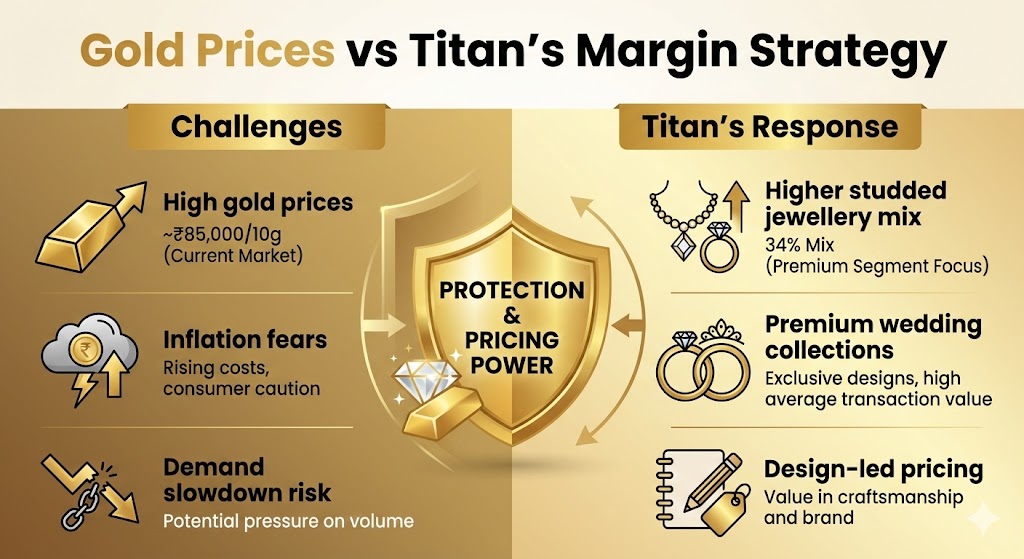
Jewellery remains Titan’s crown jewel, contributing the majority of revenue and profits. In Q3 FY26, jewellery revenue grew 18% year-on-year, outperforming the overall company growth. The most important metric, however, was the studded jewellery ratio, which rose to 34%, up from 31% last year.
This shift matters because studded jewellery—especially diamond and solitaires—carries significantly higher margins than plain gold. When gold prices rise, customers often hesitate to buy large quantities of plain gold. Titan anticipated this behavior and leaned aggressively into wedding collections featuring diamonds, polki, and design-heavy pieces where pricing is driven by craftsmanship rather than weight.
The strategy worked. Higher gold prices increased bill values, but Titan ensured that margin mix improved at the same time. This is classic pricing power in action—not raising prices blindly, but changing the product mix so that profitability improves even when volumes fluctuate.
Wedding Season Economics: Why Titan Is Insulated from Slowdowns
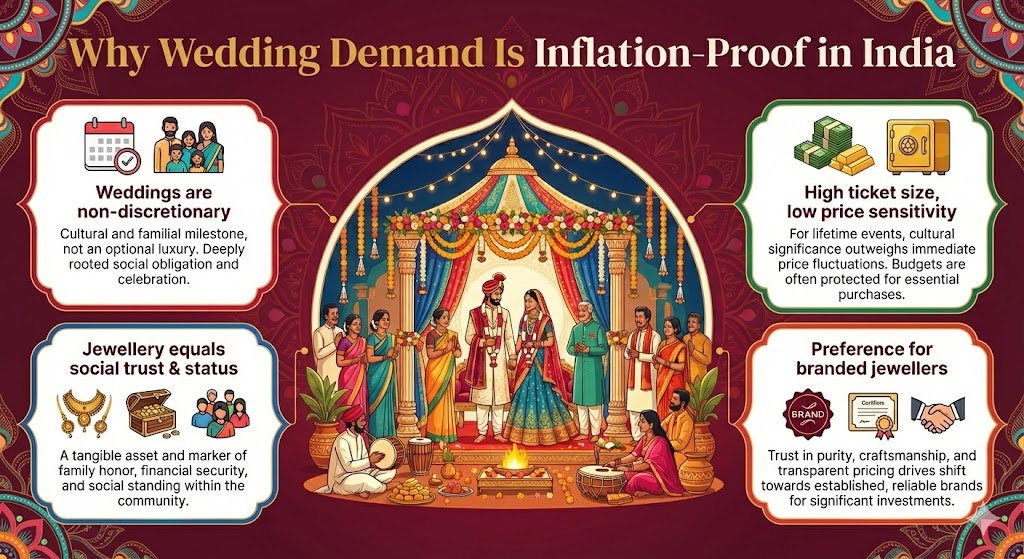
Indian weddings are not discretionary events; they are social milestones. Even when households cut back on everyday spending, wedding-related purchases remain largely protected. Q3 FY26 benefited from a strong wedding calendar, and Titan positioned itself as the default destination for trust-certified jewellery.
What is often overlooked is that wedding jewellery buyers are less price-sensitive than daily consumers. They are buying for social display, long-term value, and emotional reasons. Titan’s branding around purity, buyback assurance, and design exclusivity allows it to convert this emotional spending into predictable cash flows. This quarter once again demonstrated that Titan operates in a different demand universe compared to unorganized jewellers or discount-driven retailers.
World Gold Council – Jewellery Demand Trends
International Jewellery: Quietly Scaling Beyond India
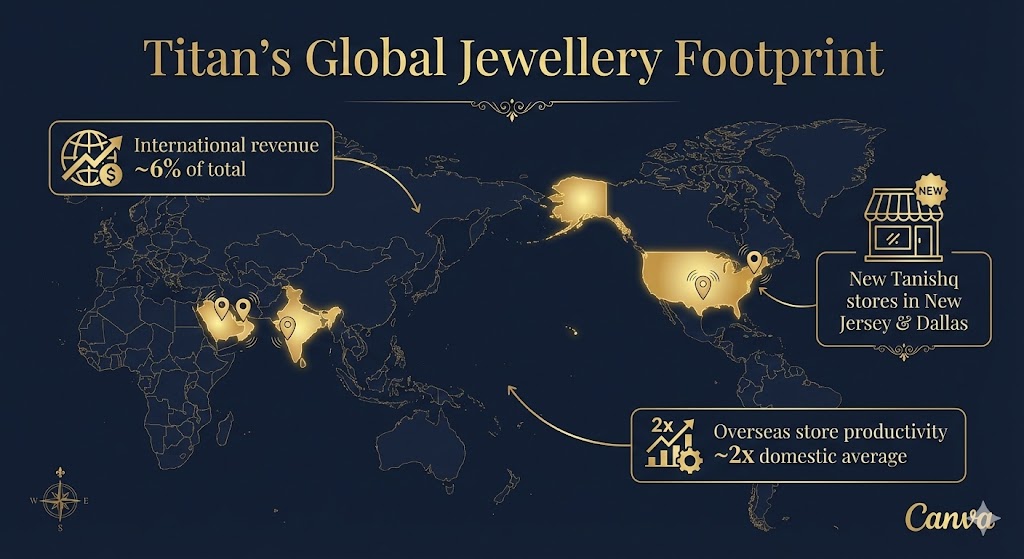
Titan’s international jewellery business, particularly through Tanishq, is no longer a side experiment. International operations now contribute roughly 6% of consolidated revenue, with strong performance in the Gulf Cooperation Council (GCC) and the United States. New stores in New Jersey and Dallas are reportedly generating revenue at nearly twice the average domestic store level, reflecting strong diaspora demand.
The India–US trade environment also turned favorable during the quarter. Under the February 2026 trade framework, duties on Indian handcrafted jewellery exports were reduced, improving pricing competitiveness. Titan is leveraging this shift to expand legally compliant, branded jewellery sales to overseas Indian consumers who previously relied on informal channels.
Watches and Wearables: Fewer Units, Higher Value
Titan’s Watches & Wearables segment grew 11% year-on-year, but the real story lies beneath the surface. Volumes were largely flat, indicating that Titan sold roughly the same number of watches as last year. However, revenue growth came from premiumization.
Customers are moving away from entry-level ₹2,000–₹3,000 watches and increasingly choosing ₹15,000+ models, including Titan Edge, Nebula, and international brands sold through Helios. Helios alone reported growth of around 25%, reflecting strong appetite for aspirational and luxury timepieces.
This mirrors a broader consumption trend in India: the middle class is splitting into two groups—one that trades down and one that trades up. Titan is firmly positioned to capture the latter.
CaratLane: Digital Jewellery Comes of Age
CaratLane, Titan’s digital-first jewellery platform, delivered one of the strongest performances this quarter. Revenue surged 32% year-on-year, and EBIT margins improved to 8.5%, signaling that scale economics are finally kicking in.
CaratLane’s success lies in its ability to attract younger, urban, working professionals—especially women—who prefer lighter designs, transparent pricing, and omnichannel convenience. Unlike traditional jewellery retail, CaratLane benefits from lower inventory intensity and faster design cycles. For Titan, this business acts as both a growth engine and a demographic hedge against changing consumer preferences.
Policy Environment: Gold Duty Stability Was a Silent Boost
One understated but critical factor this quarter was policy stability. In the Union Budget 2026, the government chose to maintain gold import duty at 6%, rather than raising it. This decision removed a major overhang for the jewellery sector.
Had duties increased, Titan would have faced inventory revaluation risks and short-term margin disruption. Instead, stable policy allowed the company to plan procurement efficiently and avoid price shocks for consumers. This highlights how regulatory predictability often matters more than regulatory generosity.
India–US Trade Deal: A Long-Term Export Lever
The India–US trade reset in early 2026 also has long-term implications for Titan. Reduced duties on Indian jewellery exports improve Titan’s ability to scale branded exports, particularly to diaspora-heavy markets. Unlike small exporters, Titan can comply with stringent sourcing, compliance, and traceability norms, giving it an edge in regulated markets.
Over time, this could transform Titan from a primarily domestic consumption play into a hybrid domestic–export luxury retailer.
Risks to Watch: What Could Go Wrong
Despite the strong quarter, risks remain. Gold prices remain volatile, and a sudden spike beyond ₹90,000 per 10 grams could temporarily freeze discretionary buying. While Titan is better positioned than peers, extreme price shocks can affect footfalls.
Another structural risk is the rapid rise of lab-grown diamonds (LGDs). Younger consumers are increasingly price-conscious and environmentally aware. Titan has made early investments in this space, but execution speed will matter to prevent margin erosion in the long run.
Valuation is also a consideration. At a P/E of around 75x, Titan is not cheap. Any sustained slowdown in discretionary spending could trigger short-term corrections, even if fundamentals remain intact.
Conclusion: Why Titan Remains India’s Best Inflation Hedge
Titan’s Q3 FY26 results validate a simple but powerful idea: brands with trust can price through inflation. While many consumer companies struggle when costs rise, Titan converts volatility into opportunity by reshaping demand, premiumizing products, and leveraging emotional consumption drivers like weddings.
For long-term investors, Titan is not a value stock—it is a quality compounder. The company is on track to achieve its Vision 2027 target of ₹1 lakh crore in retail value, backed by strong execution, policy tailwinds, and deep consumer insight. In a world of uncertain macros, Titan remains one of the most reliable ways to participate in India’s evolving consumption story.