
The deployment of Artificial Intelligence in global financial markets is no longer just a technological arms race; it has escalated into a matter of national security. For quantitative funds and institutional money managers, the thesis is clear: whoever controls the underlying AI infrastructure controls the financial data flow.
While Western hyperscalers—such as Amazon Web Services (AWS), Google Cloud, and Microsoft Azure—have historically dominated the global computing landscape, a massive geopolitical shift is underway. India, which boasts the world’s fourth-largest securities market and a rapidly expanding digital economy, is aggressively moving to decouple its financial infrastructure from foreign tech giants.
This shift is creating a lucrative battleground. Driven by strict data localization laws and a massive state-sponsored AI initiative, the infrastructure powering autonomous financial agents in India is being fundamentally rewired.
Here is the geoeconomic breakdown of India’s sovereign AI push and what it means for institutional capital in 2026.
I. The ₹10,300 Crore Sovereign AI Backbone
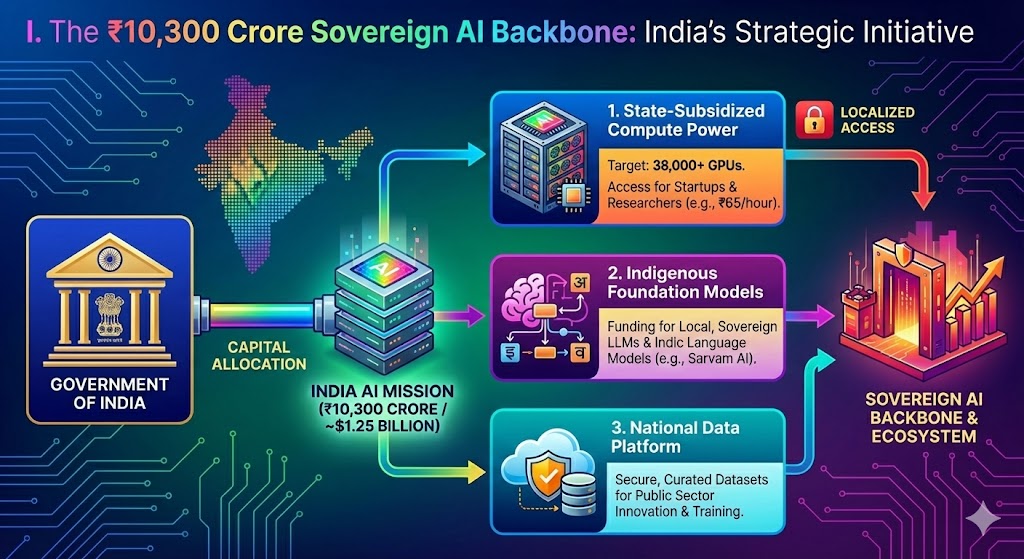
India’s strategy is built on the realization that relying entirely on foreign AI models and overseas compute power is a systemic risk to its financial sovereignty. To counter this, the Indian government has launched the “IndiaAI Mission.”
This is not a theoretical policy; it is a heavily funded, active deployment of physical and digital infrastructure designed to build a localized AI ecosystem.
Massive Capital Allocation: The Cabinet approved a budget outlay of over ₹10,300 crore (approximately $1.25 billion) spanning five years to establish India as a global AI leader.
State-Subsidized Compute Power: The government is aggressively democratizing access to high-performance computing, actively onboarding 38,000 Graphics Processing Units (GPUs) with plans to expand the pool to 58,000. To undercut Western pricing, these GPUs are being made available to startups and researchers at a heavily subsidized rate of just ₹65 per hour.
Indigenous Foundation Models: The state is actively funding the creation of Sovereign Large Language Models (LLMs) trained on local data. For example, homegrown startups like Sarvam AI have already developed advanced sovereign foundational models tailored specifically for Indic languages, which have been praised for their technological maturity.
For global fintechs and trading firms, this means that the base layer of financial AI processing in India will increasingly run on localized, government-backed infrastructure rather than generic Western cloud platforms.
budget outlay of over ₹10,300 crore or IndiaAI Mission
II. The Regulatory Moat: RBI and SEBI Data Localization
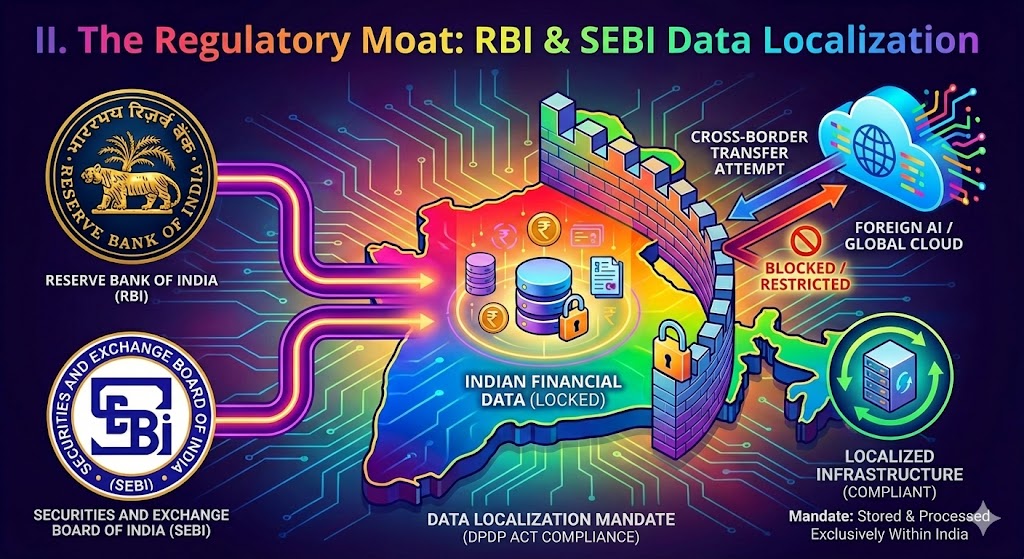
The greatest catalyst forcing global financial institutions to adopt localized AI infrastructure isn’t just government subsidies; it is strict regulatory compliance.
If an autonomous trading agent or a credit-underwriting AI processes Indian financial data, it cannot freely send that data back to a server farm in Virginia or Frankfurt.
The RBI Mandate: The Reserve Bank of India (RBI) mandated that all payment system operators must store their end-to-end transaction data exclusively within the territorial jurisdiction of India. If data processing occurs outside the country, it must be deleted from foreign systems and localized within 24 hours.
SEBI’s Iron Grip on Markets: The Securities and Exchange Board of India (SEBI) enforces similar localization. All regulated entities—including stock exchanges, brokers, mutual funds, depositories, and KYC agencies—must store and process their data within India to guarantee unrestricted regulatory access.
The DPDP Act: The Digital Personal Data Protection (DPDP) Act of 2023 further restricts cross-border data transfers, acting as a broad regulatory net over consumer financial data.
For institutional money, the implication is absolute: to run high-frequency algorithmic trading or Agentic AI in the Indian market, foreign institutions must physically co-locate their servers within Indian borders and utilize compliance-approved, localized cloud infrastructure.
store their end-to-end transaction data exclusively
III. Institutional Money Flow: The $30 Billion Data Center Boom
This collision of AI adoption and strict data localization is triggering an unprecedented boom in India’s physical data center market. Institutional capital, sovereign wealth funds, and private equity firms are pouring billions into Indian infrastructure, treating data centers not as speculative real estate, but as core national utilities.
Exponential Capacity Growth: India’s data center capacity is projected to quintuple, surging to 8GW by the year 2030.
The AI Energy Drain: Artificial Intelligence workloads demand massive power. AI servers consume five to six times more electricity than traditional servers and require advanced liquid cooling systems.
The $30 Billion Capex Requirement: To build this localized AI infrastructure and achieve the targeted 8GW capacity, the industry will require an estimated $30 billion in capital expenditures. This massive buildout is expected to generate up to $8 billion in leasing revenues by 2030.
surge to 8GW by the year 2030
The Bottom Line
The geoeconomics of AI are fracturing the global internet into regionalized, sovereign zones. For Western hyperscalers, dominating the Indian financial AI market now requires massive local capital expenditure and strict adherence to sovereign data laws. For macro analysts and institutional investors, the real alpha isn’t just in the AI software—it’s in the physical, localized infrastructure powering it.
prove absolute compliance with the RBI
Frequently Asked Questions (FAQ)
Q: What exactly is “Sovereign AI”?
A: Sovereign AI refers to artificial intelligence infrastructure, foundation models, and datasets that are developed, hosted, and controlled within a specific nation-state rather than by foreign corporate entities. It ensures that a country’s critical intelligence, financial data, and citizen records remain strictly under local regulatory jurisdiction and are not susceptible to foreign sanctions or corporate policy changes.
Q: Why is India investing ₹10,300 crore into the IndiaAI Mission?
A: India is investing this massive capital to build a self-reliant digital economy and avoid becoming a “digital colony” dependent on Western hyperscalers. The ₹10,300 crore (approx. $1.25 billion) budget is actively being used to subsidize tens of thousands of GPUs for local startups, fund the development of homegrown foundational models (like Indic-language LLMs), and build a robust, localized tech ecosystem.
Q: How do the RBI and SEBI data localization mandates affect foreign quantitative funds?
A: Both the Reserve Bank of India (RBI) and the Securities and Exchange Board of India (SEBI) mandate that critical financial and transaction data must be stored and processed exclusively within India’s borders. For foreign quantitative funds, this means their autonomous AI trading agents cannot route Indian market data through servers in the US or Europe. They are forced to utilize locally compliant, physically co-located data centers.
Q: Can Western hyperscalers like AWS, Google Cloud, and Azure still operate AI in India?
A: Yes, but the geoeconomic rules of engagement have changed. To serve Indian financial institutions and government entities, Western hyperscalers must invest heavily in building localized, physically isolated availability zones. They must prove absolute compliance with the RBI, SEBI, and the Digital Personal Data Protection (DPDP) Act, ensuring no sensitive financial data leaves the country.
Q: Why are data center investments in India projected to hit $30 billion by 2030?
A: The $30 billion capital expenditure projection is driven by the collision of two massive trends: the strict enforcement of data localization laws and the extreme hardware requirements of AI. Artificial intelligence workloads consume up to six times more electricity than traditional cloud hosting and require advanced cooling infrastructure. To host the nation’s sovereign AI and financial data locally, India must aggressively expand its data center capacity to an estimated 8GW by 2030.
People Also Ask (PAA)
What is sovereign AI in India?
India’s sovereign AI strategy, funded by the ₹10,300 crore IndiaAI Mission, focuses on building localized computing infrastructure and homegrown foundation models. This ensures critical national data and financial intelligence remain exclusively within Indian borders, drastically reducing the country’s reliance on Western tech giants.
Why does the RBI mandate data localization?
The Reserve Bank of India (RBI) enforces strict data localization to protect national financial sovereignty and guarantee immediate regulatory access. By requiring all payment and transaction data to be processed and stored solely in India, the RBI shields institutional and consumer data from foreign jurisdictional disputes.
How does data localization affect algorithmic trading?
Data localization laws force foreign quantitative funds to physically house their AI trading infrastructure within Indian data centers. Because SEBI heavily restricts exporting raw market data overseas, autonomous trading agents must run on localized, compliance-approved servers to execute high-frequency trades on Indian exchanges.
Who is building AI infrastructure in India?
A powerful mix of government policy and institutional capital is rapidly expanding India’s AI infrastructure. While the state subsidizes native GPU clusters, private equity and sovereign wealth funds are simultaneously pouring billions into the physical data center market, projecting an 8GW localized capacity by 2030.
How are Western hyperscalers adapting to Indian data laws?
Hyperscalers like AWS, Google Cloud, and Azure are adapting by investing billions to build physically isolated “availability zones” inside India. To secure lucrative enterprise fintech contracts, they must structurally guarantee that their cloud architecture complies completely with the DPDP Act and RBI mandates, ensuring zero cross-border data leakage.