1. Executive Summary: Why Chabahar Is Suddenly Back in Google Searches
If you track geopolitics through search data, one thing is clear. In early February 2026, Google searches for “Chabahar port India US sanctions” spiked sharply. That spike did not come from academic interest. It came from anxiety—across policy circles, shipping firms, diplomats, and investors tracking India’s external trade routes.
On February 6, 2026, India’s Ministry of External Affairs confirmed that New Delhi had completed the transfer of $120 million to Iran for the development of the Shahid Beheshti Terminal at Chabahar Port. The timing is critical. The special US sanctions waiver that allows India to operate the port expires on April 26, 2026.
This is not just a payment. It is a front-loaded geopolitical bet.
By clearing its full financial commitment before the waiver expires, India is trying to protect the physical infrastructure of Chabahar from future banking restrictions and secondary sanctions. In simple terms, New Delhi has paid in advance because it may not be allowed to pay later.
At stake is not a port alone, but India’s strategic autonomy, its access to Central Asia, and its ability to balance a deepening partnership with Washington without surrendering regional leverage to Beijing.
India’s Ministry of External Affairs (MEA) – Official Confirmation
2. The Financial and Operational Scorecard: Sunk Cost vs Strategic Asset
From a fundamental analyst’s lens, Chabahar must be evaluated the same way we evaluate any large project: what has already been spent, what value it protects, and what future risks remain.
As of February 2026, India’s direct investment into Chabahar stands at $120 million, now fully paid. In addition, India has extended a $250 million line of credit for rail connectivity and the surrounding Special Economic Zone. This includes the rail link from Chabahar to Zahedan, which connects onward to the International North–South Transport Corridor.
What is striking is what is missing from India’s Union Budget 2026–27: there is zero fresh allocation for Chabahar. This is not neglect. It is strategy.
By avoiding new budgetary exposure, India is signaling to US regulators that Chabahar is moving toward commercial self-sufficiency, not ongoing state-sponsored expansion. This distinction matters enormously under US sanctions law, where fresh state funding can trigger penalties.
The waiver itself remains conditional. The US Treasury has made it clear that post-April exemptions will depend on broader compliance, including India’s posture on Iran-linked trade flows and energy transactions.
India Ports Global Limited (IPGL) – Project Operator
3. Fundamental Logic Pillar One: INSTC and the Logistics Reality
To understand why India is willing to absorb this political risk, one must understand geography.
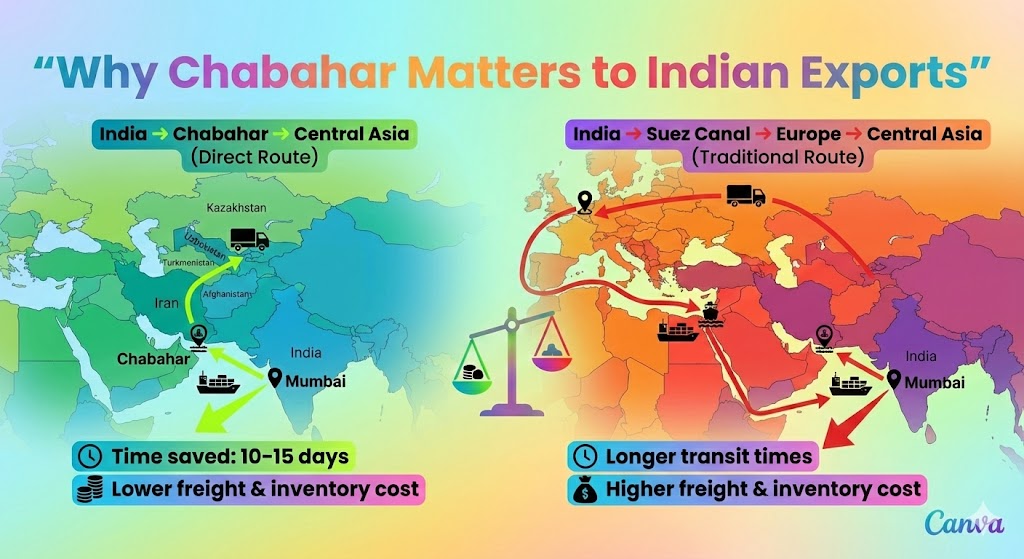
The International North–South Transport Corridor (INSTC) is not a diplomatic slogan. It is a logistics calculation. Cargo shipped from western India to Central Asia via Chabahar and onward through Iran and the Caspian Sea reaches markets 10–15 days faster than routes that go through the Suez Canal and Europe.
For Indian exporters, this time saving directly translates into lower freight costs, lower inventory cycles, and better competitiveness in markets such as Kazakhstan, Uzbekistan, and Russia. Collectively, Central Asia represents a trade opportunity estimated at over $30 billion annually.
Without Chabahar, India has only one alternative: transit through Pakistan. That option is politically and strategically non-existent.
From a cold economic standpoint, $120 million is a modest price to secure a westward trade gateway that bypasses both Pakistan and Chinese-controlled corridors.
4. Fundamental Logic Pillar Two: The China Vacuum Theory
Geopolitics abhors a vacuum. If India steps away from Chabahar, someone else will step in.
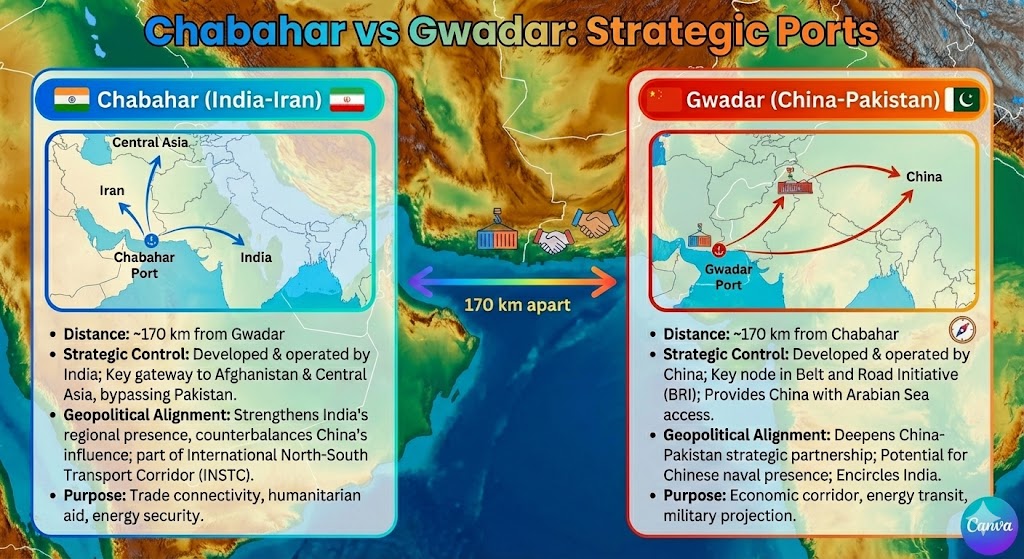
Just 170 kilometers away lies Gwadar Port, a centerpiece of the China–Pakistan Economic Corridor under China-Pakistan Economic Corridor. Beijing has already invested billions in Gwadar, but the port has struggled with throughput, security, and commercial viability.
Chabahar is Iran’s only deep-water port with direct access to the Indian Ocean. If India withdraws, China would gain an opportunity to integrate Chabahar into its broader maritime network, effectively extending Chinese influence from Gwadar to the Gulf of Oman.
For New Delhi, preventing this outcome is a strategic priority. In that context, $120 million is not an expense. It is insurance against encirclement.
5. Fundamental Logic Pillar Three: The Humanitarian Shield
There is one reason Chabahar survived US sanctions during the previous Trump administration—and that reason still applies.
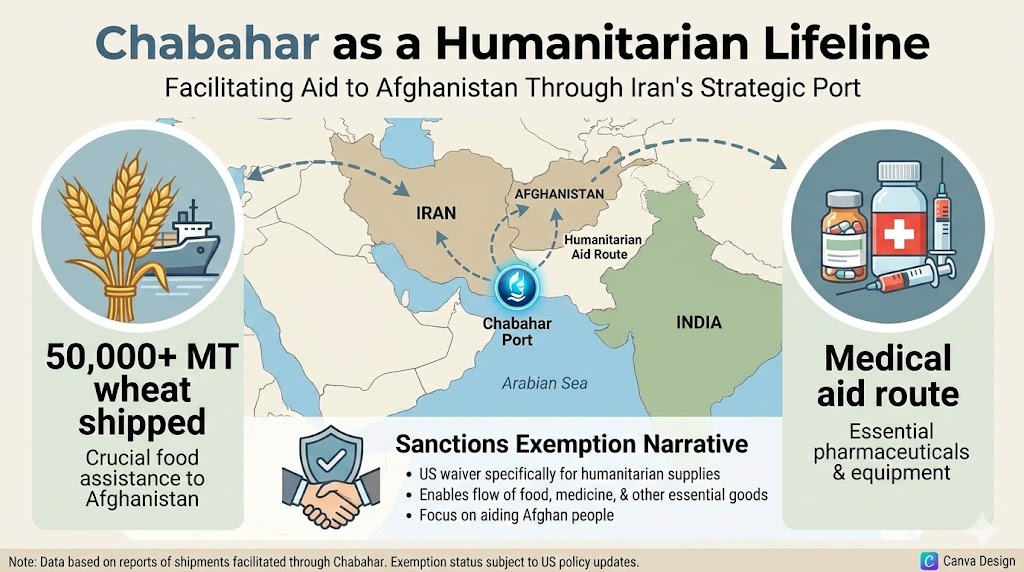
Chabahar is the primary humanitarian corridor for India’s aid to Afghanistan. Since 2021, India has shipped over 50,000 metric tonnes of wheat, along with medicines and disaster relief, to Afghanistan through this route.
India continues to frame Chabahar not as a commercial port, but as a humanitarian lifeline. This framing matters in Washington.
Even hardline sanctions regimes historically allow exceptions for food, medicine, and humanitarian logistics. By anchoring Chabahar within this narrative, India strengthens its case for a waiver extension or at least a soft enforcement posture.
6. The Core Geoeconomic Conflict: Trade with the US vs Ties with Iran
Here lies the central dilemma.
In February 2026, India and the United States finalized a major interim trade framework. Under this deal, US tariffs on Indian goods were reduced from near 50% punitive levels to 18%. This shift directly benefits Indian exporters in textiles, chemicals, engineering goods, and electronics.
The numbers are stark.
India–US bilateral trade now exceeds $130 billion annually. India–Iran trade, by contrast, stands at roughly $1.6 billion.
On paper, the rational economic choice is obvious: prioritize Washington.
Yet geopolitics is not linear. Giving up Chabahar would permanently weaken India’s access to Eurasia and surrender leverage to China. India is therefore betting that its strategic value as a counterweight to Beijing will outweigh US pressure—at least enough to secure another 12-month waiver.
US Treasury – Office of Foreign Assets Control (OFAC)
7. The Trump Factor: Why April 2026 Is So Unpredictable
The challenge India faces is not just sanctions law. It is political volatility in Washington.
The Trump administration’s approach to sanctions is transactional, not doctrinal. Waivers are tools, not principles. They can be extended, narrowed, or revoked depending on broader negotiations—from trade deficits to defense purchases.
India understands this. That is why it rushed to clear payments before April 2026. Physical infrastructure, once built and paid for, is harder to unwind than financial commitments still pending.
This is classic risk front-loading.
8. Potential Escape Routes After April 26, 2026
India is not walking into April without contingency planning.
One option under discussion is the corporatization of operations, shifting management from a state-owned entity to a Special Purpose Vehicle with minimal dollar exposure. This would reduce the visibility of transactions within US financial monitoring systems.
Another pathway involves regional mediation, particularly through Oman, which has hosted quiet US–Iran backchannel talks in the past. Including Chabahar as a neutral logistics zone could lower enforcement intensity.
A third option is expanding rupee–rial settlement mechanisms, bypassing SWIFT entirely. While imperfect, such systems reduce sanction traceability and have been used before in limited contexts.
None of these are ideal. All are survival strategies.
9. What the Zero Budget Allocation Really Signals
Many observers misread India’s zero allocation for Chabahar in Budget 2026–27 as retreat. It is the opposite.
It signals hibernation.
India has paid enough to secure its footprint. Now it waits. No new capital, no expansion announcements, no political noise. This lowers the project’s profile just as sanctions risk peaks.
For analysts, this is a classic holding pattern: preserve the asset, avoid escalation, and wait for geopolitical weather to change.
10. Conclusion: Strategic Defiance or Calculated Delay?
India’s $120 million payment to Iran is not an act of defiance. It is an act of calculated delay.
New Delhi is buying time—time to keep its western gateway alive, time to prevent Chinese entry, and time to test Washington’s tolerance for nuance in a world increasingly shaped by great-power competition.
Chabahar today is not expanding. It is surviving. And in geopolitics, survival itself is often a strategic victory.
Whether April 26, 2026, brings a waiver extension or renewed pressure, one thing is already clear: India has chosen not to walk away. It has chosen to stay at the table, pay its dues, and negotiate from presence rather than absence.
For a country balancing autonomy and alliance, that choice may define its foreign policy posture for the next decade.