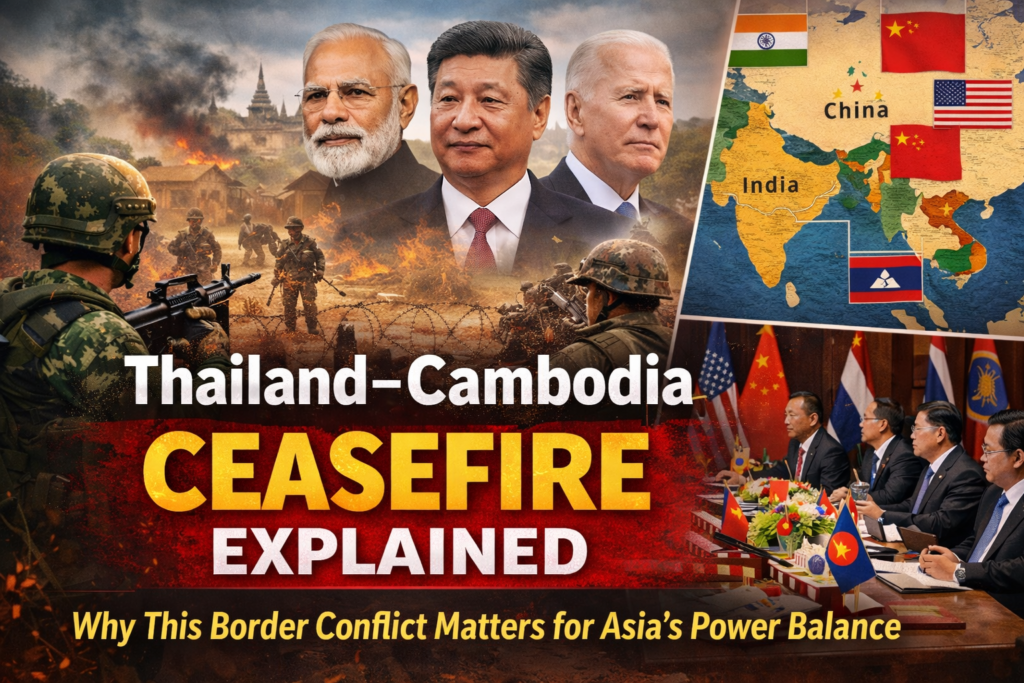
1️⃣ Introduction: Why This Border Issue Deserves Global Attention
The recent border tension between Thailand and Cambodia may look like a small regional clash, but in today’s interconnected world, even limited conflicts carry wide consequences. A few days of fighting were enough to displace thousands of people, raise regional security concerns, and pull in major diplomatic players
.
A ceasefire has now been announced, and guns have fallen silent for the moment. But history shows that ceasefires do not always mean peace. This conflict matters because it affects regional stability in Southeast Asia, trade flows, investor confidence, ASEAN’s credibility, and China’s growing role as a mediator. Understanding this issue helps readers see how geopolitics directly connects to economy, security, and everyday life.
2️⃣ What Happened Recently: A Clear Timeline in Simple Words
The latest round of tension began along disputed stretches of the Thailand–Cambodia border. Military units from both sides accused each other of moving too close to contested areas and building defensive positions. What started as small confrontations soon escalated. Troops were mobilised, weapons were used, and local authorities ordered civilians to leave nearby villages for safety.
As the situation worsened, concerns grew that the conflict could spread or drag on. Regional leaders and diplomats stepped in, urging restraint. After intense discussions, both governments announced a ceasefire, agreeing to stop military actions and prevent further escalation. While this brought immediate relief, it did not resolve the deeper dispute.
3️⃣ The Human Cost: Ordinary People Pay the Highest Price
Behind every border clash are real people whose lives are disrupted. In this conflict, thousands of civilians living near the border had to leave their homes. Many depend on farming, cross-border trade, or daily wage work, all of which stopped suddenly.
Schools were closed, health services became harder to reach, and families faced uncertainty about when they could return. Even after ceasefires, fear remains because people know tensions can return anytime. This repeated displacement shows why unresolved border disputes create long-term insecurity, not just short-term crises.
4️⃣ Why Thailand and Cambodia Fight Over This Border

To understand why this border keeps becoming tense, we must look at history. The Thailand–Cambodia border was shaped during the colonial period, when European powers drew maps without clear ground surveys. These maps left behind unclear boundaries, especially in forested and mountainous regions.
Over time, Thailand and Cambodia developed different interpretations of where the border lies. When both sides patrol or build infrastructure based on their own maps, tensions rise. This historical confusion is the root cause of repeated clashes, showing how decisions made long ago still affect today’s geopolitics.
5️⃣ The Preah Vihear Temple: More Than Just a Building

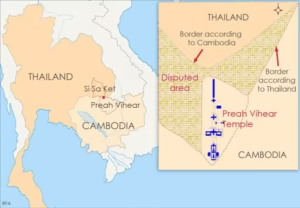
A major flashpoint in this dispute is the Preah Vihear Temple, an ancient Hindu temple located close to the border. In 1962, the International Court of Justice ruled that the temple belongs to Cambodia. Later interpretations clarified some surrounding areas, but the full border was never clearly settled.
For Cambodia, the temple is a symbol of cultural heritage. For Thailand, the surrounding land holds strategic and national importance. Because the issue involves history, culture, and pride, compromise becomes politically sensitive on both sides.
6️⃣ National Pride and Domestic Politics: Why Compromise Is Hard
Border disputes are rarely just technical problems. They touch national pride. Political leaders in both Thailand and Cambodia face domestic pressure not to appear weak. Any compromise can be portrayed as surrendering national territory.
This political reality makes long-term solutions difficult. Leaders often choose short-term calm through ceasefires rather than bold decisions that could provoke backlash at home. This is one reason why such disputes remain unresolved for decades.
7️⃣ What the Ceasefire Agreement Actually Means
The ceasefire announced by Thailand and Cambodia focuses on stopping violence, not solving the dispute. Both sides agreed to halt military operations and avoid provocative movements near the border. Communication channels between military commanders were strengthened to prevent misunderstandings.
The agreement also allows for humanitarian access so displaced civilians can safely return home if conditions remain calm. In simple terms, the ceasefire is a cooling-off period. It reduces immediate danger but leaves the core issue untouched.
8️⃣ Key Facts at a Glance: Thailand–Cambodia Border Crisis
| Aspect | Details |
|---|---|
| Countries involved | Thailand and Cambodia |
| Nature of conflict | Border dispute |
| Main flashpoint | Areas near Preah Vihear Temple |
| Recent development | Ceasefire announced |
| Civilian impact | Displacement and disruption |
| Regional involvement | ASEAN dialogue |
| External mediation | China-hosted talks |
9️⃣ ASEAN’s Role: Keeping Peace Without Force
The crisis again highlights the role of ASEAN. ASEAN works on principles of dialogue, consensus, and non-interference. These principles help reduce tensions but also limit ASEAN’s ability to enforce solutions.
ASEAN can bring countries to the table and encourage calm, but it cannot impose border settlements. This makes ASEAN effective at managing crises but less effective at resolving long-standing disputes. The Thailand–Cambodia issue shows both ASEAN’s importance and its limitations.
🔟 China’s Role: A Regional Power Stepping In
China played an important diplomatic role by hosting talks and encouraging restraint. For China, stability in Southeast Asia is crucial. The region is vital for trade routes, investments, and economic projects.
By acting as a mediator, China strengthens its image as a regional problem-solver. For Southeast Asian countries, Chinese mediation can be helpful, but it also signals a shift toward Asia-led diplomacy rather than reliance on Western institutions.
1️⃣1️⃣ Why This Conflict Matters to the Economy
Border tensions do not stay limited to security. They directly affect economies. Trade routes slow down, logistics costs rise, and insurance premiums increase. Tourism suffers as travellers avoid regions seen as unstable.
Thailand, a major tourism and manufacturing hub, and Cambodia, an economy linked to regional supply chains, both need stability to grow. Even short conflicts can harm investor confidence and delay economic projects.
1️⃣2️⃣ Geoeconomic Impact: How Border Tensions Hurt Growth
| Sector | Impact |
|---|---|
| Trade | Delays and higher transport costs |
| Tourism | Fewer visitors and cancellations |
| Agriculture | Disrupted farming and markets |
| Investment | Higher risk perception |
| Jobs | Income loss in border regions |
1️⃣3️⃣ Why Ceasefires Often Fail: Lessons From History
Across the world, ceasefires often fail when borders remain unclear and troops stay close to each other. Accidental incidents, political pressure, or miscommunication can quickly restart fighting.
From Africa to Eastern Europe, the lesson is clear: ceasefires pause conflicts, but only clear agreements end them. Without long-term solutions, tensions return again and again.
1️⃣4️⃣ Possible Scenarios After the Ceasefire
There are three main paths ahead. In the best case, the ceasefire holds, civilians return home, and structured talks begin. In the most likely case, the conflict freezes, with calm but no solution. In the worst case, a small incident breaks the ceasefire and fighting resumes.
Which scenario unfolds depends on political will, military discipline, and sustained diplomacy.
1️⃣5️⃣ What This Conflict Teaches the World
This crisis highlights three important lessons. First, old borders still shape modern politics. Second, regional organisations play a growing role in conflict management. Third, economic growth depends on political stability.
For readers, this shows how geopolitics directly affects trade, prices, jobs, and security—even far from the battlefield.
1️⃣6️⃣ Conclusion: A Pause Today, Questions for Tomorrow
The Thailand–Cambodia ceasefire is a positive step that prevents immediate violence and human suffering. However, it is not a permanent solution. The underlying border dispute remains unresolved.
Lasting peace will require clear border agreements, political courage, and continuous dialogue. Until then, the region remains vulnerable to future flare-ups. For readers, this conflict is a reminder that geopolitics is not distant or abstract—it shapes economies, livelihoods, and regional stability in very real ways.
To visit official website of Ministry of Defence {Thailand} click here
❓ Frequently Asked Questions (FAQ)
❓ What is the Thailand–Cambodia border dispute about?
The Thailand–Cambodia border dispute is mainly about unclear boundary lines created during the colonial era. Old maps left some border areas undefined, especially near important cultural and strategic locations. Over time, both countries developed different claims over these areas, leading to repeated tensions.
❓ Why did Thailand and Cambodia agree to a ceasefire now?
Both countries agreed to a ceasefire to stop violence, protect civilians, and avoid a wider conflict. The fighting caused displacement and raised concerns across Southeast Asia. Diplomatic pressure from regional partners and fear of economic damage pushed both sides to pause military action.
❓ Is the ceasefire permanent or temporary?
The ceasefire is temporary. It is meant to stop fighting and create space for dialogue. It does not solve the border dispute. Without a long-term agreement, tensions can return in the future.
❓ What role did ASEAN play in the ceasefire?
ASEAN helped by encouraging dialogue and restraint. ASEAN works through consensus and diplomacy, not force. It can help calm situations and bring countries to the table, but it cannot impose a final solution to border disputes.
❓ Why is China involved in the Thailand–Cambodia issue?
China is involved as a regional mediator. Stability in Southeast Asia is important for China’s trade routes and investments. By hosting talks and supporting peace efforts, China is increasing its diplomatic influence in the region.
❓ Why is the Preah Vihear Temple important in this conflict?
The Preah Vihear Temple is an ancient Hindu temple with deep cultural value. While an international court ruled the temple belongs to Cambodia, the surrounding land remains disputed. The issue involves history, culture, and national pride, making compromise difficult.
❓ How does this border conflict affect the economy?
Border tensions can:
Disrupt trade and transport
Reduce tourism
Increase business risk
Delay foreign investment
Even short conflicts can hurt local jobs and investor confidence.
❓ Can this conflict affect other Southeast Asian countries?
Yes. Prolonged instability can impact regional trade, supply chains, and investor sentiment. Southeast Asia’s economies are closely connected, so instability in one area can affect the whole region.
❓ Why do ceasefires often fail in border conflicts?
Ceasefires fail when:
Borders are unclear
Troops remain close to each other
Political pressure rewards confrontation
There is no long-term agreement
Without solving the root problem, peace remains fragile.
❓ What are the possible outcomes after this ceasefire?
There are three main possibilities:
Peaceful dialogue leading to long-term solutions
Frozen conflict with calm but no settlement
Renewed fighting if the ceasefire breaks
The outcome depends on political will and diplomacy.
❓ What is the main lesson from the Thailand–Cambodia border crisis?
The key lesson is that old border problems can still shape modern geopolitics and economics. Peace is not just about stopping fighting—it requires trust, clear agreements, and sustained dialogue.
To visit official website of Ministry of Defence {Cambodia} click here
🔍 People Also Ask (PAA)
🔹 Why are Thailand and Cambodia fighting over the border?
Thailand and Cambodia are fighting over the border because some boundary lines were never clearly defined during the colonial period. Old maps left parts of the border open to interpretation, leading both countries to claim the same areas. These disputes become serious when national pride, security, and politics are involved.
🔹 When did the Thailand–Cambodia border conflict start?
The roots of the conflict go back more than 100 years, but modern tensions increased in the late 2000s, especially around the Preah Vihear Temple area. Since then, clashes have happened from time to time whenever talks break down or political tensions rise.
🔹 What caused the latest Thailand–Cambodia border clashes?
The latest clashes were triggered by accusations of troop movement and construction near disputed border areas. Small incidents escalated quickly due to mistrust, heavy military presence, and lack of a clearly enforced border agreement.
🔹 Has the Thailand–Cambodia ceasefire stopped all fighting?
The ceasefire has stopped major fighting for now, but it does not guarantee lasting peace. Ceasefires reduce violence temporarily, but without a permanent border settlement, tensions can return.
🔹 What is ASEAN doing about the Thailand–Cambodia conflict?
ASEAN is helping by encouraging dialogue and calm between the two countries. However, ASEAN does not have military or legal power to enforce a final solution. Its role is mainly diplomatic.
🔹 Why is China mediating between Thailand and Cambodia?
China is mediating because it wants stability in Southeast Asia, which is important for trade, investment, and regional security. By hosting talks, China is also strengthening its influence as a key power broker in Asia.
🔹 Does this conflict affect India or other Asian countries?
Yes. Border conflicts in Southeast Asia can disrupt trade routes, supply chains, and regional stability. Countries like India, Japan, and others with economic ties to the region closely watch such developments.
🔹 How does the Thailand–Cambodia conflict affect tourism?
Tourism often suffers during border tensions because travellers avoid regions seen as unstable. Thailand, which depends heavily on tourism, can face losses even if the conflict remains limited.
🔹 Can international courts solve the Thailand–Cambodia border dispute?
International courts can clarify legal ownership, as they did with the Preah Vihear Temple. However, courts cannot enforce peace on the ground. Political agreement between the two countries is still required.
🔹 Why do border disputes keep returning even after agreements?
Border disputes return because the root causes—unclear boundaries, nationalism, and lack of trust—remain unresolved. Agreements that focus only on stopping violence do not address these deeper issues.
🔹 What is the biggest risk if the ceasefire fails?
If the ceasefire fails, fighting could resume, civilians could be displaced again, and regional stability could be threatened. It could also hurt trade, investment, and diplomatic relations across Southeast Asia.
🔹 What is the long-term solution to the Thailand–Cambodia border issue?
The long-term solution requires clear border demarcation, regular dialogue, confidence-building measures, and political courage from both sides. Without these, peace will remain fragile.
🔹 Why is this border conflict important for Asia’s power balance?
This conflict matters because it shows how regional powers like China and organisations like ASEAN manage security issues. It reflects shifting power dynamics where Asian countries increasingly handle their own geopolitical challenges.
India Manufacturing Boom vs China Slowdown: Who Are the Real ‘Make in India’ Winners in 2025?