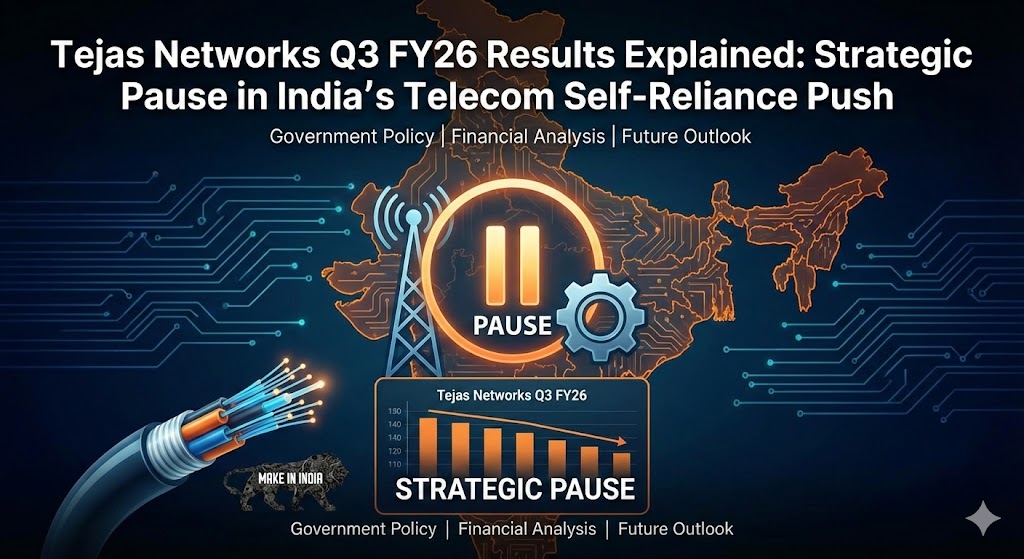
As a political-economic observer with nearly three decades of experience, I have learned one simple truth: quarterly numbers often hide long-term strategy. The Q3 FY26 results of Tejas Networks, released on January 9, 2026, fall squarely into this category. At first glance, the results look weak. Revenue is sharply lower, and the company has posted a quarterly loss. But if one looks beyond the surface, these numbers tell a far more important story—one of consolidation, patience, and national strategy.
Tejas Networks today sits at the heart of India’s ambition to become technologically sovereign in telecom. From a Government of India and Bharatiya Janata Party perspective, this company is not judged only by quarterly profits. It is judged by whether India can finally build and export its own telecom hardware without depending on foreign vendors who control critical infrastructure.
This article explains why Q3 FY26 should be seen not as a setback, but as a strategic pause before the next phase of growth.
1. The Opening Narrative: From Shipments to Sovereignty
The biggest mistake analysts make while reading Tejas Networks’ numbers is treating FY25 and FY26 as comparable years. They are not. FY25 was a shipment-heavy execution year, driven by the massive BSNL 4G/5G rollout. FY26 is a stabilisation and diversification year, where execution pauses briefly while the next wave of orders is prepared.
In FY25, Tejas executed one of the largest telecom orders ever given to an Indian company. That naturally inflated revenues in certain quarters, especially Q3 FY25. Once those shipments were completed, a temporary gap emerged before the next set of deliveries. This is common in telecom equipment manufacturing, where orders are large, milestone-based, and lumpy.
From my 30-year perspective, this phase is actually healthy. India has never before had a domestic telecom company that could even dream of competing with global giants like Huawei, Ericsson, or Nokia. Tejas is now building what I call an IP-led moat—its own software-defined networking, optical, and RAN technologies that can be upgraded and exported over time.
From a BJP-led policy angle, this is exactly what the PLI (Production Linked Incentive) scheme was designed to do. The government is not chasing short-term profits. It is building a global telecom OEM headquartered in India, even if that means tolerating uneven quarterly numbers.
Tejas Networks – Official Website
2. Q3 FY26 Financial Snapshot: Navigating the Deferment
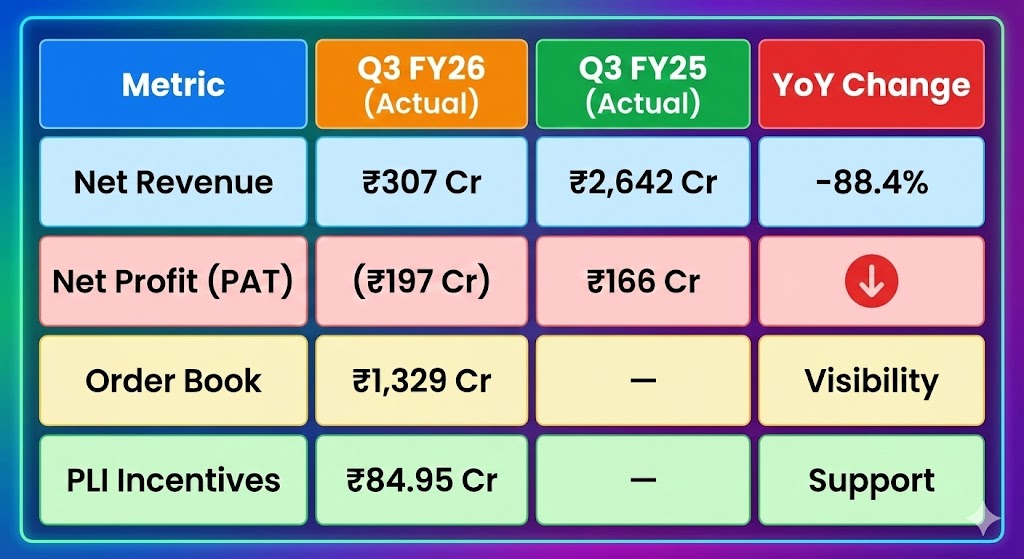
The Q3 FY26 numbers must be read with context. Net revenue for the quarter came in at ₹307 crore, compared to ₹2,642 crore in Q3 FY25. This sharp decline has raised concerns among short-term market participants, but the reason is straightforward: order timing.
The company reported a net loss of ₹197 crore, compared to a profit of ₹166 crore in the same quarter last year. This loss did not arise from operational collapse or demand destruction. It came from the deferment of a ₹1,526 crore BSNL purchase order related to around 18,000 telecom sites.
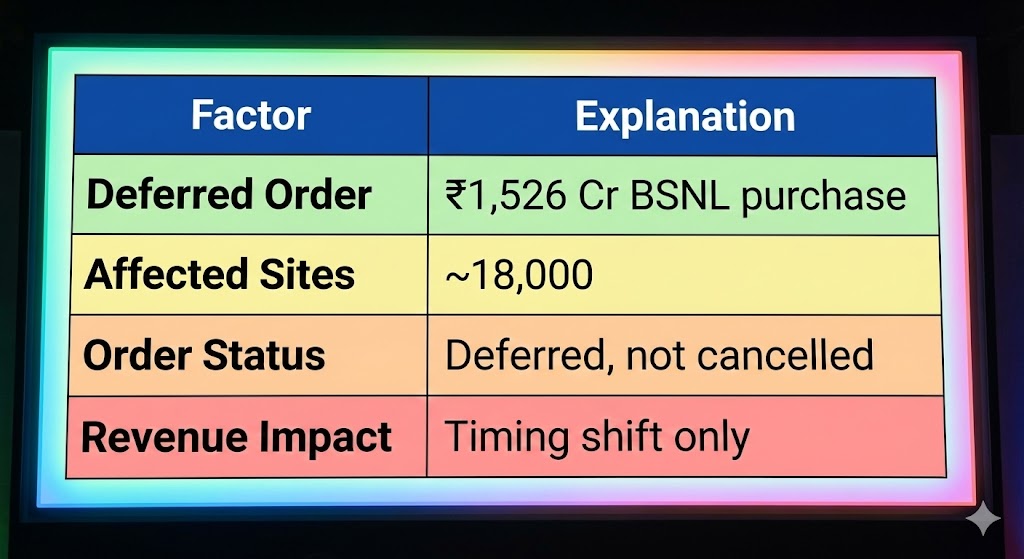
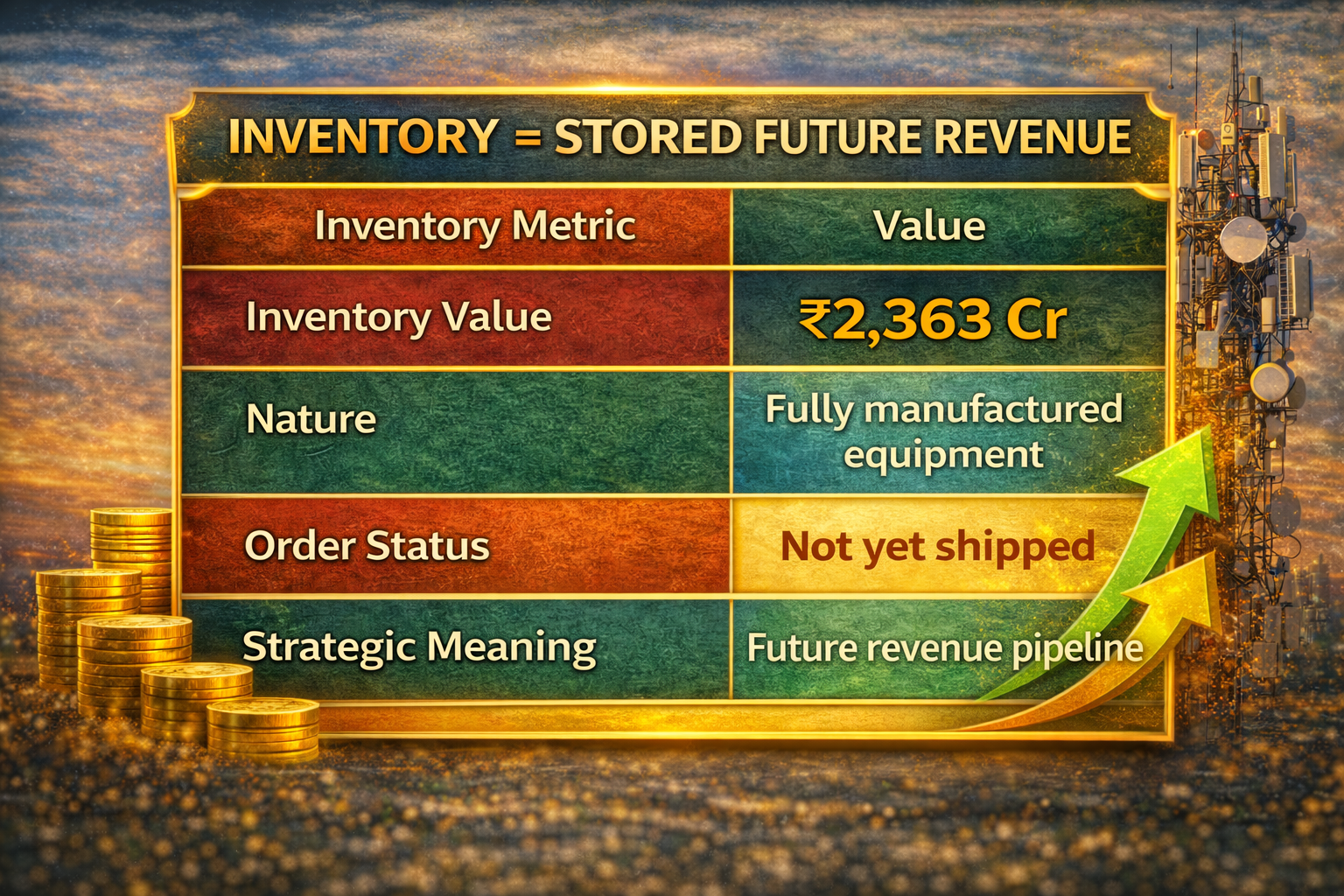
Importantly, this order was not cancelled. It was only postponed due to procedural and rollout sequencing reasons at the customer end. The equipment has already been manufactured and sits on Tejas’ balance sheet as inventory.
This is where the balance sheet tells the real story. Tejas reported inventory worth ₹2,363 crore in Q3 FY26. In simple terms, this inventory represents stored future revenue. Once shipments resume, this inventory will convert into sales without requiring fresh manufacturing costs.
The company’s order book stood at ₹1,329 crore, providing visibility for upcoming quarters. Additionally, Tejas received ₹84.95 crore in PLI incentives during the quarter, taking cumulative PLI receipts close to ₹397 crore.
In telecom manufacturing, such “lumpiness” is normal. What matters is whether orders exist and whether the technology is competitive. On both counts, Tejas remains well positioned.
Stock Exchange Filing (Q3 FY26 Results)
3. Fundamental Deep-Dive: The BharatNet Catalyst
The strongest pillar supporting Tejas Networks’ future is BharatNet Phase III. Under this ambitious programme, India aims to connect every gram panchayat with high-speed broadband using indigenous equipment wherever possible.
Tejas has emerged as the largest supplier in BharatNet Phase III, winning 7 out of the 12 packages announced so far. This gives the company long-term visibility for its IP/MPLS routers and optical transport products.
Unlike the BSNL 4G/5G project, BharatNet is not a one-time order. It is a multi-year deployment with upgrades, maintenance, and expansion built into the model. This creates recurring demand and reduces dependence on a single customer.
Beyond BharatNet, Tejas has made important inroads in strategic sectors. The company has been selected as the 5G RAN supplier for the Delhi–Mumbai railway corridor, one of the busiest and most critical transport routes in the country. It is also a key technology provider for Kavach, India’s indigenous automatic train protection system.
These wins matter because they signal diversification. Tejas is moving away from being seen as a “BSNL-only supplier” to becoming a multi-client, multi-sector telecom technology company. Railways, private 5G networks, and government broadband projects together form a more balanced revenue mix.
BharatNet Project – Official Portal
4. The Policy Angle: PLI and the Tata Factor
The PLI incentive of ₹84.95 crore received in Q3 FY26 is not a subsidy for inefficiency. It is a deliberate policy tool to offset the high costs of R&D, testing, and scaling faced by domestic manufacturers competing with global incumbents.
Telecom hardware is not like consumer electronics. It requires years of protocol development, interoperability testing, and security certification. Without state support, no domestic company can survive this phase.
Here, the Tata factor becomes critical. As part of the Tata Group, Tejas has access to long-term capital, governance discipline, and strategic patience. This allows the company to absorb short-term losses without cutting back on R&D or talent.
Strategic autonomy is not an abstract idea. Every Tejas router deployed in BharatNet or BSNL reduces India’s dependence on foreign equipment that may carry unknown vulnerabilities. In an era of cyber warfare and data sovereignty, telecom infrastructure is as strategic as defence hardware.
This is why the government views Tejas not just as a vendor, but as a national capability.
Department of Telecommunications (DoT) – Government of India
5. Geoeconomic Outlook: Scaling for the World
Tejas Networks is no longer focused only on India. Around 15% of its revenue now comes from international markets, including Africa, Europe, and Southeast Asia. These regions are actively looking for alternatives to expensive Western vendors and politically sensitive Chinese suppliers.
India is positioning Tejas as a trusted, affordable, and secure option for the Global South. Unlike some global players that bundle technology with opaque financing, Tejas offers transparent pricing and sovereign-friendly deployment.
This is where geopolitics meets commerce. As countries reassess their digital infrastructure dependencies, India’s telecom stack—hardware, software, and services—becomes a diplomatic asset. Tejas sits at the center of this strategy.
The company’s growing international footprint shows that Indian telecom manufacturing is no longer defensive. It is becoming export-capable.
6. Conclusion: Looking Beyond the “BSNL Hump”
The correct way to read Tejas Networks’ Q3 FY26 results is not through profit alone. Investors and policymakers must focus on the order book of ₹1,329 crore, the inventory of ₹2,363 crore, and the expanding role of the company across BharatNet, Railways, and global markets.
Telecom equipment manufacturing has always been cyclical and lumpy. Those who understand the industry know that quarterly losses during transition phases are not failures. They are investments.
In my 30 years of watching Indian industry, I have seen many companies collapse because they avoided R&D to protect short-term profits. Tejas has taken the opposite path. With around 65% of its workforce engaged in R&D, it is building intellectual property that will matter for decades.
Tejas Networks is not just a stock or a balance sheet. It is the Viksit Bharat vision made tangible in hardware and code. And that is why Q3 FY26 should be remembered not as a weak quarter, but as a moment of strategic resilience.
❓ FAQ + PEOPLE ALSO ASK (SEO-READY)
FAQs
What are Tejas Networks Q3 FY26 results in simple terms?
The company reported lower revenue and a loss due to delayed BSNL shipments, but retained strong inventory, order book, and government-backed project visibility.
Why did Tejas Networks post a loss in Q3 FY26?
The loss was caused by deferment of a ₹1,526 crore BSNL order, not by demand weakness or operational failure.
Is Tejas Networks dependent only on BSNL?
No. The company is expanding into BharatNet, Railways, private 5G, and international markets.
What is BharatNet Phase III and why is it important?
It is India’s rural broadband backbone project. Tejas is the largest supplier, giving it multi-year revenue visibility.
How does PLI help Tejas Networks?
PLI offsets R&D and manufacturing costs, allowing Tejas to compete with global telecom giants.
People Also Ask (PAA)
What does Tejas Networks manufacture?
Telecom networking equipment including routers, optical transport, and 4G/5G RAN systems.
Is Tejas Networks part of Tata Group?
Yes, it is a Tata Group company, providing financial and strategic backing.
Why is telecom manufacturing strategic for India?
Because telecom networks are critical infrastructure linked to data security and sovereignty.
Does Tejas Networks export products?
Yes. About 15% of revenue comes from Africa, Europe, and Southeast Asia.
Is telecom revenue always volatile?
Yes. Telecom equipment orders are milestone-based and often lumpy across quarters.