Tata Power Q3 FY26 Results Explained: Green Energy Surge, EBITDA Growth & the 10 GW Milestone

1. Executive Summary: Seeing the Big Picture Behind the Numbers
After thirty years of tracking India’s power sector—from coal linkages and SEBs to renewables and smart grids—I see Tata Power’s Q3 FY26 results (released on February 4, 2026) as a classic example of strategic cannibalization done right.
At first glance, the numbers look underwhelming. Consolidated net revenue fell 4% year-on-year to ₹14,485 crore, and net profit rose only marginally to ₹1,194 crore. In a market trained to chase top-line growth, this can feel disappointing.
But look deeper and a very different story emerges.
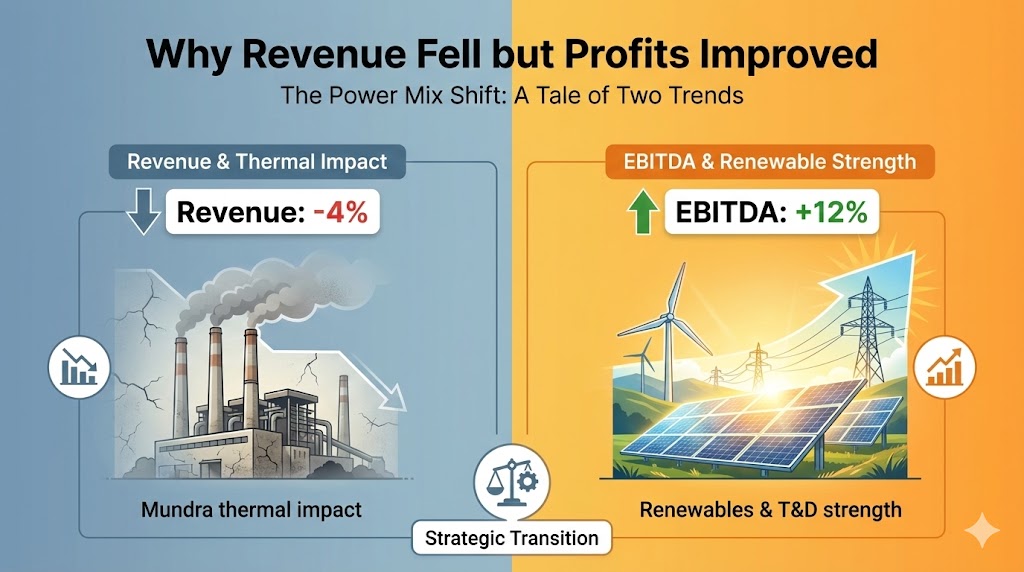
This quarter marks the point where Tata Power’s green energy engine clearly overtakes its legacy thermal base. While older coal-linked revenues softened—largely due to planned shutdowns and regulatory uncertainty at the Mundra plant—the company’s renewable energy profit surged an extraordinary 156% year-on-year. This is not accidental. It is deliberate.
Tata Power is consciously allowing its old, lower-margin thermal revenues to stagnate so that capital, management focus, and balance-sheet strength can feed its high-margin, future-facing green businesses. In energy economics, this is a bold but necessary transition.
Tata Power – Official Financial Results (Primary Source)
2. The Financial Scorecard: Why EBITDA Matters More Than Revenue
To understand Q3 FY26 properly, we need to separate headline revenue from operating quality.
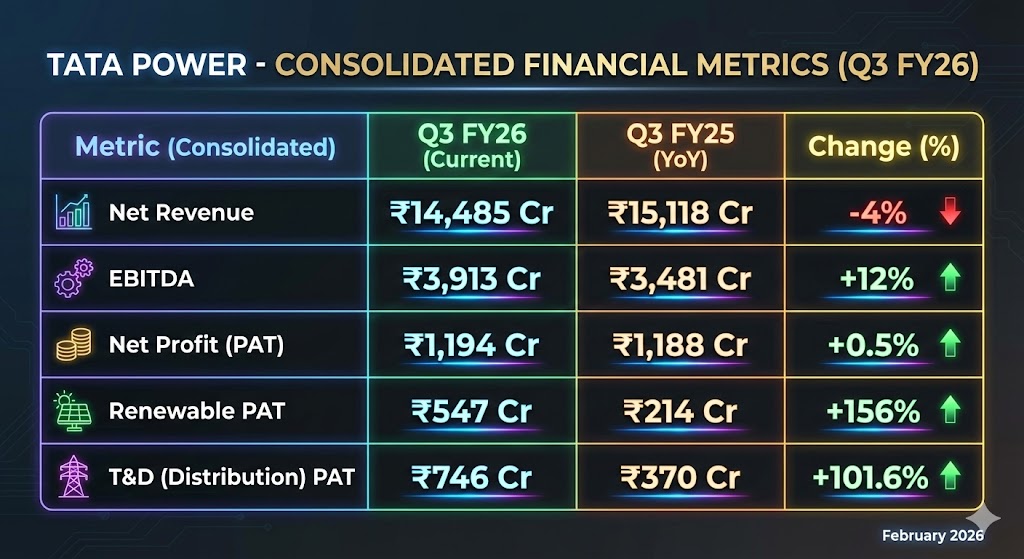
In Q3 FY26, net revenue declined to ₹14,485 crore, compared with ₹15,118 crore in Q3 FY25, a 4% drop. This was primarily due to lower generation at the Mundra thermal plant, where units were shut down for maintenance and regulatory clarity remains in flux.
However, EBITDA rose sharply by 12% to ₹3,913 crore, up from ₹3,481 crore a year ago. This divergence—falling revenue but rising EBITDA—is the most important signal in the entire results.
It tells us that Tata Power is earning more operating profit from every rupee of revenue. This is the hallmark of a company improving its business mix.
Net profit (PAT) came in at ₹1,194 crore, up marginally from ₹1,188 crore last year. On its own, this looks flat. But once we break it into segments, the picture changes dramatically.
Renewable energy PAT jumped to ₹547 crore, from ₹214 crore last year—a 156% surge.
Transmission & Distribution (T&D) PAT more than doubled to ₹746 crore, from ₹370 crore.
In other words, Tata Power’s future businesses are growing far faster than its past.
3. Fundamental Breakdown: The Three Engines Driving Quality Earnings
A seasoned analyst looks beyond profit growth and asks one key question: Where is the money really coming from? In Tata Power’s case, three engines stand out.
A. Solar Manufacturing: Owning the Margin, Not Just the Asset
One of the most underappreciated shifts at Tata Power is its move into solar manufacturing.
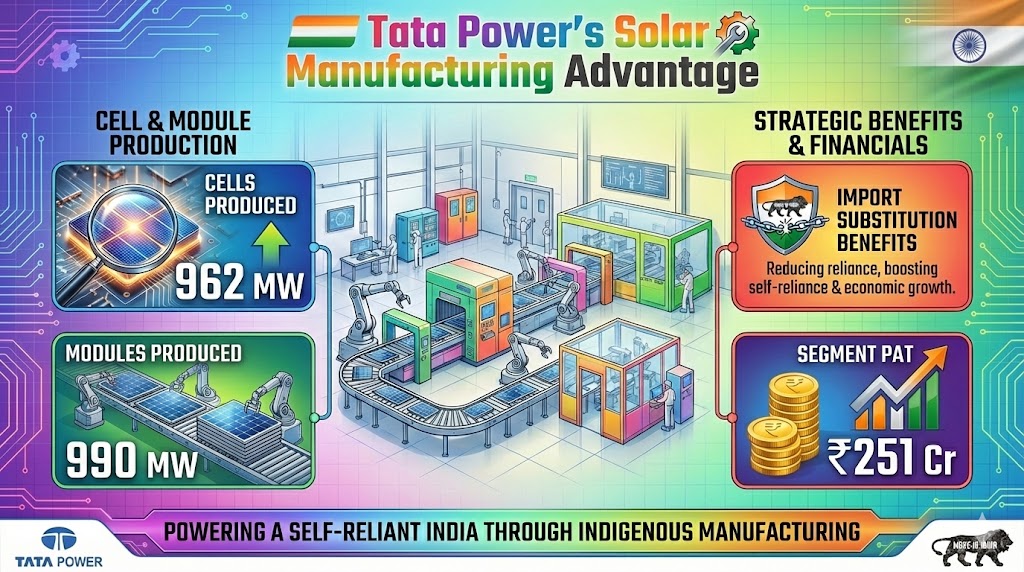
During Q3 FY26, the Tirunelveli solar plant operated at near-full capacity, producing 962 MW of solar cells and 990 MW of solar modules in just one quarter. This is not a symbolic facility; it is industrial scale.
Why does this matter?
Earlier, most Indian developers depended heavily on Chinese solar cells and modules, which meant a large chunk of margin was effectively exported overseas. By manufacturing its own cells and modules, Tata Power now captures the full value chain—from production to installation.
The result is visible in numbers. The solar manufacturing segment’s PAT more than doubled to ₹251 crore. This is high-quality profit, backed by domestic demand, policy support, and import substitution.
In simple words, Tata Power is no longer just installing solar plants. It is selling the shovels in a solar gold rush.
B. Rooftop Solar & EPC: The 10 GW Moment

The second growth engine is Tata Power’s renewable EPC and rooftop solar business, which quietly crossed a major milestone this quarter: 10 GW of cumulative EPC execution.
This matters because EPC is a high-velocity, relatively low-capex business. You don’t need to own every asset to make money. You design, build, and execute—and move on to the next project.
Q3 FY26 saw the addition of 372 MWp of rooftop solar capacity, boosted significantly by the government’s PM Surya Ghar Yojana. Under this scheme, households are incentivized to install rooftop solar, creating a massive and stable demand pipeline.
For Tata Power, rooftop solar improves Return on Equity (ROE) because it generates steady cash flows without heavy balance-sheet stress. It also strengthens customer relationships at the retail level—an often-overlooked strategic advantage.
PM Surya Ghar Yojana (Government Scheme)
C. Distribution (DISCOMs): The Silent Cash Generator
If renewables are the headline act, distribution is the unsung hero.
Tata Power’s distribution businesses, especially the Odisha DISCOMs, delivered strong results in Q3 FY26. Odisha alone contributed ₹226 crore in profit during the quarter.
The logic here is simple but powerful. Improving AT&C (Aggregate Technical & Commercial) losses directly boosts profits. There is no fuel cost, no import risk—just better billing, better collection, and better grid management.
This is pure efficiency-led growth. Every percentage point reduction in losses translates into cash. Over time, this creates a stable earnings base that supports Tata Power’s capital-intensive green expansion.
4. Geopolitics and Policy: Why the Global Context Matters
Energy is no longer just a domestic story. Tata Power’s Q3 FY26 performance must be seen in a broader geopolitical and policy framework.
The India–US Trade Deal Effect
Under the February 2026 India–US trade framework, the reciprocal tariff on several categories of high-tech electrical equipment has been reduced to around 18%. For Tata Power, this has real implications.
The company is planning 2.8 GW of pumped storage projects, which require sophisticated turbines, control systems, and grid equipment. Lower tariffs on US-origin technology can reduce capital costs, improve project IRRs, and accelerate execution timelines.
In infrastructure-heavy businesses, even small reductions in capex can significantly improve long-term profitability.
Global Funding and Regional Strategy
Another important development is the $500 million World Bank financing for the Bhutan Dorjilung hydro project, where Tata Power is a key partner. This signals something bigger.
It shows that Tata Power is increasingly viewed as a regional strategic energy partner, not just an Indian utility. Access to multilateral funding lowers financing risk and validates Tata Power’s governance and execution capabilities.
India–US Energy & Trade Cooperation
5. The Analyst’s Caution: Debt and Valuation Reality Check
No analysis is complete without addressing the risks.
Debt Profile
Tata Power’s net debt-to-equity stands at around 1.2x. This is manageable, especially since most of the debt is tied to revenue-generating assets like renewables, transmission lines, and distribution networks.
However, this level of leverage limits aggressive dividend payouts in the near term. Management’s priority remains growth and balance-sheet stability, not yield maximization.
Valuation Context
At current levels, Tata Power trades at a P/E multiple of around 29x. This puts it in an interesting middle ground.
It is more expensive than NTPC, which trades closer to 18x and is still largely thermal-heavy.
But it is far cheaper than pure-play green companies like Adani Green, where valuations often exceed 80x.
This suggests the market is still undervaluing Tata Power’s green transition relative to peers. As renewable profits continue to scale, there is room for a valuation re-rating—provided execution remains consistent.
6. Conclusion: Why This Is a “Buy on Dips” Story
Tata Power’s Q3 FY26 results may not excite short-term traders focused on revenue growth. A 4% dip in revenue is easy to headline.
But for long-term investors, the real signal lies elsewhere: 12% EBITDA growth, explosive renewable profitability, and strong distribution cash flows.
The company is becoming leaner, greener, and structurally more profitable. It is consciously sacrificing legacy thermal revenue to build a future-proof energy platform.
This is what strategic transformation looks like in the real world—messy in the short term, powerful in the long term.
For investors who understand energy cycles and policy transitions, Tata Power’s Q3 FY26 performance reinforces a simple narrative:
Ignore the revenue noise. Follow the margin quality.
That is why Tata Power increasingly fits the classic “buy on dips” framework for those willing to think beyond the next quarter and invest in India’s green energy decade.