1. Executive Summary: A Green PSU Finds Its Momentum
For many years, SJVN Limited was seen as a steady but slow-moving public sector company. Investors bought it mainly for dividends, not for growth. But Q3 FY26 results, released on February 11, 2026, have changed that perception.
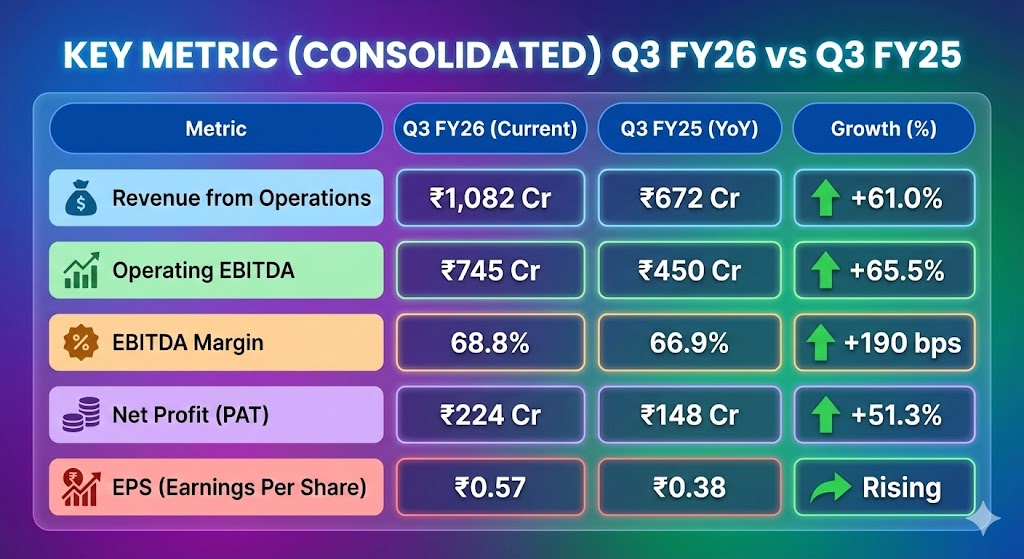
SJVN reported a consolidated net profit of ₹224 crore, a strong 51% jump compared to ₹148 crore last year. Revenue from operations rose sharply by 61% to ₹1,082 crore. These are not small improvements. These numbers show operating leverage at work.
At first glance, some may say this is just because of good rainfall or favorable hydrology. But that would be an incomplete reading. The real reason behind this surge is capacity addition and better utilization. The company has commissioned new solar projects, improved plant load factors (PLF), and benefited from higher power demand in northern India during winter.
This quarter signals something important: SJVN is no longer a single-project hydro PSU. It is becoming a diversified renewable energy player.
2. Financial Dashboard: Operational Alpha in Action
Let us look at the numbers clearly.
Revenue from operations increased from ₹672 crore to ₹1,082 crore, up 61%. Operating EBITDA rose 65.5% from ₹450 crore to ₹745 crore. EBITDA margins improved from 66.9% to 68.8%. Net profit climbed 51.3% to ₹224 crore. Earnings per share increased from ₹0.38 to ₹0.57.
These margins are impressive. An EBITDA margin of nearly 69% is very high compared to most industries. That is because hydro power plants have high fixed costs but very low variable costs. Once water starts flowing and turbines run at higher efficiency, most additional revenue directly increases profit.
This is classic operating leverage.
When generation increases even slightly, profits can rise sharply. That is exactly what happened this quarter.
SJVN share price on NSE
3. Fundamental Breakdown: The Three Growth Pillars
A. Hydrology & Plant Load Factor (PLF)
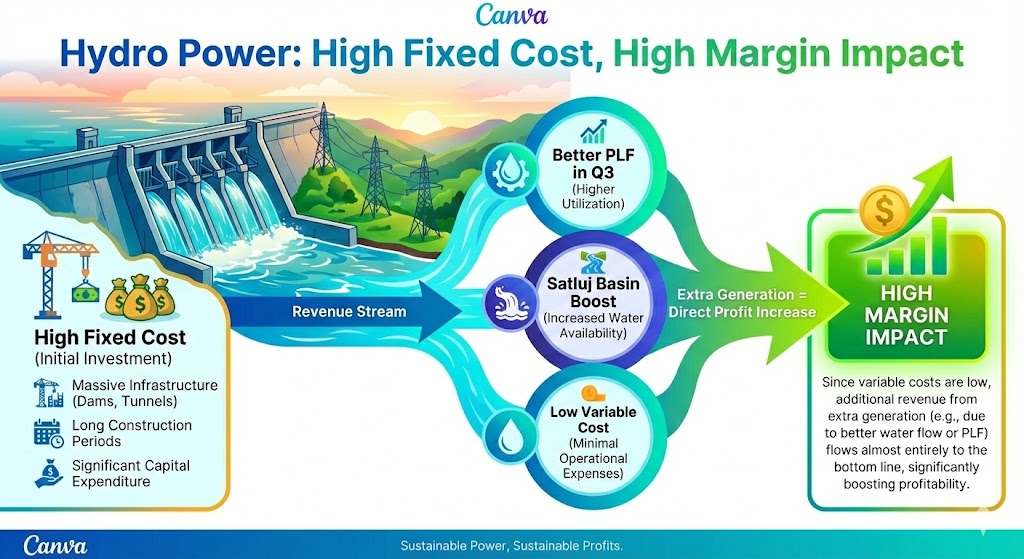
Hydro power depends on water flow. In Q3 FY26, water availability in the Satluj river basin improved significantly compared to last year’s weaker season. The Nathpa Jhakri Hydro Power Station, one of India’s largest underground hydro projects, saw better PLF levels.
Hydro plants have high infrastructure costs but very low running costs. Once the dam and turbines are built, additional electricity generation does not require much extra expense. So when water inflow improves, profitability rises sharply.
That is why revenue rose 61% while margins also expanded. Every extra unit of electricity sold contributes strongly to earnings.
But here is the key point: this is not just rainfall luck. SJVN has improved operational efficiency and turbine management. Even small improvements in PLF can create meaningful profit impact.
India hydropower capacity data
B. Solar Capacity Addition: The Stabilizer
One of the most important structural shifts is SJVN’s move into solar energy.
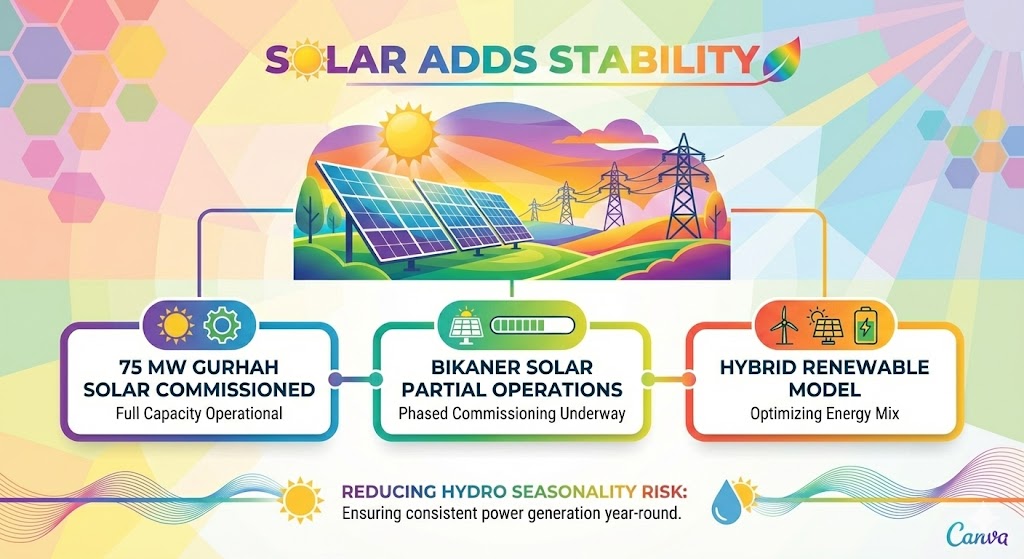
The 75 MW Gurhah Solar Power Project in Uttar Pradesh was commissioned recently. Additionally, partial commissioning of the Bikaner Solar Project contributed to revenue recognition this quarter.
Solar energy reduces seasonality risk. Hydro generation fluctuates based on rainfall and snowmelt. Solar provides more predictable output, especially during summer peak demand.
India is targeting 500 GW of non-fossil fuel capacity by 2030. SJVN has announced plans to build 25,000 MW capacity by 2030. That is ambitious but aligned with government policy.
By adding solar assets, SJVN is transforming from a hydro-only company into a hybrid renewable energy player.
This diversification is critical for long-term valuation re-rating.
Plant Load Factor (PLF) data India
C. UI Income & Grid Incentives
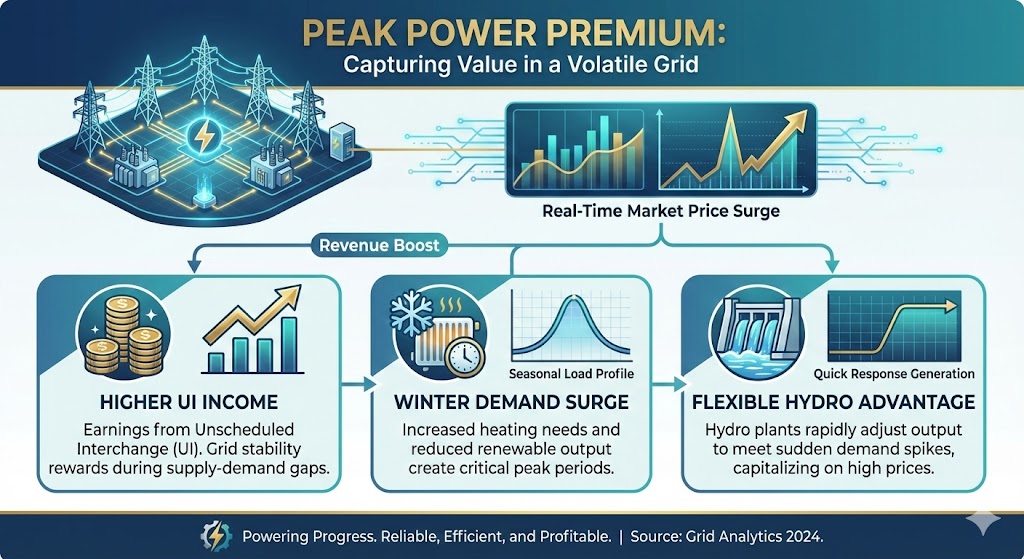
Another interesting contributor is higher Unscheduled Interchange (UI) income.
In simple terms, when power demand spikes and supply is tight, generators that can quickly supply electricity earn premium rates in real-time markets.
During winter, northern India experienced higher electricity demand due to cold waves. Heating demand and peak consumption increased. SJVN, being a flexible hydro generator, can ramp up supply quickly. That flexibility earns additional revenue.
Hydro power has a unique advantage over thermal plants in this regard. It can respond quickly to grid fluctuations.
This grid discipline and peak power premium added incremental earnings this quarter.
India renewable energy target 20304. Geopolitics & Policy: Cross-Border Strategy
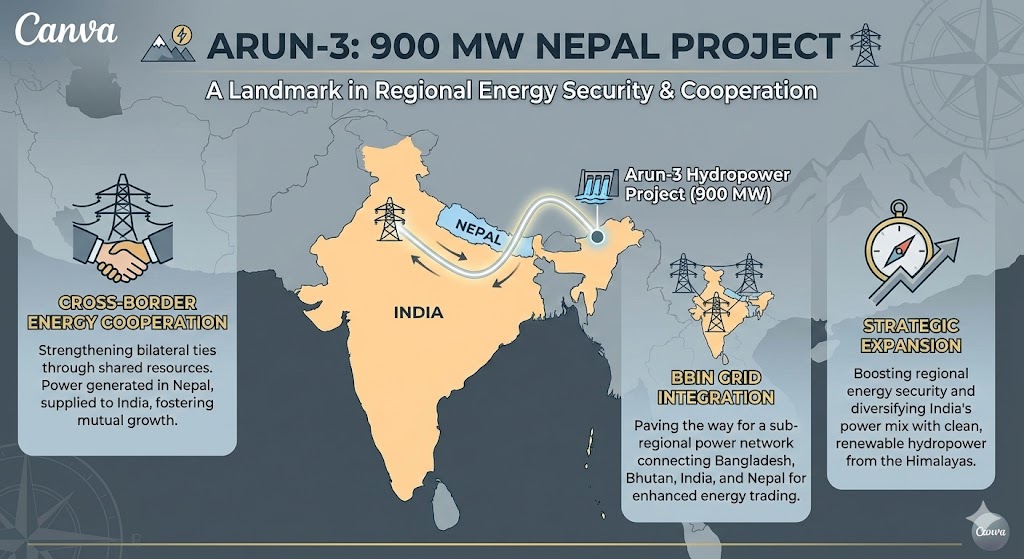
SJVN’s growth story is not limited to India.
The company is playing a key role in the Arun-3 Hydro Project (900 MW) in Nepal. This is a strategically important project. India is working to strengthen regional power connectivity under the BBIN (Bangladesh-Bhutan-India-Nepal) framework.
Energy cooperation helps India maintain influence in the region, especially as China increases infrastructure presence in Nepal.
For SJVN, cross-border projects create long-term revenue pipelines. Capital Work-In-Progress (CWIP) levels show healthy investment activity in these assets.
Another policy angle is carbon credits.
India is implementing the Indian Carbon Market (ICM) framework in 2026. Renewable generators like SJVN can generate tradable carbon credits. While revenue impact is still small, this is a potential long-term monetization opportunity.
The market has not fully priced this optional upside.
India solar power capacity addition statistics
5. Risk Factors: The Geological and Financial Reality
Despite strong Q3 numbers, risks remain.
Hydro power is vulnerable to climate volatility. If El Niño conditions affect snowfall and monsoon patterns, water availability can decline. Q1 FY27 (April–June) could see lower generation if Himalayan snowmelt is weak.
Hydrology risk is structural. It cannot be fully eliminated.
Another key issue is receivables.
State DISCOMs in regions like Jammu & Kashmir and Uttar Pradesh sometimes delay payments. If trade receivables days rise beyond 180 days, working capital gets stressed.
Power generation may be strong, but cash flow realization matters equally.
Investors should monitor receivable cycles carefully in future quarters.
6. Dividend + Growth: The New Equation
Historically, SJVN was considered a dividend stock. The company has consistently offered dividend yields in the 3–4% range.
Now, it is adding growth to that dividend base.
Private renewable players like Tata Power and Adani Green trade at higher valuations due to growth expectations. SJVN still trades at a discount compared to them.
That discount partly reflects PSU perception and hydro dependency. But as solar capacity rises and international projects progress, the valuation gap may narrow.
This creates an interesting opportunity for long-term investors seeking both yield and growth.
7. The Bigger Picture: India’s Renewable Ambition
India’s power demand continues to grow steadily. Peak power demand crossed 240 GW in 2025 and is expected to rise further in 2026.
Government policy is strongly focused on renewable energy expansion. Large PSUs are being used as implementation vehicles for this transition.
SJVN’s target of 25,000 MW by 2030 is aligned with national goals.
The Q3 FY26 results show that the company is executing, not just announcing.
Capacity addition plus improved efficiency equals operating leverage.
8. Conclusion: A Green PSU Re-Rated
The 51% profit jump is impressive. But more important is what it represents.
SJVN is no longer dependent on a single hydro project. It is building a diversified renewable portfolio. Solar capacity is stabilizing revenue. Cross-border projects are expanding the pipeline. Operating margins remain strong.
Yes, hydrology risk remains. Yes, receivables must be watched. But structurally, the business is improving.
With steady dividend yield and renewable expansion, SJVN offers a rare combination in the Indian power sector: income plus growth.
This quarter may mark the beginning of a new phase for the company.
For investors who once saw SJVN as a slow PSU, Q3 FY26 sends a different message:
The hydro heavyweight has woken up.