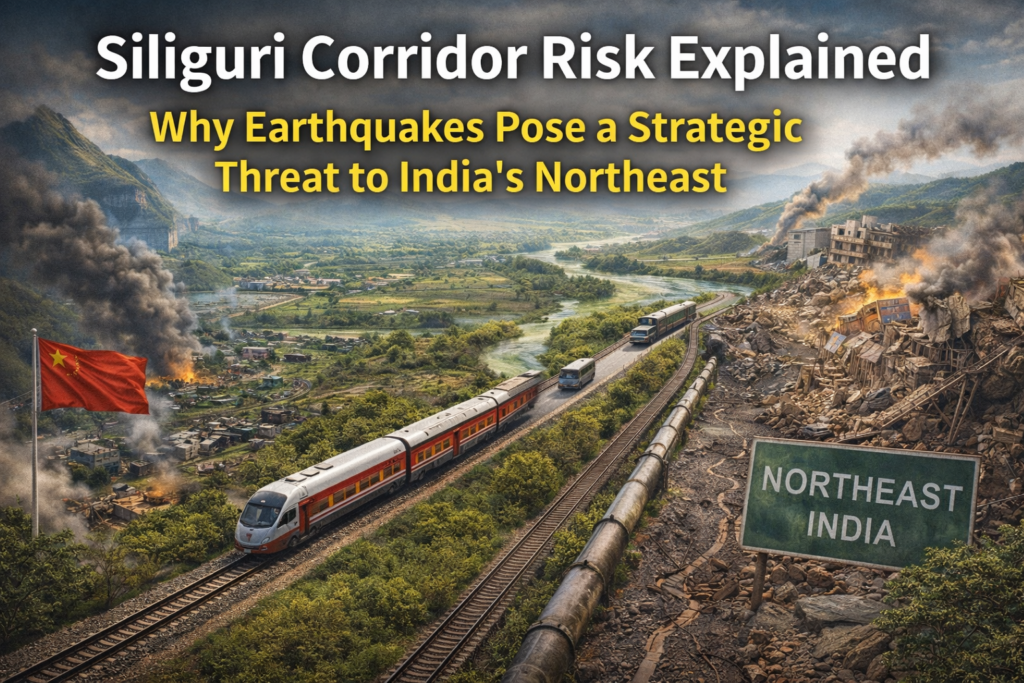
I. Introduction: The 22-Kilometer Paradox
There is a narrow stretch of land in northern West Bengal that quietly carries the weight of India’s unity. This strip, just 22–25 kilometers wide at its narrowest, is known as the Siliguri Corridor, often called the “Chicken’s Neck.” It is the only land link between mainland India and the eight Northeastern states, home to more than 45 million people.
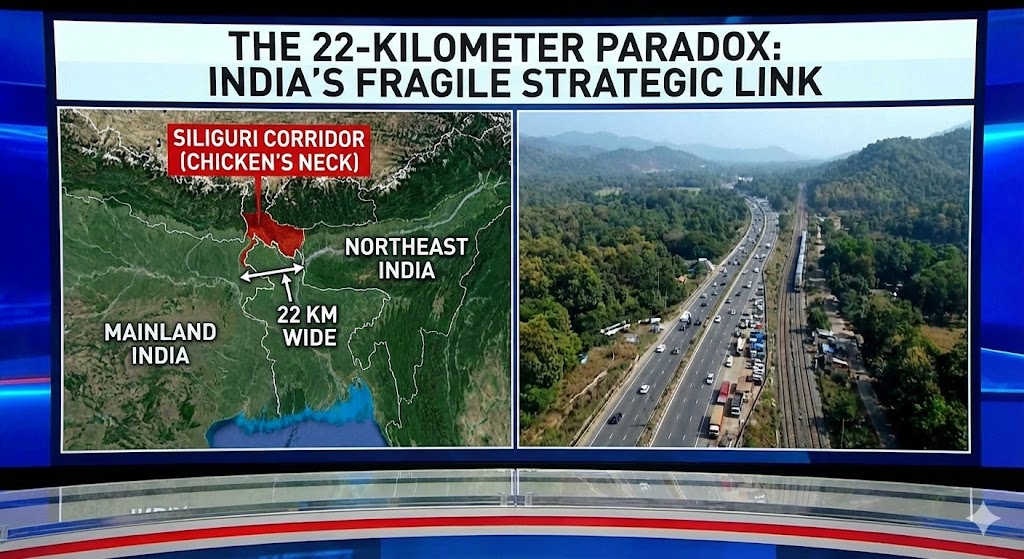
Under normal conditions, this corridor functions like a busy artery. Every day, trains, trucks, fuel pipelines, fiber-optic cables, and military convoys pass through it. But recent events have exposed how fragile this artery really is. The January 5, 2026, Assam earthquake—moderate in size but wide in impact—has once again pushed the Siliguri Corridor into strategic focus.
The concern is not the last earthquake. It is the next big one. Scientists have long warned of the possibility of a “Great Himalayan Earthquake” (magnitude 8.0 or higher) somewhere along the Himalayan arc. If such a quake strikes, the Siliguri Corridor is widely considered the most likely point of catastrophic failure in India’s national supply chain.
This is the 22-kilometer paradox: a tiny strip of land that holds together an entire region’s economy, security, and sovereignty.
National Centre for Seismology
II. The Tectonic Trap: Seismic Zone IV Meets Critical Infrastructure
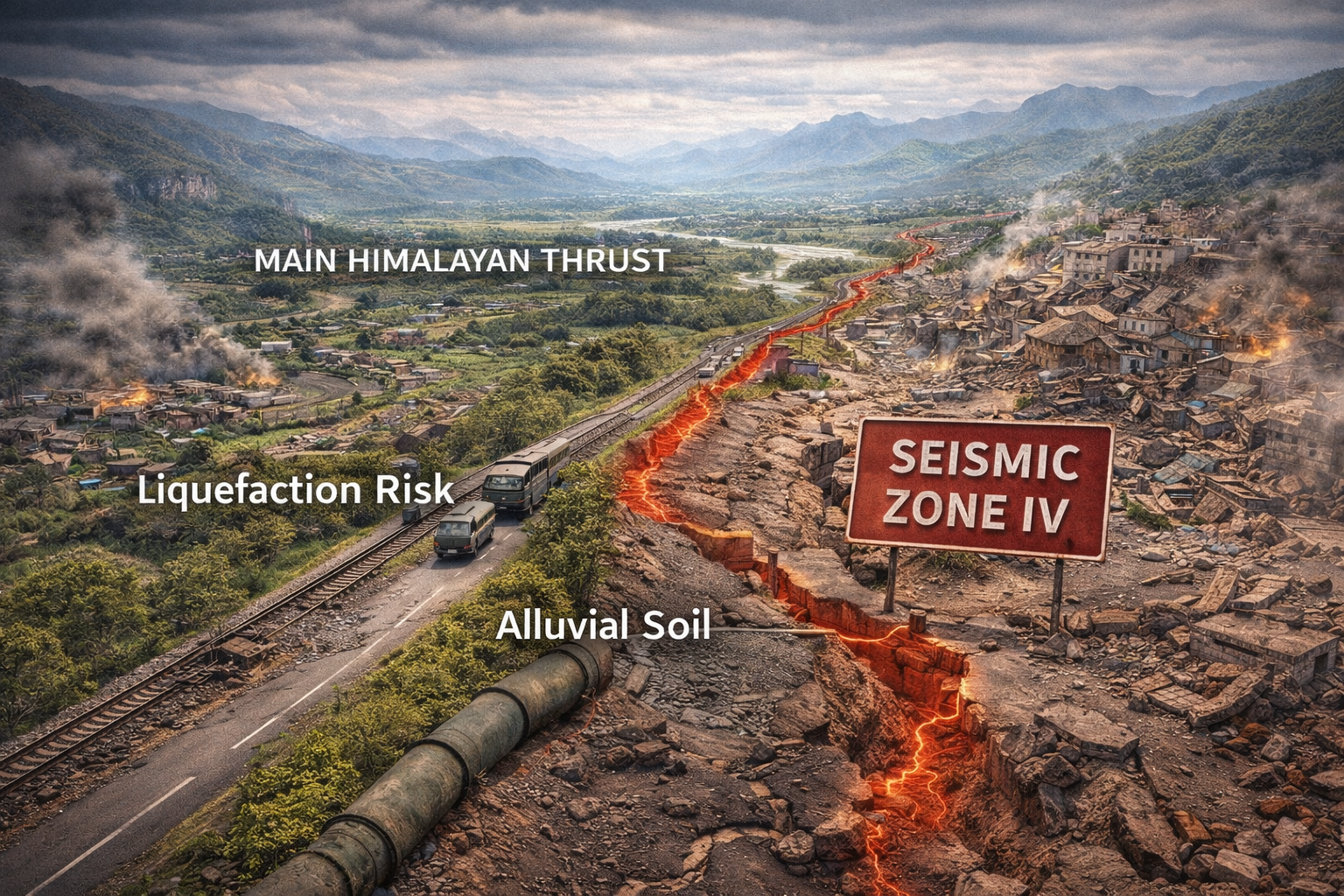
Geologically, the Siliguri Corridor sits in a dangerous neighborhood. It lies close to the Main Himalayan Thrust (MHT)—the massive fault where the Indian tectonic plate continues to push under the Eurasian plate. This convergence happens at roughly 40–50 millimeters per year, building stress that is released periodically through earthquakes.
The corridor itself is classified as Seismic Zone IV, which means high damage risk. While it is not Zone V like parts of Assam, the danger here comes from the ground beneath. Much of the corridor lies in the Teesta River basin, made up of soft alluvial soil. During strong earthquakes, this soil is prone to liquefaction—a phenomenon where solid ground temporarily behaves like liquid.
Liquefaction is especially destructive for linear infrastructure. Rail tracks can bend or sink. Highways can crack and slide. Bridge foundations can lose strength in seconds. In past earthquakes across the world—from Japan to Nepal—liquefaction has caused more damage than shaking itself.
Now consider the stakes. 100% of India’s land-based trade, troop movement, and fuel supply to the Northeast passes through this corridor. There is no redundancy on land. No parallel route. No quick bypass. In seismic terms, this makes the Siliguri Corridor a single-point failure of national importance.
Geological Survey of India (GSI)
III. The Geopolitical Pivot: The China Factor
Seismic risk alone would be serious enough. But geography adds another layer of danger.
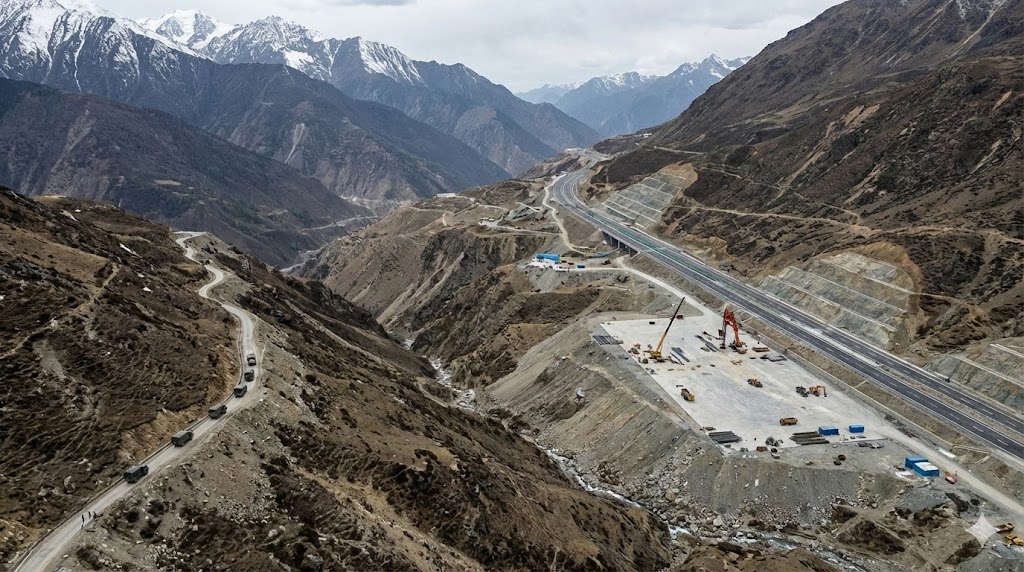
Just north of the Siliguri Corridor lies the Chumbi Valley, a narrow wedge of territory controlled by China, wedged between India and Bhutan. Over the past decade, satellite imagery and defense assessments have shown rapid expansion of dual-use infrastructure here—roads, logistics hubs, and airstrips that can serve both civilian and military purposes.
Under normal circumstances, India maintains a watchful balance in this region. But imagine a different scenario. A major earthquake hits the eastern Himalayas. Bridges in the Siliguri Corridor collapse. Rail traffic is suspended. Fuel pipelines are shut for safety. Civil administration is focused on rescue and relief.
This creates what strategists call a “gray-zone opportunity.” Without firing a shot, an adversary could exploit natural chaos. Even limited movement or pressure near disputed border areas could strain India’s response capacity when its internal lines of communication are severed.
This is the “dual disaster” scenario: a natural catastrophe combined with a geopolitical stress test. History shows that wars and crises often emerge not in moments of strength, but in moments of disruption.
IV. The Logistics of Isolation: Rail, Road, and Pipe
To understand why the Siliguri Corridor matters so much, one must break down its logistics layer by layer.
Rail: The New Jalpaiguri Nerve Center
The New Jalpaiguri (NJP) rail hub is the nervous system of the Northeast. Nearly all long-distance trains to Assam, Tripura, Manipur, Mizoram, and Arunachal Pradesh pass through NJP. A prolonged shutdown here would isolate millions within days.
Road: National Highways Under Stress
National highways running through Siliguri carry essential goods—food grains, medicines, construction materials, and fuel tankers. Even a partial closure can create shortages within a week in remote hill states.
Energy: Pipelines as Lifelines
The Guwahati–Barauni pipeline and related fuel supply chains feed refineries, power plants, and civilian consumption across the Northeast. Pipeline damage during earthquakes is a known risk, especially in liquefaction-prone zones.
Together, these systems form a single logistical spine. When the spine breaks, paralysis follows.
This is why alternative routes are no longer optional. Projects like the Kaladan Multi-Modal Transit Transport Project (via Myanmar) and access to Chittagong Port (via Bangladesh) are now widely seen as existential necessities, not diplomatic luxuries. They provide strategic depth—backup routes that reduce over-dependence on the Siliguri Corridor.
National Disaster Management Authority (NDMA)
V. Siliguri Corridor Vulnerability Matrix
| Threat Factor | Impact Level | Strategic Consequence |
|---|---|---|
| Seismic (Zone IV) | High | Destruction of bridges, rails, highways |
| Liquefaction | Severe | Long repair timelines |
| Logistics | Critical | Complete cutoff of 8 states |
| Geopolitical | Extreme | Exposure to Chumbi Valley pressure |
| Economic | High | Daily trade loss ~₹1,200 crore |
This matrix explains why planners increasingly describe the corridor as “too small to fail.”
VI. From “Act East” to “Protect East”
For years, India’s Northeast policy was framed under the banner of “Act East.” The goal was integration—better roads, more trade, stronger ties with Southeast Asia. That vision remains important, but it is no longer enough.
The reality of 2026 demands a shift toward “Protect East.” Protection does not only mean soldiers and surveillance. It means engineering, redundancy, and resilience.
Experts increasingly argue for a “tunneling revolution” in the Siliguri Corridor. Deep-rock tunnels for rail and road traffic are far less vulnerable to surface-level liquefaction. Underground fuel storage and protected pipelines can keep energy flowing even when the surface shakes. Countries like Japan and Switzerland have already shown how seismic engineering can turn geography from a weakness into a strength.
Natural disasters in the eastern Himalayas are not just humanitarian events. They are strategic stress tests. If India aspires to regional leadership and internal stability, it must treat seismic resilience as a core national security doctrine, not a footnote in disaster management plans.
The Siliguri Corridor is India’s jugular. Protecting it is not about fear—it is about foresight.
❓ Frequently Asked Questions (FAQ)
1. What is the Siliguri Corridor and why is it important?
The Siliguri Corridor is a narrow stretch of land in West Bengal that connects mainland India to the eight Northeastern states. It is India’s only land route to the Northeast, making it critical for trade, transport, energy supply, and national security.
2. Why is the Siliguri Corridor called the “Chicken’s Neck”?
It is called the Chicken’s Neck because it is very narrow—only about 22–25 km wide at its narrowest point—similar to the neck of a chicken. Any disruption here can choke movement to the Northeast.
3. Is the Siliguri Corridor located in an earthquake-prone area?
Yes. The corridor lies in Seismic Zone IV, which is a high-risk earthquake zone. It is close to major fault systems linked to the Himalayan tectonic movement.
4. What makes earthquakes especially dangerous for the Siliguri Corridor?
The region has soft alluvial soil from the Teesta river basin. During strong earthquakes, this soil can undergo liquefaction, causing roads, railways, bridges, and pipelines to sink or collapse.
5. What is liquefaction and why does it matter here?
Liquefaction happens when water-saturated soil temporarily behaves like liquid during an earthquake. In the Siliguri Corridor, liquefaction can destroy rail tracks, highways, and fuel pipelines within minutes.
6. What would happen if the Siliguri Corridor is cut off?
If the corridor is blocked, the entire Northeast could be isolated from mainland India. This would disrupt food supplies, fuel delivery, trade, military movement, and emergency response.
7. How much economic loss could a corridor failure cause?
Experts estimate that a complete disruption could lead to daily trade losses of around ₹1,200 crore, apart from long-term economic and strategic damage.
8. Why is China’s Chumbi Valley relevant to this issue?
The Chumbi Valley lies just north of the corridor. China has developed dual-use infrastructure there. In a major earthquake scenario, India’s disrupted logistics could increase vulnerability during any geopolitical tension.
9. What is the “dual disaster” scenario?
It refers to a situation where a major earthquake damages the corridor while a border standoff or geopolitical pressure occurs simultaneously, stretching India’s response capacity.
10. Are there alternative routes to the Northeast?
Yes, but they are limited. Projects like the Kaladan Multi-Modal Transit Project (via Myanmar) and access through Bangladesh ports offer alternatives, but they are still being expanded.
11. What can India do to reduce this risk?
India needs stronger seismic-resistant infrastructure, strict building code enforcement, and underground tunnels for transport and pipelines to reduce surface-level damage.
12. Why is tunneling seen as a long-term solution?
Deep-rock tunnels are far less affected by liquefaction and surface shaking. Countries like Japan use underground infrastructure to maintain connectivity during earthquakes.
13. Is this only a disaster management issue?
No. This is also a national security and strategic planning issue. Infrastructure resilience in the Siliguri Corridor directly affects India’s territorial integrity and regional stability.
14. What lesson does the Assam earthquake of 2026 offer here?
The Assam earthquake showed that even moderate quakes can disrupt large regions. It served as a warning that the Siliguri Corridor could face far greater consequences in a stronger quake.
15. What is the key takeaway from this analysis?
The Siliguri Corridor is too small to fail. Protecting it requires integrating seismic engineering, infrastructure planning, and national security thinking—not treating earthquakes as isolated natural events.
🔍 People Also Ask
Why is the Siliguri Corridor so important for India?
The Siliguri Corridor is the only land route connecting mainland India to the eight Northeastern states. All major transport, trade, fuel supply, and military movement depend on this narrow strip of land.
Is the Siliguri Corridor earthquake-prone?
Yes. The corridor lies in Seismic Zone IV, a high-risk earthquake zone, and is close to major Himalayan fault systems linked to tectonic plate movement.
What is Seismic Zone IV in India?
Seismic Zone IV indicates areas with a high probability of strong earthquakes. Infrastructure in this zone must follow strict earthquake-resistant construction standards.
Why is liquefaction a major risk in the Siliguri Corridor?
The region has soft, water-rich alluvial soil. During earthquakes, this soil can lose strength and behave like liquid, damaging roads, railways, and bridge foundations.
What happens if the Siliguri Corridor is blocked?
If blocked, the Northeast could be cut off from mainland India, affecting food supply, fuel, medical aid, trade, and security operations within days.
Can an earthquake completely shut down the corridor?
A strong earthquake could severely damage bridges, rail tracks, highways, and pipelines, making the corridor unusable for weeks or even months.
How does the Chumbi Valley affect Siliguri Corridor security?
The Chumbi Valley lies just north of the corridor and hosts Chinese dual-use infrastructure. During a crisis, disruption in Siliguri could increase strategic vulnerability.
What is the “Chicken’s Neck” in Indian geography?
“Chicken’s Neck” is another name for the Siliguri Corridor because of its narrow shape and its role as a critical lifeline to the Northeast.
Are there alternative routes to connect Northeast India?
Yes, routes through Bangladesh ports and the Kaladan Multi-Modal Project via Myanmar exist, but they are still developing and cannot fully replace the corridor yet.
How much economic loss can occur if the corridor fails?
Experts estimate daily economic losses of around ₹1,200 crore, apart from long-term trade and investment damage.
Is this risk only about natural disasters?
No. It is also a strategic and national security issue, because infrastructure failure can weaken India’s ability to respond to geopolitical challenges.
What can India do to protect the Siliguri Corridor?
India can invest in earthquake-resistant infrastructure, underground tunnels, alternative routes, and stricter enforcement of seismic building codes.
Why are tunnels safer during earthquakes?
Deep-rock tunnels are less affected by surface shaking and liquefaction, making them more reliable during major earthquakes.
Has India faced similar infrastructure risks before?
Yes. Earthquakes in Nepal (2015) and Japan (2011) showed how fragile surface infrastructure can be in seismic zones.
What is the key lesson from the Siliguri Corridor analysis?
The main lesson is that infrastructure resilience is national security. The corridor is too critical to rely on a single, surface-level route.