For anyone who has tracked India’s manufacturing story over the last three decades, Samvardhana Motherson International Ltd stands out as one of the most dramatic transformations. What began as a modest wiring harness supplier in India has evolved into a sprawling global manufacturing platform with operations across Europe, the Americas, and Asia. The Q3 FY26 results, released on February 10, 2026, mark a moment when years of global bets, acquisitions, and operational discipline finally came together in one clean narrative.
This quarter matters because it strips away the usual complexity surrounding Motherson’s numbers. The message is now simple: global supply chains are moving away from China, electric vehicles are increasing component intensity, and customers want scale plus reliability. Motherson sits exactly at that intersection.
Executive Summary: The Quarter the Global Bet Paid Off
In Q3 FY26, Motherson reported a consolidated net profit of ₹1,105 crore, a strong 22% year-on-year increase, supported by record quarterly revenue of ₹32,150 crore, up 18% YoY. EBITDA rose even faster, climbing 27.2% to ₹3,150 crore, pushing margins higher despite inflationary pressures across logistics and wages.
The stock touched a 52-week high after the results, not because of a one-off earnings beat, but because the market finally recognized that Motherson’s global diversification strategy is working. The February 2026 India–US trade framework, which lowered effective tariffs on auto components to around 18%, further strengthened Motherson’s competitive position in the American market.
More importantly, this quarter confirmed that Motherson is no longer just an auto ancillary company. Its non-auto businesses—Aerospace, Health, and Industrial solutions—are now meaningful contributors to margins, changing the quality of earnings.
Samvardhana Motherson Investor Presentation
Financial Dashboard: Scale Meets Efficiency
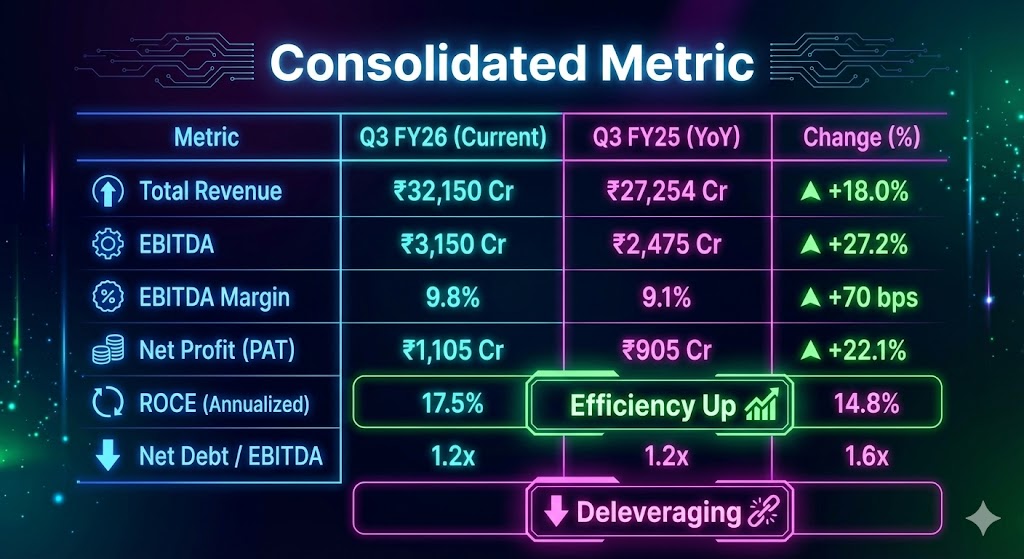
The financial numbers tell a clear story of operational leverage. Revenue grew 18% YoY, but EBITDA expanded at a much faster 27.2%, indicating better pricing, improved product mix, and successful integration of acquired businesses. EBITDA margins improved to 9.8%, up 70 basis points from last year, which is significant for a global manufacturing company operating in multiple geographies.
Net profit growth of 22.1% outpaced revenue growth, showing that cost control and efficiency initiatives are translating into shareholder value. Return on capital employed (ROCE), on an annualized basis, improved to 17.5%, up from 14.8%, reflecting better utilization of both organic and acquired assets.
Equally important is balance sheet discipline. Net debt to EBITDA reduced to 1.2x, down from 1.6x a year ago. This deleveraging strengthens resilience in a world where interest rates remain volatile and capital is no longer cheap.
The Wiring Harness Supercycle: Why EVs Are a Game Changer
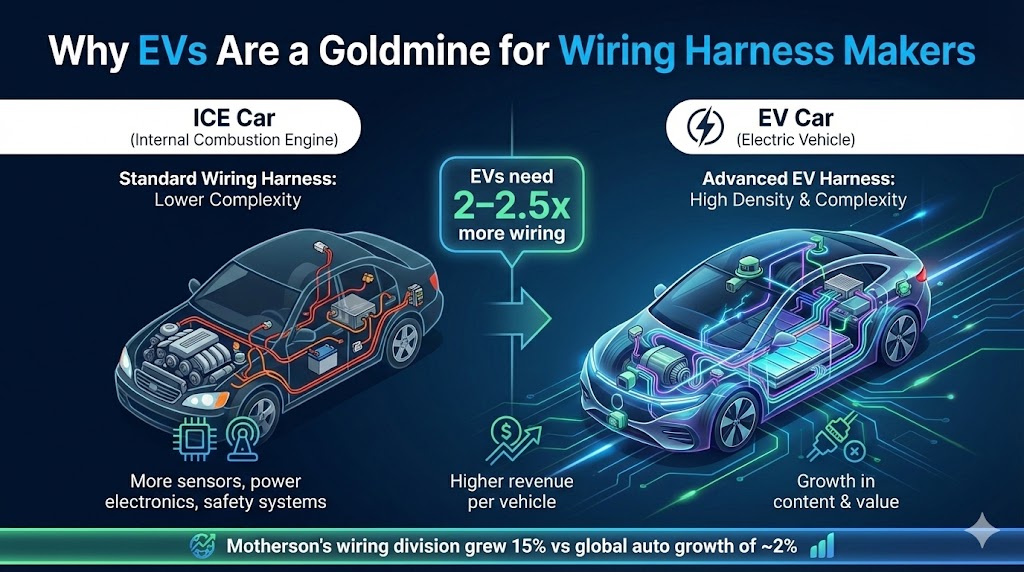
At the heart of Motherson’s growth lies its wiring harness business, which continues to be the company’s single most important engine. The logic is structural and long-term. Electric vehicles require 2 to 2.5 times more wiring than internal combustion engine vehicles. They are not just cars with batteries; they are computers on wheels, packed with sensors, power electronics, and safety systems.
In Q3 FY26, Motherson’s wiring harness division grew 15% year-on-year, far outpacing global automobile production growth, which stood at roughly 2%. This gap is crucial. It shows that Motherson is not merely riding industry growth—it is gaining market share and increasing revenue per vehicle.
Global OEMs such as Volkswagen, Mercedes-Benz, and BMW are accelerating EV platform rollouts in 2026. Each new platform increases wiring complexity, and OEMs prefer suppliers who can deliver at scale, across geographies, with high quality. Motherson fits that requirement better than most peers.
International Energy Agency – Global EV Outlook
Beyond Autos: The Non-Auto Moonshot Takes Shape
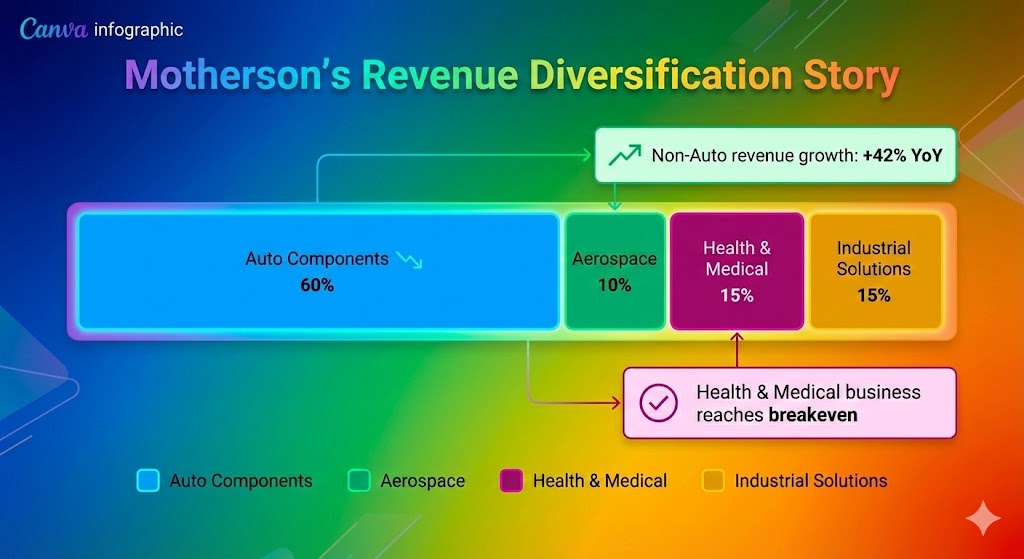
One of the most underappreciated aspects of Motherson’s transformation is its non-auto business, which grew an impressive 42% YoY in Q3 FY26. This segment includes Aerospace, Health & Medical, and Industrial solutions, and it is central to the company’s long-term risk diversification strategy.
The aerospace division, which supplies components to global giants like Boeing and Airbus, benefits from long product cycles, high entry barriers, and superior margins. Orders in this segment are less sensitive to short-term economic fluctuations and are often backed by multi-year contracts.
The Health & Medical division reached breakeven this quarter, a milestone that management has been working toward for several years. While still small in revenue terms, this business represents a strategic hedge against cyclicality in auto demand and aligns with global trends toward medical device outsourcing.
Boeing Commercial Market Outlook
3CX10 Strategy: Risk Reduction Through Design
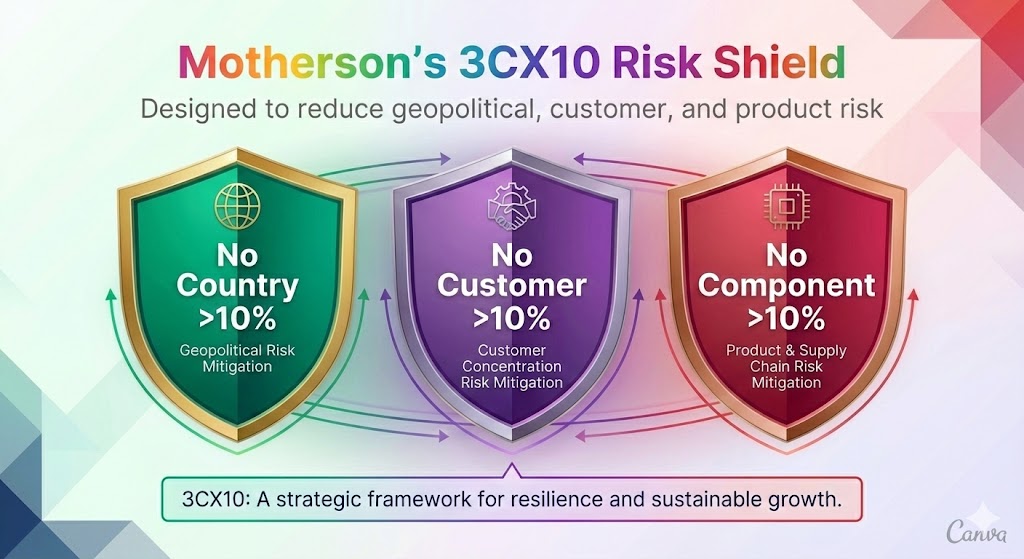
Motherson’s 3CX10 strategy—no country, customer, or component contributing more than 10% of revenue—may sound like corporate jargon, but Q3 FY26 shows its real-world impact. Revenue growth is now broad-based across geographies, customers, and product categories.
This diversification protects Motherson from geopolitical shocks, regulatory changes, or customer-specific downturns. When European auto demand softens, North American EV programs compensate. When auto slows, aerospace and industrial segments step in. This structural balance is why earnings volatility has reduced despite the company’s massive global footprint.
Inorganic Growth: Turning Acquisitions into Assets
Motherson has built its empire through acquisitions, but critics have often questioned whether it can integrate them profitably. Q3 FY26 provides a strong answer. The integration of SAS Autosystemtechnik, acquired during 2024–25, is now fully accretive to margins.
EBITDA margin improvement to 9.8% is proof that the “Motherson Way”—focused on lean operations, local management empowerment, and cost discipline—works even in mature European markets. What once looked like distressed assets are now stable contributors to cash flow.
This ability to buy stressed businesses and turn them around is a core competitive advantage. It allows Motherson to grow faster than peers without paying peak-cycle valuations.
Geopolitics and Policy: The Trade Deal Tailwind
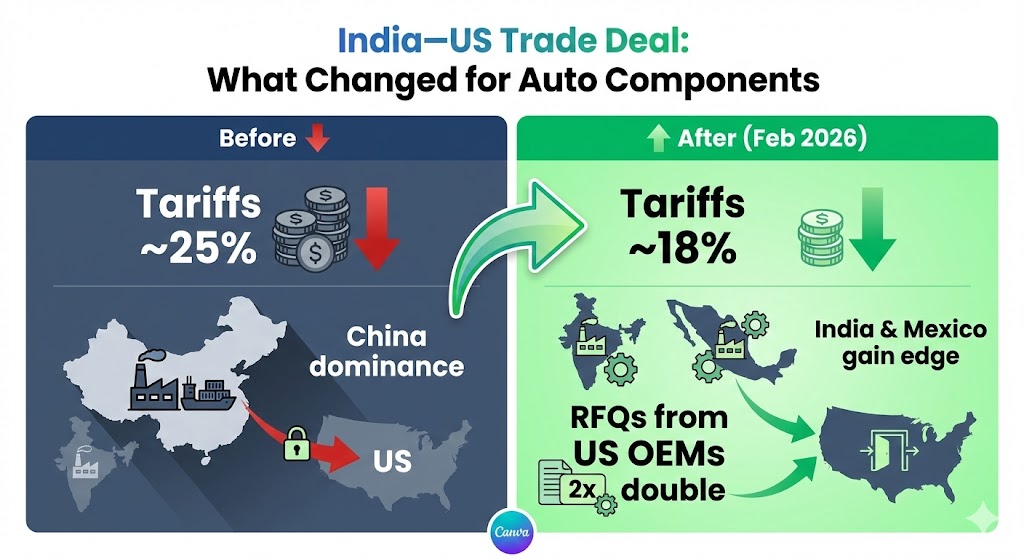
The February 2026 India–US Trade Deal has meaningful implications for Motherson. Earlier, Indian auto components faced punitive tariffs under US trade laws, often touching 25% or more. The new framework reduces effective tariffs to around 18%, making Indian and Mexico-based production more competitive.
For Motherson, this is critical. Its Indian and Mexican plants can now supply US OEMs at lower landed costs than Chinese suppliers, who continue to face higher tariffs and geopolitical scrutiny. Management disclosed that RFQs from US automakers have doubled since the trade deal announcement.
This is not a short-term boost; it is a structural shift. As global automakers de-risk supply chains away from China, Motherson is increasingly viewed as a “safe pair of hands” for complex components requiring manual assembly and engineering precision.
China+1 Is No Longer a Theory
For years, “China+1” was discussed as a concept. Q3 FY26 shows it in execution. Automakers want redundancy, political neutrality, and operational resilience. Motherson offers all three, with facilities across India, Eastern Europe, Mexico, and Southeast Asia.
Unlike pure-play Chinese suppliers, Motherson’s global manufacturing network allows customers to shift production without redesigning components. This flexibility is now a decisive advantage, especially in a world of trade tensions and regional conflicts.
Risks to Monitor: What Could Go Wrong
Despite the strong quarter, risks remain. Freight and logistics costs, especially due to Red Sea disruptions, have risen. While Motherson has pass-through clauses with customers, there is often a 3–6 month lag that can temporarily affect cash flows.
Wage inflation is another concern. A significant portion of Motherson’s workforce is based in Eastern Europe and Mexico, where labor costs are rising. Sustained margin expansion will require productivity gains to offset these pressures.
Currency volatility is also a factor, given the company’s multi-currency revenue base. However, Motherson’s natural hedges across regions help reduce extreme exposure.
Valuation and Investor Perspective
At around 28x FY27 earnings, Motherson is not cheap by traditional auto ancillary standards. However, this valuation reflects its transformation into a global, diversified manufacturing platform, not a cyclical supplier.
The combination of margin expansion, deleveraging, and trade-policy tailwinds supports a premium valuation. Importantly, earnings quality has improved, with higher contribution from non-auto and high-value segments.
Conclusion: A Global Manufacturing Sovereign
Samvardhana Motherson is no longer a proxy for the Indian auto cycle. It is a proxy for global manufacturing realignment. Q3 FY26 demonstrates that scale, complexity, and geographic diversity are now being rewarded in a fractured global economy.
For long-term investors, this is not a momentum story. It is a structural “Buy on Dips” candidate for those who believe that supply chains will continue to diversify, EVs will increase component intensity, and geopolitics will favor trusted, neutral manufacturers.
The global bet has paid off—and the runway still looks long.
❓ FAQ
Q1. Why did Samvardhana Motherson’s profit rise in Q3 FY26?
Samvardhana Motherson’s profit rose due to higher EV-led wiring harness demand, margin expansion, growth in non-auto businesses like aerospace, and improved global supply chain positioning.
Q2. What is the China+1 strategy and how does it benefit Motherson?
China+1 refers to global companies diversifying manufacturing away from China. Motherson benefits because global OEMs are shifting sourcing to India, Mexico, and Europe where Motherson has strong operations.
Q3. How does EV growth impact Motherson’s business?
Electric vehicles require up to 2.5 times more wiring than traditional vehicles, increasing revenue per vehicle for wiring harness suppliers like Motherson.
Q4. Is Motherson still just an auto ancillary company?
No. Motherson has expanded into aerospace, health, and industrial manufacturing, reducing dependence on auto cycles and improving earnings stability.
Q5. How does the India-US trade deal affect Motherson?
The trade deal lowered US tariffs on Indian auto components, making Motherson more competitive versus Chinese suppliers and increasing RFQs from US automakers.