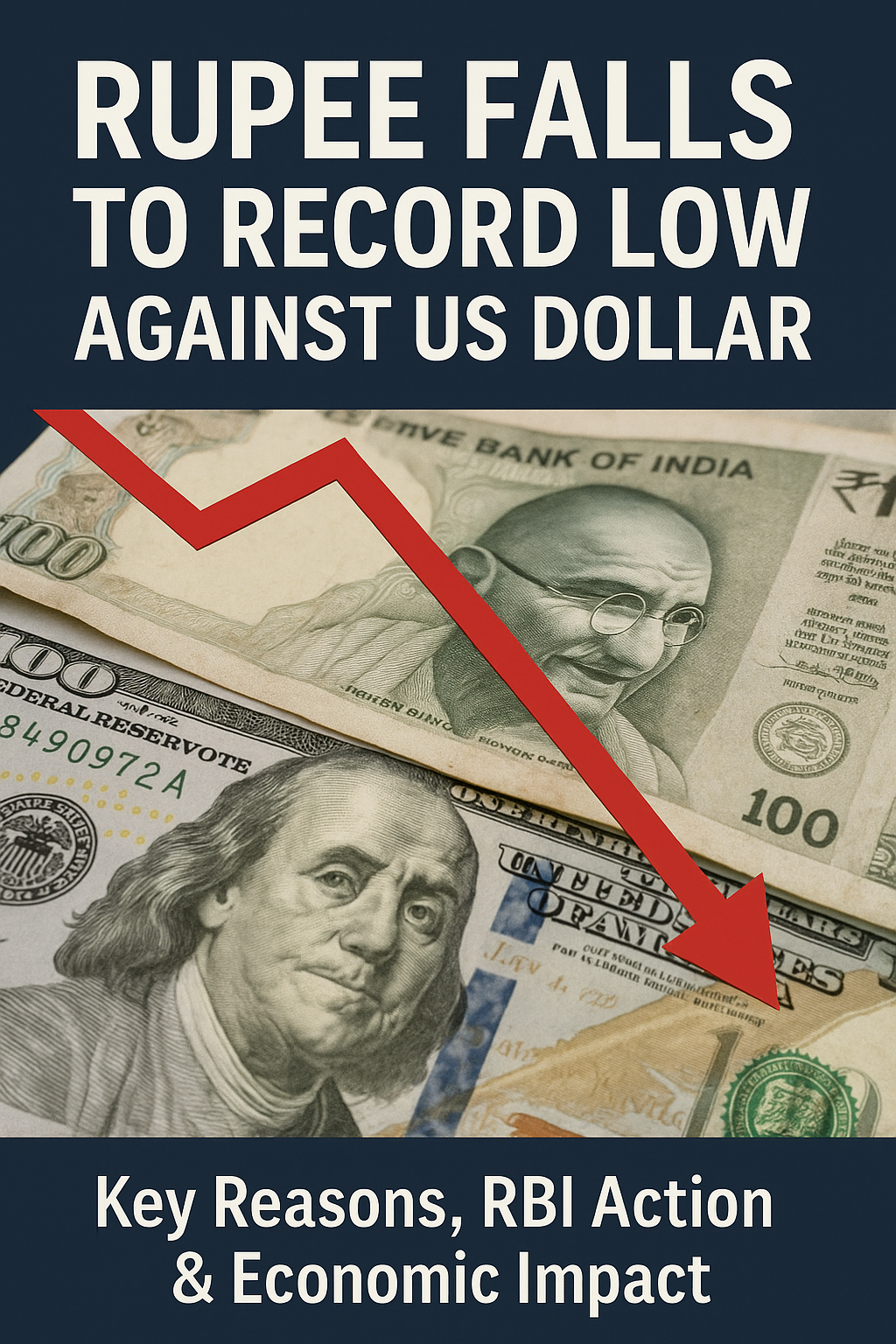
Indian Rupee Reaches Record Low Against US Dollar Today: Why It Fell & What It Means for India
The Indian rupee today slipped to a new record low against the US dollar, briefly touching the ₹90 per dollar level in intraday trade. This fall has created concern among businesses, importers, exporters, investors, and ordinary citizens watching inflation rise steadily.
Despite India being one of the fastest-growing major economies, the rupee continues to face pressure due to global uncertainties, foreign outflows, and rising demand for the US dollar.
In this detailed analysis, we break down:
Why the rupee is falling
What the RBI said
Government’s stand on the currency slide
Impact on imports, exports, and India’s current account
What foreign and domestic brokerages predict
Rupee’s long journey from ₹50 per dollar to ₹90 per dollar
Past trends and future expectations
Final takeaway and conclusion
Why Is the Indian Rupee Falling?
The fall in the rupee is not due to just one reason. It’s the result of multiple global and domestic economic factors, which together create pressure on the currency.
1. Strong US Dollar Worldwide
The US Federal Reserve has kept interest rates high for a longer period. When US rates are high, global investors prefer to put their money in the US instead of emerging markets like India.
This leads to:
Outflow of foreign capital
Strong demand for the US dollar
Pressure on currencies like the rupee
2. India’s Rising Trade Deficit
India currently imports more than it exports.
High imports + lower exports = large trade deficit
A higher deficit means India needs more dollars to pay for imports like oil, electronics, gold, and machinery. This increases demand for the US dollar and weakens the rupee.
3. Delay in US–India Trade Deal
The uncertainty in trade agreements between the US and India is also creating market nervousness. Without clarity on tariff structures and bilateral commitments, global investors are hesitant.
A delayed deal means:
Lower foreign investment
Higher risk perception
Weakness in the rupee
4. Heavy Foreign Portfolio Outflows
Foreign investors have been selling Indian stocks and bonds. After selling, they convert the rupees into dollars, increasing dollar demand.
FPIs pulling out billions of dollars has directly impacted the rupee’s stability.
5. Market Psychology
When rupee weakens:
Importers buy more dollars quickly to avoid future losses
Exporters hold dollars, expecting the rupee to fall more
This imbalance increases volatility.
What RBI Said on the Rupee Fall
The Reserve Bank of India (RBI) does not target a fixed exchange rate. Its official stand remains:
The rupee is a market-determined currency
RBI only intervenes to prevent excessive volatility, not to fix a specific level
However, in the last few days, signs suggest that RBI has been:
Selling dollars through state-run banks
Managing volatility in both spot and forward markets
Ensuring the fall does not turn into a free fall
RBI also has comfortable forex reserves, giving them enough strength to support the rupee during extreme pressure.
Government’s Stand on the Rupee Slide
The government usually avoids daily commentary on exchange rates. Its broad position is:
Exchange rate is driven by market forces
India’s economic fundamentals remain strong
A weaker currency is not always negative, as it can boost exports
The government highlights that India’s:
GDP growth
Manufacturing push
Infrastructure investment
Digital economy
…will keep medium-term investor confidence intact.
How Rupee Fall Impacts Imports, Exports & India’s Current Account
This is one of the most important sections for your readers. A falling rupee affects the economy in many ways:
1. Impact on Imports: Costlier Goods for India
India imports:
Crude oil
Electronics
Fertilizers
Edible oil
Machinery
When the rupee weakens:
These goods become more expensive in rupee terms
Fuel prices can rise
Transportation cost increases
Inflation pressure goes up
A ₹1 depreciation can cost Indian oil companies thousands of crores more annually.
2. Impact on Exports: A Mixed Outcome
A weaker rupee helps exporters on paper, because:
They earn in dollars
After conversion, they get more rupees
Sectors that benefit:
IT services
Pharma
Textiles
Chemicals
However, export gains are not always automatic because:
Many exporters import raw materials
Global demand is weak
Competition from other countries is high
So the benefit is limited, not massive.
3. Impact on India’s Current Account Deficit (CAD)
CAD = difference between what India earns from exports & what it spends on imports
When imports become costlier:
CAD widens
The government and RBI face pressure
Ratings agencies worry
Foreign investors become cautious
A higher CAD puts downward pressure on the rupee, creating a cycle.
4. Impact on Inflation
A weak rupee increases the price of:
Fuel
Imported food
Electronics
Consumer goods
Medicines
This pushes inflation up — something RBI wants to avoid.
5. Impact on Common People
A record-low rupee affects everyday life:
Foreign travel becomes expensive
Students studying abroad pay higher fees
Imported gadgets cost more
Petrol and diesel prices can rise
Daily-use products get costlier
Essentially, a weak rupee hits the middle class the hardest.
What Foreign Brokerages Are Saying About Rupee’s Future
Top global financial institutions remain cautious but not overly negative.
Jefferies
Believes the “worst may be over”
Expects rupee to hover around ₹90 for the next year
Goldman Sachs
Says rupee’s fall is overdone
Predicts appreciation to ₹88–89 if the US–India trade deal improves
ANZ Banking Group
If trade deal is positive → rupee can reach ₹88
If it delays → rupee can slide to ₹90.5
Consensus:
Rupee will stay weak in the short term, but no panic-level crash is expected.
Domestic Brokerages on Rupee’s Future Performance
Indian research houses remain conservative.
HDFC Securities
Predicts a trading range of:
₹89.3–₹89.95 near term
Kotak & ICICI Sec
Say rupee may remain under pressure due to:
High imports
Weak exports
Global uncertainties
Domestic view:
Weakness will continue but the rupee will not “collapse.”
Rupee’s Journey From ₹50 to ₹90 Per Dollar
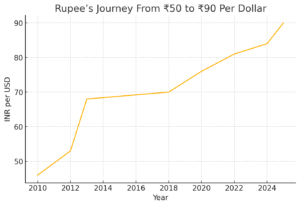
A quick timeline:
2010: ₹46
2012: ₹53
2013: ₹68 (taper tantrum)
2018: ₹70
2020: ₹76 (Covid period)
2022: ₹81
2024: ₹84
2025: Nearly ₹90
This nearly 80% depreciation in 15 years shows a long-term trend.
Why?
Because India’s inflation has historically been higher than the US.
Higher inflation → weaker currency over time.
How Rupee May Perform Based on Past Data
Historical data shows three patterns:
1. Rupee weakens gradually long term
Due to:
Higher inflation
Trade deficit
Import dependence
2. Rupee falls “in steps,” not continuously
2013 fall → stability 60–65
2018 fall → stability 69–75
2022 fall → stability 80–83
2025 → likely stability near 88–90
3. Stability returns after every sharp fall
Markets adjust, RBI intervenes, and global conditions normalise.
Final Takeaway
Rupee touching ₹90 is a reminder that India needs stronger export growth, reduced import dependence, and policy stability.
In the short term, the rupee may remain weak due to global uncertainty.
In the medium term, India’s strong economic fundamentals can bring stability.
For common Indians, the impact will be felt through inflation, travel, tuition fees, gadgets, and energy costs.
Conclusion
The Indian rupee hitting a record low against the US dollar is a major economic moment. It highlights the challenges India faces in global markets — from trade deficits to foreign outflows and policy delays.
But it also shows the strength of India’s growth story, which is why no major brokerage is predicting a collapse.
The rupee may stay around ₹88–₹90, depending on how global and domestic events shape up.
For now, the key takeaway is clear:
A weaker rupee affects everyone — from businesses to households — and understanding these changes helps us prepare for the future.