Why the ₹492 Billion Debt Sale Matters Right Now
India’s bond market recently witnessed a rare and powerful event. Indian state governments and state-run companies (PSUs) announced plans to raise ₹492 billion (₹49,200 crore) in a single-day cluster debt sale. In dollar terms, this amounts to roughly $5.49 billion, making it one of the largest one-day state-level borrowing exercises ever attempted in India.
This sudden surge in bond supply immediately pushed bond yields higher, while demand from traditional long-term investors such as pension funds and insurance companies remained weak. The reaction has triggered an important debate in financial markets: is this large borrowing programme a sign of fiscal stress, or does it present a tactical opportunity for investors looking for higher yields?
This development matters far beyond bond traders. Rising yields influence loan interest rates, state government spending, bank credit availability, pension returns, and even stock market sentiment. When governments borrow heavily and investors hesitate, the bond market sends a clear signal—and that signal deserves close attention.
What Is a Cluster Debt Sale? Explained in Simple Words

A cluster debt sale happens when several borrowers enter the bond market on the same day to raise large sums of money. In this case, both state governments and public sector undertakings (PSUs) are borrowing simultaneously.
A simple way to understand this is to imagine many people visiting the same bank on the same day, all asking for big loans. The bank becomes cautious, interest rates rise, and not everyone gets money at the same price or speed. The same logic applies in the bond market.
In India, borrowing typically happens at three levels:
Central Government Bonds (G-Secs) – lowest risk, lowest yield
State Government Bonds (SDLs) – slightly higher risk, higher yield
PSU Bonds – higher risk, higher return
States usually cluster borrowing because of urgent funding needs, cash-flow mismatches, large infrastructure spending, or fiscal year-end pressure. However, when too many bonds hit the market together, supply overwhelms demand and yields rise.
Breaking Down the ₹492 Billion Figure: Who Is Borrowing and Why
The proposed ₹492 billion debt sale includes borrowing by:
Multiple Indian state governments
Several state-owned firms in sectors such as power, transport, and infrastructure
The timing is critical. States are under pressure to fund:
Ongoing infrastructure projects
Subsidy payments and welfare schemes
Capital expenditure commitments
Budgeted spending targets before the fiscal year closes
To put this in perspective, most weekly state bond auctions usually range between ₹100–200 billion. A single-day supply of ₹492 billion is extraordinary and explains why bond markets reacted quickly.
| State | Auction Date | Amount Raised (₹ Crore) | Cut-off Yield (%) | Tenor (Years) |
| Maharashtra | Oct 7, 2025 | 5,000 | 7.09% – 7.26% | 11 – 17 |
| Telangana | Sept 23, 2025 | 5,000 | 7.44% | 22 – 26 |
| Bihar | Sept 23, 2025 | 4,000 | 7.45% | 20 – 25 |
| Tamil Nadu | Sept 23, 2025 | 4,000 | 7.02% – 7.26% | Re-issued bonds |
| Madhya Pradesh | Sept 23, 2025 | 3,000 | 7.43% – 7.44% | 18 – 21 |
| West Bengal | Sept 23, 2025 | 2,500 | 7.42% – 7.45% | 11 – 20 |
| Gujarat | Oct 7, 2025 | 2,000 | 7.06% | 8 |
Why Bond Yields Are Rising and Investor Demand Is Weak
Bond yields rise when prices fall, and prices fall when there are too many bonds and not enough buyers. That is exactly what the market is seeing now.
Heavy supply has flooded the bond market, forcing investors to demand higher yields as compensation. At the same time, traditional buyers are staying cautious.
Pension funds and insurance companies prefer stable, long-term bonds, but rising yields signal uncertainty. Banks are focused more on loan growth than bond investment. Liquidity conditions remain tight, and inflation concerns have not fully disappeared.
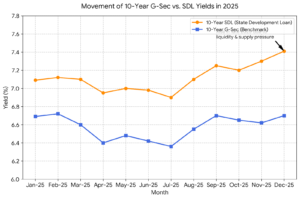
India’s 10-year government bond yield has been hovering around 7.2–7.3%, while yields on state development loans have moved even higher due to supply pressure.
Has India Seen Such Borrowing Pressure Before? A Historical View
India has experienced similar episodes, though rarely at this scale.
During the post-COVID period (2020–21), states borrowed heavily to fund healthcare and welfare spending. Bond yields rose sharply at first but later stabilised with RBI support.
During the global financial crisis (2008–09), aggressive government borrowing initially pushed yields higher before easing as growth slowed and policy support kicked in.
The key lesson from history is clear: large borrowing episodes usually create short-term stress in bond markets, followed by medium-term stabilisation if economic growth supports government revenues. This suggests that today’s stress is serious but not unprecedented.
What This Means for India’s Fixed-Income Market
For investors, the current environment presents both risk and opportunity.
Long-duration bond holders face pressure because rising yields reduce bond prices. Conservative debt funds may struggle in the short term. However, higher yields also mean better future returns for investors who enter carefully.
Short-term traders, tactical debt funds, and yield-focused investors may benefit if they manage interest-rate risk properly. In simple terms, higher yields today can translate into stronger income tomorrow—but only with discipline.
Impact on Banks, Pension Funds, and Insurance Companies
Banks are currently managing strong credit growth and capital requirements, leaving limited appetite for large bond purchases. Pension funds and insurance companies, which usually anchor government bond demand, are becoming selective due to volatility.
Their weaker participation matters because these institutions provide stability to bond auctions. If they stay cautious, future state borrowing programmes may also face pricing pressure.
What This Means for Government Finances and Fiscal Health
Higher yields directly increase borrowing costs for states. Interest payments already consume 15–20% of many state budgets. If yields remain elevated, states may face pressure to cut spending or delay projects in the future.
This becomes especially important during periods of high infrastructure spending, welfare commitments, and election-cycle pressures. Fiscal discipline will be tested.
How This Affects Common People
This is not just a market story—it affects everyday life.
When governments borrow at higher interest rates:
Loan EMIs can rise
Bank credit becomes costlier
State spending may slow later
Inflation risks increase
Taxes or fees may rise eventually
Simply put, when borrowing costs go up, someone pays—and that someone is often the citizen.
Bond Market vs Stock Market: Where Is Money Moving?
Rising yields make bonds more attractive for income seekers, but equity markets still offer growth potential. As a result, money is shifting—not fleeing—from bonds to equities and vice versa depending on risk appetite.
This rebalancing reflects caution, not panic.
Who Might Gain from This Debt Sale?
Potential beneficiaries include:
Short-duration debt fund investors
High-yield bond investors
Institutional players with long-term horizons
However, this is not a risk-free opportunity. Timing and risk management are crucial.
Key Risks to Watch Going Forward
Several risks remain:
Continued heavy borrowing by states
Global interest-rate movements
Inflation surprises
Fiscal slippage
Weak demand in future auctions
Each of these can influence bond yields further.
What Investors and Readers Should Watch Next
Key indicators to track include:
Upcoming state bond auctions
Yield movements
Investor demand trends
RBI liquidity signals
Budget-related borrowing announcements
Conclusion: A Stress Signal and an Opportunity at the Same Time
The ₹492 billion debt sale is historic not because borrowing is bad, but because it tested the bond market’s limits. Rising yields are a warning sign for fiscal discipline, yet also a potential opportunity for informed investors.
The bond market is sending a message.
And smart readers would do well to listen carefully.
To visit official site of RBI click here
Frequently Asked Questions (FAQ)
1️⃣ What is the ₹492 billion debt sale by Indian states and PSUs?
It refers to a planned one-day bond auction where Indian state governments and state-run companies aim to raise ₹492 billion (₹49,200 crore) from the bond market. This is one of the largest single-day state-level borrowings ever in India.
2️⃣ Why are Indian states borrowing such a large amount at once?
States are borrowing to fund infrastructure projects, welfare and subsidy payments, and to meet fiscal year-end spending targets. Clustering borrowing into a single day helps meet urgent cash needs but puts pressure on bond demand.
3️⃣ What is a cluster debt sale in simple terms?
A cluster debt sale happens when many borrowers raise money on the same day. Just like too many people applying for loans at once raises interest rates, heavy bond supply pushes yields higher.
4️⃣ Why did bond yields rise after the debt sale announcement?
Bond yields rose because the supply of bonds increased sharply, while demand from major investors like pension funds and insurers remained weak. Investors demanded higher returns to absorb the extra supply.
5️⃣ Why are pension funds and insurance companies cautious?
These long-term investors prefer stability. Rising yields, inflation uncertainty and tight liquidity make them hesitant to lock funds into long-duration bonds at this stage.
6️⃣ Does this debt sale indicate financial stress for Indian states?
Not necessarily distress, but it does signal fiscal pressure. Rising borrowing costs increase interest burdens and limit future spending flexibility if revenue growth does not keep pace.
7️⃣ How does this affect common people?
Higher government borrowing costs can lead to higher loan interest rates, reduced public spending in the future, and possible inflation pressure. Over time, citizens bear the impact through EMIs, taxes, or service charges.
8️⃣ Is this situation bad or good for bond investors?
It is both. Rising yields hurt existing bond prices but create opportunities for new investors seeking higher income, especially in short-duration or tactical debt instruments.
9️⃣ How does this impact banks and the financial system?
Banks are currently focused on credit growth rather than bond investments. Weak participation by banks and institutional investors could make future bond auctions more volatile.
🔟 How does this compare with past borrowing episodes in India?
Similar pressure was seen during the COVID-19 borrowing surge (2020–21) and the 2008–09 global financial crisis. In both cases, short-term yield spikes were followed by stabilisation as growth and policy support improved.
1️⃣1️⃣ Should retail investors worry about India’s bond market?
Retail investors should not panic but stay informed. Understanding duration risk, yield trends and policy signals is more important than reacting emotionally to headlines.
1️⃣2️⃣ What should investors watch next?
Key indicators include upcoming bond auctions, yield movements, institutional demand, RBI liquidity measures, and Budget borrowing plans.
To visit RBI Retail Direct click here
People Also Ask (PAA)
What is a cluster debt sale in India?
A cluster debt sale happens when several state governments or public sector companies issue bonds on the same day. This increases bond supply sharply and usually pushes interest rates higher.
Why are Indian states borrowing so heavily right now?
States need funds for infrastructure projects, welfare schemes, subsidies and fiscal year-end spending. Higher capital expenditure and tighter budgets are forcing larger borrowings.
Why do bond yields rise when government borrowing increases?
When more bonds are issued at once, investors demand higher returns to absorb the supply. This causes bond prices to fall and yields to rise.
Is India’s ₹492 billion debt sale a sign of fiscal stress?
It indicates fiscal pressure but not a crisis. Large borrowings increase interest costs, and markets closely watch whether revenue growth can support higher debt.
How does this debt sale affect banks and pension funds?
Banks are prioritising loan growth, while pension and insurance funds are cautious due to volatility. Their weak demand can make bond auctions more volatile.
Does rising bond yield affect home loans and EMIs?
Yes. Higher government bond yields often lead to higher interest rates across the economy, which can increase home loan and personal loan EMIs over time.
Is this a good time to invest in bonds in India?
Rising yields create opportunities for new investors seeking higher income, but risks remain. Short-duration or tactical investments are generally safer than long-term bonds during volatile periods.
How does state borrowing impact inflation?
If higher borrowing leads to more spending without matching revenue, it can increase inflation. However, productive infrastructure spending may support growth without causing inflation.
What is the difference between state bonds and central government bonds?
State bonds (SDLs) offer higher yields but carry slightly more risk than central government bonds, which are considered the safest fixed-income instruments in India.
How does this compare with past borrowing periods like COVID-19?
During the COVID-19 period, states borrowed heavily and yields rose initially. Later, yields stabilised due to policy support and economic recovery.
Will future state bond auctions face similar pressure?
If borrowing remains high and investor demand stays weak, future auctions may continue to see higher yields and volatility.
What should investors watch after this debt sale?
Key factors include upcoming bond auctions, yield movements, inflation data, RBI policy actions and government borrowing plans.