Introduction: Why RBI’s Annual Banking Report Matters So Much
Every year, one report quietly tells the real story of India’s financial system. It does not create headlines like Budget Day, and it does not move markets in minutes like interest rate announcements. Yet, for anyone who wants to understand the true health of India’s banks, this report is critical. That document is the Trend and Progress of Banking in India Report released by the Reserve Bank of India.
The latest report, released in 2025, comes at a time when India’s economy is growing, credit demand is strong, and digital banking has reached almost every household. On the surface, things look stable and positive. But RBI’s report goes deeper. It celebrates major achievements, especially the sharp fall in bad loans, while also warning about new risks that could quietly damage the system if ignored. This balance between confidence and caution defines RBI’s current approach.
The Big Headline: Bad Loans at a Multi-Decade Low
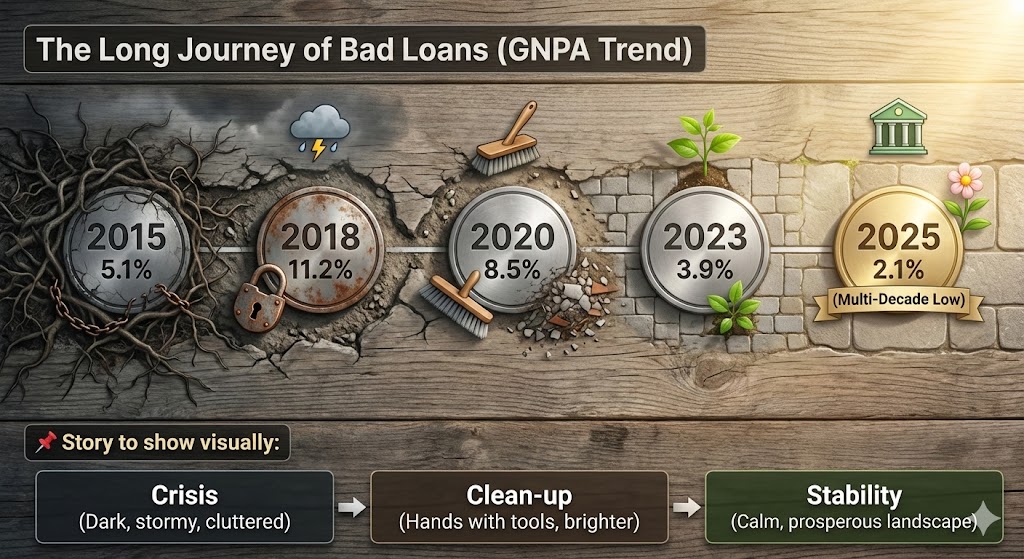
📌 Story to show visually: Crisis → Clean-up → Stability.
The most striking number in the report is this: Gross Non-Performing Assets (GNPA) of scheduled commercial banks fell to 2.1%. This is the lowest level India has seen in decades. For readers unfamiliar with banking terms, GNPA simply means the share of loans where borrowers have stopped repaying for a long period.
To understand how big this achievement is, one must look back. In 2018, India’s GNPA ratio had crossed 11%, putting enormous stress on public and private banks. At that time, banks were hesitant to lend, projects stalled, and economic growth slowed. Compared to that crisis period, today’s 2.1% level marks a dramatic turnaround and reflects years of policy effort.
How India Cleaned Up Its Banking System
This improvement did not happen overnight. It is the result of a long and sometimes painful clean-up process. One of the most important steps was the Insolvency and Bankruptcy Code (IBC), which changed how defaulting companies were handled. Earlier, bad loans remained unresolved for years. Under IBC, time-bound resolution forced both lenders and borrowers to act seriously.
Another major step was RBI’s Asset Quality Review (AQR). This exercise forced banks to recognise bad loans honestly instead of hiding them through restructuring. While this initially increased reported NPAs, it created transparency and trust in bank balance sheets. The government also supported banks through capital injections, helping them absorb losses and start fresh lending.
What “Strongly Positioned” Actually Means
In its report, RBI described the banking system as “strongly positioned.” This phrase is carefully chosen. It does not mean the system is perfect or free from risk. It means banks today have enough capital, liquidity, and profitability to handle shocks.
Most Indian banks now maintain capital levels well above regulatory minimums. Their profitability has improved, supported by higher interest income and better cost control. Liquidity conditions remain comfortable, allowing banks to meet withdrawal demands and fund credit growth. This overall strength gives RBI confidence, but not complacency.
Credit Growth Is Back — And That Brings New Challenges
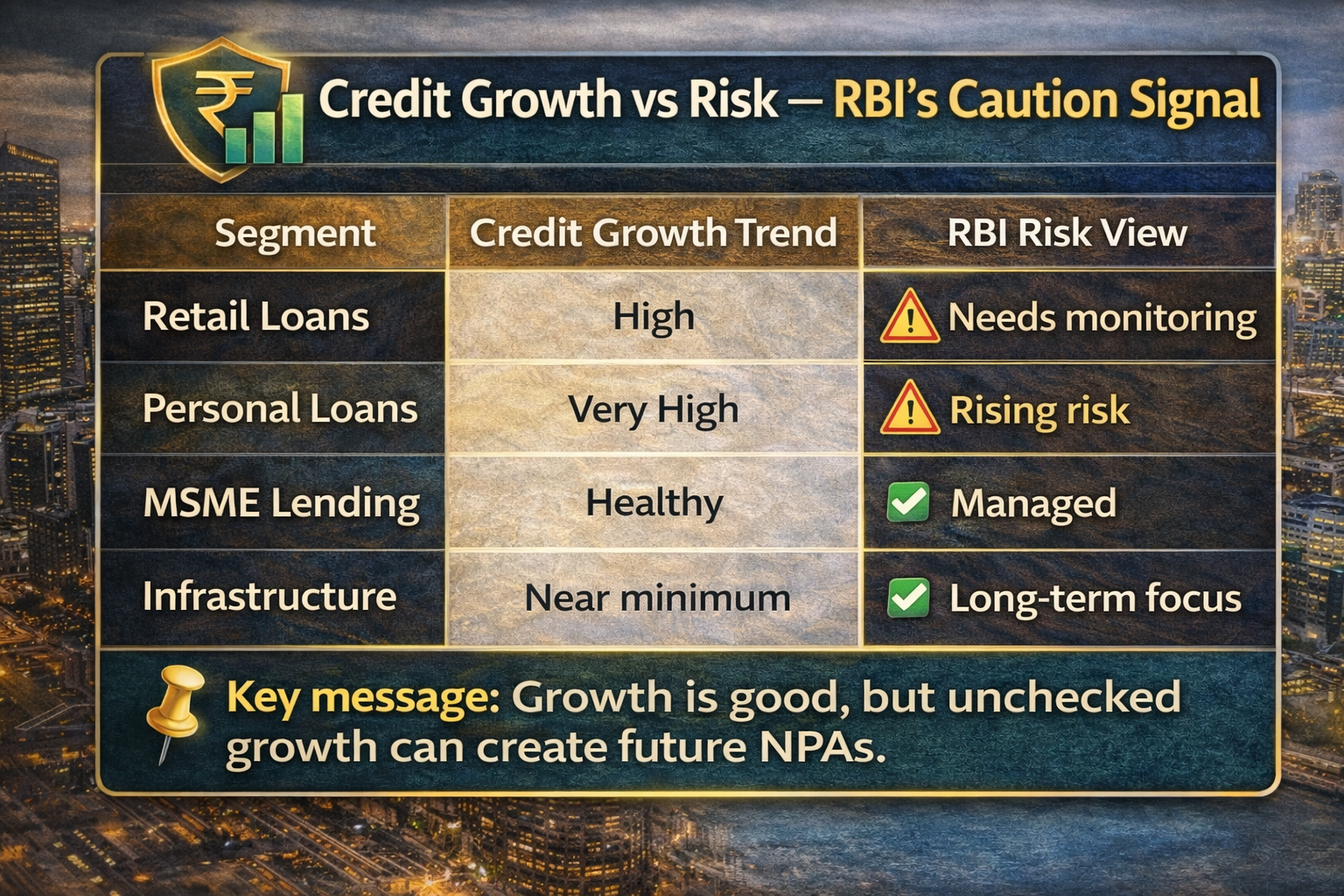
With balance sheets repaired, banks have resumed lending aggressively. Credit growth in 2024-25 remained in double digits, driven by retail loans, MSME financing, and infrastructure projects. Home loans, vehicle loans, and personal loans saw strong demand, reflecting rising incomes and consumption.
However, RBI warns that fast credit growth can carry hidden risks. History shows that many banking crises begin during good times, when optimism weakens lending discipline. RBI is therefore closely monitoring loan quality, especially in unsecured personal loans and certain commercial real estate segments.
Why RBI Is Worried About Cyber-Enabled Financial Fraud
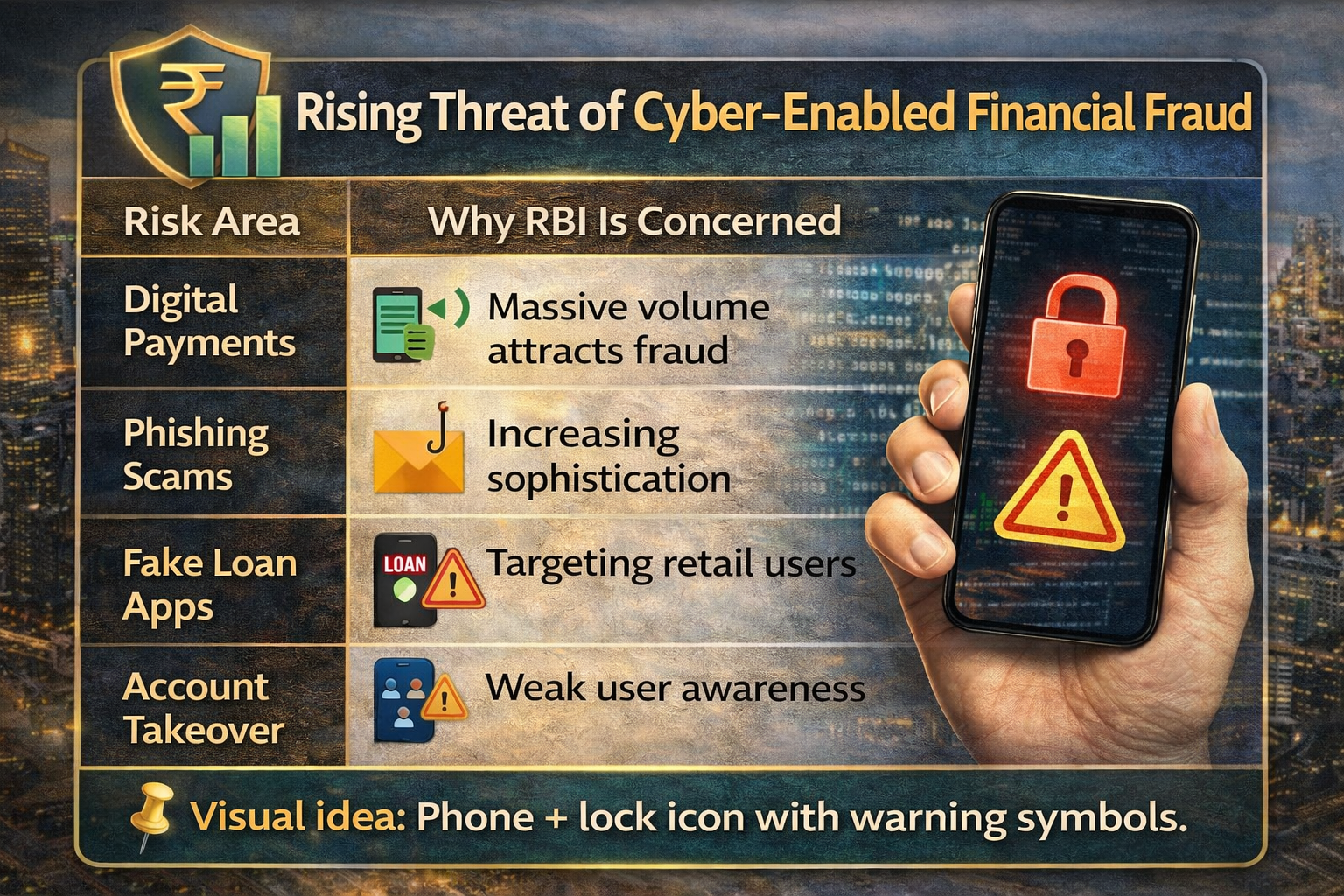
One of the strongest warnings in the report relates to cyber-enabled fraud. As India becomes one of the world’s largest digital payment markets, fraudsters are becoming more sophisticated. Phishing attacks, fake loan apps, and account takeover fraud have increased sharply.
According to RBI and banking industry data, digital fraud cases have risen significantly in recent years, even as overall transaction volumes exploded. The concern is not just about individual losses, but about systemic trust. If people lose confidence in digital banking, financial inclusion and efficiency could suffer.
Digital Growth Is a Strength — and a Vulnerability
India’s digital banking success is undeniable. UPI transactions crossed billions of transactions per month, making India a global leader in real-time payments. But this success also expands the attack surface for cyber criminals.
RBI’s concern is that banks, fintech companies, and payment platforms must invest continuously in cybersecurity. This includes better fraud detection systems, stronger customer awareness, and faster response mechanisms. The cost of ignoring this risk could be far higher than the cost of prevention.
Climate Change: A Slow but Serious Financial Risk
Another important warning in the RBI report relates to climate-related financial risks. At first glance, climate change may seem unrelated to banking. But RBI makes it clear that extreme weather events directly affect loan repayment ability.
Floods, droughts, and heatwaves damage crops, factories, and infrastructure. This increases the risk of loan defaults in agriculture, MSMEs, and infrastructure projects. RBI is encouraging banks to start climate stress testing and assess how their loan portfolios would perform under extreme climate scenarios.
Why Climate Risk Matters More Than It Appears
Climate risk is not about tomorrow’s profits; it is about long-term stability. Insurance costs rise, asset values change, and certain regions become more vulnerable. RBI’s approach aligns with global central banks, which are increasingly integrating climate risks into financial supervision.
For India, where a large part of the economy depends on monsoons and natural resources, ignoring climate risk would be dangerous. RBI’s warning is early, but necessary.
The Global Backdrop: Why RBI Remains Careful
India’s banking system does not operate in isolation. Globally, interest rates remain high, geopolitical tensions continue, and financial markets are volatile. Recent banking stresses in advanced economies have shown that even well-regulated systems can face sudden shocks.
This global uncertainty explains RBI’s cautious tone. While domestic indicators look strong, external shocks can quickly change conditions. RBI prefers to prepare banks in advance rather than react after problems emerge.
What This Report Means for Banks
For banks, the message is clear. The worst phase of bad loans is behind them, but responsibility has increased. RBI expects stronger governance, better risk management, and continuous investment in technology and resilience.
Banks that fail to upgrade cybersecurity or ignore climate exposure may face regulatory pressure in the future. Profitability alone will no longer define success; stability and preparedness will matter equally.
What This Means for Borrowers and Businesses
For borrowers, a healthy banking system is good news. Credit is more easily available, interest rates are competitive, and banks are willing to fund expansion. MSMEs, startups, and infrastructure projects benefit directly from improved bank confidence.
However, borrowers must also expect greater scrutiny. Banks are becoming more selective, especially in high-risk segments. Transparent financial reporting and responsible borrowing will become increasingly important.
What Investors Should Take Away
For investors, RBI’s report signals that Indian banks are fundamentally stronger than they were a decade ago. This supports confidence in banking stocks and debt markets. However, investors should watch emerging risks, especially unsecured lending growth and digital fraud exposure.
Markets reward stability, but they also punish complacency. RBI’s warnings serve as early indicators for long-term investors.
RBI’s Policy Style: Calm Confidence with Clear Warnings
One striking feature of RBI’s communication is its tone. It avoids celebration, even when data is positive. Instead, it combines quiet confidence with loud warnings. This approach has helped India avoid sudden banking crises seen elsewhere.
RBI’s philosophy is simple: good times are when risks are built, not when they appear. Acting early is always cheaper than fixing crises later.
Risks to Watch in the Coming Years
Looking ahead, key risks include excessive personal loan growth, concentration of exposure in certain sectors, cyber fraud sophistication, and climate-related loan stress. RBI will likely tighten supervision in these areas.
Banks that adapt early will thrive. Those that delay may struggle.
Conclusion: Stronger, But Not Invincible
India’s banking system in 2025 is healthier than it has been in many years. A GNPA ratio of 2.1% reflects deep reforms, tough decisions, and sustained policy effort. However, strength does not mean invincibility.
Cyber risks and climate risks are real and growing. RBI’s message is not to relax, but to remain alert. For readers, the key takeaway is simple: India’s financial system is on solid ground, but its future stability depends on how well today’s warnings are taken seriously.
Final Thought for Readers
Low bad loans are an opportunity, not a guarantee. The real test of India’s banking system will be how it handles the risks that are still forming — quietly, steadily, and in plain sight.
Frequently Asked Questions (FAQ)
1. What is the RBI Trend and Progress Report?
The Reserve Bank of India publishes the Trend and Progress of Banking in India report every year. It reviews the overall health of Indian banks, including bad loans, capital strength, risks, and future challenges. It is considered one of the most important official reports on India’s banking system.
2. What does GNPA mean in simple words?
GNPA stands for Gross Non-Performing Assets. It means loans where borrowers have stopped paying interest or principal for a long time. A lower GNPA ratio means banks are healthier and face fewer loan defaults.
3. Why is the GNPA level of 2.1% important?
A GNPA level of 2.1% is important because it is the lowest level seen in decades. In 2018, GNPA was above 11%. This sharp fall shows that Indian banks have cleaned up bad loans and improved lending discipline.
4. How did Indian banks reduce bad loans so much?
Indian banks reduced bad loans through several reforms such as the Insolvency and Bankruptcy Code (IBC), stricter RBI supervision, better loan recovery processes, and government support through bank recapitalisation. Banks also became more careful in giving new loans.
5. Why does RBI still warn about risks if banks are strong?
RBI believes that risks usually build up during good times. Even though banks are strong today, fast credit growth, digital fraud, and climate risks can create problems in the future if ignored. RBI prefers to warn early rather than react late.
6. What is cyber-enabled financial fraud?
Cyber-enabled financial fraud includes scams like phishing, fake loan apps, online payment fraud, and account takeover. These crimes use technology to trick people and steal money. RBI is worried because digital banking is growing very fast in India.
7. Why is digital banking increasing fraud risk?
Digital payments are fast, easy, and used by millions every day. This large volume attracts fraudsters. Many users also lack awareness about online safety, making them easy targets for scams.
8. What are fake loan apps and why are they dangerous?
Fake loan apps offer quick loans but steal personal data, charge illegal fees, and harass borrowers. RBI and banks see these apps as a growing risk, especially for retail users and small borrowers.
9. How does climate change affect banks?
Climate change affects banks because floods, droughts, and heatwaves can damage businesses, farms, and infrastructure. This increases the chance of loan defaults. RBI wants banks to prepare for these long-term risks.
10. What does RBI mean by climate risk to financial stability?
Climate risk to financial stability means that extreme weather events can weaken the ability of borrowers to repay loans and reduce the value of assets. Over time, this can hurt banks and the overall financial system.
11. Is credit growth in India a good or bad sign?
Credit growth is a good sign because it shows economic activity and demand. However, RBI warns that unchecked or very fast credit growth, especially in personal loans, can create future bad loans if lending standards weaken.
12. Which loan segments is RBI watching closely?
RBI is closely watching retail loans and personal loans because growth in these segments is very high. MSME and infrastructure loans are seen as healthier and more balanced.
13. What does this report mean for common people?
For common people, the report means banks are safer, deposits are secure, and credit is more easily available. At the same time, people must be careful about digital fraud and protect their personal banking information.
14. What does this report mean for businesses?
For businesses, a strong banking system means better access to loans and financial stability. However, banks may ask for better documentation and risk assessment, especially in uncertain sectors.
15. What should readers remember from the RBI Report 2025?
The key message is simple: India’s banking system is stronger than before, but not risk-free. Cyber threats and climate risks are rising, and careful policy action is needed to keep banks safe in the long run.
Official website of RBI
People Also Ask (PAA)
What is the RBI Trend and Progress of Banking Report?
The Trend and Progress of Banking in India is an annual report published by the Reserve Bank of India. It gives a detailed picture of how Indian banks are performing, covering bad loans, profits, risks, and future challenges.
Why are bad loans in India at a record low in 2025?
Bad loans are low because banks cleaned up old stressed loans, recovered dues under the Insolvency and Bankruptcy Code (IBC), improved risk checks, and became more disciplined in lending. RBI’s strict supervision also played a major role.
What does GNPA of 2.1% mean for the Indian economy?
A GNPA of 2.1% means Indian banks have very few problem loans compared to the past. This improves confidence, supports credit growth, and reduces the risk of a banking crisis, helping overall economic stability.
Are Indian banks completely safe now?
Indian banks are much stronger than before, but they are not completely risk-free. RBI has clearly said that new risks like cyber fraud, fast personal loan growth, and climate-related stress could cause problems if not managed carefully.
Why is RBI worried about cyber fraud?
RBI is worried because digital payments have grown very fast in India. High transaction volumes, low awareness among users, and advanced scam techniques make cyber fraud a serious threat to trust in the banking system.
What are the most common cyber banking frauds in India?
Common cyber frauds include phishing messages, fake loan apps, UPI scams, OTP fraud, and account takeovers. These frauds mainly target retail users and small borrowers.
How does climate change affect banks and loans?
Climate change can damage farms, factories, and infrastructure due to floods, droughts, and heatwaves. This reduces borrowers’ ability to repay loans, increasing default risk for banks over time.
What loan segments is RBI watching closely?
RBI is closely monitoring retail loans and personal loans because their growth is very fast. These loans can turn risky if income growth slows or interest rates rise.
Is high credit growth a good sign for India?
High credit growth is generally positive because it supports economic activity. However, RBI warns that unchecked growth without proper risk checks can lead to future bad loans.
What does RBI’s report mean for depositors?
For depositors, the report is reassuring. Banks are financially stronger, better capitalised, and more stable, making deposits safer than during past banking stress periods.
What does the RBI report mean for borrowers?
Borrowers may find loans more easily available, but banks will be stricter about credit checks, documentation, and repayment ability, especially for personal and unsecured loans.
How does this report affect investors?
For investors, the report signals long-term strength in the banking sector. However, investors should keep an eye on cyber risks, personal loan growth, and regulatory changes.
Why does RBI warn about risks even when things look good?
RBI believes risks build up during good times. Early warnings help prevent future crises. This cautious approach has helped India avoid sudden banking shocks seen in other countries.
What is the main takeaway from RBI Report 2025?
The main takeaway is simple: India’s banking system is stronger than it has been in years, but rising cyber and climate risks must be managed carefully to protect future stability.
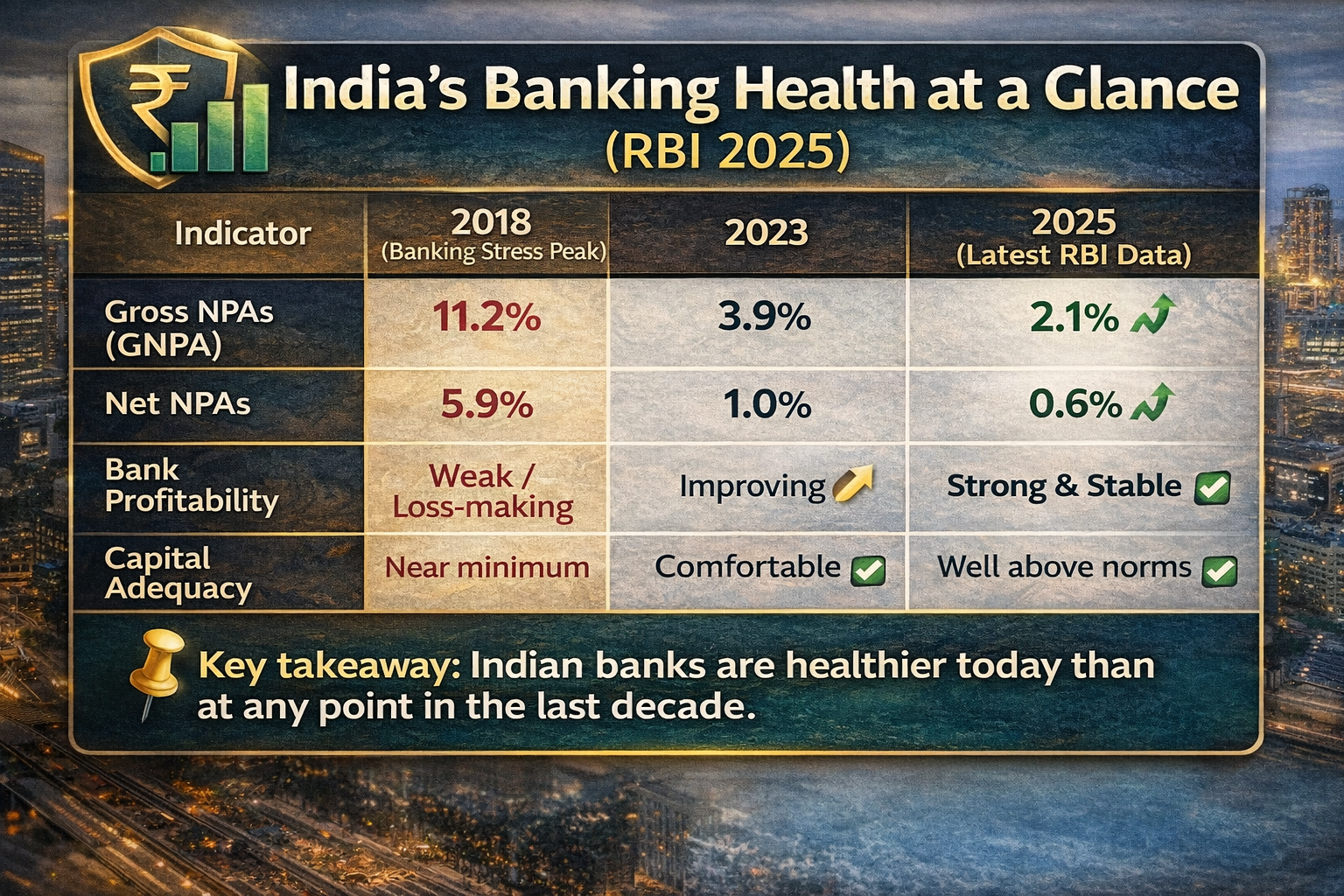
📊 Infographic 1: India’s Banking Health at a Glance (RBI 2025)
| Indicator | 2018 (Banking Stress Peak) | 2023 | 2025 (Latest RBI Data) |
|---|---|---|---|
| Gross NPAs (GNPA) | 11.2% | 3.9% | 2.1% |
| Net NPAs | 5.9% | 1.0% | 0.6% |
| Bank Profitability | Weak / Loss-making | Improving | Strong & Stable |
| Capital Adequacy | Near minimum | Comfortable | Well above norms |
📌 Key takeaway: Indian banks are healthier today than at any point in the last decade.
📉 Infographic 2: The Long Journey of Bad Loans (GNPA Trend)
| Year | GNPA (%) |
|---|---|
| 2015 | 5.1% |
| 2018 | 11.2% |
| 2020 | 8.5% |
| 2023 | 3.9% |
| 2025 | 2.1% (Multi-Decade Low) |
📌 Story to show visually: Crisis → Clean-up → Stability.
🏦 Infographic 3: Why RBI Says the Banking System Is “Strongly Positioned”
| Strength Area | RBI Assessment |
|---|---|
| Capital Levels | Strong buffers |
| Liquidity | Comfortable |
| Profitability | Sustained improvement |
| Asset Quality | Best in decades |
| Shock Absorption | High |
📌 Design tip: Use green check icons for each row.
💳 Infographic 4: Credit Growth vs Risk — RBI’s Caution Signal
| Segment | Credit Growth Trend | RBI Risk View |
|---|---|---|
| Retail Loans | High | ⚠️ Needs monitoring |
| Personal Loans | Very High | ⚠️ Rising risk |
| MSME Lending | Healthy | ✅ Managed |
| Infrastructure | Stable | ✅ Long-term focus |
📌 Key message: Growth is good, but unchecked growth can create future NPAs.
🛡️ Infographic 5: Rising Threat of Cyber-Enabled Financial Fraud
| Risk Area | Why RBI Is Concerned |
|---|---|
| Digital Payments | Massive volume attracts fraud |
| Phishing Scams | Increasing sophistication |
| Fake Loan Apps | Targeting retail users |
| Account Takeover | Weak user awareness |
📌 Visual idea: Phone + lock icon with warning symbols.
🌍 Infographic 6: Climate Risk & Financial Stability
| Climate Event | Banking Impact |
|---|---|
| Floods | Loan defaults in agriculture & MSMEs |
| Heatwaves | Power & infrastructure stress |
| Droughts | Rural credit risk |
| Extreme Weather | Insurance & asset losses |
📌 RBI insight: Climate risk is slow-moving but system-wide.
🌐 Infographic 7: Why RBI Remains Cautious Despite Good Numbers
| Global Risk | Potential Impact on India |
|---|---|
| High Global Interest Rates | Capital flow volatility |
| Geopolitical Conflicts | Trade & energy risk |
| Global Banking Stress | Investor confidence shock |
| Climate Regulations | Compliance cost for banks |
📌 Design tip: Use muted colors (grey/orange) to show caution.
🧠 Infographic 8: RBI’s Policy Message in One Slide
| What’s Going Well | What Needs Attention |
|---|---|
| Record-low NPAs | Cyber fraud |
| Strong capital | Climate stress |
| Stable liquidity | Unsecured lending |
| Healthy profits | Risk discipline |
📌 Perfect summary slide for readers who skim.
🎯 Infographic 9: What This Means for You (Reader Impact)
| Group | Key Impact |
|---|---|
| Depositors | Safer banks |
| Borrowers | Easier credit, more checks |
| Businesses | Stable funding |
| Investors | Stronger banking sector |
| Economy | Lower systemic risk |