
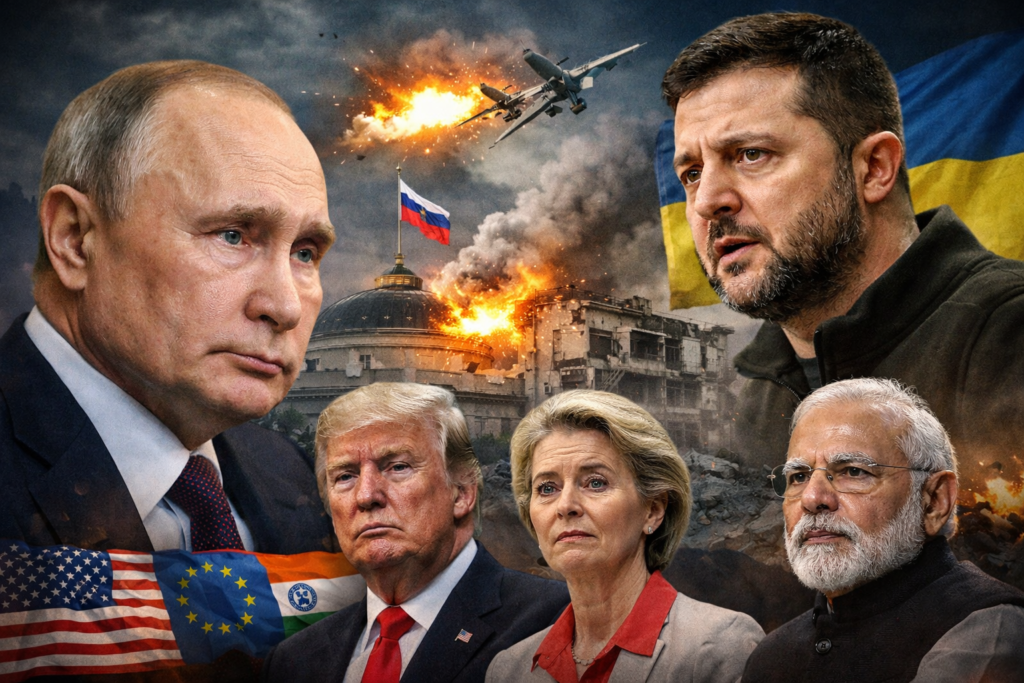
Introduction: A War Claim That Shook Diplomacy
The Russia–Ukraine war took a new political turn after Russia claimed that Ukraine tried to attack one of President Vladimir Putin’s residences using drones. Ukraine immediately denied the accusation. This claim came at a sensitive time when peace talks were being discussed. As expected, it has increased tension, raised global concern, and made the road to peace more uncertain.
Russia’s View: A Serious Security Threat
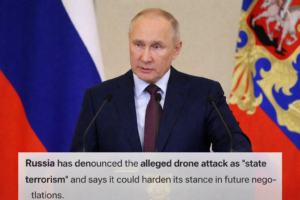
From Russia’s point of view, the alleged drone attack is being treated as a direct and dangerous provocation. Russian officials said that dozens of long-range drones were launched toward a residence connected to President Putin and were intercepted by air defence systems. Russia described the incident as “state terrorism” and suggested that such actions show Ukraine is not serious about peace. Moscow has also hinted that this event could harden its stance in future negotiations.
Ukraine’s View: A False Accusation
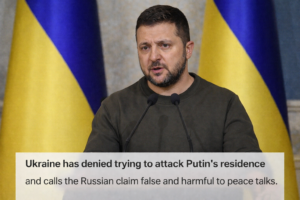
Ukraine has completely rejected Russia’s claim. President Volodymyr Zelenskyy said the allegation is false and misleading. Ukraine argues that Russia often uses such claims to justify military action or shift attention away from peace discussions. Kyiv insists it has no interest in attacking symbolic or residential locations, especially during a phase when diplomacy is being explored.
The Evidence Question: What the World Is Asking
A key issue in this situation is the lack of publicly available evidence. Russia has not shared verified images, drone debris, or independent proof. Because of this, many international observers are treating the claim cautiously. In modern conflicts, information spreads fast, but without proof, claims remain disputed. This uncertainty is why global reactions have been careful rather than aggressive.
Why Timing Matters for Peace Talks
The timing of the claim is important. It came just as discussions about ending the war were being talked about in diplomatic circles. Any allegation involving the safety of a national leader can quickly destroy trust. Even if the claim is unproven, it creates fear and anger, making compromise more difficult. This is why peace hopes have taken a hit after the accusation.
The United States’ Stand: Concern but Caution
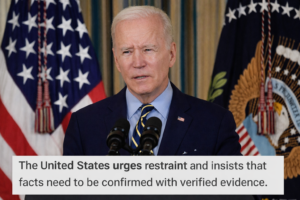
The United States has reacted with concern but restraint. President Donald Trump said attacks on leaders’ residences would be unacceptable, but he also noted that facts must be confirmed. Washington has not taken Russia’s claim at face value. The US continues to push for dialogue while warning against actions that could escalate the war further.
Europe’s Position: Focus on De-Escalation
European countries have taken a cautious and diplomatic approach. Europe’s main concern is avoiding escalation that could spill beyond Ukraine. European leaders have stressed the need for verified facts and have urged both sides to stay committed to peace efforts. Given Europe’s energy dependence and proximity to the conflict, stability remains their top priority.
India’s Stand: Dialogue Over Escalation
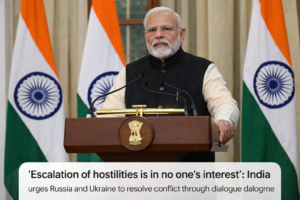
India has responded by urging restraint and dialogue. New Delhi has consistently maintained that the conflict should be resolved through talks, not military escalation. India has avoided taking sides but has expressed concern over any incident that could derail peace. For India, stability matters because the war affects global oil prices, inflation, and economic growth.
Information Warfare: A Battle Beyond the Battlefield
This episode highlights how modern wars are fought not just with weapons but also with narratives. Claims, denials, and counter-claims play a major role in shaping public opinion. In the Russia–Ukraine war, information itself has become a tool. This makes it harder for ordinary people to separate facts from strategy.
Impact on Global Markets and Economy
Even unconfirmed incidents can affect the global economy. News of escalation often pushes oil prices higher and makes investors nervous. Countries worry about energy supply, defence costs, and inflation. That is why financial markets closely watch developments in the Ukraine war, even when details remain unclear.
What This Means for the Future of the War
This incident shows how fragile peace efforts are. One claim, even without proof, can slow talks and increase mistrust. If evidence emerges, the situation could worsen. If not, the claim may fade, but the damage to trust will remain. The future now depends on whether leaders choose diplomacy or escalation.
Simple Takeaway for Readers
Russia says Ukraine tried to attack Putin’s residence. Ukraine says the claim is false. The US and Europe are cautious and want proof. India is calling for dialogue and restraint. No evidence has been shown so far, but the claim has already made peace talks harder.
🔗 Official Ministry of Defence of Russia (English version)
Frequently Asked Questions (FAQ)
1. Did Ukraine really attack Vladimir Putin’s residence?
Russia claims that Ukraine tried to attack a residence linked to Vladimir Putin using drones. However, Ukraine has strongly denied this claim. As of now, no independent proof has been made public to confirm that such an attack actually happened.
2. What exactly has Russia said about the alleged attack?
Russia says that dozens of long-range drones were launched toward a residence associated with President Putin and that all were intercepted by Russian air defence systems. Moscow has called it an act of terrorism and said it could affect its approach to peace talks.
3. What is Ukraine’s response to Russia’s accusation?
Ukraine has rejected the accusation completely. President Volodymyr Zelenskyy said the claim is false and meant to damage peace efforts. Ukraine argues that Russia often uses such accusations to justify future military action or to shift attention away from diplomacy.
4. Has any proof of the drone attack been shown?
No. Russia has not released verified photos, videos, or drone debris that can independently confirm the attack. Because of this, many countries and experts are treating the claim with caution and waiting for facts.
5. Why is this claim important for peace talks?
The claim came at a time when discussions about ending the war were being talked about. Allegations involving a leader’s safety increase anger and mistrust. Even if unproven, such claims can slow down or damage peace negotiations.
6. What is the United States’ position on this issue?
The United States has reacted cautiously. President Donald Trump said that attacks on leaders’ residences would be serious, but also stressed that facts must be confirmed. The US has not officially accepted Russia’s claim and continues to encourage dialogue.
7. How has Europe reacted to the situation?
European countries have urged restraint and calm. Europe wants to avoid further escalation because the war affects its energy supply and economic stability. European leaders have asked both sides to focus on diplomacy and rely on verified information.
8. What is India’s stand on this issue?
India has called for peace, dialogue, and restraint. New Delhi has avoided taking sides and has consistently said that war is not a solution. India is concerned because the conflict impacts oil prices, inflation, and global economic stability.
9. Can such claims affect global markets?
Yes. Even unconfirmed news can push oil prices higher, make investors nervous, and increase market volatility. That is why financial markets closely watch developments in the Russia–Ukraine war.
10. What should readers watch next?
Readers should watch for clear evidence, official statements from neutral observers, and whether peace talks continue or stall. These factors will show whether this incident leads to escalation or fades away.
🔗 Official Ministry of Defence of Ukraine (English):
People Also Ask (PAA)
Did Ukraine attack Vladimir Putin’s residence?
Russia says Ukraine tried to attack a residence linked to Vladimir Putin using drones. Ukraine has denied this claim. So far, no independent or verified evidence has been released to confirm that such an attack actually took place.
Where is the Putin residence Russia says was targeted?
Russian officials said the alleged drone attack was aimed at a residence in the Novgorod region of Russia. However, Russia has not shared detailed proof such as photos, videos, or physical drone debris from the location.
What did Ukraine say about the alleged drone attack?
Ukraine strongly rejected the accusation. President Volodymyr Zelenskyy said the claim is false and meant to damage peace efforts. Ukraine says it has no reason to target residential or symbolic locations during talks about ending the war.
Has Russia provided any proof of the attack?
No clear proof has been shared publicly. Russia has not released verified images, radar data, or independent confirmation. Because of this, many countries and analysts are treating the claim cautiously.
Why would Russia make such a claim during peace talks?
Experts say such claims can be used to harden public opinion, justify future military action, or increase pressure during negotiations. In wars, information and narratives are often used as strategic tools.
What is the United States’ response to this claim?
The United States has reacted carefully. President Donald Trump said attacks on leaders’ residences would be serious, but also stressed the need to confirm facts. The US has not officially accepted Russia’s claim and continues to support dialogue.
How has Europe reacted to the alleged attack?
European countries have urged calm and restraint. Europe wants to avoid escalation because the war affects energy prices, inflation, and regional security. European leaders have asked both sides to rely on verified facts and keep diplomatic channels open.
What is India’s position on the issue?
India has called for peace and dialogue. New Delhi has avoided taking sides and has repeated that war is not a solution. India is concerned because the conflict affects oil prices, global trade, and economic stability.
Can this claim affect global oil prices and markets?
Yes. Even unverified news related to the Ukraine war can push oil prices up and make financial markets volatile. Investors closely watch any sign of escalation between Russia and Ukraine.
What should people watch next in this situation?
People should watch for verified evidence, official statements from neutral observers, and whether peace talks continue or stop. These developments will show whether the situation escalates or cools down.







1 thought on “Putin Residence Attack Claim Explained: Russia–Ukraine Standoff, US, Europe & India React”