Nikhil Gupta Guilty Plea 2026: What It Means for India-US Relations & Covert Policy
1. The Executive Summary (The Macro Hook)
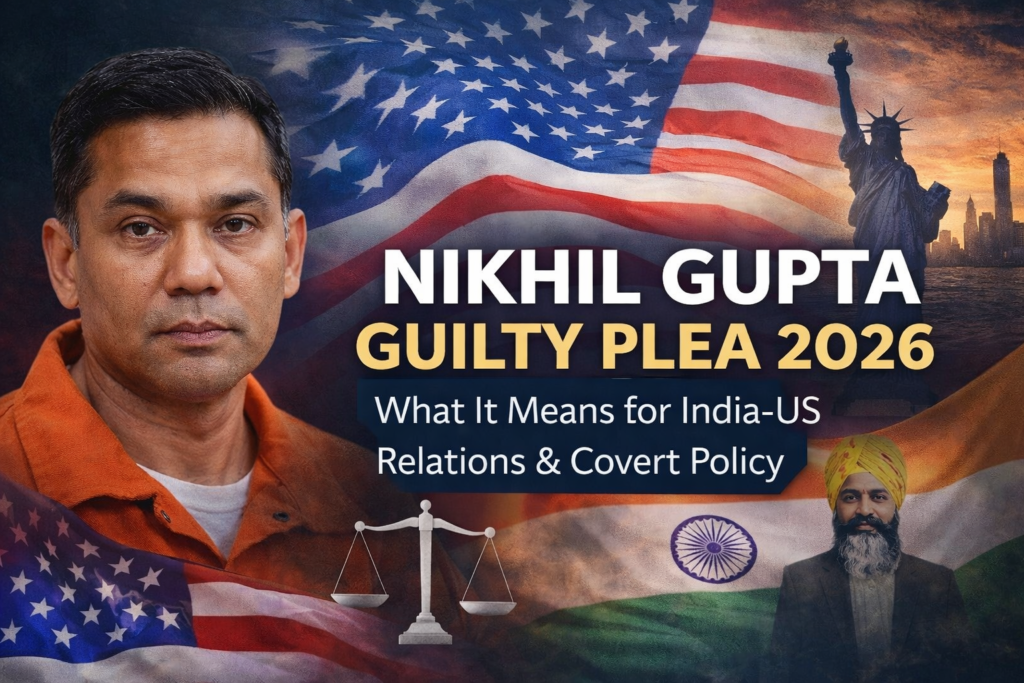
On February 13, 2026, Indian national Nikhil Gupta pleaded guilty in a New York federal court to charges of murder-for-hire and conspiracy to launder money in an alleged plot targeting Khalistani separatist Gurpatwant Singh Pannun. The case had already drawn global attention since it first surfaced in 2023. Now, with the guilty plea entered, Gupta faces a possible sentence of 20 to 40 years in prison, with sentencing scheduled for May 29, 2026.
At first glance, this looks like a legal defeat. But when viewed through a geopolitical lens, the plea appears more like a containment strategy. A full trial would have meant months of public hearings, wiretaps played in open court, cross-examinations, and media headlines linking Indian officials to an overseas assassination plot. That scenario would have caused prolonged reputational damage. By pleading guilty, Gupta effectively shuts down the public trial process. In financial terms, this resembles a “stop loss” order — take the damage now to prevent larger losses later.
This plea also helps Washington. The United States is entering an election cycle, and dragging a strategic partner like India into daily courtroom controversy would complicate diplomacy. By resolving the case through a plea agreement, both governments avoid a prolonged media storm. The “individual” has been separated from the “state.”
U.S. Department of Justice press release
2. The Fact Sheet: Legal Reality vs Diplomatic Reality
As of February 14, 2026, Nikhil Gupta has formally pleaded guilty, avoiding a jury trial. In legal terms, this means he accepts responsibility, and prosecutors no longer need to present their full evidence publicly. The file closes procedurally, even if political questions remain.
Another key figure in the case is Vikas Yadav, identified in U.S. court documents as a former Indian government employee. The U.S. Department of Justice has indicted him, but he remains in India. India has stated that he is no longer associated with the government. Interestingly, Delhi Police booked Yadav in a local extortion case in late 2024. Under international law, a person facing trial in their home country cannot easily be extradited. This creates a legal barrier, often described as a “sovereign shield.”
Gurpatwant Singh Pannun, the alleged target of the plot, remains active in the United States. India has designated him as a terrorist under its laws. However, in the U.S., he is treated as a protected individual under free speech protections. This legal difference continues to irritate Indian policymakers.
Despite this controversy, diplomatic fallout has been contained. Defense cooperation between India and the United States continues. Major deals involving jet engine technology and advanced drones are moving forward. This signals that both governments see the broader strategic relationship as more important than this individual case.
Southern District of New York federal court
3. Fundamental Analysis: The “India Angle”
A. The Trial Avoidance Premium
If this case had gone to trial, prosecutors would likely have introduced recordings, digital communications, and testimony linking Gupta to intermediaries and possibly to Vikas Yadav. Open court proceedings in the United States are public and heavily covered by media. A multi-month trial would have kept India in the headlines in a negative context.
For a country positioning itself as a rising global power and a rule-of-law democracy, that would have hurt its image. Investors, especially in Western markets, are sensitive to governance perception. India is currently attracting large inflows into manufacturing, technology, and defense sectors. A prolonged scandal could have created uncertainty.
By accepting a guilty plea, the detailed evidence remains largely within Department of Justice records rather than being broadcast globally. The reputational cost is limited and predictable. In geopolitical strategy, predictability is valuable.
B. The Vikas Yadav Dilemma
The United States wants accountability beyond Gupta. The indictment of Vikas Yadav suggests that prosecutors believe there was a higher-level link. India’s response has been careful. Officials have stated that Yadav is no longer employed by the government.
The timing of the local case against him is important. Once domestic legal proceedings begin, extradition becomes legally complex. This is a classic sovereign maneuver. Countries often prioritize domestic jurisdiction to prevent citizens from being transferred abroad.
From India’s perspective, allowing extradition of a former official in a sensitive case would create a precedent. It could expose operational details of intelligence work. Therefore, retaining jurisdiction protects institutional secrecy.
This episode may also trigger internal reforms. Intelligence operations in the modern era are more visible due to digital surveillance and global cooperation. The cost of operational mistakes is higher. India is likely to tighten protocols to prevent freelance intermediaries from being used in sensitive missions.
C. The Five Eyes Hypocrisy Debate
India argues that there is an asymmetry. Gurpatwant Singh Pannun has made statements calling for secession and, in some videos, has used aggressive language toward Indian institutions. India designates him as a terrorist. However, in the United States, his speech is protected unless it crosses a legal threshold.
India points out that the U.S. has historically taken strict action against threats linked to groups like Al-Qaeda. Why then is a separatist figure allowed to operate openly? The U.S. legal answer lies in constitutional protections. The First Amendment protects speech unless it directly incites imminent violence.
This difference reflects contrasting legal cultures. For India, national unity and sovereignty are core constitutional principles. For the U.S., free speech is foundational. These philosophical differences create friction but are unlikely to derail strategic cooperation.
India Ministry of External Affairs statement
4. Government Policy: The “Rogue Agent” Narrative
India’s official position is that if wrongdoing occurred, it was not authorized at the highest level. A High-Level Inquiry Committee was set up to examine the allegations. This step signals cooperation without admitting institutional responsibility.
The “rogue agent” narrative is not new in global intelligence history. Many countries, including Western powers, have used it when covert actions become public controversies. It allows the state to protect diplomatic relationships while handling internal accountability discreetly.
Going forward, India will likely professionalize its covert tradecraft. The use of criminal intermediaries carries high risk. Modern surveillance, digital tracking, and international legal cooperation make deniability harder to maintain. India’s intelligence agencies will probably tighten oversight and reduce reliance on informal networks.
This case could become a turning point. Rather than expanding covert operations recklessly, India may adopt more calibrated methods aligned with diplomatic strategy.
5. Conclusion: Realpolitik Prevails
In the larger geopolitical picture, the United States needs India as a counterbalance to China in the Indo-Pacific. Trade between India and the U.S. has crossed significant milestones in recent years. Defense cooperation has deepened, with technology transfers and joint exercises expanding.
For Washington, isolating India over one case would undermine broader strategic goals. For New Delhi, maintaining strong ties with the United States is essential for economic growth, technology access, and security cooperation.
The guilty plea serves as a transaction cost. Gupta may serve a substantial sentence in the United States. Years later, diplomatic channels could potentially negotiate prisoner transfer arrangements, as has happened in other international cases. For now, both sides appear content to move forward.
For markets and investors, this case is largely a non-event. Foreign direct investment flows continue. Defense partnerships remain active. Trade negotiations are unaffected.
This episode highlights an uncomfortable reality of global politics: intelligence operations exist in the shadows, and sometimes they surface. When they do, governments must manage the fallout carefully.
In this case, containment appears to have worked. The controversy has been narrowed. The strategic partnership remains intact. Realpolitik, once again, has prevailed.
And in geopolitics, outcomes matter more than headlines.
U.S.–India Strategic Partnership Fact Sheet (U.S. State Department)
✅ FAQ
1. Who is Nikhil Gupta?
Nikhil Gupta is an Indian national who pleaded guilty in a US federal court in February 2026 in connection with a murder-for-hire conspiracy case.
2. What charges did Gupta plead guilty to?
He pleaded guilty to conspiracy to commit murder-for-hire and money laundering charges related to a plot targeting Gurpatwant Singh Pannun.
3. How does this case affect India-US relations?
Despite the controversy, diplomatic ties remain stable, and strategic defense cooperation continues between both countries.
4. What is the significance of avoiding a public trial?
A guilty plea prevents months of open-court evidence that could have created prolonged diplomatic tension and reputational risk.
5. What is the extradition issue in this case?
Another accused, Vikas Yadav, remains in India. Legal proceedings in India may complicate any extradition attempt.
6. Will this case impact defense deals between India and the US?
So far, major defense agreements and Indo-Pacific cooperation remain unaffected.
7. What is the broader geopolitical impact?
The case highlights tension between national security priorities and international law but does not fundamentally alter strategic alignment.