Nifty’s Cold Shower: Decoding the 26,150 Slip Amid U.S. Tariff Threats
On January 7, 2026, Indian equity markets delivered what I would call a “geopolitical reality check.” After weeks of optimism, record highs, and bullish forecasts, the market finally paused — not because India’s growth story has weakened, but because global power politics has entered the price discovery process.
As someone who has spent three decades watching markets across cycles, I can say this with confidence: markets don’t fall only because of earnings or valuations. They fall when certainty breaks. And today’s move is not random selling — it is strategic de-risking.
This article is written to help readers of SRVISHWA understand what really happened, why it happened now, and what matters next — without jargon, without panic, and without noise.
I. Nifty’s 26,150 Breach
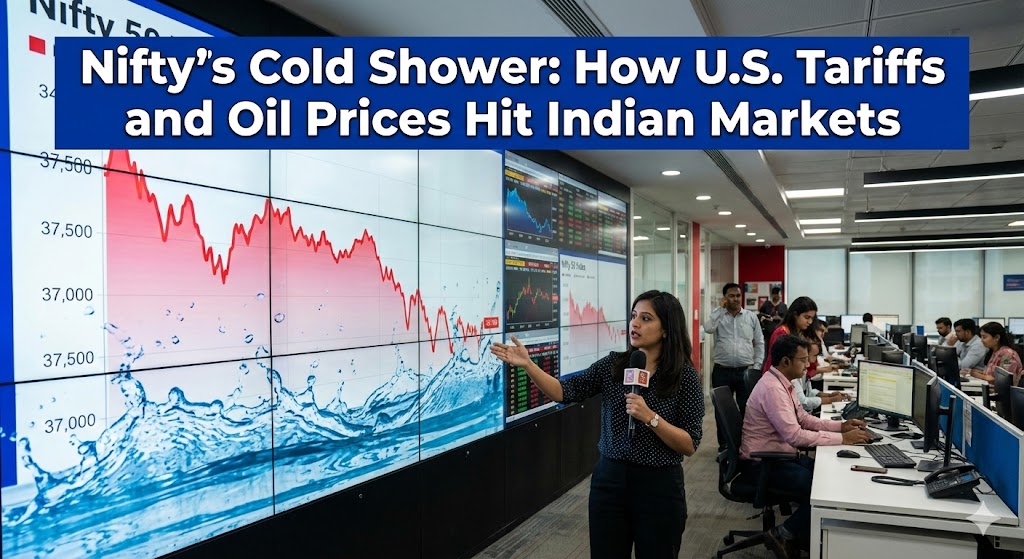
The headline number grabbed attention immediately. After touching a record high of 26,328 earlier this week, the Nifty 50 slipped to 26,128.90, while the Sensex declined to 84,909.30 by the close on January 7.
On the surface, a fall of less than 1% may look harmless. But in markets, where the fall happens matters more than how much it falls. This decline came right after record highs, during a phase of extreme optimism. That timing is crucial.
This was not panic selling. Volumes were controlled. There was no across-the-board crash. Instead, the selling was selective, calculated, and institutional.
That tells us something important: big money is reducing risk, not exiting India.
NSE India – Nifty 50 & Sensex Data
The Logic: Why This Is Strategic De-Risking, Not Panic
Foreign Institutional Investors (FIIs) are reacting to a growing uncertainty around India–U.S. trade relations. Talks have stalled, and the risk of a punitive 50% tariff on Indian labour-intensive exports is now being openly discussed in policy circles.
For global funds managing billions, this is not a headline — it’s a scenario risk.
When trade visibility breaks down, FIIs don’t wait for confirmation. They cut exposure at highs, especially when valuations are rich. This is exactly what we are seeing now.
Key Technical Level: 26,000 Is the Line in the Sand
Markets always anchor around psychological levels. Right now, 26,000 on Nifty is that anchor.
As long as Nifty holds above 26,000 on a closing basis, this move remains a healthy correction within a secular bull market. A decisive close below it would open the door to a deeper correction, potentially toward the 200-day Exponential Moving Average (EMA).
In short: trend intact, nerves shaken.
II. Geoeconomic Catalyst: The “Trump–Venezuela” Paradox
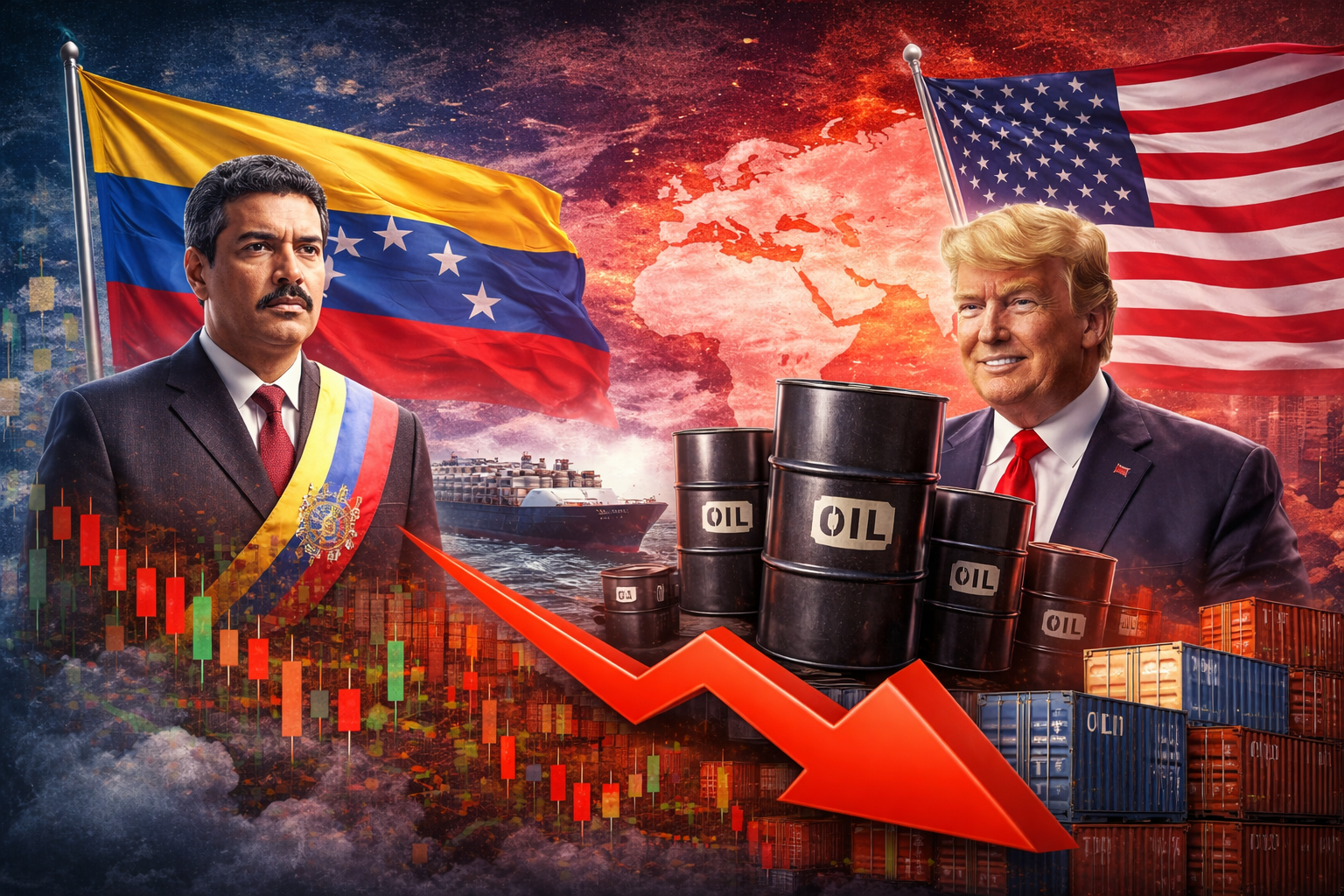
To understand today’s market action, we must look beyond Dalal Street and straight into global energy geopolitics.
Brent crude is trading near $60.17 per barrel, sharply down from $78 just weeks ago. This is unusual. Normally, geopolitical shocks push oil higher. But this time, oil is falling — and that contradiction explains a lot.
Why Oil Is Falling When Geopolitics Is Heating Up

The answer lies in what I call the shift from risk premium to supply pessimism.
The U.S. administration is actively working to release up to 50 million barrels of Venezuelan crude into global markets. This changes the narrative completely.
Instead of worrying about supply disruptions, markets are now pricing in a potential supply glut.
The traditional “geopolitical risk premium” in oil has collapsed. In its place is fear that prices could stay low for longer.
What This Means for India
Lower oil prices are, in theory, good for India. They help reduce the Current Account Deficit (CAD), support the rupee, and keep inflation under control.
But markets don’t react to theory — they react to second-order effects.
The sell-off in Reliance Industries (RIL) tells us investors are worried that Indian refiners may lose their competitive advantage if the U.S. gains control over Venezuelan heavy crude supplies.
This is not about today’s profits. It’s about future bargaining power.
III. Sectoral Deep-Dive: Heavyweights Under Pressure
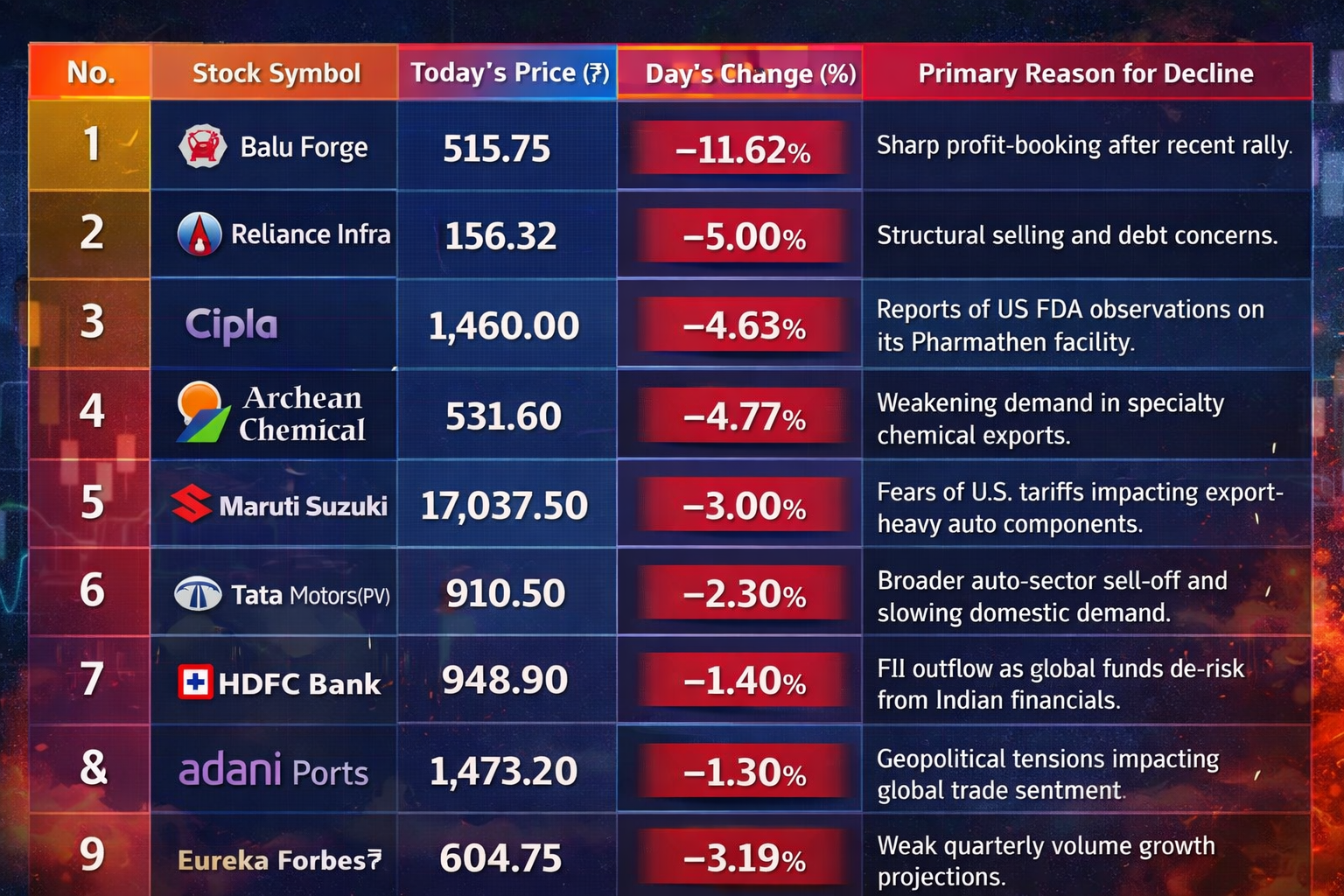
Let’s now break down where the pressure actually showed up.
Reliance Industries (RIL): The Feedstock Pivot Risk
RIL fell between 4.4% and 5%, making it one of the biggest drags on the index.
For years, RIL’s Jamnagar refinery benefited from discounted Russian Urals crude. But the U.S. is now pushing India to reduce purchases from Russia.
If Indian refiners are forced into a “feedstock pivot” — away from discounted supplies — margins could compress.
Markets are forward-looking. They don’t wait for earnings to disappoint.
Maruti & Auto: Margin and Demand Risk
Maruti Suzuki fell 3% to 4.5%, reflecting two concerns.
First, input cost pressures may not ease as fast as expected if global supply chains remain unstable.
Second, if inflation does not cool rapidly, discretionary spending — especially on big-ticket items like cars — could slow.
This is not a rejection of India’s auto story. It is timing risk being priced in.
HDFC Bank & Financials: The Beta Trade
Selling in HDFC Bank is a classic example of what traders call a beta trade.
When global funds reduce exposure to a country, they sell the most liquid stocks first. Not because the fundamentals are weak, but because liquidity allows fast exits.
This is important for retail investors to understand: liquidity selling is not fundamental selling.
IV. The VIX Anomaly: Silence Before the Storm?

One of the most important — and ignored — signals today is the India VIX.
It is currently around 10.02, close to historic lows.
This is dangerous.
Why a Low VIX During a Pullback Is a Warning
A falling market with a rising VIX signals fear.
A falling market with a flat or falling VIX signals complacency.
Right now, traders are not buying protection. They are assuming that every dip will be bought — because that has worked for months.
Markets punish complacency.
India VIX Explanation – NSE / Market Volatility
The January 15 Risk Window
There is a critical date ahead: January 15, the informal deadline for clarity on India–U.S. trade negotiations.
If this passes without resolution, we could see a sudden volatility spike as traders rush to hedge positions.
In my 30 years of experience, markets often ignore tail risks — until they don’t.
V. Strategic Conclusion: The “Wait-and-Watch” Zone
Let’s zoom out.
This move is not the end of the bull market. India still enjoys:
~6.9% GDP growth outlook for FY27
Strong domestic demand
Healthy banking balance sheets
Capex revival
But 2026 is a Janus-faced year — strong domestic floor, but a global ceiling shaped by Washington.
U.S. Trade Representative (USTR) – Tariff Policy Context
What Should Investors Do Now?
This is not a time for aggressive buying or panic selling.
This is a wait-and-watch zone.
The smarter strategy is sectoral rotation.
Export-heavy sectors like IT and Textiles remain vulnerable to tariff risks. Domestic-focused sectors such as Banking, Infrastructure, Capital Goods, and Select Consumption offer relative safety.
The Big Picture Takeaway
Today’s correction is not a warning about India.
It is a warning about the world India operates in.
Markets are reminding us that geopolitics, energy, and trade policy are no longer background noise — they are price-setting variables.
Those who understand this will not fear corrections.
They will use them intelligently.
Market Snapshot: Infographic Data Table
| Indicator | Jan 1 Peak | Jan 7 Status | % Change | Sentiment |
|---|---|---|---|---|
| Nifty 50 | 26,328 | 26,128 | -0.76% | Cautious |
| Brent Crude | $78.00 | $60.17 | -22.8% | Bearish |
| India VIX | 12.50 | 10.02 | -19.8% | Complacent |
Final Thought
Markets don’t move in straight lines.
They move in waves shaped by power, policy, and perception.
January 7, 2026, was not a crash.
It was a message.
And smart investors listen when markets speak quietly.
❓ Frequently Asked Questions (FAQ)
Why did Nifty fall after touching record highs?
Nifty fell due to strategic profit-booking and global risk reduction. Concerns over potential U.S. tariffs on Indian exports, falling oil prices, and uncertainty in global trade pushed investors to reduce risk after record highs.
Is the Nifty fall a correction or the start of a crash?
This move is currently seen as a healthy correction, not a crash. As long as Nifty holds above key support levels like 26,000, the long-term bullish trend remains intact.
How do U.S. tariffs affect the Indian stock market?
U.S. tariffs can hurt export-heavy sectors such as IT, auto components, textiles, and pharmaceuticals. This increases uncertainty for earnings, leading foreign investors to reduce exposure to Indian equities.
Why are oil prices falling despite global geopolitical tensions?
Oil prices are falling because markets are pricing in a possible supply glut, especially due to expectations that the U.S. may release additional Venezuelan crude into global markets. This has reduced the traditional geopolitical risk premium.
Is falling oil price good or bad for India?
Lower oil prices are mixed for India. They help reduce inflation and the current account deficit but can negatively impact energy companies and refiners, affecting stock prices in the short term.
Why did Reliance Industries and auto stocks fall sharply?
Reliance fell due to concerns about refining margins and crude sourcing risks, while auto stocks declined amid fears of U.S. trade restrictions, margin pressure, and slowing discretionary demand.
Why is India VIX remaining low despite market volatility?
A low India VIX suggests market complacency. It indicates that investors are not fully pricing in future risks, which can lead to sudden volatility spikes if negative news emerges.
What role are FIIs playing in the current market move?
Foreign Institutional Investors (FIIs) are selectively selling due to global uncertainty. They usually exit high-liquidity stocks first, such as large banks and index heavyweights, even if fundamentals remain strong.
Which sectors are relatively safer during this phase?
Domestic-focused sectors like banking, infrastructure, capital goods, healthcare, and consumption are relatively safer compared to export-dependent sectors facing tariff risks.
Should retail investors panic or sell their holdings now?
Retail investors should avoid panic selling. This phase calls for patience, selective buying, and sector rotation, rather than aggressive exits or leveraged trades.
What key level should investors watch on Nifty now?
The 26,000 level on Nifty is a crucial support. A sustained break below it may indicate deeper correction, while holding above it supports the bullish long-term outlook.
What is the biggest risk for Indian markets in the coming weeks?
The biggest risk is uncertainty around India–U.S. trade talks, combined with global policy decisions on tariffs, oil supply, and geopolitical developments.
What is the long-term outlook for Indian markets?
Despite short-term volatility, India’s long-term outlook remains strong due to healthy GDP growth, domestic demand, and structural reforms, provided global risks remain manageable.
🔍 People Also Ask (PAA)
Why did the Indian stock market fall today?
The Indian stock market fell due to profit-booking at record highs, uncertainty over U.S. trade tariffs, falling oil prices, and foreign investor de-risking amid global geopolitical concerns.
Is the current Nifty fall a buying opportunity?
For long-term investors, corrections like this can offer selective buying opportunities, especially in strong domestic sectors. However, short-term volatility may continue until global trade and policy clarity improves.
How do U.S. tariffs impact Indian stocks?
U.S. tariffs hurt export-oriented sectors such as IT, auto components, textiles, and pharma by raising costs and reducing competitiveness, which negatively impacts earnings and investor sentiment.
Why are oil prices falling despite global tensions?
Oil prices are falling because markets expect a supply increase, particularly from potential U.S.-backed Venezuelan crude exports. This has reduced the geopolitical risk premium in oil markets.
Which Indian sectors benefit from falling oil prices?
Sectors like aviation, paints, logistics, and consumer goods generally benefit from lower oil prices due to reduced input and transportation costs.
Why did Reliance Industries fall during the market correction?
Reliance Industries declined due to concerns over refining margins, uncertainty around crude sourcing, and global policy pressure affecting energy trade flows.
What does low India VIX indicate?
A low India VIX suggests market complacency, meaning investors are underestimating future risks. This can lead to sudden spikes in volatility if negative news emerges.
Are FIIs selling Indian stocks in 2026?
FIIs are selectively reducing exposure, mainly in large-cap and high-liquidity stocks, due to global uncertainty and trade-related risks rather than weakness in India’s fundamentals.
What level should investors watch on Nifty now?
The 26,000 level on Nifty is a crucial support zone. Holding above it indicates stability, while a sustained break below may lead to a deeper correction.
Is India’s long-term growth story still intact?
Yes. India’s long-term growth outlook remains strong, supported by domestic consumption, infrastructure spending, banking stability, and a 6%+ GDP growth trajectory, despite short-term volatility.
How should retail investors react to market volatility?
Retail investors should avoid emotional decisions, focus on quality stocks, maintain asset allocation, and use corrections for gradual accumulation rather than panic selling.
What global events can impact Indian markets next?
Key events include India-U.S. trade negotiations, U.S. tariff announcements, oil supply decisions, inflation data, and central bank policy signals.