1. The Opening Narrative: Beyond the Index Number
As a political and economic strategist who has tracked India’s markets for over three decades, I see the current “range-bound” behaviour of the Nifty 50 not as a sign of weakness, but as a phase of quiet strength. On January 14, 2026, the index is hovering close to the 25,700 level, and many short-term traders are calling it a pause or even stagnation. But history tells us that markets often slow down not because they are tired, but because they are thinking.
This pause comes immediately after the Reserve Bank of India delivered a 25 basis point rate cut, bringing the repo rate down to 5.25%. Such moments are rarely impulsive in market terms. Instead, investors usually step back, reassess valuations, and wait for the next big signal. In this case, that signal is the Union Budget 2026, due on February 1.
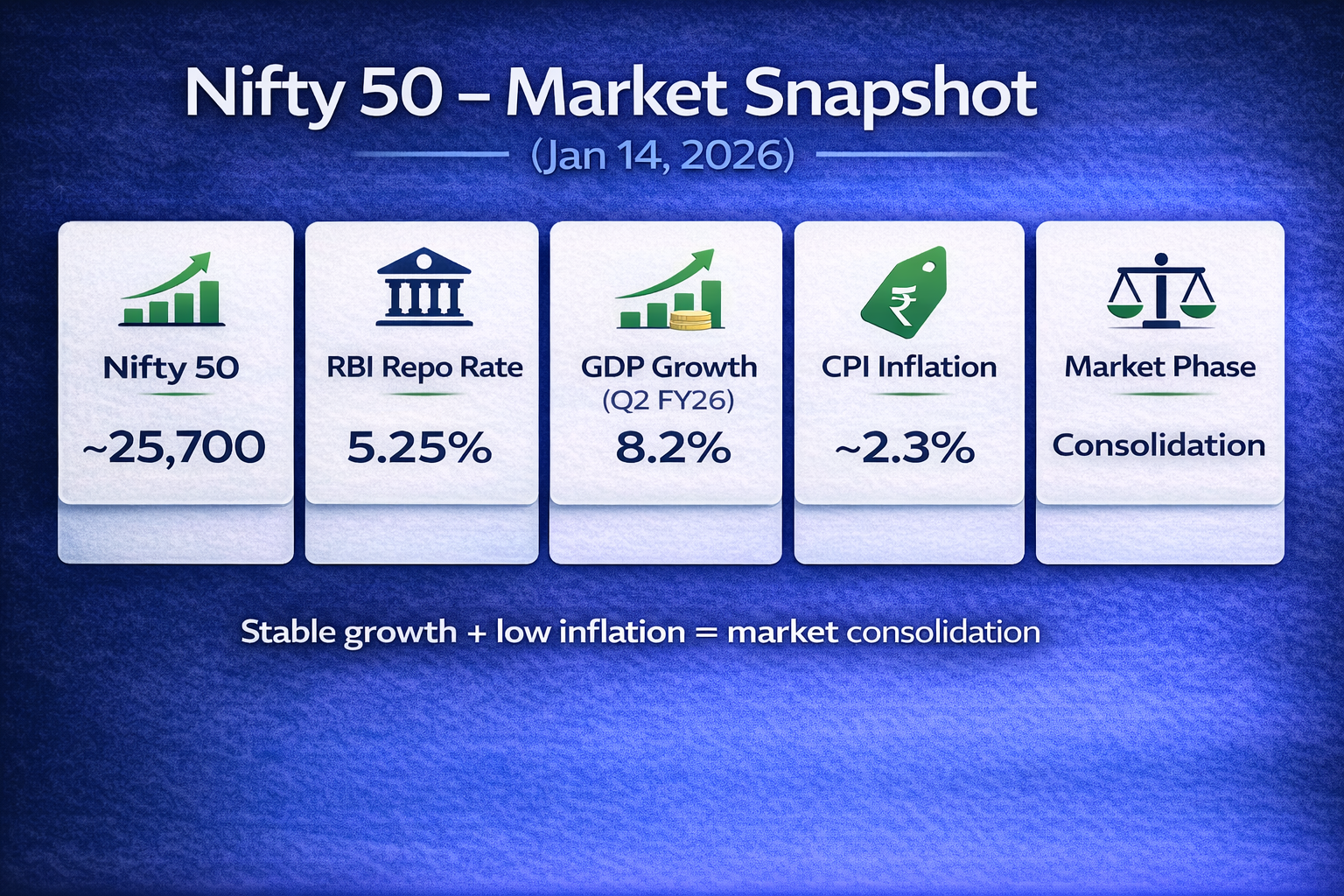
From a broader lens, India is currently in what can best be described as a “Goldilocks period”—not too hot, not too cold. GDP growth in Q2 FY26 came in at around 8.2%, one of the strongest among major economies, while retail inflation has cooled to nearly 2.3%, well within comfort levels. When growth is strong and inflation is low, markets don’t rush. They consolidate. That is exactly what we are witnessing at 25,700.
Reserve Bank of India – Monetary Policy Statements
2. Sectoral Resilience: The IT and Metal “Safety Trade”
A. IT: The Rupee Hedge
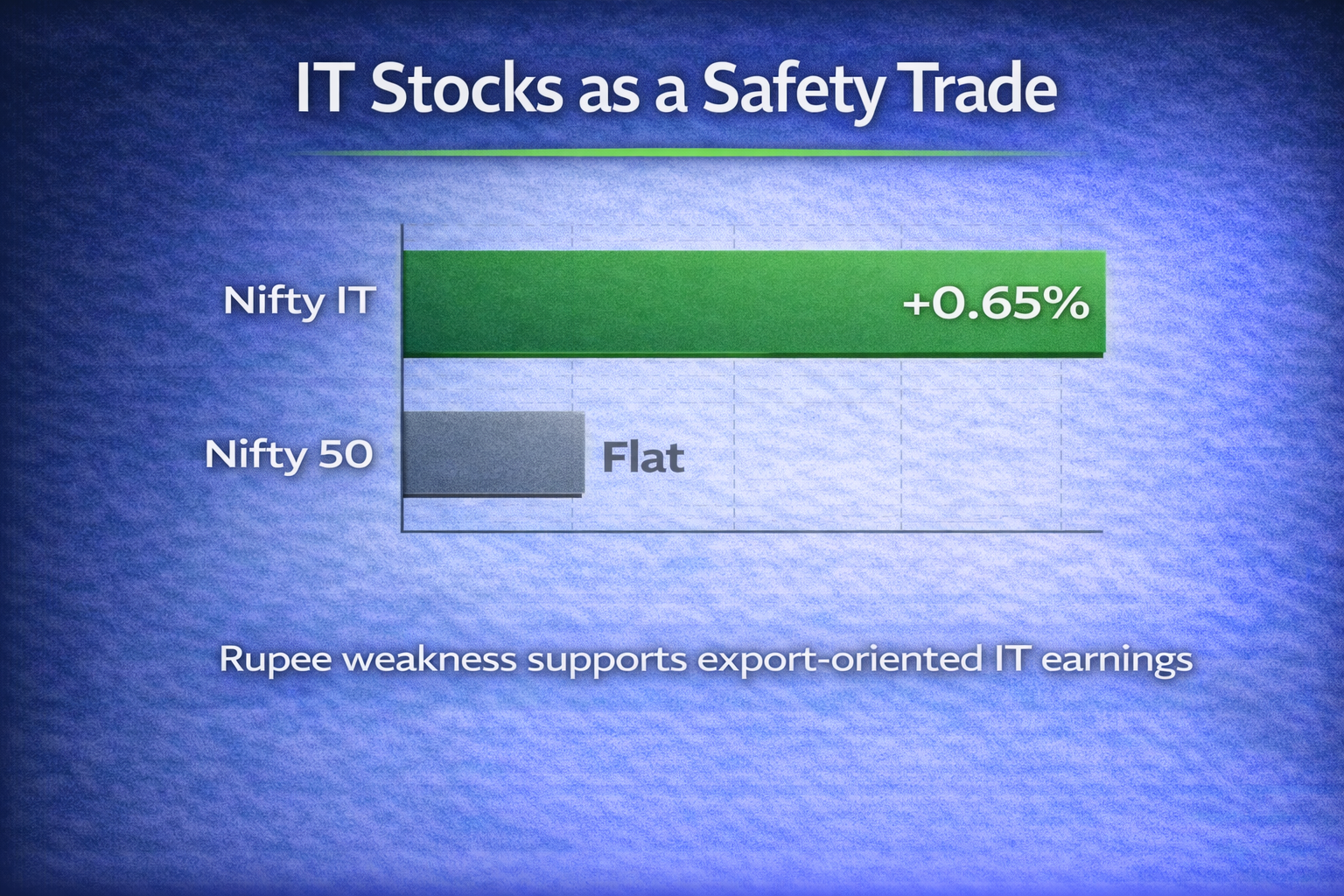
One of the clearest signals during this consolidation phase has been the relative strength of the IT sector. On the previous trading day, the Nifty IT index gained about 0.65%, climbing to roughly 38,236, even as the broader market stayed flat. This outperformance is not accidental.
The fundamental logic is simple. As the Indian rupee has shown mild depreciation, trading near ₹84.20 per US dollar, export-oriented IT companies naturally become more attractive. Their revenues are largely dollar-linked, while a significant part of their costs remain rupee-based. This currency mismatch acts as a natural hedge during global uncertainty, making IT a preferred “safety trade.”
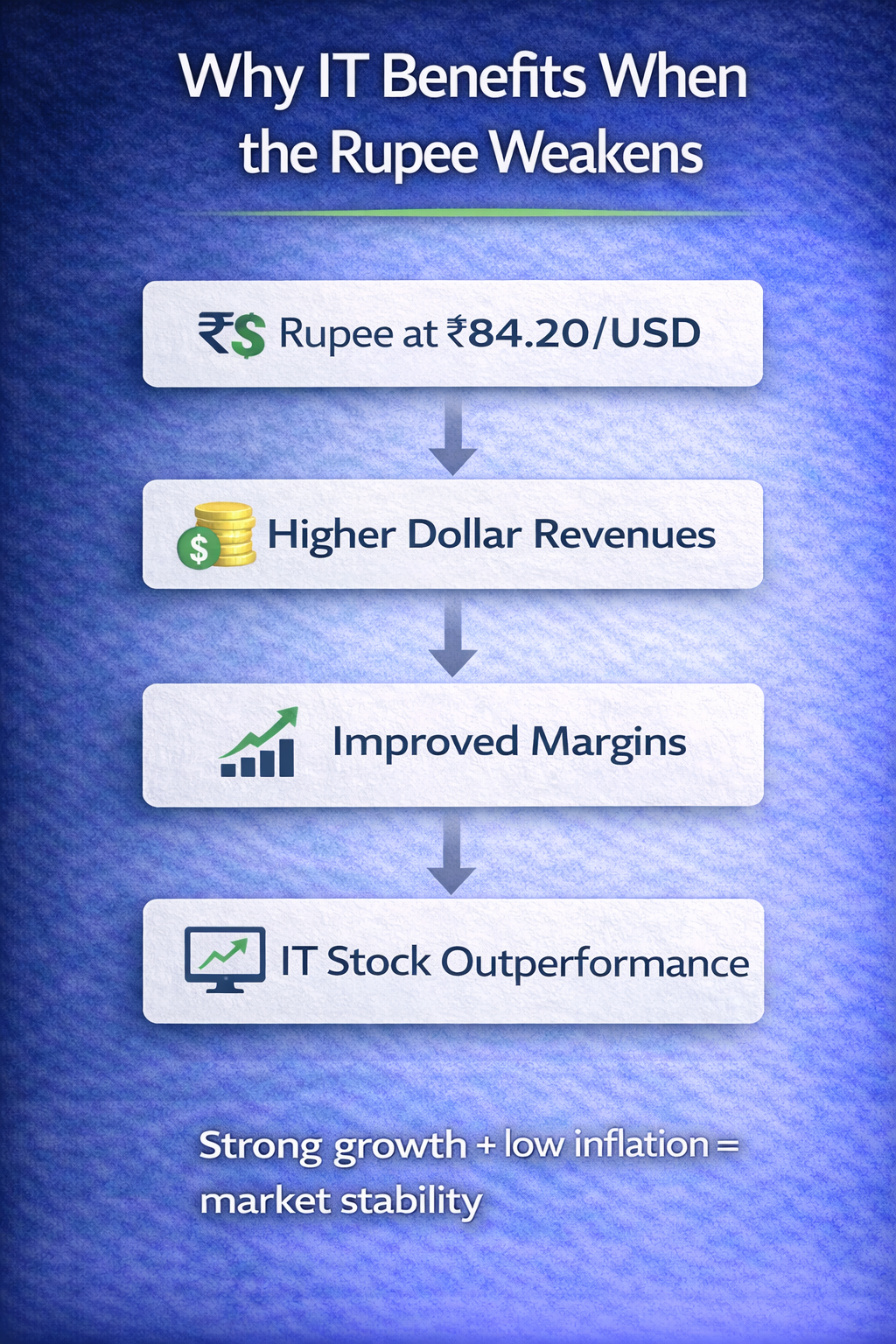
There is also a deeper shift happening within the global technology space. After a cautious 2024 and early 2025, global enterprises are once again opening their wallets, especially for projects linked to automation, data infrastructure, and what many analysts now call “Physical AI”—AI systems embedded into real-world processes like manufacturing, logistics, and energy management. These deals tend to be long-term and margin-accretive, offering Indian IT firms a cushion that was missing a year ago.
B. Metals: Domestic Boom vs. Global Dumping
The metals sector tells a more complex story. On the surface, margins look under pressure, and global metal prices are not particularly supportive. Yet, Indian metal stocks continue to find buyers. The reason lies in the sharp contrast between domestic demand and global supply dynamics.
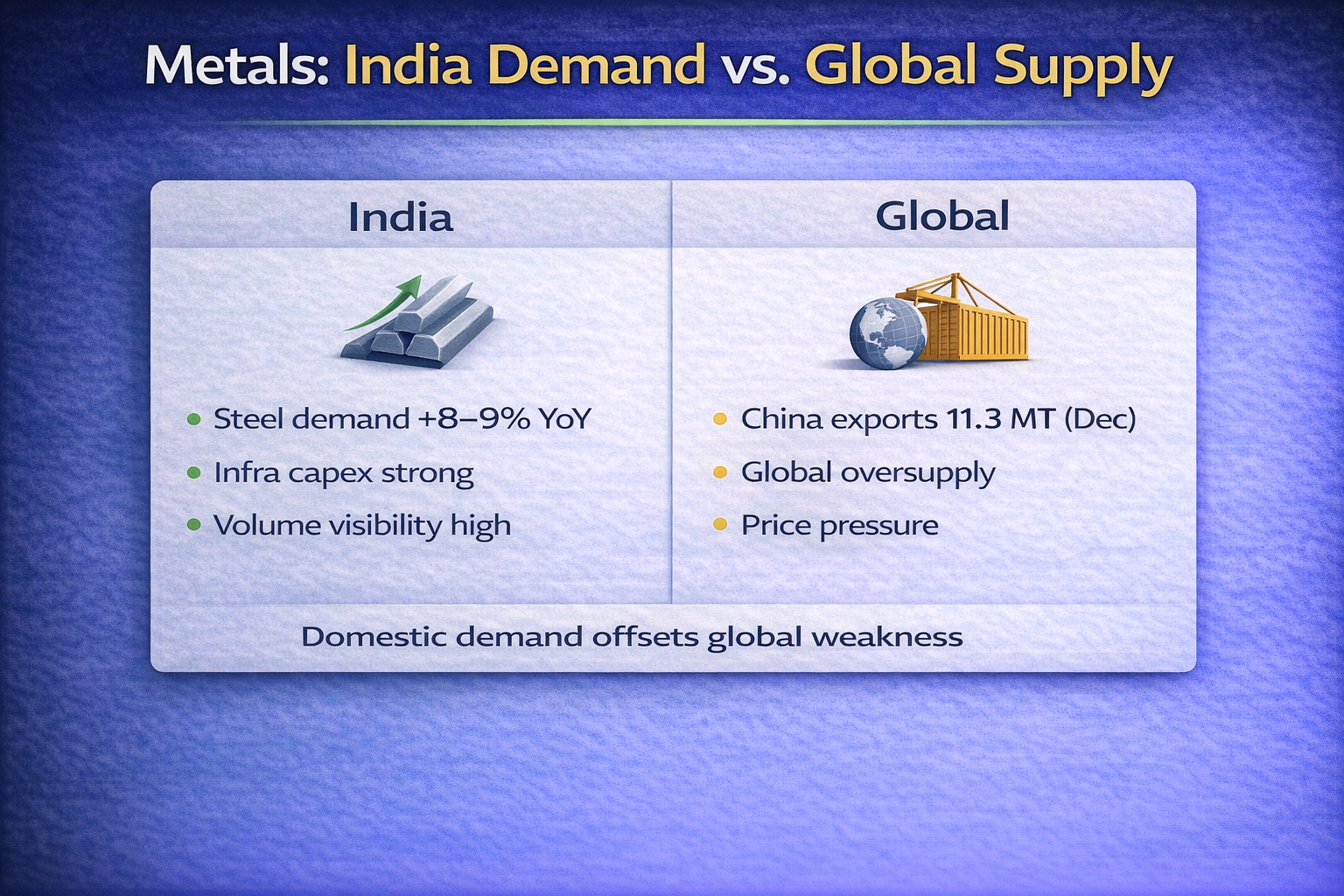
India’s steel demand is currently growing at 8–9% year-on-year, driven by infrastructure spending on roads, railways, ports, and urban housing. Government capex remains strong, and private sector investment is slowly following. This domestic boom supports volumes for Indian producers.
However, global prices are being weighed down by the China factor. China exported nearly 11.3 million metric tonnes of steel in December alone, as producers rushed shipments ahead of a new 2026 export licensing system. This front-loading has created excess supply in global markets, keeping prices soft. Investors, however, are making a calculated bet: domestic demand in India will offset global price pressure over time. In short, the metal trade today is less about global prices and more about India’s internal growth engine.
INDIA GDP & INFLATION DATA
3. The Pharma Lag: A “Tale of Two Halves”
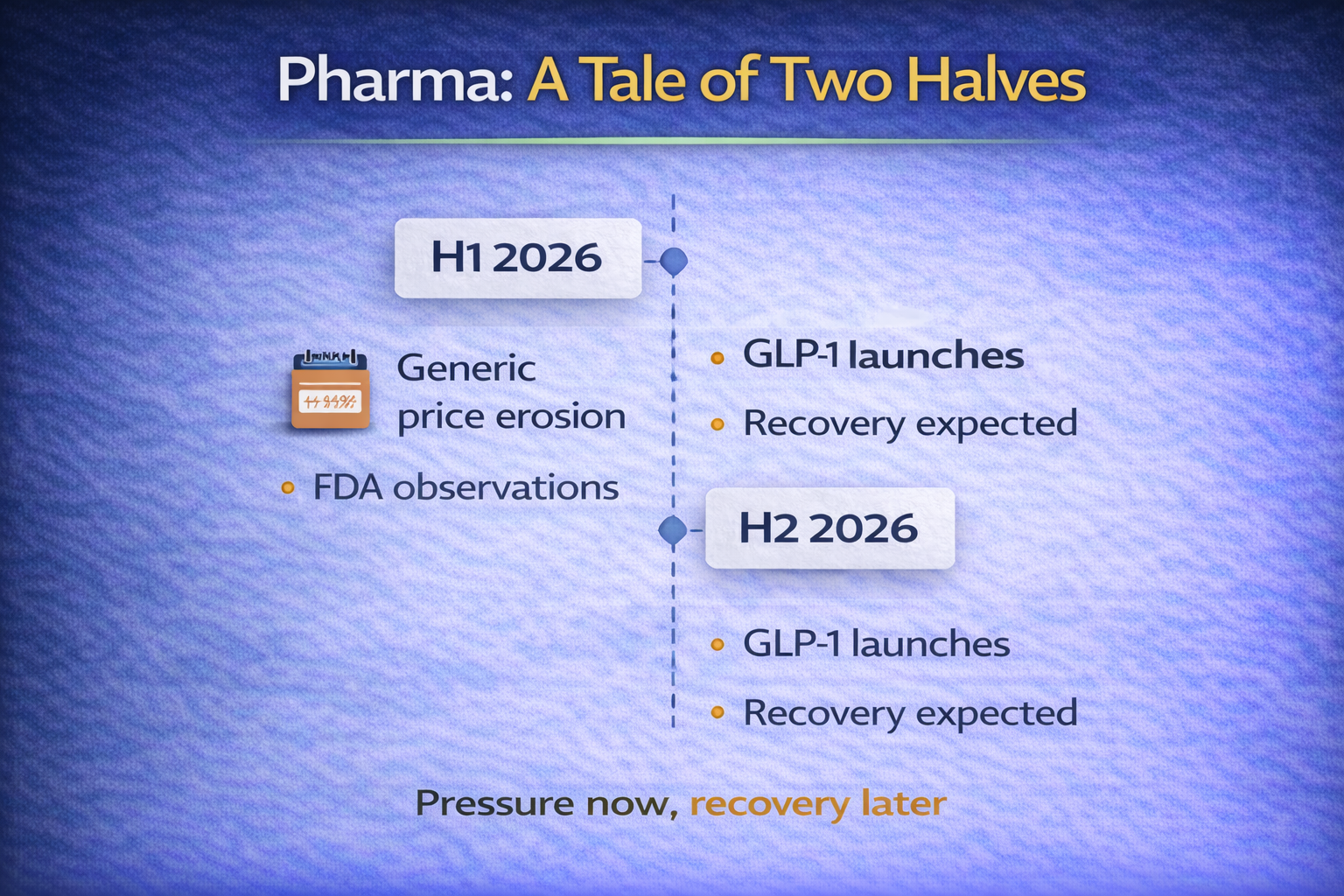
While IT and metals offer relative comfort, pharmaceuticals remain the laggard. The Nifty Pharma index has struggled to keep pace, and the reasons are largely structural rather than cyclical.
The sector is currently facing what analysts call a “generic cliff.” Several blockbuster drugs, especially in the US market, have seen intense competition following patent expiries. A well-known example is Revlimid, where multiple generic players entered almost simultaneously, sharply reducing pricing power. This has squeezed margins across the board.
Regulatory issues have added to the pressure. Recent US FDA observations at facilities in Srikakulam and certain Greek manufacturing units have kept investor sentiment cautious. Even when such observations are manageable, they delay approvals and slow revenue visibility.
That said, this is not a permanent slowdown. Most analysts expect H1 2026 to remain subdued, with a more meaningful recovery in H2 2026. The trigger is expected to be the rollout of GLP-1 based drugs, including semaglutide-related launches, likely around March–April 2026. These drugs address diabetes and obesity—two of the fastest-growing therapeutic areas globally—and could revive growth momentum for Indian pharma exporters.
4. The Geoeconomic Macro-Drivers (January 14 Context)
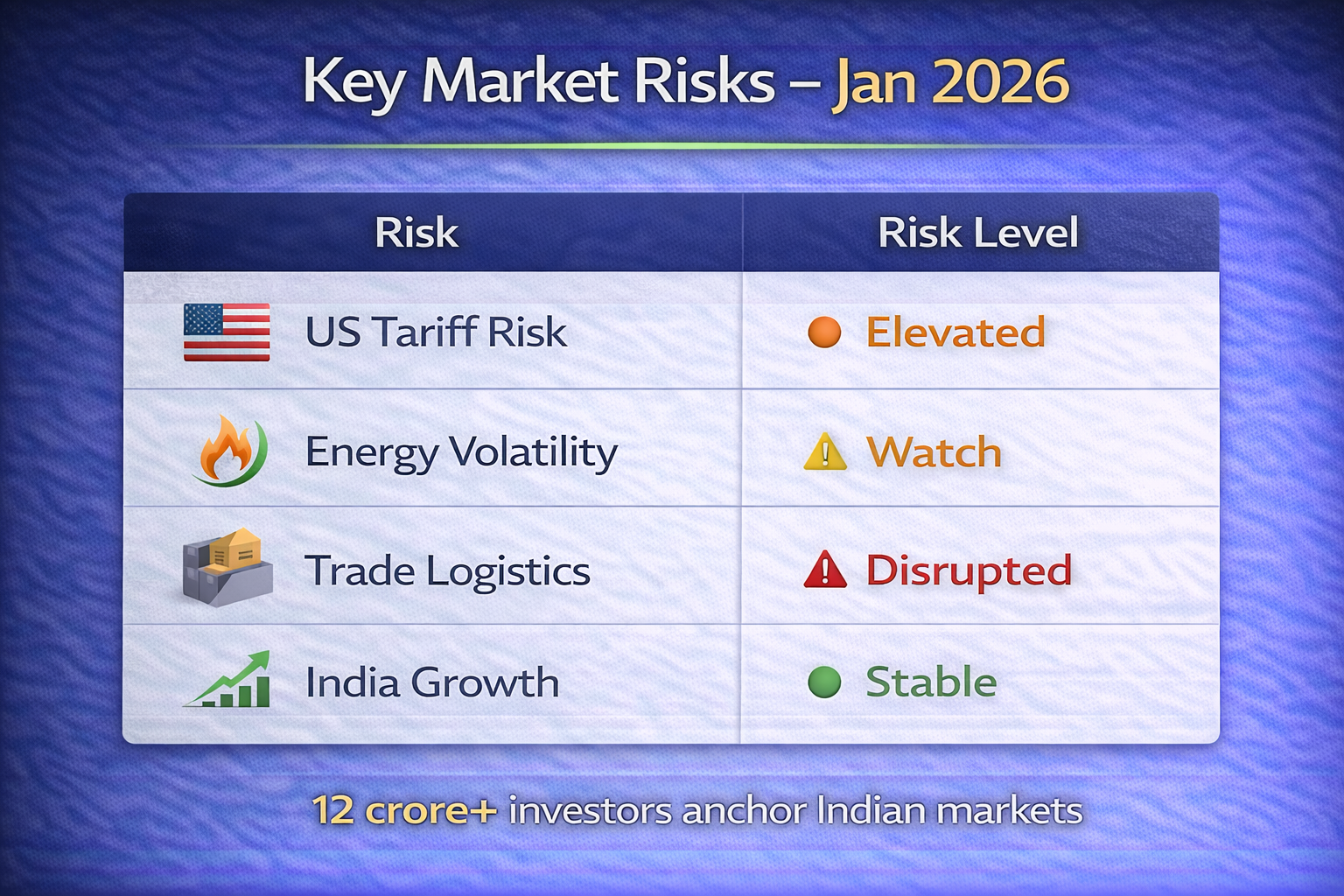
The US Tariff Overhang
Global geopolitics continue to cast a long shadow over markets. The renewed focus on US Section 232 investigations has raised concerns around fresh tariffs on steel, aluminium, and select industrial goods. These discussions have gained urgency amid trade talks involving Marco Rubio and India’s External Affairs leadership.
While India is not the primary target, any escalation in global trade barriers tends to increase volatility. Markets are factoring in the risk without panicking, which again explains the cautious sideways movement of the index.
Energy Volatility and Trade Logistics
Energy markets are another source of uncertainty. Internal unrest in Iran has raised questions about supply stability, while closer to home, India has faced logistical challenges, including stranded Basmati rice shipments worth nearly ₹2,000 crore. These issues don’t immediately derail growth, but they increase costs and complicate trade flows, keeping investors alert.
Liquidity Dynamics: FII vs. DII
Foreign Institutional Investors (FIIs) have been net sellers in recent sessions, with outflows of over ₹3,600 crore. In earlier cycles, such selling would have triggered sharp corrections. This time, the impact has been muted, thanks to strong Domestic Institutional Investor (DII) participation.
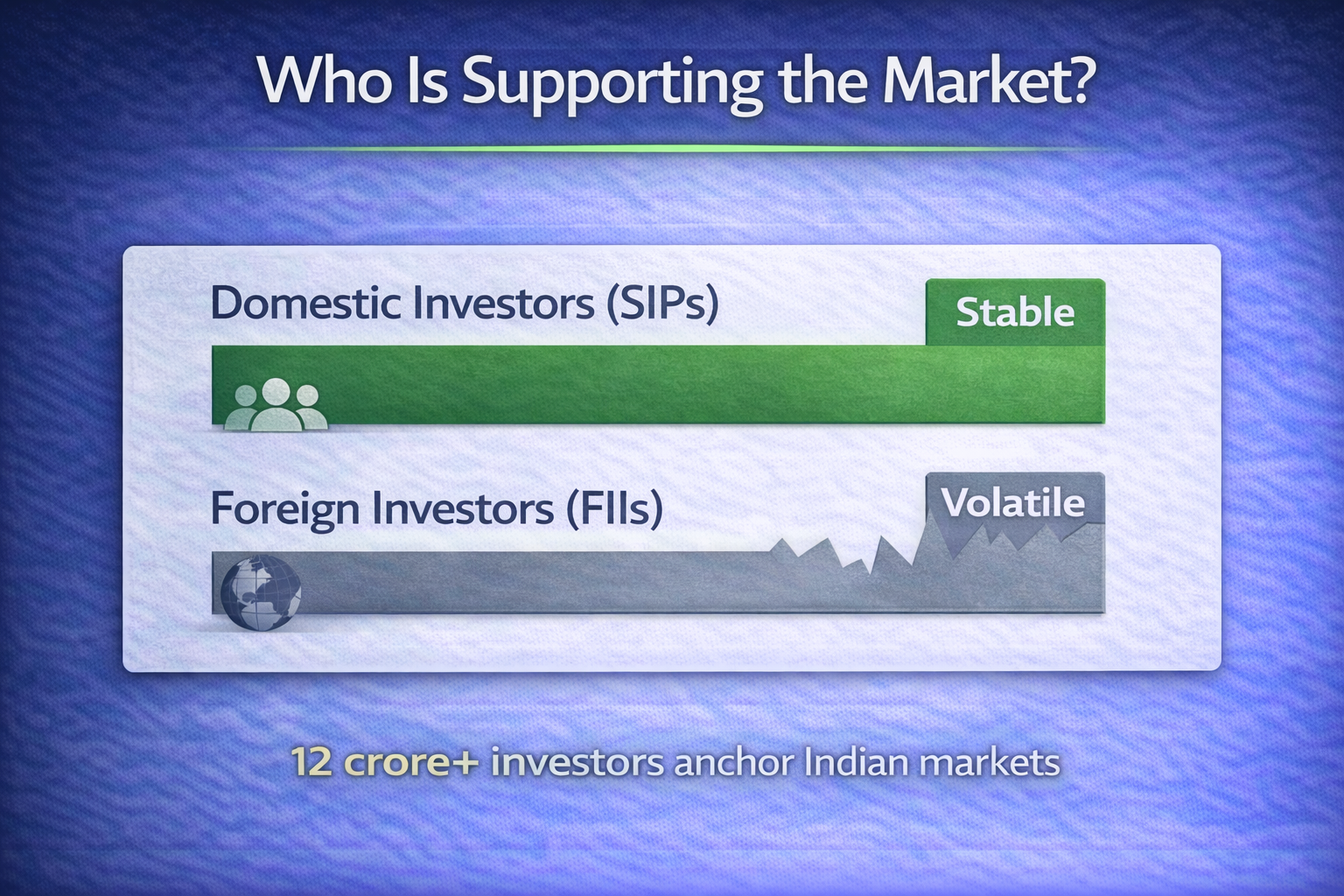
The backbone of this domestic liquidity is the SIP culture. Monthly inflows remain robust, supported by a registered investor base that has now crossed 12 crore individuals. This structural shift—from foreign-driven to domestically anchored markets—is one of the most underappreciated strengths of India’s current market cycle.
5. Risk-Reward Matrix: The Pivot Points
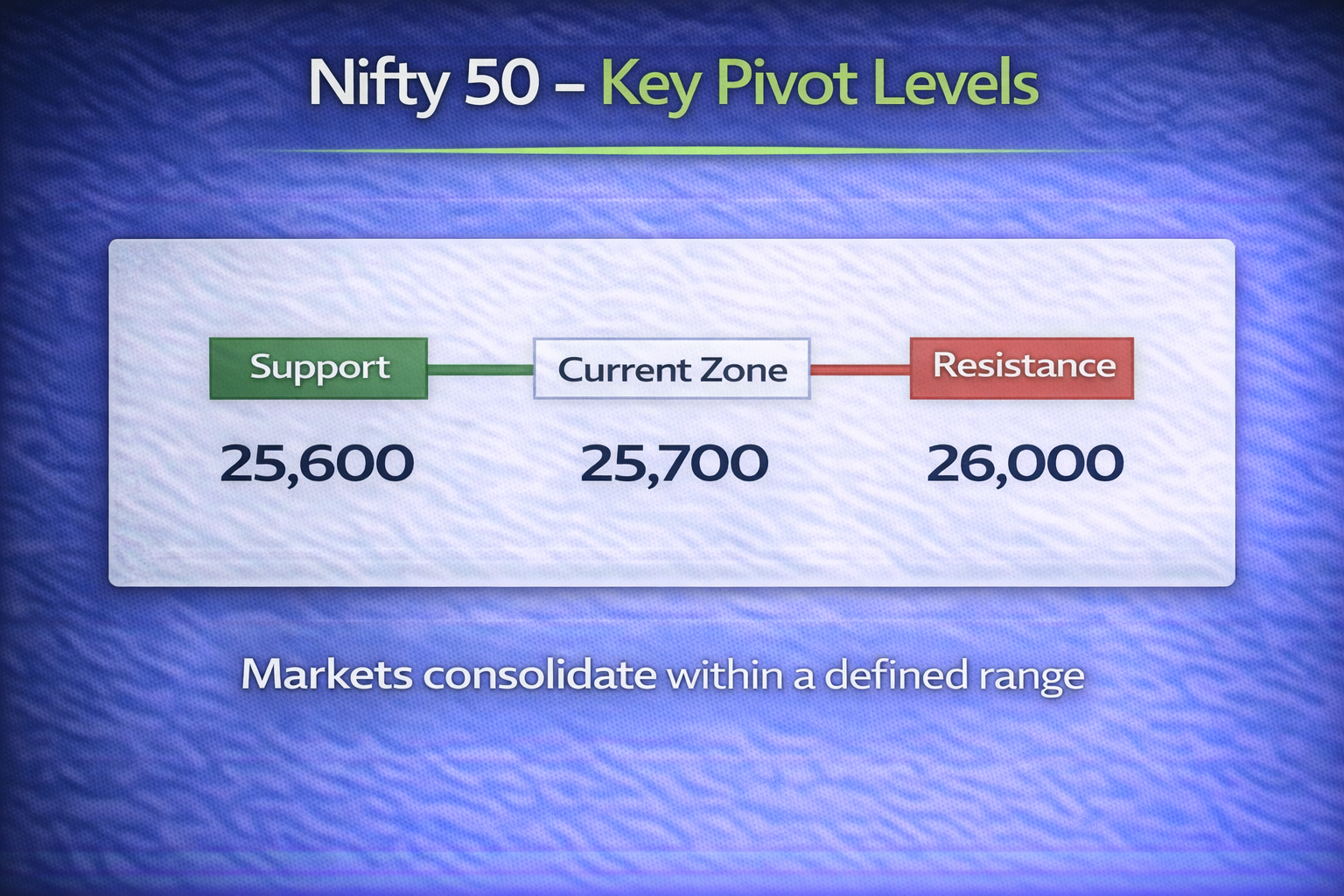
From a risk-reward perspective, the market’s technical and fundamental signals are unusually aligned. On the downside, 25,600 has emerged as a strong support level. Options data suggests this is the “max pain” zone, where option writers are most comfortable defending their positions.
On the upside, 26,000 acts as a psychological ceiling. It is not just a round number but also a level where valuations start to look stretched in the absence of fresh earnings upgrades or budget-driven policy catalysts.
Fundamentally, large-cap stocks are trading close to their 10-year average price-to-earnings multiples, suggesting fair valuation rather than excess. Small- and mid-cap stocks, however, remain more expensive, with parts of the segment trading at 28x forward earnings. This divergence explains why investors are becoming selective rather than broadly bullish.
NIFTY 50 INDEX DATA
6. Closing Expert Verdict: The Analyst’s “Makar Sankranti” Message
Today also marks Makar Sankranti, a festival symbolising transition. In many ways, the Indian equity market is undergoing a similar shift. The rally of the past few years was largely liquidity-driven, powered by easy money and global stimulus. The phase ahead will be more earnings-driven, demanding real delivery from companies rather than just narratives.
The message for investors is simple but important: do not mistake a range-bound market for a weak market. In a world dealing with 50% tariffs, geopolitical realignments, and supply chain shocks, an index holding steady at 25,700 is not a failure. It is a sign of maturity.
This consolidation is the market’s way of preparing for the next leg—one that will likely be shaped by budget priorities, sector-specific earnings, and India’s ability to convert macro strength into corporate profitability. Patience, as always, remains the most undervalued asset in investing.
❓ SEO-OPTIMIZED FAQs (HIGH-CPC)
1. Why is the Nifty 50 consolidating near 25,700?
The Nifty 50 is consolidating as markets digest Q3 earnings, absorb the RBI rate cut, and wait for policy clarity from the Union Budget 2026.
2. Is a range-bound Nifty 50 a negative sign?
No. A range-bound market often indicates stability and valuation comfort, especially when GDP growth is strong and inflation is low.
3. What is the support and resistance for Nifty 50 now?
Key support lies near 25,600, while 26,000 remains a strong psychological resistance in the short term.
4. Which sectors are performing well in this phase?
IT stocks are benefiting from rupee weakness, while metal stocks are supported by strong domestic infrastructure demand.
5. Why is the pharma sector underperforming?
Pharma stocks face pricing pressure from generic competition and regulatory issues, with recovery expected only in the second half of 2026.
6. How important is domestic liquidity for the market?
Domestic SIP inflows and DII participation are offsetting foreign selling, making Indian markets more resilient than in past cycles.
7. How does the Union Budget 2026 impact market direction?
The Budget can influence sectors through taxation, capital expenditure, and policy reforms, acting as a trigger for the next market move.
🔍 PEOPLE ALSO ASK (PAA) – GOOGLE-READY QUESTIONS
(Use these exactly as sub-headings or FAQ schema)
Is Nifty 50 overvalued at 25,700?
Large-cap valuations are close to long-term averages, suggesting the market is fairly valued rather than expensive.
What does a Goldilocks market mean for investors?
It means growth is strong, inflation is under control, and volatility is moderate — ideal conditions for selective investing.
Should investors invest during a sideways market?
Yes, sideways markets are often best for accumulating quality stocks at reasonable valuations.
How do FII and DII flows affect Nifty 50?
While FIIs add volatility, strong DII and SIP flows provide stability and downside support to the index.
What is the biggest risk to the Indian stock market right now?
Global risks such as US tariffs, energy volatility, and geopolitical tensions “can” create short-term uncertainty.