1. The Executive Summary (The Macro Hook)
NBCC (India) Limited, often referred to as India’s “Sarkari Builder,” reported its Q3 FY26 results on February 13, 2026. On the surface, the numbers look impressive. The company posted a consolidated net profit of ₹197 crore, a sharp 38.5% jump compared to ₹142 crore in Q3 FY25. Naturally, headlines celebrated the strong growth.
But when we look closely, the story becomes more nuanced.
A significant portion of the profit increase came from an exceptional gain of ₹80.15 crore. This gain resulted from the reversal of an earlier loss provision related to a stalled project in Kochi. After a favorable Supreme Court ruling, NBCC was allowed to write back this amount into its profits.
If we remove this one-time gain, the core operational performance appears steady but not extraordinary. Revenue from operations grew 7.6% to ₹3,022 crore. Considering NBCC has a massive order book of ₹1.26 lakh crore, investors expected faster execution growth.
The market reaction reflected this reality. Despite a 38% profit jump, the stock traded weak, falling around 2% after the announcement. That tells us the market understands the difference between recurring earnings and legal windfalls.
NBCC Q3 FY26 financial results
2. Financial Dashboard: Separating One-Off Gains from Operations
Let us break down the key numbers.
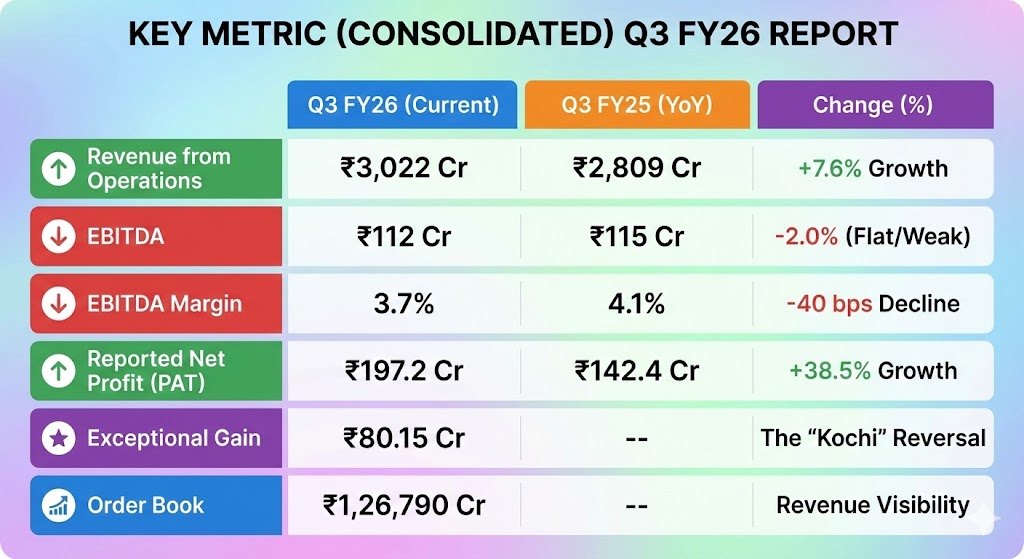
Revenue from operations stood at ₹3,022 crore, up from ₹2,809 crore last year. That is a growth of 7.6%. While positive, it is not high enough to excite growth investors.
EBITDA came in at ₹112 crore compared to ₹115 crore last year, showing a slight 2% decline. EBITDA margin dropped to 3.7% from 4.1%, indicating some margin pressure.
The reported net profit of ₹197.2 crore includes the ₹80.15 crore exceptional gain. Without that gain, profit growth would have been modest.
However, one number remains very strong — the order book. At ₹1,26,790 crore, NBCC has one of the largest order backlogs among public sector construction firms. This provides long-term revenue visibility.
The key question is execution speed. A large order book is meaningful only if projects move quickly from paperwork to billing.
NBCC quarterly results filing
3. Fundamental Breakdown: The Three Verticals
NBCC operates through three major segments: Project Management Consultancy (PMC), Real Estate, and EPC (Engineering, Procurement & Construction). Each has a different risk and margin profile.
A. PMC (Project Management Consultancy): The Cash Engine
PMC remains NBCC’s most stable and profitable segment. Revenue from this vertical reached ₹2,010 crore, growing 11.5% year-on-year.
Under this model, NBCC manages government projects such as AIIMS, IIT campuses, housing for central government employees, and redevelopment projects. Instead of taking construction risk, NBCC earns a fixed consultancy fee, typically between 6% and 8% of project cost.
This fee-based model offers steady margins and lower capital risk. The growth in this segment aligns with the government’s capital expenditure push in FY26. The Union Budget 2026 continued strong infrastructure spending, which supports PMC growth.
In simple terms, PMC is NBCC’s “safe income.”
B. Real Estate: The Kochi Reversal
The ₹80 crore exceptional gain came from the Real Estate segment. Earlier, NBCC had written off inventory related to a stalled project in Kochi due to legal complications.
Recently, the Supreme Court restored certain writ petitions in favor of NBCC, allowing the company to reverse that earlier provision. Accounting rules permit companies to write back provisions when legal uncertainties are resolved.
This improves reported profit but does not represent fresh cash inflow from new sales.
For investors, this means the Q3 profit jump cannot be projected into future quarters. However, it does clean up the balance sheet and improves financial clarity.
It is good news — but it is not recurring growth.
C. EPC: The Low-Margin Pressure
The EPC segment continues to be a drag. This segment involves direct construction contracts, which are highly competitive and margin-sensitive.
EBITDA margin compression to 3.7% largely reflects higher EPC contribution this quarter. In construction, raw material costs, delays, and tender-based pricing reduce profitability.
Compared to private construction companies, NBCC operates with thinner margins but lower risk because most clients are government agencies.
Still, for a stock trading at a premium valuation, investors expect margin expansion, not compression.
4. Policy & Geoeconomics: The Amrapali Mandate
NBCC is not a typical construction company. It has a social mandate as well.
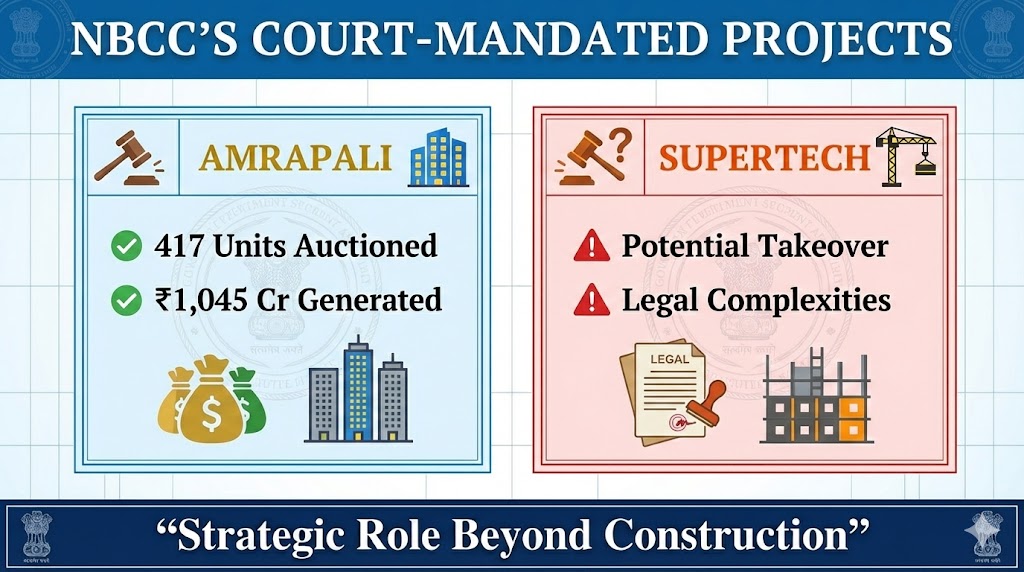
The Supreme Court appointed NBCC as the receiver to complete stalled Amrapali housing projects. In Q3 FY26, NBCC successfully auctioned 417 Amrapali units, generating ₹1,045 crore.
This shows NBCC’s ability to monetize stressed real estate assets.
Recently, the Supreme Court also asked NBCC to take over stalled Supertech projects. While this increases the order book, these projects are complex and litigation-heavy.
Such mandates enhance NBCC’s strategic importance but may not immediately boost margins. They require legal coordination, stakeholder negotiations, and long execution timelines.
This creates a trade-off: social responsibility versus shareholder returns.
Amrapali housing project update
5. Risk Factors: The Execution Gap
The biggest concern remains execution velocity.
With an order book of ₹1.26 lakh crore and annual revenue of roughly ₹12,000 crore, the order book-to-bill ratio stands near 10x. At the current pace, it would take almost a decade to clear the backlog.
The market wants to see revenue growth accelerate toward 15–20% annually. So far, growth remains around 7–8%.
Another risk is receivables. Since NBCC works largely with government entities, payment cycles can be long. Delayed payments can affect working capital and cash flow.
Additionally, redevelopment projects such as Nauroji Nagar and Sarojini Nagar are high-value but complex. Delays in approvals, environmental clearances, or contractor issues can slow billing.
Investors should monitor trade receivables and cash flow statements in upcoming quarters.
6. Conclusion: Value Play or Value Trap?
At current levels, NBCC trades at around 44x earnings. That is expensive for a construction company growing revenue at 7%.
The premium valuation reflects belief in the long-term redevelopment story. Projects like Nauroji Nagar and Sarojini Nagar in Delhi are high-value government redevelopment assets. If executed well, they could significantly boost earnings.
However, Q3 FY26 results show that operational performance remains average once we exclude the Kochi exceptional gain.
For investors, the message is clear: do not chase headline profits without reading the fine print.
NBCC remains a stable PSU-backed entity with strong government support. But for the stock to break out meaningfully above the ₹105 level, execution speed must improve.
Until then, the stock may consolidate in the ₹90–₹105 range as the market waits for evidence of faster revenue growth.
In the end, this quarter is not bad — but it is not transformative either.
And in investing, sustainable growth matters more than legal windfalls.
✅ FAQ
1. How much profit did NBCC report in Q3 FY26?
NBCC reported a net profit of ₹197 crore, up 38.5% year-on-year.
2. What boosted NBCC’s Q3 FY26 profit?
An exceptional gain of ₹80.15 crore from the Kochi project reversal boosted reported profit.
3. What is NBCC’s order book size?
NBCC’s order book stands at approximately ₹1.26 lakh crore, providing long-term revenue visibility.
4. Why did NBCC EBITDA margin decline?
EBITDA margin fell to 3.7% due to a higher contribution from low-margin EPC projects.
5. Is NBCC stock overvalued?
NBCC trades around 44x P/E, which is expensive for a construction company growing revenue at 7–8%.
6. What is NBCC’s role in Amrapali projects?
NBCC is appointed by the Supreme Court to complete stalled Amrapali housing projects.
7. What are key risks for NBCC?
Execution delays, receivable cycles, and legal complexities in redevelopment projects remain risks.