
I. Introduction: Defining the NAVI Era
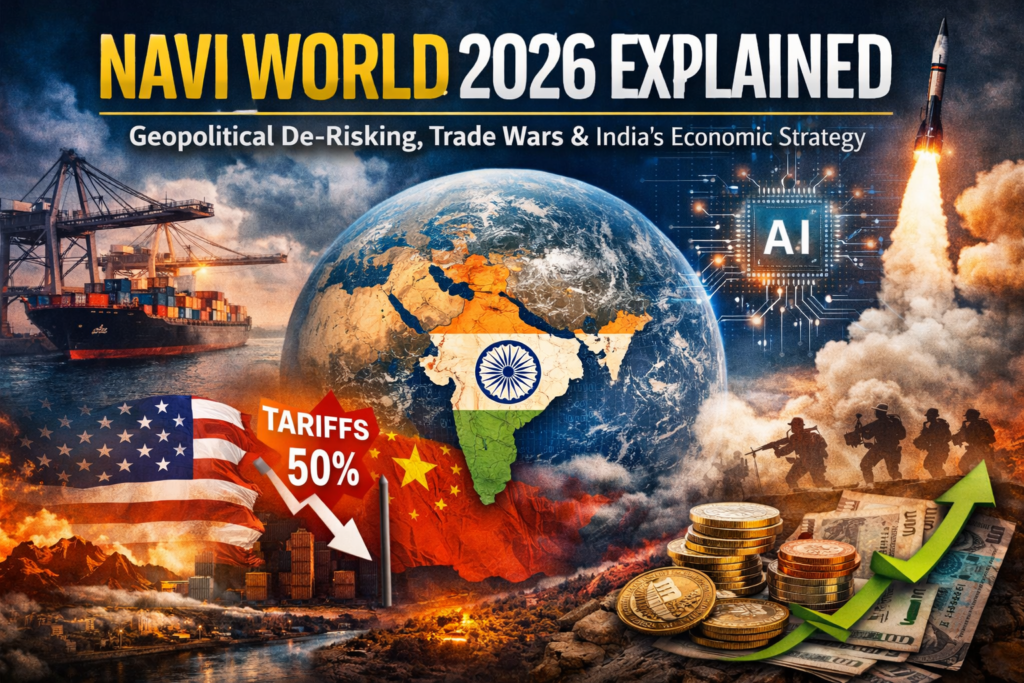
The world entering 2026 does not behave the way it did even five years ago. Global shocks no longer arrive slowly or in isolation. A cyberattack in one country can freeze ports in another. A drought can halt semiconductor supply. A tariff decision in Washington can change factory plans in Asia overnight. This new reality is best explained by the NAVI framework, a concept widely discussed in global strategy circles and originally popularised by Ernst & Young.
NAVI stands for Non-linear, Accelerated, Volatile, and Interconnected. Non-linear means small events now trigger oversized consequences. Accelerated means crises move at digital speed, not bureaucratic speed. Volatile reflects sudden swings in markets, currencies, and politics. Interconnected means no sector is isolated anymore—energy affects AI, water affects chips, and security affects investment. In short, 2026 is not unstable because of one crisis; it is unstable because everything is linked.
This marks a sharp break from the 2010s. That decade was built on the logic of “Just-in-Time” efficiency—cheap imports, long supply chains, and minimal buffers. It worked as long as geopolitics stayed quiet. The 2020s have shattered that assumption. Pandemics, wars, sanctions, climate shocks, and technology controls have forced countries to adopt “Just-in-Case” resilience instead.
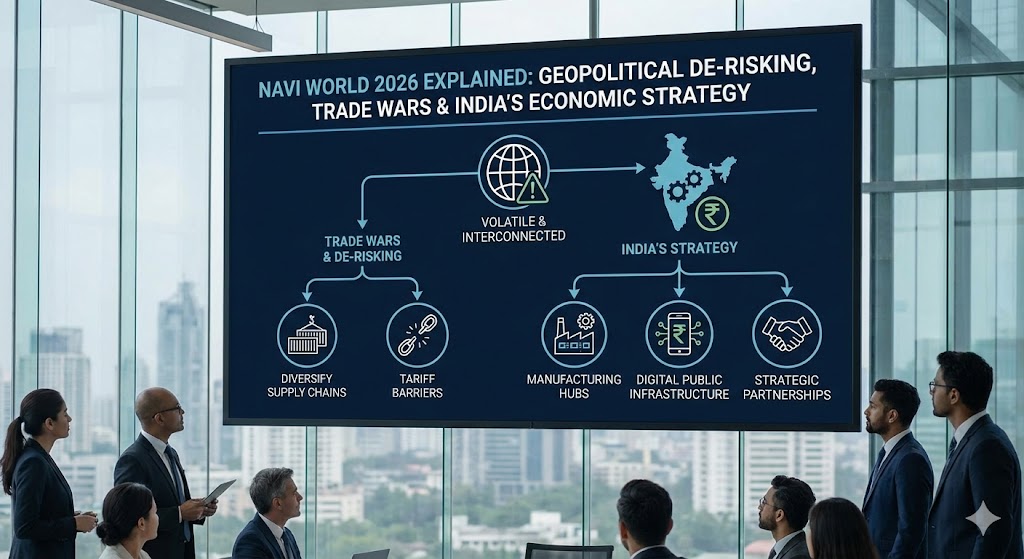
By 2026, national security and economic policy are no longer separate discussions. Trade, technology, defence, and internal security now sit on the same decision table. Countries that fail to adapt to this merged reality will not just lose growth—they will lose strategic relevance.
1️⃣ Global Framework & Risk Analysis
II. Pillar 1: The Geopolitics of Scarcity
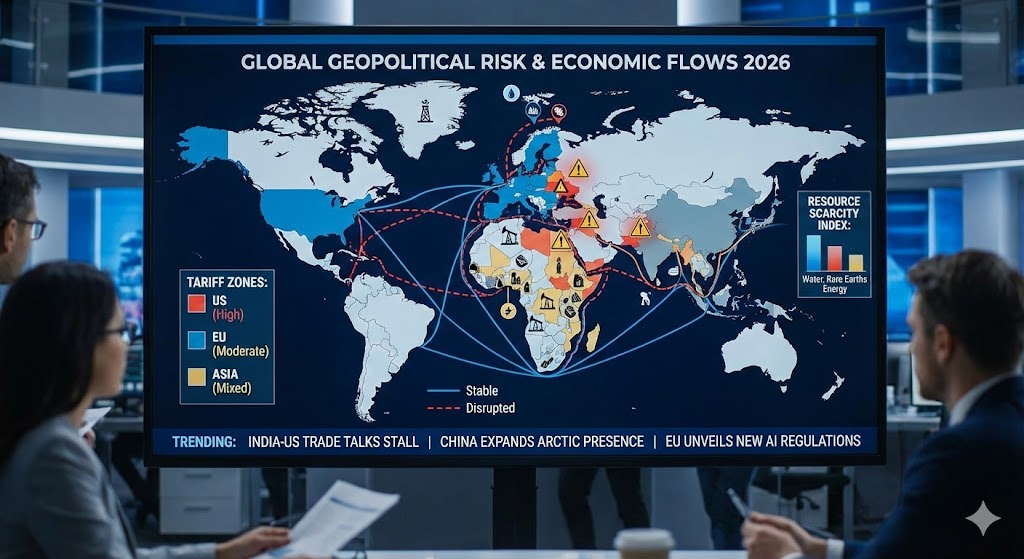
The most powerful driver of geopolitical tension in 2026 is not ideology but scarcity. Critical minerals—lithium, cobalt, nickel, rare earth elements—are no longer simple industrial inputs. They are strategic assets. According to 2025–26 global supply assessments, over 70% of rare earth processing and nearly 60% of battery-grade mineral refining remain concentrated in a handful of countries. This concentration has triggered a shift from open markets to resource nationalism.
Countries are no longer asking who can mine resources cheaply; they are asking who controls them politically. Governments are rewriting mining laws, restricting exports, and demanding local value addition. The competition has moved from discovery to control. Nations rich in these resources now wield disproportionate influence over clean energy, defence electronics, and electric mobility supply chains.
This scarcity becomes even sharper when viewed through the AI–Water–Energy triangle. In 2026, global data centres are expected to consume around 4.5% of total world electricity, up from roughly 2% in 2020. Large AI training models require massive computing power, which in turn requires reliable electricity and huge volumes of water for cooling. Semiconductor fabs can consume millions of litres of ultra-pure water per day, creating stress in already water-scarce regions.
This is why water is emerging as a silent geopolitical factor. Regions that can provide energy stability, water security, and mineral access together are becoming strategic hubs. Countries like Australia and parts of the Global South, including the Democratic Republic of the Congo, are no longer peripheral players. They are power brokers in the new scarcity chain.
In the NAVI world, control over scarcity determines leverage. Nations that ignore this reality risk becoming dependent consumers in a producer-driven system.
III. Pillar 2: The End of “Trade-as-Usual”
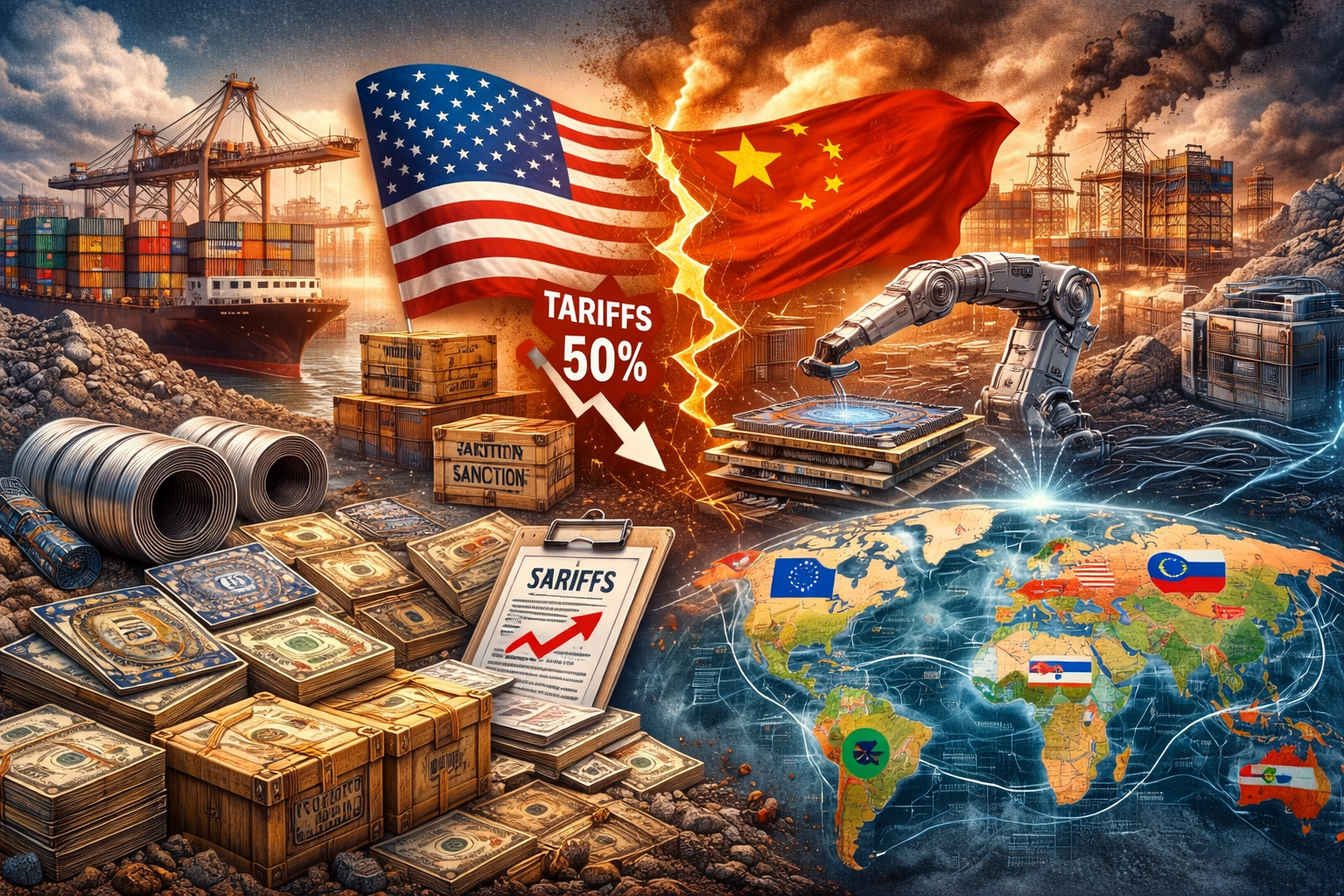
The second pillar of the NAVI world is the collapse of old trade assumptions. Free trade has not ended, but frictionless trade has. The clearest example is the renewed tariff conflict led by the United States. Under reciprocal trade frameworks and national security clauses, tariff hikes of up to 50% have been imposed or threatened on sensitive sectors such as steel, aluminium, industrial machinery, electric vehicles, and advanced electronics.
These tariffs are not temporary negotiating tools anymore. They are structural instruments of economic security. For exporting nations, this means price competitiveness alone is no longer enough. Political alignment, supply-chain trust, and domestic capacity now matter just as much.
At the same time, global observers are witnessing what many call the “China thaw.” Relations between Washington and Beijing remain tense, but outright decoupling has proven too costly. The China and the US are now managing rivalry rather than escalating it. This has produced a state best described as a “Cold Peace.” Strategic technologies remain restricted, but trade in non-sensitive goods continues under careful supervision.
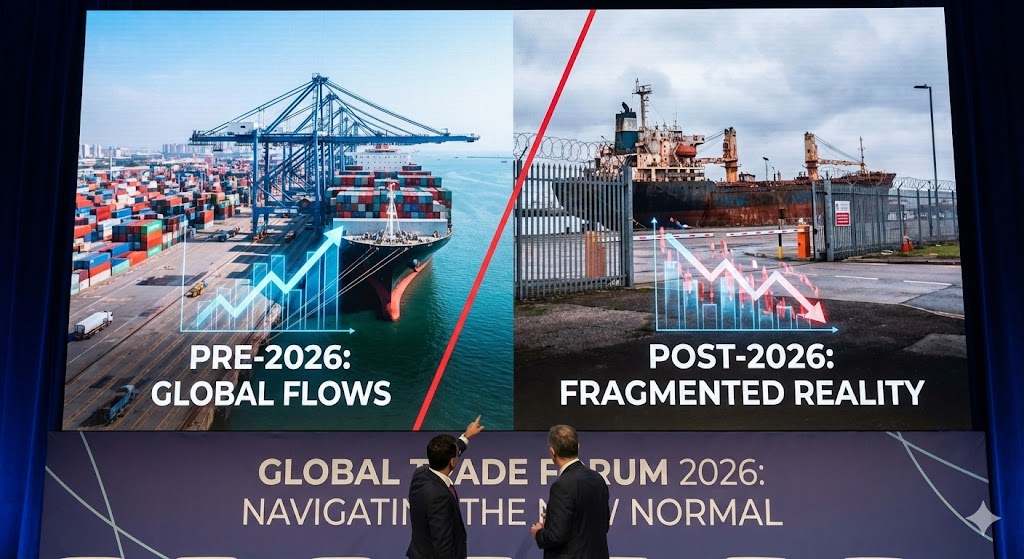
The key takeaway is that globalisation has not collapsed—it has regionalised. Supply chains are shortening. Trade blocs are tightening. Countries prefer “friendly” or “trusted” partners even at higher costs. In the NAVI world, stability is valued more than maximum efficiency.
IV. India’s Calculated Risk Management: A NAVI Case Study
Among major economies, India offers one of the clearest examples of calculated risk management in the NAVI era. Rather than choosing sides, India has chosen diversification. Its strategy is not confrontation or dependence, but balance.
One major shift is in export geography. Facing slower demand growth in the US and Europe, India expanded trade with Latin America, Africa, and the Middle East. In 2025, Indian exports to these regions grew by around 12% year-on-year, helped by infrastructure diplomacy and new shipping corridors such as the India–Middle East–Europe Economic Corridor (IMEC). This buffered external shocks and reduced over-reliance on any single market.
India has also accelerated its Free Trade Agreement (FTA) offensive. The India–UK FTA, expected to be fully operational in 2026, opens services, pharmaceuticals, and advanced manufacturing access. The India–EFTA agreement brings high-value investment commitments in technology and clean energy. These agreements are not about cheap exports; they are about embedding India into trusted value chains.
Financial resilience is another pillar. Despite global volatility, India recorded over 367 IPO listings in 2025, making it one of the world’s most active equity markets. Combined with a projected GDP growth rate of around 7.3%, India has positioned itself as a stabilising bridge between developed economies and the Global South. In a world seeking safe alternatives, predictability has become India’s competitive advantage.
3️⃣ Global Economic Outlook & Inflation
V. Internal Security and Economic Stability
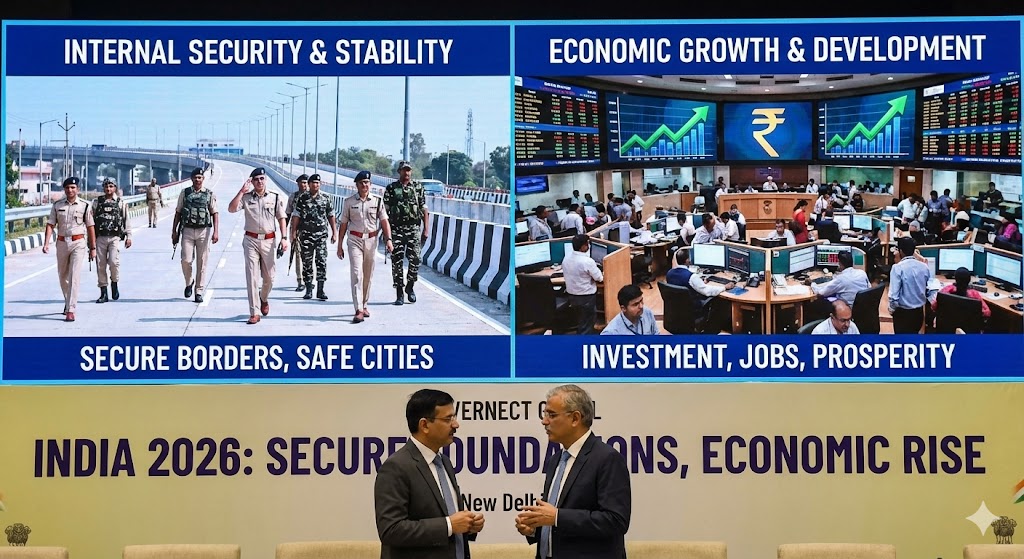
Geopolitics does not stop at borders. In the NAVI world, internal security directly affects economic outcomes. This logic explains India’s firm stance on eliminating left-wing extremism, including the government’s target of a Maoist-free corridor by March 31, 2026.
The connection is straightforward. Regions affected by long-term internal conflict remain locked out of investment, infrastructure, and industrial activity. Once security improves, these areas unlock access to minerals, land, and labour. This is particularly important for India’s ambitions in strategic manufacturing.
A secure internal environment supports what can be described through a simple formula:
Resilience = Political Stability + Supply Chain Diversification − External Debt
When stability increases and debt remains controlled, resilience improves. This is not theory; it is observed reality across emerging markets.
A clear example is the ₹7,280-crore Production Linked Incentive (PLI) scheme for rare-earth magnet manufacturing. These magnets are essential for electric vehicles, wind turbines, and defence systems. Many of the required raw materials are located in regions once considered high-risk. Improving security converts these areas from liabilities into strategic assets.
In the NAVI world, internal order is not just about law and order—it is about economic sovereignty.
VI. Conclusion: The Roadmap for Leaders
The defining lesson of 2026 is simple but uncomfortable: scale without agility is a weakness. Large economies that cannot adapt fast enough will suffer more than smaller, flexible ones. In a NAVI environment, the ability to reroute supply chains, adjust policies quickly, and absorb shocks matters more than sheer size.
From the SR Vishwa outlook, the second half of 2026 is likely to see stagflationary pressure in the United States, driven by high interest rates, fiscal stress, and election-year uncertainty. This creates a narrow but real opportunity for India to capture additional global market share in value-added manufacturing, especially in electronics, defence components, and clean-energy equipment.
The global order is not collapsing. It is hardening. Rules are becoming stricter, borders more meaningful, and trust more valuable. Countries that continue to chase yesterday’s efficiency models will struggle. Those that de-risk today will shape tomorrow.
Final thought:
The future will not reward the cheapest producer. It will reward the most resilient one.
International Energy Agency
❓ Frequently Asked Questions (FAQ)
1. What is the NAVI World in geopolitics?
The NAVI World describes the global environment where events are Non-linear, Accelerated, Volatile, and Interconnected. In simple words, small shocks now cause big impacts, crises spread very fast, markets change suddenly, and problems in one sector quickly affect others. This framework helps explain why trade, security, technology, and climate issues are now tightly linked.
2. Why is geopolitical de-risking important in 2026?
Geopolitical de-risking is important because global trade and supply chains are no longer stable. Tariff wars, sanctions, cyber risks, and regional conflicts can disrupt business overnight. By de-risking—diversifying suppliers, markets, and partners—countries and companies reduce sudden economic shocks and protect long-term growth.
3. What does “End of Trade-as-Usual” really mean?
“End of Trade-as-Usual” means the old system of free, low-cost, and frictionless global trade no longer exists. In 2026, trade is shaped by tariffs, strategic trust, national security rules, and regional blocs. Countries now prefer reliable partners over the cheapest suppliers.
4. How are trade wars affecting the global economy?
Trade wars increase costs for industries, raise inflation, and slow global growth. Higher tariffs on metals, machinery, and technology make products more expensive and disrupt supply chains. Instead of boosting domestic industries quickly, trade wars often create uncertainty that delays investment decisions worldwide.
5. What is resource nationalism and why is it rising?
Resource nationalism happens when countries restrict or control exports of key resources like lithium, cobalt, rare earths, water, or energy. It is rising because these resources are critical for electric vehicles, clean energy, defence, and AI. Governments want to protect their strategic assets and reduce foreign dependence.
6. Why are AI, water, and energy now linked geopolitically?
AI data centres consume large amounts of electricity and water for cooling. Semiconductor manufacturing also needs ultra-pure water. This creates pressure on energy grids and water supplies, especially in climate-stressed regions. As a result, water and energy security are becoming as important as technology itself.
7. How is India adapting to the NAVI World?
India is adapting by diversifying export markets, signing new trade agreements, boosting domestic manufacturing, and maintaining financial stability. Instead of relying on one region or one partner, India spreads risk across multiple geographies and sectors, making its economy more resilient to global shocks.
8. Why is internal security linked to economic growth?
Internal security affects investor confidence, infrastructure development, and access to natural resources. Regions affected by conflict remain economically isolated. Improving security allows governments to build roads, attract industries, and use mineral resources, directly supporting long-term economic growth.
9. What role does manufacturing play in geopolitical resilience?
Manufacturing reduces dependence on imports and strengthens supply chains. Countries with strong domestic manufacturing can handle trade disruptions better. In the NAVI world, value-added manufacturing is seen as a national security asset, not just an economic activity.
10. Is globalisation ending in 2026?
No, globalisation is not ending—but it is changing. Instead of one global market, the world is moving toward regional trade blocs and trusted partnerships. Trade continues, but under stricter rules, higher scrutiny, and stronger geopolitical influence.
11. What does geopolitical resilience mean for ordinary people?
For ordinary people, geopolitical resilience affects jobs, prices, energy costs, and economic stability. Countries that manage risks well can control inflation better, protect employment, and avoid sudden economic shocks that hurt households.
12. What is the biggest economic risk in the NAVI World?
The biggest risk is ignoring interconnected threats. Focusing only on growth while ignoring security, supply chains, or resource dependence can lead to sudden crises. In the NAVI world, balanced policy matters more than fast growth alone.
13. How can businesses survive in the NAVI World?
Businesses can survive by diversifying suppliers, investing in regional markets, building inventory buffers, and tracking geopolitical risks closely. Companies that rely on a single country or trade route face higher disruption risks.
14. What is the long-term lesson of the NAVI World?
The long-term lesson is simple: resilience beats efficiency. The future belongs to countries and companies that can adapt quickly, manage risk smartly, and stay flexible in an uncertain global environment.
🔍 People Also Ask (PAA)
What does NAVI World mean in 2026?
The NAVI World in 2026 refers to a global system that is Non-linear, Accelerated, Volatile, and Interconnected. It explains why geopolitical shocks, trade wars, climate events, and technology disruptions now spread faster and cause larger economic impacts than before.
Why is geopolitical de-risking replacing globalization?
Geopolitical de-risking is replacing full globalization because countries no longer trust long, fragile supply chains. Trade wars, sanctions, pandemics, and conflicts have shown that efficiency without security creates high risk. Governments now prioritise resilience over low cost.
How do trade wars affect global supply chains?
Trade wars disrupt global supply chains by increasing tariffs, raising costs, and forcing companies to relocate production. This leads to higher inflation, delayed manufacturing, and regionalisation of trade instead of global sourcing.
What is meant by the end of “trade-as-usual”?
The end of “trade-as-usual” means global trade is no longer free, predictable, or rules-based. In 2026, trade decisions are driven by national security, strategic alliances, and political risk rather than pure market efficiency.
Why are critical minerals becoming geopolitical weapons?
Critical minerals like lithium, cobalt, and rare earths are essential for EVs, defence systems, renewable energy, and AI. Countries controlling these resources use export restrictions and regulations to gain strategic advantage, turning minerals into geopolitical tools.
How are AI and energy connected to geopolitics?
AI systems need massive electricity and water for data centres and chip production. This increases pressure on energy grids and water resources, making energy security and climate stability central geopolitical concerns in the AI era.
Why is India important in the NAVI World?
India is important in the NAVI World because it offers political stability, strong economic growth, diversified trade partnerships, and large manufacturing capacity. This makes India a trusted alternative supply-chain hub between the West and the Global South.
How is India reducing economic risk in 2026?
India is reducing economic risk by diversifying exports, signing new trade agreements, expanding domestic manufacturing, strengthening internal security, and maintaining financial stability. This approach limits dependence on any single country or market.
What is resource nationalism and why does it matter?
Resource nationalism occurs when governments control or restrict natural resources for domestic advantage. It matters because it can disrupt global industries, raise prices, and increase geopolitical competition over minerals, energy, and water.
How does internal security impact economic growth?
Internal security improves economic growth by reducing risk for investors, enabling infrastructure development, and unlocking resource-rich regions. Stable regions attract industries, lower borrowing costs, and support long-term development.
Is globalization ending or just changing?
Globalization is not ending; it is changing. The world is moving from a single global market to regional trade blocs, trusted partnerships, and supply-chain security models. Trade continues but under stricter geopolitical conditions.
What industries benefit most in the NAVI World?
Industries that benefit most include defence manufacturing, semiconductors, clean energy, EV supply chains, critical minerals, infrastructure, and domestic manufacturing. These sectors align with national security and resilience goals.
What is the biggest economic risk in 2026?
The biggest economic risk in 2026 is ignoring interconnected risks—such as trade shocks, energy shortages, and geopolitical conflict—while focusing only on growth. Lack of preparedness can turn small disruptions into major crises.
What is the key lesson of the NAVI World for policymakers?
The key lesson is that resilience matters more than efficiency. Policymakers must balance growth with security, diversify economic links, and prepare for shocks rather than assuming global stability.
📊 Infographic Table 1: Old World (2019) vs NAVI World (2026)
| Indicator | Old World (2019) | NAVI World (2026) |
|---|---|---|
| Global Trade Model | Open globalization | Regionalized blocs |
| Supply Chains | Long, cost-driven | Short, resilience-driven |
| Inflation Trend | Low & stable | Sticky & volatile |
| Energy Prices | Cheap & predictable | Strategic & uncertain |
| Technology Flow | Free & global | Restricted & sovereign |
| Crisis Speed | Slow, linear | Fast, non-linear |
| Policy Priority | Growth & efficiency | Security + growth |
🌍 Infographic Table 2: What NAVI Really Means
| NAVI Factor | Simple Meaning | Real-World Example |
|---|---|---|
| Non-Linear | Small shock → big impact | One cyberattack halts global ports |
| Accelerated | Crisis spreads instantly | Tariff decision hits markets in hours |
| Volatile | Sudden policy swings | Interest rate shocks |
| Interconnected | One sector breaks another | Water crisis hits AI chip supply |
⛏️ Infographic Table 3: Geopolitics of Scarcity (2026)
| Resource | Why It Matters | Strategic Risk |
|---|---|---|
| Lithium | EV batteries | Export controls |
| Cobalt | Energy storage | Supply concentration |
| Rare Earths | Defence & electronics | Resource nationalism |
| Water | Chip manufacturing | Climate stress |
| Electricity | AI & data centres | Grid instability |
⚡ Infographic Table 4: AI–Water–Energy Triangle
| Component | Dependency | Risk Created |
|---|---|---|
| AI Models | High power | Energy shortages |
| Data Centres | Water cooling | Local water stress |
| Semiconductors | Ultra-pure water | Production delays |
| Clean Energy | Minerals | Supply bottlenecks |
🌐 Infographic Table 5: End of “Trade-as-Usual”
| Trade Aspect | Before | Now |
|---|---|---|
| Tariffs | Low & negotiable | High & structural |
| Trade Wars | Temporary | Long-term |
| China–US | Integration | Cold Peace |
| Supply Chains | Cheapest source | Trusted source |
| Globalisation | Borderless | Bloc-based |
🇮🇳 Infographic Table 6: India’s NAVI Strategy (2026)
| Area | India’s Action | Outcome |
|---|---|---|
| Export Markets | Latin America, Africa, Middle East | Risk diversification |
| Trade Deals | UK FTA, EFTA | Market access |
| Manufacturing | PLI expansion | Domestic capacity |
| Finance | Strong IPO market | Investor confidence |
| Growth | ~7.3% GDP | Stability anchor |
💰 Infographic Table 7: India Financial Resilience Snapshot
| Indicator (2025–26) | Data |
|---|---|
| IPO Listings | 367+ |
| GDP Growth | ~7.3% |
| Export Growth (New Markets) | ~12% |
| Manufacturing PLI | ₹7,280 crore |
| FX Reserves | Stable & diversified |
🛡️ Infographic Table 8: Internal Security = Economic Strength
| Factor | Impact on Economy |
|---|---|
| Maoist-Free Zones | Infrastructure access |
| Stable Regions | Investment inflow |
| Mineral Access | Strategic manufacturing |
| Reduced Conflict | Lower risk premium |
India 2026 Strategy Decoded: US Trade War, China Engagement & Domestic Security Push



1 thought on “NAVI World 2026 Explained: Geopolitical De-Risking, Trade Wars & India’s Economic Strategy”