
1. The Executive Summary (The Money Hook)
Muthoot Finance has delivered one of the most powerful quarterly performances in India’s financial sector this year. In Q3 FY26, the company reported a consolidated net profit of ₹2,656 crore, marking a stunning 95% year-on-year growth compared to ₹1,362 crore in the same quarter last year. This is not just a routine earnings beat. It is a signal that something structural is happening in the gold loan sector.
While many sectors like IT services and auto manufacturing are facing margin pressure due to global slowdown and weak exports, gold loan companies are benefiting from a completely different macro environment. Gold prices in 2026 have been hovering near historic highs due to global uncertainty, geopolitical tensions, and central bank buying. Whenever gold prices rise, gold loan companies automatically gain strength because their collateral becomes more valuable.
For investors, this is more than just a profit spike. It confirms that the secured lending model, especially gold-backed lending, is one of the safest and most profitable segments in India’s NBFC space today. In a volatile market where unsecured consumer loans are showing stress, secured gold lending looks like a fortress.
Muthoot Finance Q3 FY26 earnings release
2. Financial Dashboard: Q3 FY26 Real-Time Data
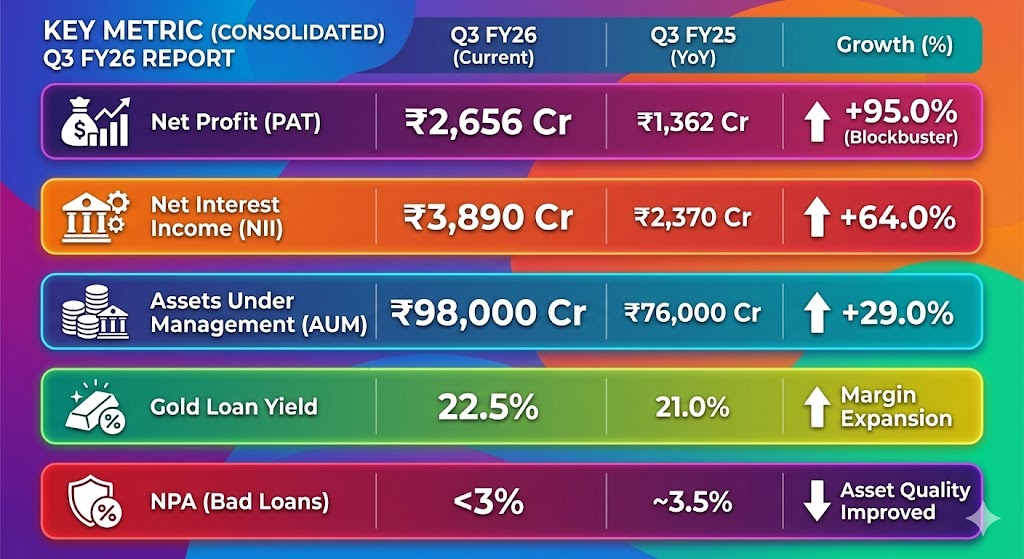
Let us look at the numbers in detail to understand why this quarter matters.
Net profit stood at ₹2,656 crore, up 95% year-on-year. Net Interest Income (NII) jumped to ₹3,890 crore from ₹2,370 crore, showing 64% growth. Assets Under Management (AUM) expanded to ₹98,000 crore, up from ₹76,000 crore last year, reflecting a strong 29% increase. Gold loan yield improved to 22.5% compared to 21% last year. Non-performing assets (NPA) declined below 3%, compared to around 3.5% last year.
This combination of higher yields, strong AUM growth, and improving asset quality is rare in financial services. Typically, when loan books grow rapidly, bad loans increase. But here, asset quality actually improved. That tells us the lending model is working.
The jump in NII clearly shows that Muthoot is earning more from every rupee lent. When margins expand alongside growth, it signals strong pricing power.
Muthoot Finance quarterly results filing
3. Fundamental Breakdown: Why This Is a Structural Opportunity
A. The “LTV” Arbitrage (Loan-to-Value Advantage)

The most powerful factor behind Muthoot’s growth is the Loan-to-Value (LTV) arbitrage. When gold prices rise, the value of collateral increases automatically. If a customer pledged 100 grams of gold worth ₹5 lakh last year, and gold prices rise 15%, that same gold may now be worth ₹5.75 lakh.
This gives Muthoot two advantages. First, it can lend more money safely against the same collateral. Second, even if gold prices correct by 5–10%, the company still remains protected because it maintains conservative LTV ratios.
Unlike unsecured personal loans, where recovery depends entirely on borrower income, gold loans are secured by physical assets. If a borrower defaults, the company auctions the gold. Recovery rates in gold loans are extremely high compared to unsecured retail loans.
This is why secured gold loan benefits are attracting conservative investors in FY26. The risk profile is fundamentally lower.
B. The SME Cash Crunch
India’s small business sector is currently facing working capital challenges. Banks have tightened unsecured business lending due to rising credit risk. Many small shop owners, traders, and micro-entrepreneurs need quick liquidity but do not want long approval processes.
Gold loans offer instant liquidity. In many cases, loans are approved within minutes because gold is easy to value and store.
The 29% AUM growth shows that SME borrowers are increasingly relying on gold monetization. This is an important macro indicator. It tells us that while formal credit channels are tightening, gold-backed lending is filling the gap.
This shift is structural. India is estimated to hold over 25,000 tonnes of household gold. That is an enormous dormant asset pool. Gold loan companies are effectively unlocking that capital for productive use.
C. Operating Leverage: The Silent Multiplier
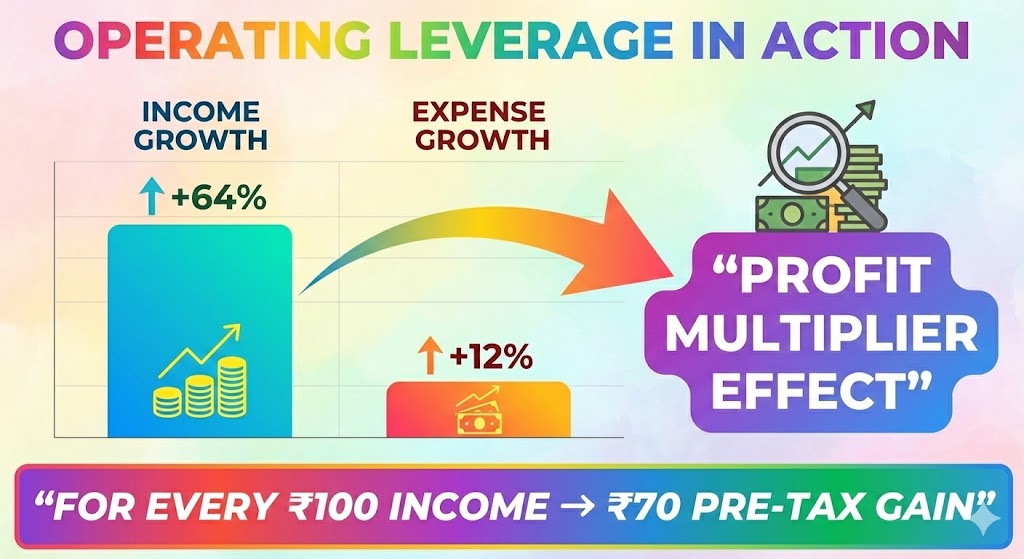
Another key reason behind the 95% profit growth is operating leverage. While net interest income grew 64%, operating expenses increased only 12%.
This means that revenue growth is translating directly into profit. For every ₹100 of incremental income, a large portion is flowing into the bottom line.
Financial companies rarely achieve this kind of efficiency. Usually, higher growth requires aggressive expansion, marketing, and hiring. But gold loan branches are relatively low-cost to operate. Once a branch is established, incremental business adds very little additional cost.
This efficiency is what creates super-normal profit growth during a gold bull cycle.
global gold price trends
4. Sector Comparison: Muthoot vs Traditional Banks
To understand the opportunity, it helps to compare gold NBFCs with traditional banks.
Banks like HDFC Bank and SBI are currently facing “deposit wars.” They are offering higher interest rates to attract depositors because liquidity is tight. This compresses their net interest margins.
Muthoot and other gold-focused NBFCs do not rely on retail deposits. They borrow from the bond market or financial institutions at competitive rates. Then they lend at 20%+ yields against gold.
In a high-interest-rate environment, this model becomes even more profitable. Borrowing costs may rise slightly, but lending yields remain strong because customers value convenience and speed.
Moreover, gold-backed loans are short tenure loans, often 3 to 12 months. This reduces long-term interest rate risk. Banks, on the other hand, deal with long-term mortgages and corporate loans.
In FY26’s uncertain macro climate, gold NBFCs appear structurally better positioned than traditional lenders.
5. Investment Verdict: A Strong Buy Candidate?
Despite the massive earnings growth, Muthoot Finance trades at around 14x price-to-earnings ratio. Compare this with fintech companies trading at 40–50x multiples without consistent profitability.
This valuation suggests that the market is still pricing Muthoot as a cyclical gold play rather than a structural secured lender.
Dividend expectations are also strong. With record profits and strong cash flow, the company may announce higher dividends in Q4 FY26.
For conservative investors, Muthoot acts as a hedge. If stock markets correct due to global uncertainty, gold prices typically rise. Higher gold prices increase collateral value, benefiting gold loan companies.
This creates a rare defensive growth profile. It performs well during economic stress and also during moderate expansion phases.
Broader Macro Context: Why Gold Is Back
Gold has been in a structural uptrend due to multiple global factors. Central banks have increased gold reserves to diversify away from dollar assets. Geopolitical tensions continue in various parts of the world. Inflation remains a concern in developed markets.
Whenever uncertainty rises, investors move toward safe-haven assets. Gold benefits from this trend. Higher gold prices directly strengthen gold loan companies.
Additionally, India’s cultural attachment to gold ensures steady collateral availability. Unlike Western markets, Indian households continue to accumulate gold for weddings and savings.
This combination of global macro support and domestic cultural preference creates a strong long-term demand base.
Risk Factors to Watch
No investment is risk-free. A sharp and sustained fall in gold prices could temporarily reduce collateral value. However, gold typically does not collapse overnight without macro triggers.
Regulatory changes are another risk. RBI could tighten gold loan norms if LTV ratios rise excessively. However, current regulations are well-defined and monitored.
Competition from fintech gold lenders is increasing. But established players like Muthoot have strong branch networks and trust built over decades.
Asset quality remains stable for now. If economic conditions deteriorate severely, some borrowers may default. But the secured nature of gold loans limits downside risk.
Final Conclusion: The Recession-Proof Stock?
Muthoot Finance’s 95% profit jump is not just a good quarter. It is confirmation of a gold lending super-cycle.
The company is benefiting from high gold prices, strong SME demand, disciplined cost control, and secured lending efficiency.
At 14x P/E with improving asset quality and strong dividend potential, the stock appears attractive compared to many overvalued financial peers.
For investors seeking stability in FY26’s volatile market, gold loan stocks offer a unique combination of safety and growth.
If gold prices remain strong, this cycle may continue.
And if markets turn volatile, gold usually shines brighter.
That makes Muthoot Finance not just a lender, but a hedge embedded inside a stock.
✅ FAQ
1. How much profit did Muthoot Finance report in Q3 FY26?
Muthoot Finance reported a net profit of ₹2,656 crore, up 95% year-on-year.
2. Why did Muthoot Finance profit increase sharply?
Higher gold prices, strong AUM growth, margin expansion and operating leverage drove the profit surge.
3. What is Muthoot Finance’s AUM in FY26?
Assets Under Management (AUM) reached approximately ₹98,000 crore.
4. How safe are gold loans compared to unsecured loans?
Gold loans are secured by physical gold collateral, making recovery easier and reducing credit risk.
5. What is the current gold loan yield for Muthoot?
Gold loan yield stands around 22.5%, higher than last year’s 21%.
6. Is Muthoot Finance a dividend-paying stock?
Yes, Muthoot Finance regularly pays dividends and strong earnings may support higher payouts.
7. Are gold loan stocks recession-proof?
Gold loan companies often benefit during economic uncertainty because gold prices typically rise in volatile markets.