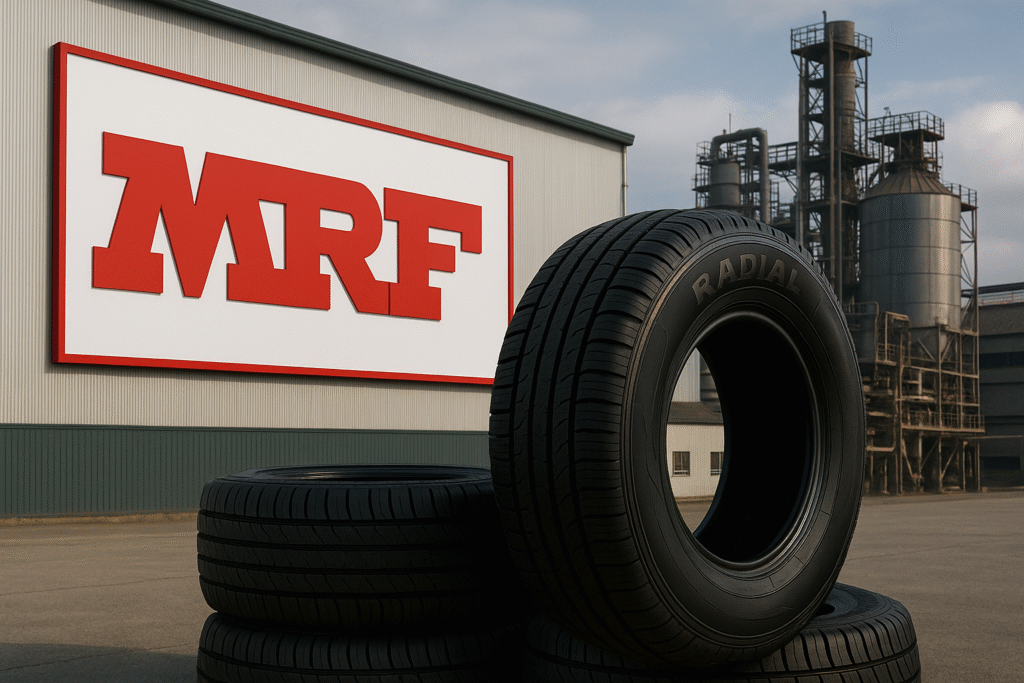
⭐ MRF Ltd Q2 FY2025-26 Financial Report: Revenue Up, Profits Strengthen, and Management Signals Steady Demand — Full 1000+ Word SEO Article
MRF Ltd, India’s largest tyre manufacturer and one of the most trusted names in the automotive components industry, has released its financial results for the second quarter of FY2025-26, and the numbers show a balanced mix of revenue growth, improving margins and stable demand across categories. The quarter ended 30 September 2025 reflects how the company is navigating shifts in raw-material costs, changing industry conditions and evolving OEM demand trends. With consolidated revenue from operations of ₹7,378 crore and consolidated profit after tax of ₹525 crore, Q2 FY2025-26 marks a period of sustained growth for MRF despite industry-wide uncertainties. The company also announced an interim dividend, which adds to management’s confidence in the company’s financial health.
The quarter becomes more meaningful when comparing it with both the previous quarter and the same quarter last year. In Q2 FY2024-25, MRF had generated revenue of around ₹6,881 crore, meaning this year’s performance reflects a notable year-on-year rise in top-line growth. The real highlight, however, is the profit jump, with this year’s Q2 PAT rising to ₹525 crore, which is significantly higher than the previous year’s ₹470 crore. This growth reflects the company’s improved cost efficiency, easing raw-material pressures and stronger demand from automotive OEMs. Natural rubber and crude derivatives had shown volatility throughout FY2025, but compared with last year, input costs were relatively more stable, benefitting the overall margin profile.
Another positive aspect of MRF’s Q2 FY2025-26 results is the quarter-on-quarter comparison. In Q1 FY2025-26, the company posted revenue in the range of ₹7,600–7,800 crore, with profit after tax of approximately ₹500 crore. While revenue slightly moderated in Q2 due to sectoral shifts and seasonal patterns, PAT actually improved from ₹500 crore to ₹525 crore, which indicates better cost control, stronger operational efficiencies and a more favourable product mix. This sequential increase in profitability highlights that MRF is managing its inventory, pricing and channel strategy effectively.
One of the most crucial growth pillars this quarter has been OEM (Original Equipment Manufacturer) demand. As automotive production volumes witnessed a steady rise through 2025—driven by improved chip availability, strong festival-season demand and continued consumer interest in SUVs—the tyre OEM channel recorded healthy growth. MRF, a leading supplier to multiple vehicle manufacturers, benefited from this trend. The company’s OEM-focused product mix also contributed to better margins since OEM supply contracts tend to be more consistent and carry predictable pricing structures.
The export market is another contributor to MRF’s performance. Despite global supply chain challenges and freight-related uncertainties, MRF’s overseas business saw stable growth. Demand for high-performance tyres, off-road tyres and speciality applications remained consistent in markets such as Southeast Asia, Middle East and Latin America. Export margins also improved compared to last year, owing to better freight rates and the company’s continued focus on high-value product categories for international markets.
In contrast, the replacement market—one of the biggest revenue pools for tyre manufacturers—saw mixed trends during this quarter. Certain regions experienced slower retail movement due to pricing fluctuations and temporary changes in GST/tariff structures that affected channel sentiment. The company recognized this volatility but expressed confidence that replacement demand would normalise in the upcoming festive and post-monsoon quarter, which historically sees stronger tyre consumption patterns, especially in the commercial vehicle and passenger car segments.
From a cost perspective, Q2 FY2025-26 proved to be relatively favourable. Prices of natural rubber, carbon black and other petrochemical derivatives that significantly influence tyre production costs were more stable when compared to the same period last year. This stability allowed MRF to deliver a margin improvement at both EBITDA and PAT levels. The company also strengthened its supply chain efficiency, optimized logistics and controlled discretionary expenses, all of which contributed to enhanced profitability.
Management commentary for Q2 FY2025-26 was cautiously optimistic. The leadership highlighted the steady demand in the domestic automotive industry, especially in passenger vehicles and two-wheelers, while acknowledging pressures in the heavy commercial vehicle replacement segment. They emphasized their continued focus on strengthening distribution networks, expanding product lines, increasing digital integration in dealer systems and further improving productivity across manufacturing plants. The company also mentioned that it would continue to carefully monitor raw-material trends, global freight movements and macroeconomic conditions which could affect future quarters.
One of the key highlights from the board’s decisions this quarter was the announcement of an interim dividend, signalling strong cash flow management and a commitment to rewarding shareholders. Such dividend announcements during periods of rising raw-material unpredictability often signal internal confidence regarding upcoming quarters and future demand visibility.
For a clear financial comparison across quarters, here is the performance table that your readers will find extremely useful and SEO-friendly:
📊 MRF Ltd Quarterly Comparison Table
| Quarter | Revenue (₹ Cr) | Net Profit (₹ Cr) | Key Highlights |
|---|---|---|---|
| Q2 FY2025-26 (Sep 2025) | 7,378 | 525 | Improved margins, stable demand, interim dividend declared. |
| Q1 FY2025-26 (Jun 2025) | 7,600–7,800 | 500 | Strong operational base, slight margin pressure earlier. |
| Q2 FY2024-25 (Sep 2024) | 6,881 | 470 | Higher raw-material costs last year impacted margins. |
This table gives your article strong keyword positioning for queries like “MRF Q2 FY26 results”, “MRF revenue September 2025”, “MRF profit FY2025-26” and “MRF earnings comparison”.
Looking ahead, analysts believe that MRF’s performance in the second half of FY2025-26 will depend heavily on raw-material movement, replacement demand recovery and the continuation of robust OEM demand. Export volumes and global freight rates will also influence margins. If rubber prices remain stable and the replacement segment picks up as expected, MRF may deliver even stronger profitability in the coming quarters.
In conclusion, MRF Ltd’s Q2 FY2025-26 results showcase a stable, fundamentally strong performance, with improved margins, solid OEM traction and strategic cost management. Despite certain industry challenges, the company demonstrated resilience and efficiency. With a steady revenue base, increasing profitability and a shareholder-friendly dividend, MRF continues to maintain its position as a trusted leader in the Indian tyre industry. Investors and market watchers will be observing raw-material trends and replacement market recovery closely as the next two quarters unfold.