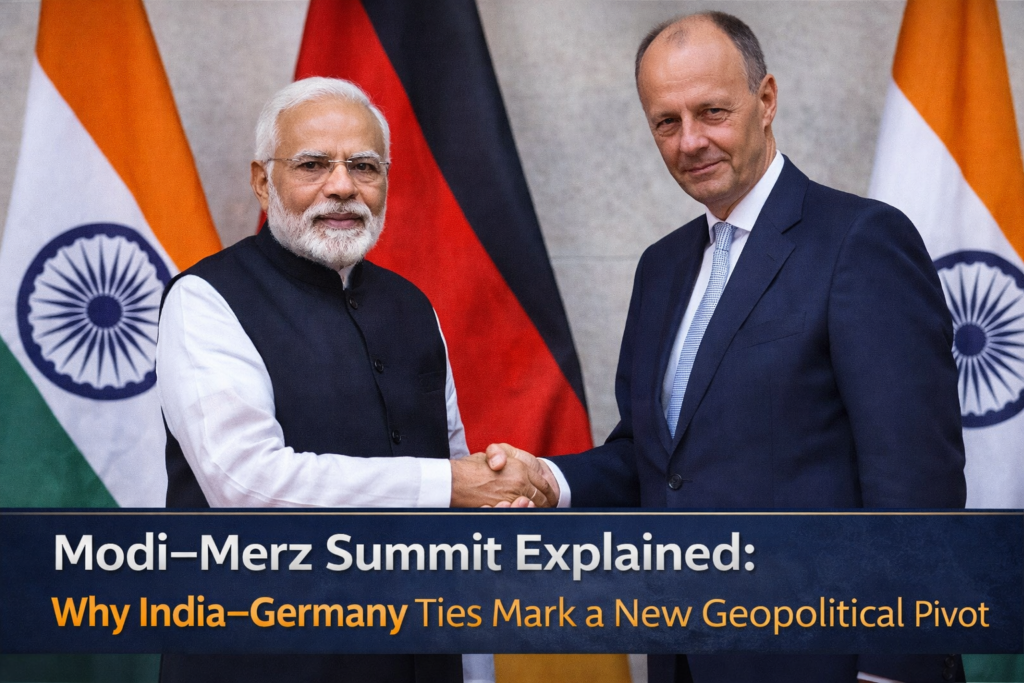
As a long-time observer of global politics and economics, I have learned that power shifts rarely announce themselves loudly. They often arrive quietly, wrapped in symbolism, culture, and carefully chosen locations. The recent India visit by German Chancellor Friedrich Merz, hosted by Prime Minister Narendra Modi, was one such moment. On the surface, it looked ceremonial. In reality, it marked a deep geopolitical recalibration.
This was not just another diplomatic visit. It was Germany’s clearest signal yet that India is no longer a secondary Asian partner. For Berlin, New Delhi is now a strategic anchor—economically, politically, and security-wise. In the language of diplomacy, this visit moved the relationship from “important” to indispensable.
I. The Hook: Symbolism at Sabarmati and the Kite Diplomacy
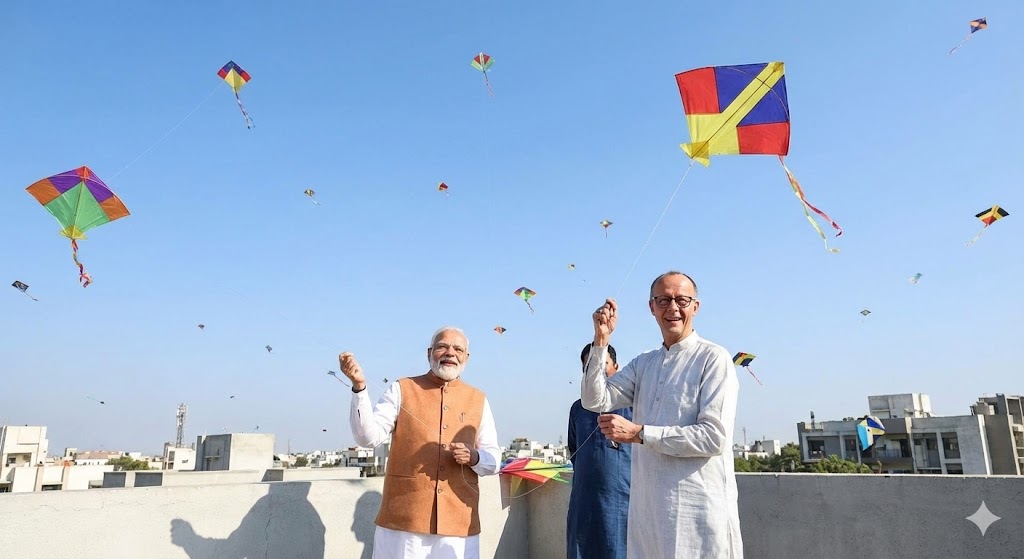
The choice of setting mattered. The visit unfolded against the calm spiritual backdrop of Sabarmati Ashram and the vibrant energy of the International Kite Festival. This contrast was deliberate. Sabarmati represents India’s civilizational values—peace, self-reliance, and moral clarity. The kite festival represents aspiration, openness, and upward movement.
While diplomats discussed trade, defense, and technology behind closed doors, the message outside was clear: India is confident in its identity and open to equal partnerships. Diplomacy here was not just about documents. It was about shared values and mutual respect.
One detail stood out. This was Chancellor Merz’s first major bilateral visit outside the NATO and EU space, and he chose India—specifically Gujarat. That choice alone signals a shift in German strategic thinking. Berlin now sees India not merely as a market, but as its primary long-term partner in Asia.
This visit also coincided with important milestones. India and Germany completed 75 years of diplomatic relations in 2026, with ties established in 1951. They also marked 25 years of Strategic Partnership. These are not just anniversaries. They are proof of a relationship that has matured from formality to trust.
Government of India – Ministry of External Affairs
II. Geoeconomics: Beyond the $50 Billion Milestone
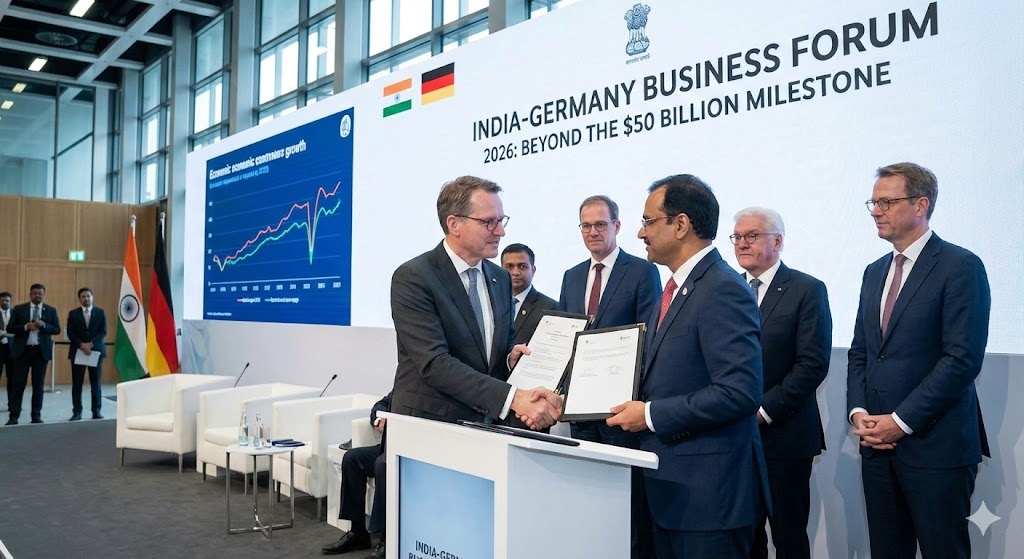
The economic backbone of the relationship is now solid. Germany is India’s largest trading partner in the European Union, and the numbers prove it. In the 2025–26 period, bilateral trade officially crossed the $50 billion mark. This is not a symbolic figure. It reflects deep integration across manufacturing, engineering, services, and technology.
But the real shift is qualitative, not just quantitative. India and Germany are moving away from a simple buyer-seller model. The new approach is co-production. German firms no longer want to just sell to India. They want to build in India, design in India, and export from India.
Foreign direct investment tells this story clearly. Cumulative German FDI in India has crossed $15.1 billion, and more than 2,000 German companies now operate in India. Names like Siemens, SAP, and Bosch are not just present; they are deeply embedded in India’s manufacturing and digital ecosystems.
At the CEO Forum in Gandhinagar, Prime Minister Modi captured this shift with one word: “limitless.” He described the partnership not as a capped agreement but as an open-ended collaboration across energy, defense, technology, and skills. For Germany, struggling with slowing growth and supply-chain risks, India offers scale and stability. For India, Germany offers precision, technology, and credibility.
Indo-German Chamber of Commerce (IGCC)
III. The Strategic Angle: Defense and Decoupling from the Past
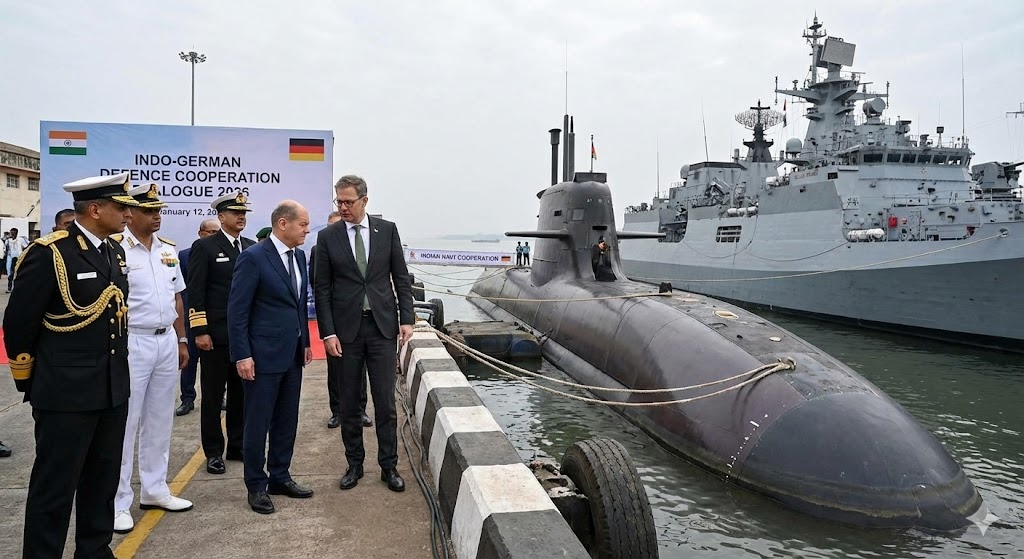
Geoeconomics cannot be separated from geopolitics. Both India and Germany are undergoing strategic transitions. For decades, India relied heavily on Russia for defense equipment. Germany, in turn, built deep economic dependence on China. Both models are now being reassessed.
From a nationalist-strategic perspective, this convergence is important. India is emerging as a net security provider in the Indo-Pacific, while Germany is looking for reliable partners beyond its traditional Atlantic focus. The Modi–Merz talks reflected this reality.
A key outcome was the Joint Declaration of Intent on defense cooperation. This is not an arms deal. It is a roadmap. The focus areas include submarines under Project 75I, aircraft engine collaboration, and advanced underwater technologies. These are high-value, sensitive domains. Germany’s willingness to discuss them shows trust in India’s strategic maturity.
The logic is simple. German precision plus Indian scale creates strategic autonomy for both. It reduces dependence on volatile supply chains and politically risky vendors. In a world shaped by sanctions, conflicts, and trade weaponisation, this autonomy is priceless.
German Federal Government (Bundesregierung)
IV. The Triple-Pillar MoUs: Green Energy, Auto, and IT
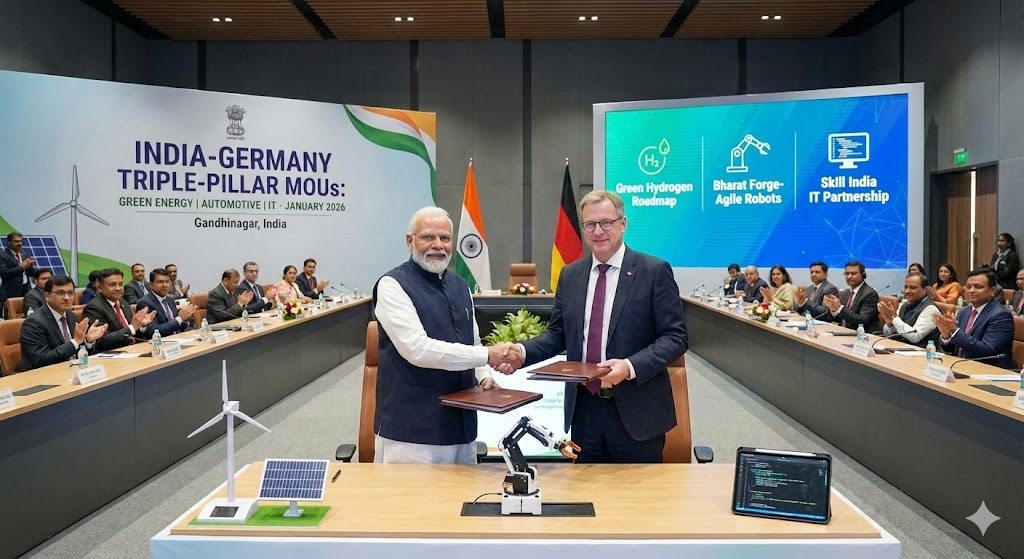
The summit’s outcomes were not limited to defense. Three sectors stood out as pillars of the future partnership.
The first is green energy, especially hydrogen. Germany needs massive imports of clean energy to meet its climate goals. India, with its solar capacity and cost advantage, aims to become a global green hydrogen hub. The Indo-German Green Hydrogen Roadmap aligns these needs perfectly. India produces; Germany consumes. Both decarbonise.
The second pillar is automotive and robotics. A standout example is the MoU between Bharat Forge and Agile Robots. This partnership moves Indian suppliers beyond components into AI-driven automation and so-called “dark factories.” It marks India’s entry into advanced manufacturing, not just assembly.
The third pillar is people and skills. Germany faces a severe labour shortage due to ageing demographics. Its new “Focus on India” strategy aims to attract 60,000 or more Indian students and skilled professionals in the coming years. This is not brain drain. It is brain circulation. Skills flow both ways, strengthening innovation and cultural ties.
V. Capital Market Outlook: Winners of the Summit
Geopolitics always leaves fingerprints on markets. The Modi–Merz summit sends a strong signal to global investors, especially institutional funds.
Defense companies stand to benefit from co-development and technology transfer. Renewable energy firms, particularly those involved in hydrogen, storage, and electrolyzers, gain long-term visibility. Automotive and auto-ancillary players gain access to German automation and EV technologies.
There is also a broader market logic at work. Germany is known for conservative, risk-averse policymaking. When a leader like Friedrich Merz publicly commits to India, it sends a message to foreign institutional investors (FIIs): India’s macro-stability is a reliable hedge in an uncertain world.
At a time when global trade faces the risk of renewed protectionism and fragmented blocs, India’s partnerships with disciplined economies like Germany add a confidence premium to Indian assets.
VI. Conclusion: The Rise of the Global South Leader
This summit was not just about India and Germany. It was about the future shape of the global order. As discussions on UN Security Council reform and the long-pending India–EU Free Trade Agreement gain momentum, partnerships like Modi–Merz become engines of what can be called re-globalization—a fairer, multipolar version of global integration.
India is no longer asking for a seat at the table. It is helping design the table. Germany’s pivot towards India reflects a broader truth: in the coming decade, the Global South will not be led by slogans, but by capability.
The final thought is simple. In 2026 and beyond, Europe’s path to resilience, growth, and strategic balance increasingly runs through New Delhi. Or, to put it more clearly: the road to Berlin now goes through India.
Frequently Asked Questions (FAQs)
1. Why is the Modi–Merz summit important for India?
The Modi–Merz summit is important because it signals that India is now Germany’s primary strategic partner in Asia. The partnership goes beyond trade and focuses on defence cooperation, green energy, technology, and long-term geopolitical alignment.
2. What does “limitless partnership” mean in India–Germany relations?
The term “limitless partnership” reflects a shift from fixed agreements to open-ended collaboration. It means India and Germany will work together across sectors like defence, hydrogen energy, advanced manufacturing, and skills without traditional caps.
3. How much is India–Germany trade today?
India–Germany bilateral trade has crossed $50 billion in 2025–26, making Germany India’s largest trading partner in the European Union.
4. Why did Germany choose Gujarat for this summit?
Gujarat represents India’s manufacturing strength, governance model, and cultural identity. Choosing Gujarat signals Germany’s interest in India’s industrial base, not just its political capital.
5. What defence areas are India and Germany cooperating on?
Key focus areas include Project 75I submarines, aircraft engines, underwater systems, and co-development of defence technologies. The aim is strategic autonomy, not arms imports.
6. How does this summit help India’s green energy goals?
Germany needs clean energy imports, while India aims to be a global green hydrogen hub. The Indo-German Green Hydrogen Roadmap aligns India’s production capacity with Germany’s energy transition needs.
7. What role do Indian professionals play in Germany’s strategy?
Germany faces a labour shortage and aims to attract 60,000+ Indian students and skilled professionals. This creates a skill circulation model that benefits both economies.
8. Is this partnership linked to global geopolitics?
Yes. The partnership reflects a broader shift toward multipolar global order, reduced dependence on China, and stronger Global South leadership led by India.
🔍 PEOPLE ALSO ASK (PAA)
What is the Modi–Merz summit about?
It focuses on strengthening India–Germany cooperation in trade, defence, green energy, technology, and global geopolitics.
Why is Germany increasing engagement with India?
Germany sees India as a stable democracy, manufacturing hub, and strategic counterbalance in a fragmented global economy.
How does India benefit from closer ties with Germany?
India gains access to advanced technology, defence cooperation, investment, and global credibility in supply chains.
Is India replacing China in Germany’s Asia strategy?
India is emerging as a preferred alternative partner, especially for trusted manufacturing and strategic sectors.
Will this affect India–EU relations?
Yes. Strong India–Germany ties accelerate momentum for the India–EU Free Trade Agreement and deeper European engagement.