MGL Q3 FY26 Results Explained: Revenue Up, Profit Down & the APM Gas Allocation Challenge
1. The Lead: Understanding the Fundamental Paradox
After spending nearly three decades tracking India’s energy corridors—from oil pipelines and LNG terminals to city gas networks—I see Mahanagar Gas Limited (MGL) as the textbook example of a “City Gas Moat.” It controls a dense, hard-to-replicate network in India’s richest urban cluster. Yet, as its Q3 FY26 results (released February 7, 2026) show, even the strongest moat can feel pressure when policy and input costs turn hostile.
At first glance, MGL’s numbers look contradictory. Revenue rose a healthy 11.6% year-on-year, driven by strong gas consumption across vehicles, homes, and factories. But net profit fell 9.4%, unsettling investors who are used to MGL’s steady earnings profile.
This is the paradox of the City Gas Distribution (CGD) business in one line:
volume is vanity, margin is sanity.
Mumbai’s vehicles and industries are consuming more gas than ever, but MGL is also paying more for every molecule it sells. The silver lining is confidence. Despite the margin squeeze, the board announced an interim dividend of ₹12 per share, signaling that cash flows remain robust and the balance sheet is comfortable.
MGL Official Financial Results (Primary Source)
2. The Financial Scorecard: What the Q3 FY26 Numbers Really Say
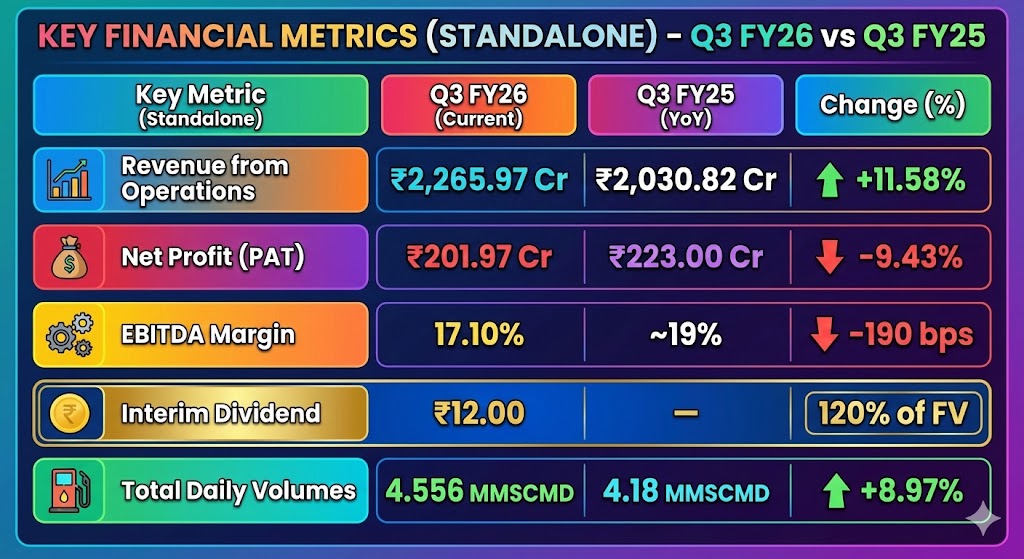
A clean look at the financial scorecard explains where the pressure is coming from.
In Q3 FY26, MGL reported revenue from operations of ₹2,265.97 crore, up from ₹2,030.82 crore in Q3 FY25—an 11.58% increase. This growth came largely from higher gas volumes rather than aggressive price hikes, reflecting strong underlying demand in Mumbai and its surrounding regions.
However, net profit (PAT) declined to ₹201.97 crore, compared with ₹223 crore last year. That’s a 9.43% drop, despite higher sales. The reason becomes clear when we look at margins. EBITDA margin slipped to 17.10%, down nearly 190 basis points from around 19% a year ago.
Volumes tell a more encouraging story. Total daily gas volumes rose to 4.556 MMSCMD, up from 4.18 MMSCMD, marking 8.97% growth. In plain language, MGL sold significantly more gas, but earned less per unit because input costs rose faster than selling prices.
The declared ₹12 interim dividend—equivalent to 120% of face value—is important. It suggests management believes the margin squeeze is cyclical, not structural.
3. Deep Dive: The Fundamental Drivers Behind the Numbers
To understand why profits fell despite strong volumes, we need to break the business into its key drivers.
Pillar 1: The Sourcing Crisis and the Margin Squeeze
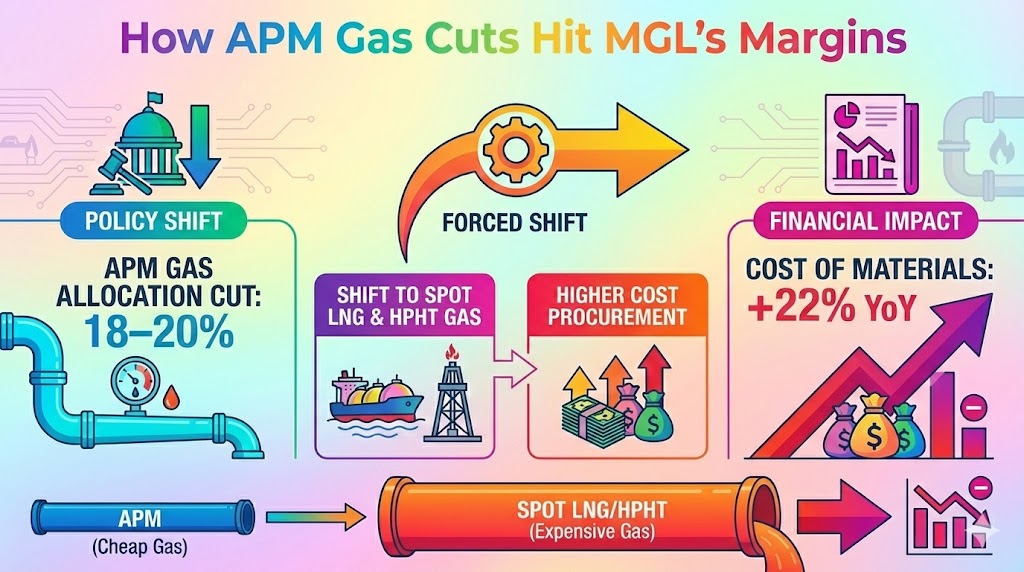
The single biggest factor behind MGL’s Q3 FY26 margin pressure is gas sourcing.
In the quarter, MGL faced an 18–20% cut in APM (Administered Price Mechanism) gas allocation by the Ministry of Petroleum and Natural Gas. APM gas is domestically produced and significantly cheaper than imported alternatives. When this allocation is reduced, CGD companies are forced to buy gas from more expensive sources.
As a result, MGL had to replace low-cost APM gas with spot LNG and HPHT (High Pressure High Temperature) gas. These sources are linked to global gas prices, which remained volatile through 2025 due to geopolitical tensions and supply disruptions.
The impact was direct and severe. Cost of materials rose by around 22% year-on-year, almost double the pace of revenue growth. This mismatch explains why EBITDA margins compressed even as volumes expanded.
For investors, this highlights a crucial point: MGL’s profitability is highly sensitive to gas allocation policy, not just demand.
Ministry of Petroleum & Natural Gas (APM Gas Policy)
Pillar 2: Industrial PNG—The Quiet Growth Engine
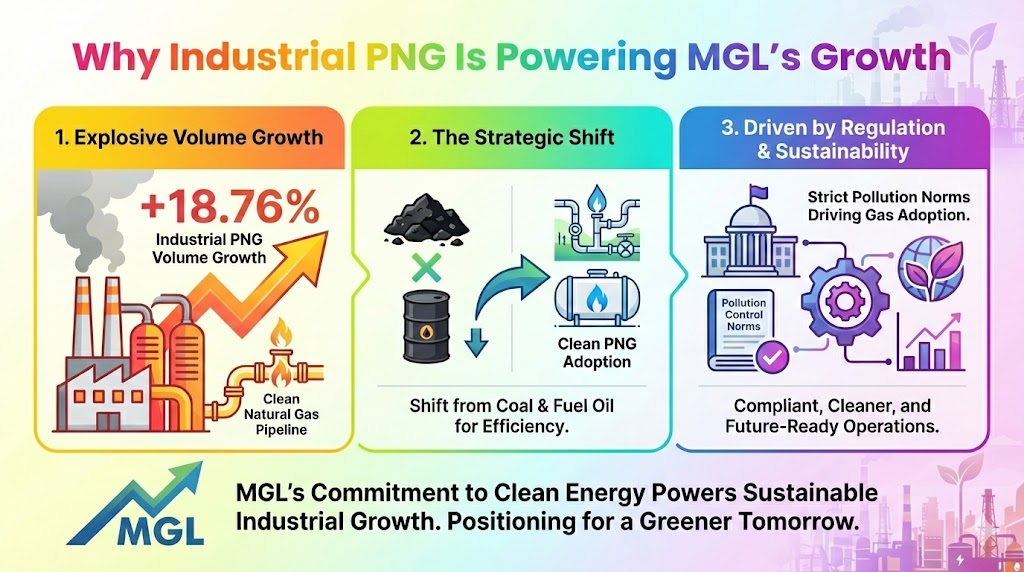
While sourcing hurt margins, demand trends were clearly positive—especially in the industrial and commercial PNG segment.
In Q3 FY26, industrial PNG volumes grew by a strong 18.76%. This is not a short-term blip. Mumbai’s satellite towns—Navi Mumbai, Thane, and Raigad—are expanding rapidly, with new factories, logistics hubs, and data centers coming online.
At the same time, stricter pollution norms and rising costs of coal and fuel oil are pushing industries toward cleaner fuels. Piped Natural Gas offers a reliable, lower-emission alternative, making it a “sticky” fuel choice once infrastructure is in place.
For MGL, industrial PNG is attractive because it offers higher volumes and better pricing flexibility compared with household PNG. Over time, this segment can help offset margin pressure from sourcing volatility.
Pillar 3: EV Threat vs. CNG Expansion
One of the most common investor questions today is: Will electric vehicles kill CNG demand?
The Q3 FY26 data suggests not—at least not yet.
Despite the introduction of electric buses and rising EV adoption in Mumbai, CNG volumes still grew by 7.24% year-on-year. This reflects the sheer scale of Mumbai’s transport ecosystem. Taxis, auto-rickshaws, and commercial fleets continue to rely heavily on CNG due to lower running costs and established refueling infrastructure.
MGL’s moat here is physical. Its dense network of CNG stations across Mumbai and adjoining regions makes switching costly and inconvenient for fleet operators.
More importantly, MGL is actively reducing dependence on the saturated Mumbai market. Its expansion into Raigad district and the acquisition of Unison Enviro (UEPL) provide geographical diversification. These newer areas have lower EV penetration and rising industrial demand, extending the runway for gas growth.
4. Regulatory and Geopolitical Overtones
MGL’s business is shaped as much by policy as by demand, and Q3 FY26 makes this clear.
One important development is the broader India–US energy relationship. The 2026 India–US trade and energy framework has improved access to US LNG and ethane, opening the door for long-term sourcing contracts.
For MGL, this matters greatly. If the company can lock in long-term LNG supply agreements at stable prices, it can reduce dependence on volatile spot markets. Over the next few years, margin recovery will depend less on volume growth and more on how effectively MGL manages this sourcing transition.
Another regulatory issue to watch is the ₹331.80 crore transportation tariff dispute with GAIL. While management remains confident of a favorable outcome, it remains a contingent liability. Investors should track updates closely, as an adverse ruling could temporarily impact cash flows.
LNG Price & Global Gas Market Reference
5. Investor Verdict: Viewing MGL as a Utility Play
From an investor’s perspective, MGL increasingly looks like a utility stock rather than a high-growth energy play.
At current levels, the stock trades at a P/E multiple of around 10–11x, which is cheaper than peer Indraprastha Gas (IGL). This discount reflects uncertainty around gas allocation and margins rather than doubts about demand.
The dividend story strengthens the utility argument. With a ₹12 interim dividend and a record date of February 13, 2026, MGL is positioning itself as a reliable income generator. Over the past decade, it has built a reputation for consistent payouts, appealing to conservative investors.
The key question is timing. A meaningful re-rating will likely occur when either APM gas allocations stabilize or global LNG prices cool. Until then, returns may come more from dividends than price appreciation.
6. Conclusion: A Transition Quarter, Not a Broken Story
MGL’s Q3 FY26 results should be read as a transition quarter, not a sign of structural weakness.
The company remains a proxy for Mumbai’s industrial and transport heartbeat. Volumes are rising across segments, infrastructure is expanding beyond core Mumbai, and demand for cleaner fuel remains strong.
The challenge lies on the cost side. Policy-driven reductions in cheap gas allocations and volatile global LNG prices have compressed margins—but these are external pressures, not operational failures.
For long-term investors, the most important indicator to watch is volume growth and sourcing strategy, not a temporary dip in quarterly profit. If MGL navigates the APM allocation challenge successfully, today’s margin pain could turn into tomorrow’s value opportunity.
In short, volume is telling the future story—profit is just catching its breath.