1. Executive Summary: The Macro Narrative Behind the Numbers
After three decades of closely tracking India’s economic and defence policy landscape, I can say with confidence that Mazagon Dock Shipbuilders Ltd (MDL) has quietly transformed from a government-owned shipyard into one of India’s most important strategic industrial assets. Its Q3 FY26 results, released on February 5, 2026, are not just about quarterly profit. They are a window into how India is building long-term defence strength through execution, technology, and global partnerships.
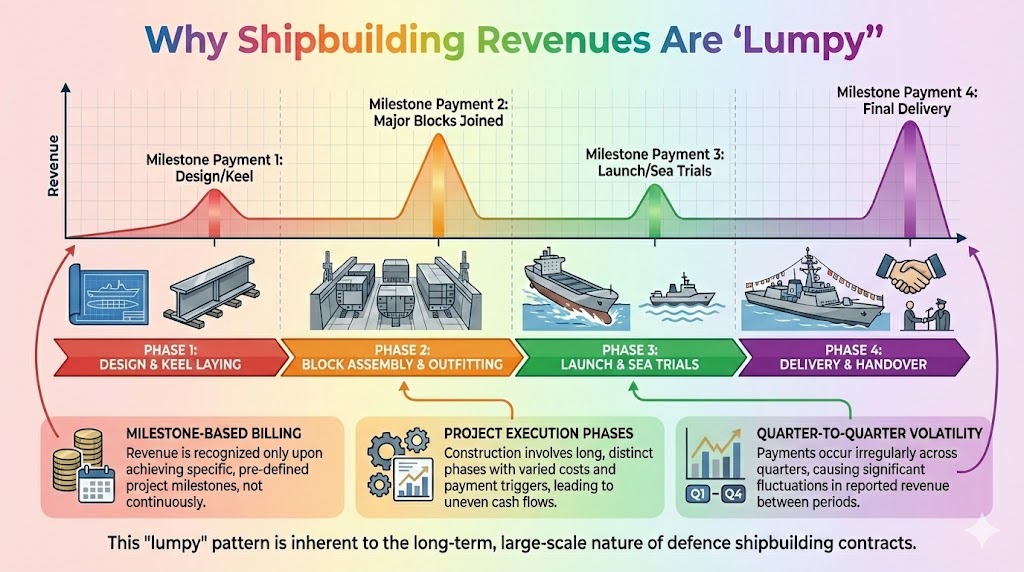
On paper, the numbers look strong. MDL reported a consolidated net profit of ₹880 crore, up 9% year-on-year, while revenue from operations rose 14.6% to ₹3,601 crore. For most companies, that would already be impressive. But shipbuilding does not work like FMCG or IT. Revenues are lumpy, tied to project milestones rather than smooth monthly sales.
What makes this quarter special is why the numbers came in strong. The growth was driven by accelerated execution on two of the Indian Navy’s most critical programmes: the Project 15B guided missile destroyers and the Project 17A stealth frigates. These are not routine vessels. They sit at the core of India’s blue-water naval capability.
Beyond the quarterly performance, there is an even bigger story unfolding. The Indian government’s clearance of a $10 billion (around ₹83,000 crore) submarine programme with Germany is a strategic turning point. For MDL, this deal could redefine its role—from a domestic defence supplier to a global co-developer of advanced naval platforms.
Mazagon Dock Shipbuilders – Official Financial Results (Primary Source)
2. Financial Dashboard: Q3 FY26 Performance at a Glance
To understand MDL’s performance, it helps to start with the hard data.
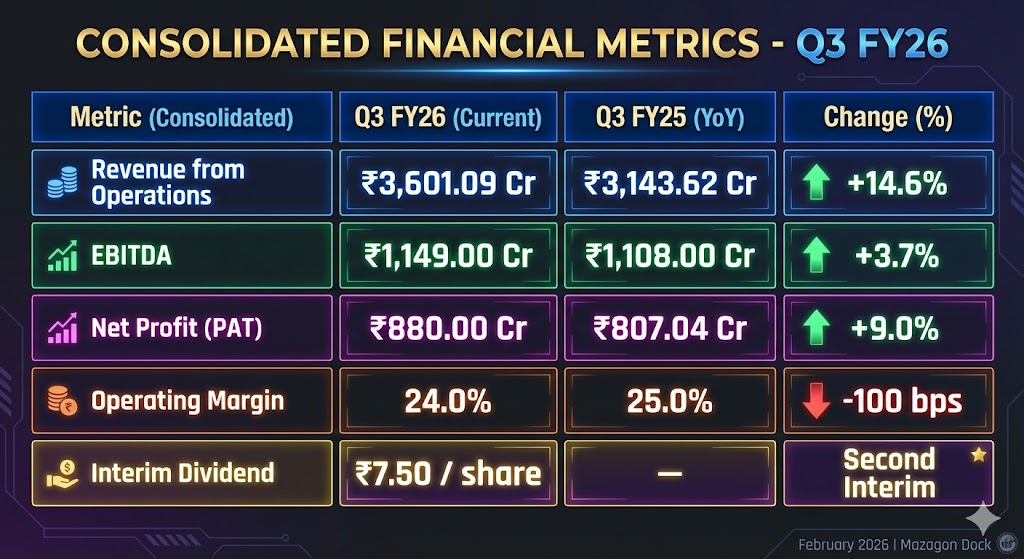
In Q3 FY26, MDL’s revenue from operations stood at ₹3,601.09 crore, compared with ₹3,143.62 crore in Q3 FY25. This represents a 14.6% year-on-year increase, reflecting faster execution and milestone completion on ongoing naval projects.
EBITDA came in at ₹1,149 crore, up modestly from ₹1,108 crore last year, translating into 3.7% growth. As a result, operating margin softened slightly to around 24%, compared with about 25% a year ago. This margin compression may look negative at first glance, but context is critical in heavy engineering.
Net profit (PAT) rose to ₹880 crore, from ₹807 crore in Q3 FY25, marking 9% growth. MDL also declared a second interim dividend of ₹7.50 per share, reinforcing management’s confidence in cash flows and balance-sheet strength.
The key takeaway from the dashboard is this: revenue growth was strong, margins remained industry-leading despite cost pressures, and profits continued to rise in a business known for volatility.
3. Fundamental Breakdown: Inside the “Engine Room” of Growth
To truly understand why MDL is delivering consistent results, we need to go beyond the headline numbers and examine the fundamental drivers.
A. The Order Book Moat: Visibility and Optionality
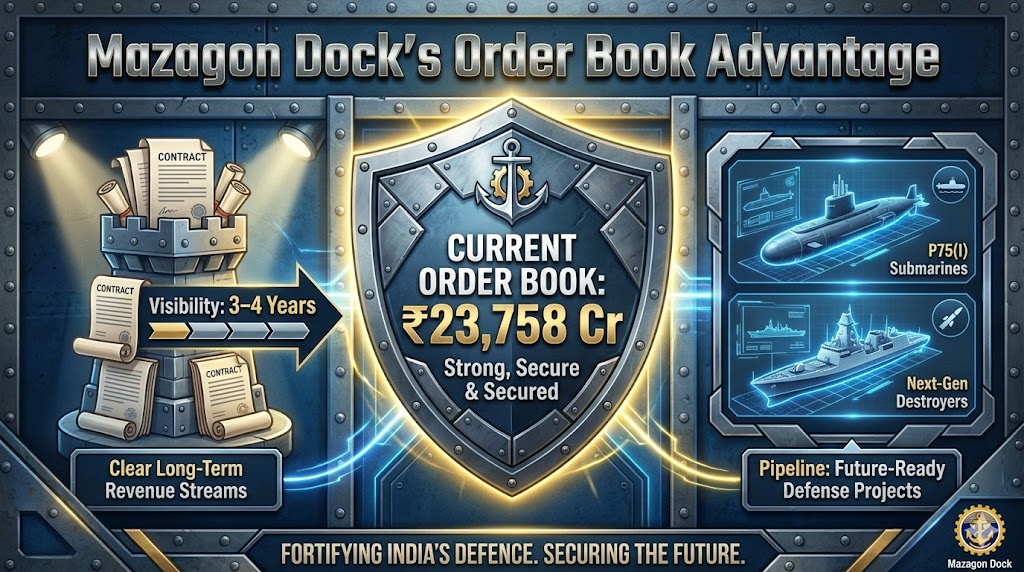
As of December 31, 2025, MDL’s order book stood at a robust ₹23,758 crore. This alone provides revenue visibility for the next three to four years, a rare luxury in capital-intensive manufacturing.
But the real value lies not just in the confirmed order book, but in the pipeline. MDL is at the centre of several upcoming mega-projects, including the P75(I) conventional submarine programme and next-generation destroyers for the Indian Navy. If even a portion of this pipeline materialises, MDL’s order book could multiply by 2027.
In defence manufacturing, order books are more than future revenue. They represent strategic trust. Governments do not hand out long-term naval contracts lightly. MDL’s position reflects decades of delivery, learning, and process improvement.
Project 75(I) Submarine Programme (Official Brief)
B. Margin Resilience Amid Cost Pressures
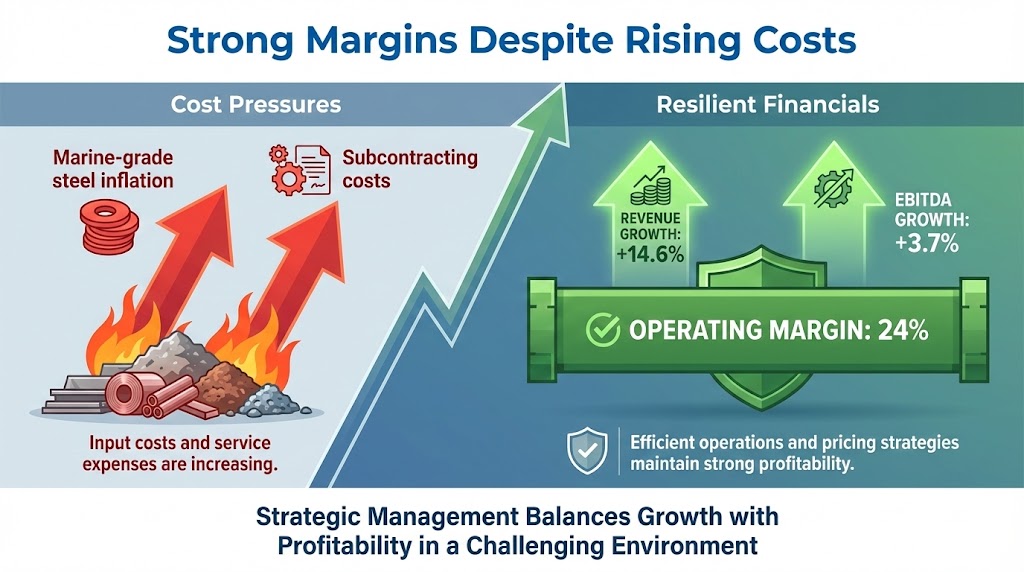
One concern some analysts flagged this quarter was that EBITDA growth (3.7%) lagged revenue growth (14.6%), leading to a slight margin contraction.
The reasons are largely operational. Input costs for specialised marine-grade steel, electronics, and propulsion systems have risen globally. In addition, MDL incurred higher subcontracting and integration costs linked to the delivery of INS Taragiri, a Project 17A stealth frigate delivered in November 2025.
From a fundamental perspective, this is not alarming. A 24% operating margin in shipbuilding is still exceptionally strong by global standards. Many international shipyards operate at single-digit margins. MDL’s ability to maintain margins above 20% even during cost inflation highlights its execution discipline and bargaining power.
C. The “Other Income” Safety Net
Another often-overlooked strength of MDL is its near debt-free balance sheet.
The company sits on a large cash reserve, accumulated over years of profitable operations. In Q3 FY26, “other income” from interest on cash and investments contributed roughly ₹260 crore to profit before tax. This acts as a natural buffer against the uneven cash flows typical of project-based businesses.
In simple terms, MDL earns meaningful income even when shipbuilding milestones are temporarily delayed. This financial cushion significantly reduces downside risk for investors.
4. Geopolitics and Strategy: MDL’s Global Leap
Defence manufacturing does not exist in isolation. It is deeply intertwined with geopolitics, alliances, and technology access. This is where MDL’s story becomes truly compelling.
The German Submarine Deal: A Technology Inflection Point
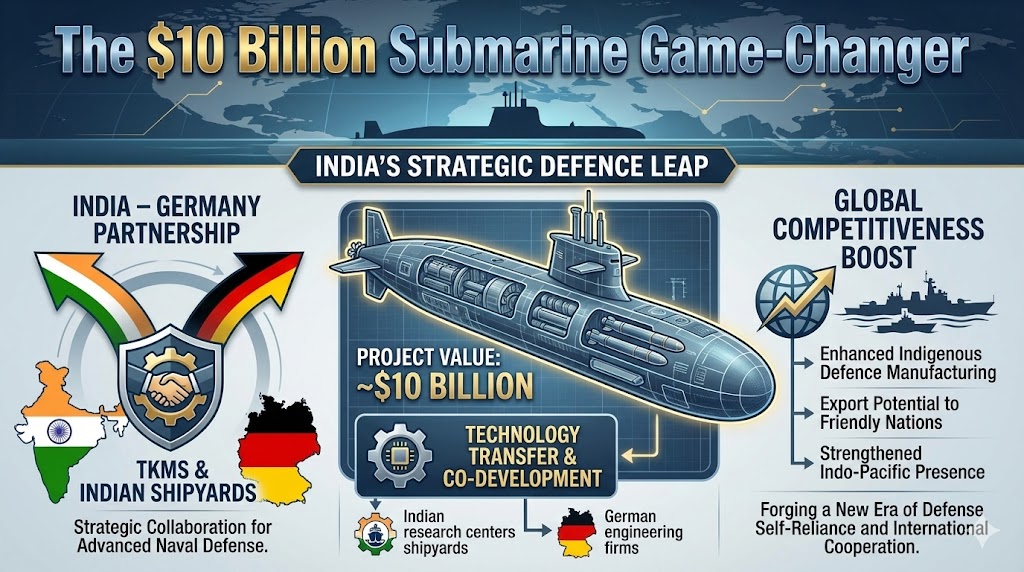
The Indian government’s approval of a $10 billion submarine programme with Germany’s ThyssenKrupp Marine Systems is a watershed moment. For MDL, this is not just another contract. It represents a shift in capability.
Historically, Indian shipyards operated largely as license builders, assembling platforms designed elsewhere. The new submarine programme emphasises deep technology transfer and co-development, pushing MDL up the value chain.
If executed well, this deal could permanently alter MDL’s technological base, enabling it to compete for global submarine and naval contracts in the future. In defence terms, this is how industrial sovereignty is built.
Strategic MoUs and Global Partnerships
MDL has also strengthened its global footprint through strategic agreements with Naval Group of France and partnerships with domestic players like Swan Defence for Landing Platform Docks (LPDs). These collaborations expand MDL’s portfolio beyond destroyers and frigates into amphibious and support vessels.
Each new platform adds not just revenue, but institutional knowledge—design integration, supply-chain coordination, and lifecycle support.
Colombo Dockyard: Dominating the Indian Ocean Region
MDL’s acquisition of a stake in Colombo Dockyard PLC is another strategic move that deserves attention. This investment signals MDL’s ambition to become a dominant ship-repair and maintenance player in the Indian Ocean Region (IOR).
Naval and commercial vessels operating in the IOR need regular maintenance. By positioning itself strategically, MDL can tap into a steady, service-based revenue stream that complements its project-heavy shipbuilding business.
Ministry of Defence (India) – Defence Procurement Context
5. Investor Verdict: The “Quality Check”
From an investor’s standpoint, MDL stands out on several quality metrics.
Efficiency Ratios That Rarely Show Up in Heavy Engineering
MDL currently delivers a Return on Capital Employed (ROCE) of around 43.2% and a Return on Equity (ROE) of about 34%. These numbers are extraordinary for a heavy engineering and defence manufacturing company.
Such ratios reflect not only profitability, but capital discipline. MDL generates high returns without excessive leverage, a combination rarely seen in PSU manufacturing firms.
Valuation: Premium, But With Reasons
At current levels, MDL trades at a price-to-earnings multiple of roughly 40x, which is above its three-year historical average. This premium valuation reflects market expectations of strong order inflows, execution momentum, and global expansion.
However, investors must understand the risks. Defence revenues are lumpy. If a major milestone slips from one quarter to the next, profits can appear artificially weak, even if the long-term outlook remains intact.
Project delays, geopolitical shifts, or changes in procurement timelines are the main risks to watch.
6. Conclusion: The “Atmanirbhar” Sovereign Play
Mazagon Dock Shipbuilders is no longer just another PSU. It has become a cornerstone of India’s Atmanirbhar Bharat strategy in defence manufacturing.
Q3 FY26 demonstrates what MDL does best: execute complex projects, maintain strong margins, and compound value over long cycles. The declared ₹7.50 interim dividend, with a record date of February 13, 2026, adds immediate shareholder reward to long-term growth potential.
For investors who understand the long-cycle nature of defence manufacturing, MDL represents a rare asset—financially strong, strategically vital, and increasingly global in ambition.
In a market often obsessed with short-term growth stories, Mazagon Dock stands apart as an “Iron Fortress”—built not for speed, but for endurance. Those willing to look beyond quarterly volatility may find that this fortress continues to compound wealth quietly, backed by India’s rising naval ambitions and a rapidly changing global security landscape.
❓ FAQ
FAQ 1
What are Mazagon Dock’s Q3 FY26 results?
Mazagon Dock reported consolidated revenue of ₹3,601 crore and net profit of ₹880 crore in Q3 FY26, driven by strong execution of naval shipbuilding projects.
FAQ 2
Why are Mazagon Dock’s revenues described as “lumpy”?
Shipbuilding revenues depend on project milestones. Payments are recognised when key construction or delivery stages are completed, causing quarter-to-quarter fluctuations.
FAQ 3
What is Mazagon Dock’s current order book?
As of December 31, 2025, Mazagon Dock’s order book stood at approximately ₹23,758 crore, providing revenue visibility for the next 3–4 years.
FAQ 4
What is the $10 billion submarine deal and why is it important?
The $10 billion submarine programme with Germany involves advanced technology transfer, positioning Mazagon Dock as a global co-developer rather than just a license builder.
FAQ 5
Is Mazagon Dock a good long-term defence stock?
Mazagon Dock is considered a strong long-term defence play due to its near debt-free balance sheet, high ROCE, strategic importance, and multi-year order visibility.