
1. Executive Summary: The Quarter That Changed the Narrative
There are quarters that show growth. And then there are quarters that change perception.
Lenskart’s Q3 FY26 result, released on February 11, 2026, falls in the second category.
The company reported a consolidated net profit of ₹131 crore. In the same quarter last year, it made just ₹1.85 crore. That is nearly a 70x jump. For a company that was once criticized for burning cash, this number is symbolic.
Revenue grew 38% year-on-year to ₹2,308 crore. But the real story is not just revenue growth. It is operating leverage. Lenskart has moved from “growth at all costs” to “profitable scale.”
This is the first major quarterly result after its blockbuster IPO in November 2025. Many investors were unsure whether Lenskart could convert scale into consistent profits. This quarter answers that question.
Lenskart Solutions Limited
2. Financial Dashboard: The Turnaround in Numbers
Let’s look at the data clearly.
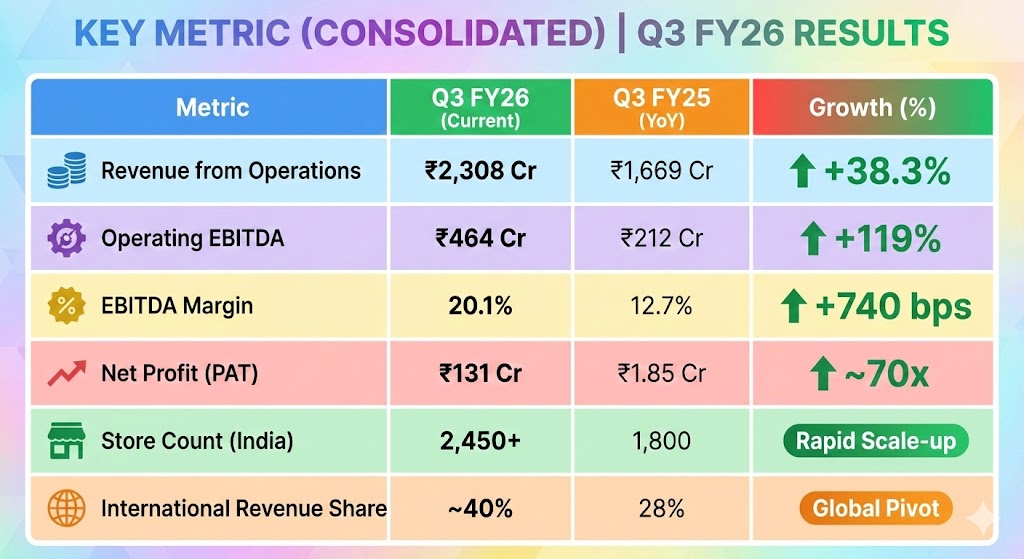
Revenue from operations increased from ₹1,669 crore to ₹2,308 crore — up 38.3%. Operating EBITDA more than doubled from ₹212 crore to ₹464 crore, a 119% increase. EBITDA margin expanded sharply from 12.7% to 20.1%, an improvement of 740 basis points.
Net profit jumped from ₹1.85 crore to ₹131 crore.
Store count in India crossed 2,450 outlets compared to around 1,800 last year. International revenue contribution increased to about 40% from 28% last year.
These numbers show something powerful. Revenue grew strongly, but profit grew much faster. That means fixed costs are getting absorbed better. In simple words, scale is now working in Lenskart’s favor.
Lenskart share price on NSE
3. The Manufacturing Moat: The Bhiwadi Advantage
Most people still think of Lenskart as a retailer. But that is not accurate anymore.
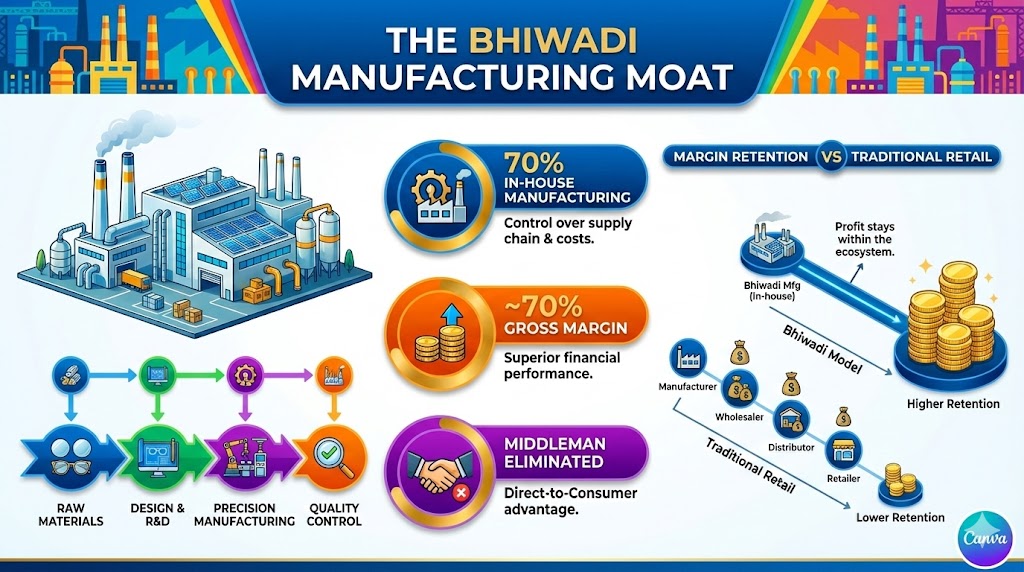
Lenskart manufactures nearly 70% of its frames and lenses at its large factory in Bhiwadi, Rajasthan. This is where the real advantage lies.
In traditional eyewear retail, distributors and wholesalers take large margins — often 40–50%. Lenskart eliminated these layers. By producing its own frames and lenses, it controls the entire value chain.
Gross margins are estimated at around 70%. When volumes increase, factory overheads do not increase at the same rate. That is why EBITDA margins expanded sharply this quarter.
Think of it like this: once the factory is built, producing the next one lakh frames costs much less than building the plant itself. As demand rises, profitability scales faster than revenue.
This is vertical integration at work.
Make in India manufacturing initiative
4. Omnichannel Strategy: The Hidden Profit Engine
One of Lenskart’s smartest moves has been its omnichannel model.
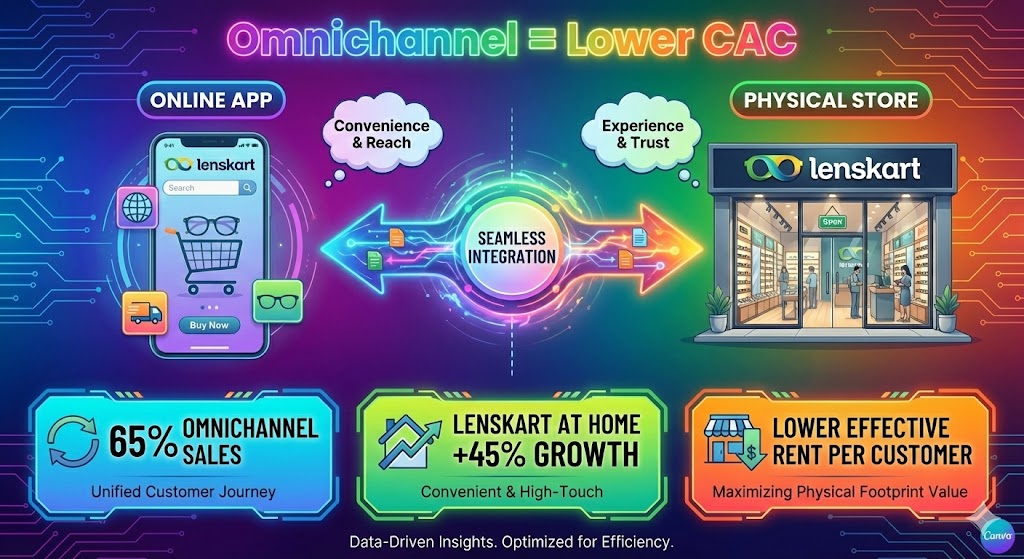
Around 65% of Q3 sales involved omnichannel behavior — meaning customers browsed online and purchased offline, or the other way around.
Pure online companies suffer from high Customer Acquisition Cost (CAC). Pure offline retailers suffer from high rental and inventory costs. Lenskart blends both.
Its app drives traffic to physical stores. Stores act as experience centers. Customers can get eye tests, try frames, and receive home delivery.
The “Lenskart at Home” service grew 45% this quarter. A trained executive visits customers at home with multiple frame options. This reduces rental expenses and increases conversion rates.
This hybrid model lowers effective cost per customer and improves margins.
RODTEP export incentive scheme
5. Southeast Asia: The International Growth Engine
International operations are becoming a major contributor.
The Owndays acquisition, combined with Southeast Asia expansion, contributed around ₹936 crore in revenue this quarter. International revenue share now stands at roughly 40%.
Lenskart has integrated Owndays efficiently, improving sourcing and supply chain coordination.
The acquisition of a manufacturing facility in Thailand (Macro Optical) is strategically important. It reduces dependence on Chinese imports and provides a “China+1” supply base.
In a world where trade tensions can disrupt supply chains, diversification matters. Manufacturing closer to key markets like Singapore, Japan, and Thailand improves delivery timelines and lowers tariff risks.
International expansion is no longer experimental. It is now a growth pillar.
6. Geopolitics & Policy: The Made in India Edge
Policy support is quietly helping Lenskart.
Under the RODTEP (Remission of Duties and Taxes on Exported Products) scheme, exporters receive duty credits. Lenskart exports frames manufactured in India to Middle East and Southeast Asian markets.
These duty credits improve effective margins.
The recent India-US trade developments also create long-term opportunity. The reduction or removal of tariffs on optical lenses can make exporting prescription glasses to the US viable.
The US eyewear market is massive, estimated at over $30 billion annually. If Lenskart can supply from Rajasthan factories directly to US consumers within 48 hours, it could disrupt pricing.
Geopolitical shifts are creating opportunities for Indian manufacturers who control their supply chain.
7. Store Expansion: Scaling Without Losing Control
Crossing 2,450 stores in India is not just about numbers. It is about coverage.
Tier-2 and Tier-3 cities are driving demand. Affordable prescription eyewear and fashionable frames are no longer limited to metros.
Eye care awareness is rising. Increased screen time, especially among young professionals and students, is boosting demand for anti-glare and blue-light glasses.
According to industry estimates, India’s eyewear market is expected to grow at 8–10% annually. Organized players still control less than half the market. That leaves room for consolidation.
Lenskart’s brand trust and transparent pricing model give it an edge over unorganized local optical shops.
8. Risks: The Valuation Question
No growth story is complete without risks.
After the IPO in November 2025, Lenskart trades at a premium valuation — around 95x annualized earnings. That means the market expects strong growth to continue.
If consumer spending slows, especially discretionary purchases like multiple fashion frames, growth could moderate.
Competition in developed markets will also be intense. Companies like Warby Parker and EssilorLuxottica have strong brand recall and large budgets.
Execution risk in international markets remains real. Scaling manufacturing while maintaining quality standards is not easy.
Investors should track same-store sales growth and margin sustainability carefully.
9. Titan Playbook: Organizing the Unorganized
Lenskart’s strategy resembles what Titan did in jewelry.
Titan organized a fragmented market by building trust, offering transparency, and standardizing quality.
Eyewear in India has long been unorganized. Local optical stores dominate. Pricing lacks transparency. Quality varies widely.
Lenskart is changing that through standard pricing, easy returns, home trials, and technology-driven eye testing.
Brand trust matters in healthcare-related products. Glasses are not just fashion items. They affect vision quality.
By combining fashion, healthcare, and technology, Lenskart is building a durable moat.
10. The Bigger Picture: Operating Leverage at Work
The 70x profit jump is dramatic. But the key takeaway is operating leverage.
Revenue grew 38%. EBITDA grew 119%. Profit multiplied sharply.
This pattern shows that fixed costs are stabilizing while scale is expanding.
When EBITDA margin rises from 12.7% to 20.1%, it signals that the business model is maturing.
The IPO skeptics feared endless cash burn. Q3 FY26 shows a different story — disciplined expansion, controlled costs, and improving profitability.
11. Conclusion: A Core Portfolio Candidate?
Lenskart has reached an important milestone.
It has proven that vertical integration works. Manufacturing control improves margins. Omnichannel reduces acquisition costs. International expansion diversifies revenue.
Risks remain, especially valuation risk. But the structural thesis is strong.
India’s eyewear market remains underpenetrated. Southeast Asia offers scale. Policy tailwinds support manufacturing.
If execution continues, Lenskart could become the dominant eyewear brand across Asia.
This quarter is not just about profit. It is about graduation — from a startup mindset to a structured, scalable, profitable enterprise.
For long-term investors who understand operating leverage and brand building, Lenskart is no longer just a unicorn story.
It is becoming a serious consumer manufacturing company.
And that shift is far more important than a single quarter’s headline number.
❓ FAQ
Q1. Why did Lenskart profit jump sharply in Q3 FY26?
Profit surged mainly due to operating leverage, higher manufacturing control, strong revenue growth, and margin expansion.
Q2. How much did Lenskart’s revenue grow in Q3 FY26?
Revenue increased 38% year-on-year to ₹2,308 crore.
Q3. What is Lenskart’s EBITDA margin in Q3 FY26?
EBITDA margin expanded to 20.1%, compared to 12.7% in the same quarter last year.
Q4. How important is vertical integration for Lenskart?
Vertical integration allows Lenskart to manufacture most of its frames and lenses, reducing middlemen costs and improving margins.
Q5. Is Lenskart overvalued after its IPO?
The company trades at a premium valuation (~95x earnings), meaning future growth expectations are high.