🔥 1️⃣ Introduction: Why KSH International IPO Is Suddenly on Every Investor’s Radar
Over the last few weeks, KSH International IPO has quietly moved from being just another SME issue to a name that retail investors are actively searching for. Google Trends shows a noticeable spike in searches such as “KSH International IPO GMP”, “KSH International IPO review”, and “Is KSH IPO worth applying?”. This sudden interest is not happening in isolation. It comes at a time when SME IPOs in India are witnessing strong participation, especially from retail investors looking for listing gains and early-stage growth stories.
What makes KSH International stand out is that it is not a flashy consumer brand or a loss-making startup. Instead, it represents the kind of old-economy, operations-driven business that often flies under the radar until it comes to the market. Investors are curious because such companies sometimes deliver steady growth rather than speculative hype.
However, curiosity alone is not enough. SME IPOs carry higher risk, lower liquidity, and limited public information. This article does not promise guaranteed gains. Instead, it promises something more valuable — a clear-eyed look at business reality, financial strength, risks, and whether this IPO deserves investor attention or caution.
🏭 2️⃣ KSH International’s Business Model Explained in Simple Language

KSH International operates in a business-to-business (B2B) environment, which means it does not sell directly to everyday consumers. Its operations are focused on supplying products/services to other businesses, making it less visible but potentially more stable than consumer-facing startups. The company’s revenue primarily comes from its core operational activities rather than speculative or unrelated ventures.
The business model revolves around execution, volume, and repeat orders. Instead of relying on branding or aggressive marketing, KSH International focuses on fulfilling client requirements efficiently. This kind of model generally depends on long-term relationships with customers rather than one-time sales.
Most of its customers are likely to be domestic industrial or commercial entities, though any exposure to exports would add diversification. Revenue predictability depends on how concentrated its client base is — a small number of large customers can boost revenue quickly but also increase dependency risk.
Scalability in this model comes from expanding capacity, entering new regions, or increasing wallet share with existing clients. Unlike tech startups, growth is gradual but often more cash-flow driven. Investors should understand that this is a business of margins and discipline, not hype and rapid disruption.
📊 3️⃣ Financial Performance: Revenue, Profit & Growth Trend

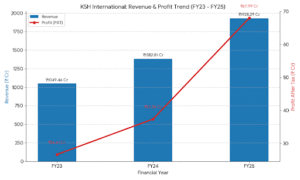
Financials are the backbone of any IPO decision, especially in the SME segment. KSH International’s reported numbers show a clear growth trend in revenue, which signals expanding operations or improved demand. Consistent revenue growth is a positive sign, particularly if it is accompanied by improving profitability rather than rising costs.
Profit margins provide deeper insight. Stable or improving EBITDA margins indicate operational efficiency and pricing power. If margins are thin but improving, it suggests the company is still optimising scale. Net profit growth is equally important because it reflects the company’s ability to control finance costs and taxes.
Cash flow is often ignored by retail investors, but it matters more than profit in SMEs. A business may show accounting profits but struggle with cash due to working capital pressure. Investors should check whether operating cash flows are positive and improving.
Debt levels also matter. A manageable debt-to-equity ratio indicates balance-sheet discipline. Compared to peers in the SME space, KSH International’s financial stability appears reasonable, but investors must remember that SME benchmarks are different from large-cap standards.
💰 4️⃣ IPO Details at a Glance: Price, Issue Size & Use of Funds
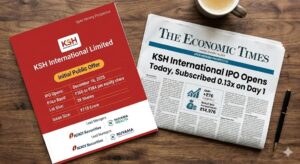
KSH International IPO is structured as an SME public issue, which automatically places it in a higher-risk category compared to mainboard IPOs. The price band is set at a level that reflects both growth expectations and SME valuation norms. The lot size determines the minimum investment, which is usually higher than mainboard IPOs and limits participation to more committed investors.
The total issue size is relatively modest, typical of SME offerings. A key detail to watch is whether the issue is a fresh issue or includes an Offer for Sale (OFS). A higher fresh issue component is generally positive because it means funds are being injected into the business rather than promoters exiting.
Use of funds is crucial. If IPO proceeds are earmarked for working capital, expansion, or debt reduction, it supports future growth. If funds are used largely for general corporate purposes without clarity, investors should be cautious. In KSH International’s case, proceeds appear aligned with operational needs rather than promoter monetisation, which is a neutral-to-positive signal.
📈 5️⃣ Valuation Check: Is KSH International IPO Expensive or Fairly Priced?
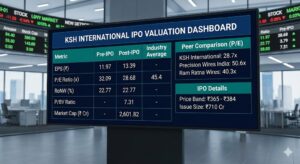
Valuation is where emotions often overpower logic in IPO investing. For KSH International, valuation must be judged within the SME universe, not against large listed peers. The commonly used metric is the Price-to-Earnings (P/E) ratio, adjusted for post-issue equity.
If the IPO P/E is significantly higher than comparable SME companies with similar growth, it raises red flags. If it is reasonable or slightly discounted, it indicates fair pricing. Growth-adjusted valuation is equally important — a higher P/E may be justified if earnings growth is strong and sustainable.
| Financial Year | Revenue (₹ Cr) | Profit After Tax (₹ Cr) |
| FY23 | 1,049.46 | 26.61 |
| FY24 | 1,382.81 | 37.35 |
| FY25 | 1,928.29 | 67.99 |
Grey Market Premium (GMP) often influences perception, but valuation should not depend solely on GMP trends. From a CA-style perspective, KSH International appears not aggressively overpriced, but not a deep-value bargain either. The pricing seems to factor in moderate growth expectations rather than speculative optimism.
🔎 6️⃣ Grey Market Premium (GMP): What It Signals and What It Doesn’t
GMP is one of the most searched terms during IPO season, and KSH International is no exception. A positive GMP suggests demand in the unofficial market and hints at possible listing gains. However, GMP is not regulated, not guaranteed, and highly sentiment-driven.
In SME IPOs, GMP can change quickly due to limited supply and speculative trades. A rising GMP indicates short-term interest, but a falling GMP does not necessarily mean the business is weak. Many quality companies have listed at low or zero GMP and delivered returns over time.
Investors should treat GMP as a sentiment indicator, not a valuation tool. For long-term investors, fundamentals matter far more than grey market buzz. GMP should be the last factor in the decision-making process, not the first.
⚠️ 7️⃣ Key Risks in KSH International IPO That Retail Investors Must Understand
Every SME IPO carries risks, and KSH International is no exception. The biggest risk is liquidity after listing. SME stocks often have low trading volumes, making exit difficult during market stress.
Client concentration is another concern. If a large portion of revenue comes from a handful of customers, any loss of a key client can impact earnings sharply. Industry-specific risks, such as regulatory changes or input cost volatility, may also affect margins.
Working capital dependency is common in operational businesses. Delays in receivables can strain cash flows even when profits look healthy. Lastly, SME governance standards, while improving, may not match large-cap transparency levels. These risks do not make the IPO bad — they simply require higher risk tolerance.
🧠 8️⃣ Management & Promoters: Track Record and Credibility
In SME investing, management quality often matters more than brand value. KSH International’s promoters appear to have industry experience and operational understanding, which is essential for execution-heavy businesses.
The promoters’ past track record, continuity in leadership, and commitment to the business are key positives if maintained over time. Shareholding patterns before and after the IPO show whether promoters are staying invested or diluting aggressively.
A meaningful post-IPO promoter stake suggests confidence in future growth. Alignment of interest between promoters and public shareholders is crucial, especially in SMEs where promoter decisions have a direct impact on outcomes.
🧮 9️⃣ Who Should Consider This IPO—and Who Should Avoid It
KSH International IPO may suit investors who:
Understand SME risks
Are comfortable with limited liquidity
Are looking for medium- to long-term growth, not guaranteed listing gains
It may not suit:
First-time IPO investors
Those seeking quick exits
Conservative investors prioritising capital safety
Retail investors should allocate only a small portion of their IPO capital to SME issues. HNIs and experienced investors may view it as a diversification play rather than a core holding.
To visit official website of NSE Click here
🏁 🔟 Final Verdict: Should You Apply for KSH International IPO or Skip It?
KSH International IPO is neither a no-brainer nor a red flag. It represents a steady, execution-focused SME business with reasonable financials and manageable risks. The valuation appears balanced, not euphoric. GMP may offer short-term cues, but fundamentals suggest a measured approach.
Verdict:
👉 Apply with caution if you understand SME risks and are investing with a long-term perspective.
👉 Avoid if you are chasing guaranteed listing gains or low-risk returns.
In SME IPOs, discipline matters more than excitement — and KSH International deserves analysis, not blind optimism.
❓ FAQs: KSH International IPO – What Investors Want to Know
❓ What does KSH International do?
KSH International operates as a B2B-focused SME company, meaning it supplies products or services to other businesses rather than directly to consumers. Its business model is execution-driven and depends on operational efficiency, long-term client relationships, and repeat orders. Unlike consumer brands, KSH International’s growth is less visible to the public but can be more stable if demand from clients remains consistent.
❓ Is KSH International IPO a mainboard or SME IPO?
KSH International IPO is an SME IPO, which means it will be listed on the SME platform of the stock exchange. SME IPOs generally involve higher risk and lower liquidity compared to mainboard IPOs, but they can also offer higher growth potential if the business performs well after listing.
❓ What is the minimum investment required in KSH International IPO?
Since this is an SME IPO, the lot size is higher than mainboard IPOs. Retail investors need to apply for at least one full lot, which results in a higher minimum investment amount. Investors should check the final lot size and price band before applying, as SME IPOs are not suitable for very small ticket investments.
❓ Is KSH International IPO good for retail investors?
KSH International IPO may be suitable for experienced retail investors who understand SME risks and are comfortable with price volatility and low liquidity. It may not be ideal for first-time IPO investors or those looking for guaranteed listing gains. Retail investors should limit exposure and avoid over-allocation.
❓ What are the key risks in KSH International IPO?
The main risks include:
Low liquidity after listing, which can make exit difficult
Client concentration risk, if revenue depends on a few large customers
Working capital pressure, common in operational businesses
SME governance risks, as disclosures may be less detailed than large companies
These risks do not mean the IPO is bad, but they require a higher risk appetite.
❓ How important is Grey Market Premium (GMP) for this IPO?
GMP reflects short-term market sentiment, not business fundamentals. A positive GMP may indicate listing gains, while a low GMP does not necessarily mean the IPO lacks value. Investors should not rely only on GMP and must evaluate financials, valuation, and risks before making a decision.
❓ How will the IPO funds be used by KSH International?
The IPO proceeds are primarily expected to be used for working capital requirements, business expansion, and general corporate purposes. This suggests the company is raising funds to support operations and growth rather than for promoter exit, which is generally viewed as a neutral-to-positive sign.
❓ Is KSH International IPO suitable for long-term investment?
For long-term investors, SME IPOs require patience. If KSH International continues to grow revenue, maintain margins, and manage working capital efficiently, long-term value creation is possible. However, investors should be prepared for limited liquidity and higher volatility compared to mainboard stocks.
❓ Should investors apply for KSH International IPO or skip it?
KSH International IPO may be considered by investors who:
Understand SME IPO risks
Have a medium to high risk appetite
Are not dependent on immediate liquidity
Conservative investors or those seeking stable, low-risk returns may prefer to skip it.
❓ What should investors track after listing?
After listing, investors should monitor:
Quarterly revenue and profit trends
Cash flow and working capital position
Order book or client additions
Promoter shareholding changes
Trading volumes and liquidity
🔍 People Also Ask (PAA): KSH International IPO
🔹 Is KSH International IPO worth applying for?
KSH International IPO may be worth considering for investors who understand SME IPO risks and are comfortable with limited liquidity after listing. The company shows operational stability, but returns will depend on post-listing execution rather than hype. It may not suit conservative investors seeking guaranteed returns.
🔹 Is KSH International IPO risky?
Yes, like most SME IPOs, KSH International IPO carries medium to high risk. Risks include low trading volumes after listing, dependency on a limited customer base, and working capital pressure. These risks should be evaluated alongside the company’s financial performance and valuation.
🔹 What is the GMP of KSH International IPO today?
The Grey Market Premium (GMP) of KSH International IPO changes daily and reflects unofficial market sentiment. GMP should not be treated as a confirmed indicator of listing gains and must be viewed only as a short-term sentiment signal, not a valuation tool.
🔹 Can retail investors apply for KSH International IPO?
Yes, retail investors can apply, but the minimum investment amount is higher due to SME lot sizes. Retail investors should assess their risk tolerance carefully and avoid over-allocation to SME IPOs.
🔹 Is KSH International IPO good for long-term investment?
For long-term investors, KSH International IPO could be considered if the company continues to grow revenue, manage margins, and control debt. However, liquidity constraints and higher volatility mean it should form only a small part of a diversified portfolio.
🔹 What happens if KSH International IPO does not list at a premium?
If the IPO lists at or below the issue price, investors may need to hold for the long term to realise value. In SME IPOs, listing gains are uncertain, and long-term fundamentals matter more than first-day performance.
🔹 How does KSH International IPO compare with other SME IPOs?
Compared to many SME IPOs driven by speculative narratives, KSH International appears more operations-focused. However, investors should compare financials, valuation, and risk factors with other recent SME listings before deciding.
🔹 Is GMP reliable for deciding on KSH International IPO?
No. GMP is not regulated and highly volatile. Many IPOs with strong GMPs have delivered poor long-term returns, while others with low GMP have performed well. Fundamentals should always take priority.
🔹 What should investors monitor after KSH International IPO listing?
After listing, investors should track quarterly financial results, working capital cycles, promoter shareholding, and trading volumes. These indicators provide a clearer picture of business health than IPO-day price movement.