1. Executive Summary: Why This Quarter Signals an Urban Consumption Revival
After watching India’s food service industry for nearly three decades, one thing becomes clear — when pizza orders increase, urban discretionary spending is back. The Q3 FY26 results of Jubilant FoodWorks, released on February 10, 2026, send exactly that signal. The company reported a consolidated net profit of ₹72.9 crore, a strong 69% year-on-year jump. But the real story is not just profit growth. Revenue increased 13.3% to ₹2,437 crore, and more importantly, EBITDA margins expanded to 19.8%, up 110 basis points. In a business where input costs like cheese, wheat, and chicken have remained volatile, margin expansion is a clear sign of operational control. Even more significant is the 5% like-for-like (LFL) growth in Domino’s India. After several quarters of flat or weak same-store growth, customers are not just ordering — they are ordering more frequently. This is what makes this quarter important. It signals that urban consumers are regaining confidence.
Jubilant FoodWorks Limited
2. Financial Dashboard: Quality of Earnings, Not Just Growth
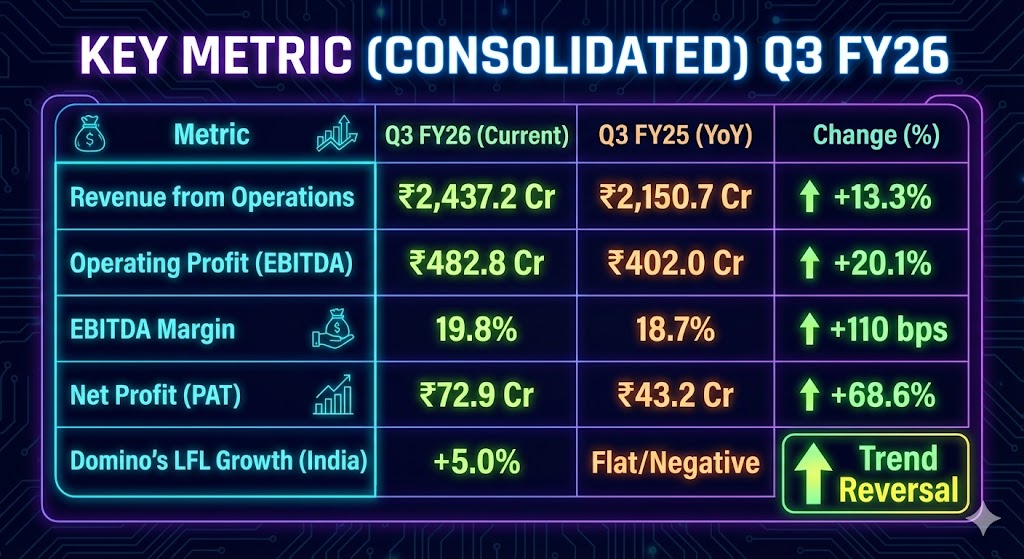
The Q3 FY26 numbers reflect healthy earnings quality rather than temporary gains. Revenue rose to ₹2,437.2 crore from ₹2,150.7 crore in Q3 FY25, showing a 13.3% increase driven by both store expansion and higher same-store sales. Operating profit (EBITDA) jumped 20.1% to ₹482.8 crore, faster than revenue growth, which explains the margin expansion to 19.8%. Net profit surged 68.6% from ₹43.2 crore to ₹72.9 crore, reflecting improved operational leverage. Domino’s India reported 5% LFL growth — a key metric that measures performance of stores open for more than a year. In restaurant businesses, LFL growth is the most honest indicator of demand. When LFL turns positive after stagnation, it means footfall and order frequency have improved without depending only on new store openings. This makes the current earnings sustainable rather than cosmetic.
Jubilant FoodWorks share price
3. Domino’s: The Return of Volume and Frequency

The strongest pillar of this turnaround is Domino’s India. Jubilant has now delivered its eighth consecutive quarter of positive LFL growth, with Q3 FY26 hitting 5%. This proves that the company’s heavy investments in digital ordering and 20-minute delivery infrastructure are finally paying off. Nearly 75% of Domino’s sales now come through delivery channels, making the company function more like a technology-enabled food platform than a traditional dine-in chain. The mobile app has become the core sales engine, reducing dependency on third-party aggregators. In addition, Jubilant opened 75 new Domino’s stores in India during the quarter, aggressively expanding into Tier-2 and Tier-3 cities. These cities offer a powerful combination — rising income levels and aspirational spending. In places like Lucknow, Indore, and Coimbatore, branded quick-service restaurants are no longer a luxury; they are becoming routine weekend choices. Domino’s is positioned perfectly to capture this shift.
4. Popeyes: The Challenger Brand Finding Its Footing
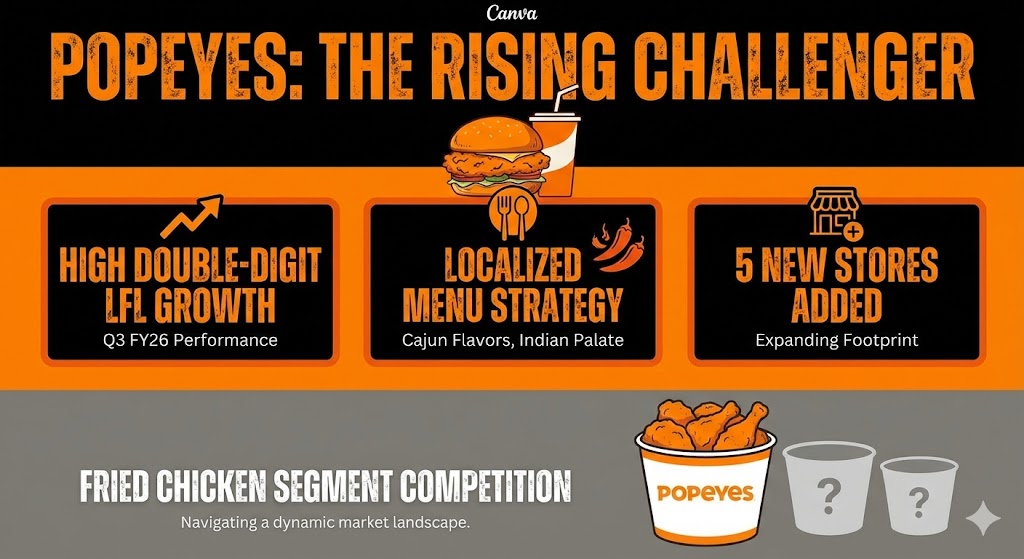
While Domino’s remains the flagship, Popeyes is quietly becoming a meaningful second growth engine. The fried chicken chain reported high double-digit LFL growth this quarter, signaling that the brand has crossed the critical “product-market fit” stage in India. By localizing flavors — especially through its popular “Hot & Messy” range — while maintaining the global Cajun identity, Popeyes is carving space in a segment traditionally dominated by KFC. The company added five new Popeyes outlets this quarter, choosing cautious but profitable expansion rather than reckless growth. India’s fried chicken market is expanding rapidly as urban consumers shift toward protein-rich fast food. Popeyes is positioning itself as a premium yet accessible alternative, and early performance suggests it is working.
5. International Operations: Turkey and South Asia Surprise on the Upside
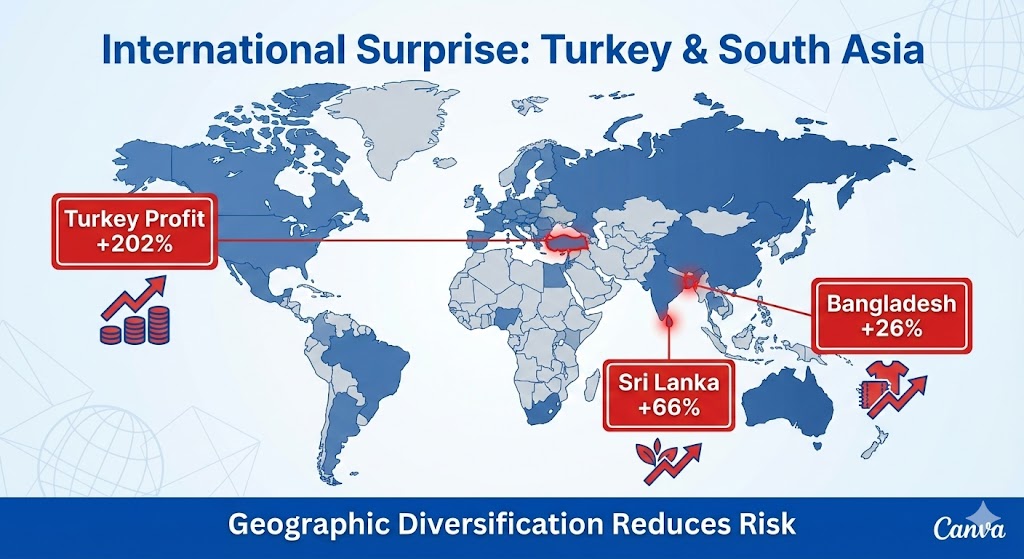
Jubilant’s international operations added strength to Q3 performance. The company operates Domino’s stores in Turkey through its subsidiary DP Eurasia. Despite Turkey facing hyperinflation and currency volatility, revenue there grew 15% year-on-year, while profit surged an impressive 202%. This demonstrates Domino’s strong pricing power — when costs rise, prices can be adjusted quickly without losing customers. In South Asia, markets like Sri Lanka and Bangladesh also showed strong recovery, with revenue growth of 66% and 26% respectively. These markets were earlier seen as drag factors due to political and economic instability. Their turnaround provides geographic diversification and reduces India-specific risks. The international business is no longer just an add-on; it is becoming a meaningful contributor.
6. Policy and Labor Reform Impact: The One-Time Hit
One noticeable line item in Q3 FY26 was a one-time exceptional charge of ₹33.7 crore due to implementation of India’s new labor codes. These reforms increased liabilities related to gratuity and leave encashment. While this temporarily affected reported earnings, it is important to understand that this is not a recurring cost. It represents statutory compliance under India’s 2026 labor reforms. In fact, the absence of such clean-up charges in the future will make earnings look stronger. Investors should treat this as an accounting adjustment rather than operational weakness. It also signals that the company is aligning itself fully with new regulatory standards.
7. Input Costs: Managing Cheese and Chicken Inflation
One of the biggest risks in quick-service restaurants is commodity volatility. Cheese and chicken remain key cost components for Domino’s and Popeyes respectively. Global dairy prices have remained elevated due to supply constraints, and any spike in milk procurement costs could pressure margins. However, in Q3 FY26, Jubilant managed to expand gross margins despite these headwinds. This was achieved through better supply chain efficiency, menu optimization, and price rationalization. Instead of aggressive price hikes that could hurt demand, the company focused on bundle offers and strategic pricing. This approach helped maintain both customer traffic and profitability. Sustaining a 19.8% EBITDA margin in such an environment shows operational discipline.
8. Aggregator Wars: The Bold Digital Strategy
Another structural risk comes from food delivery aggregators like Swiggy and Zomato. These platforms charge significant commissions, which can erode restaurant margins. Jubilant has chosen a bold strategy — prioritize its own app and website for orders rather than rely heavily on aggregators. This reduces commission expenses and gives the company full control over customer data. However, it is also risky because aggregator platforms offer massive visibility. So far, the strategy appears to be working, as Domino’s strong digital ecosystem drives repeat orders. But this competitive landscape must be monitored closely.
9. Store Expansion: Scaling with Discipline
As of Q3 FY26, Jubilant operates nearly 3,600 stores globally across brands. In India alone, Domino’s continues to expand aggressively, focusing on asset-light formats and efficient store sizes. Unlike earlier years when expansion sometimes outpaced demand, the current strategy emphasizes profitable growth. New stores are being opened in clusters to optimize supply chain logistics. This reduces delivery times and improves service quality. Store economics have improved compared to the post-pandemic slowdown phase. This shift from “growth at any cost” to “disciplined scaling” is a critical strategic evolution.
10. Conclusion: A Bellwether for Urban Consumption
Jubilant FoodWorks’ Q3 FY26 performance goes beyond pizza sales. It reflects a broader revival in urban discretionary spending. When consumers increase order frequency, it signals confidence in income stability. The combination of revenue growth, margin expansion, positive LFL, and disciplined cost management marks a strong operational comeback. After two years of stock underperformance, this quarter could represent a breakout phase. The company has shifted from expansion-driven growth to profitability-focused scaling. With strong digital infrastructure, international diversification, and brand strength, Jubilant stands as one of Asia’s largest food service players. For investors and observers alike, this quarter rings a clear bell — India’s urban consumption engine is turning again.
Jubilant FoodWorks Q3 FY26 results
❓ FAQ
Q1. Why did Jubilant FoodWorks’ profit surge in Q3 FY26?
The profit increased due to revenue growth, improved operational efficiency, and EBITDA margin expansion to 19.8%, along with positive LFL growth in Domino’s India.
Q2. What is LFL growth and why does it matter?
LFL (Like-for-Like) growth measures sales growth from stores open for more than a year. It shows real demand improvement without relying only on new store openings.
Q3. Is Domino’s India demand recovering?
Yes. Domino’s reported 5% LFL growth in Q3 FY26, indicating stronger order frequency and improving urban discretionary spending.
Q4. What are the biggest risks for Jubilant FoodWorks?
Key risks include rising cheese and chicken prices, competitive pressure from aggregators, and global commodity volatility.
Q5. Is Jubilant FoodWorks a good long-term stock?
Jubilant is a leading QSR player with strong digital infrastructure and international diversification, but valuation and input cost risks should be considered.