1️⃣ What just happened — and why this matters
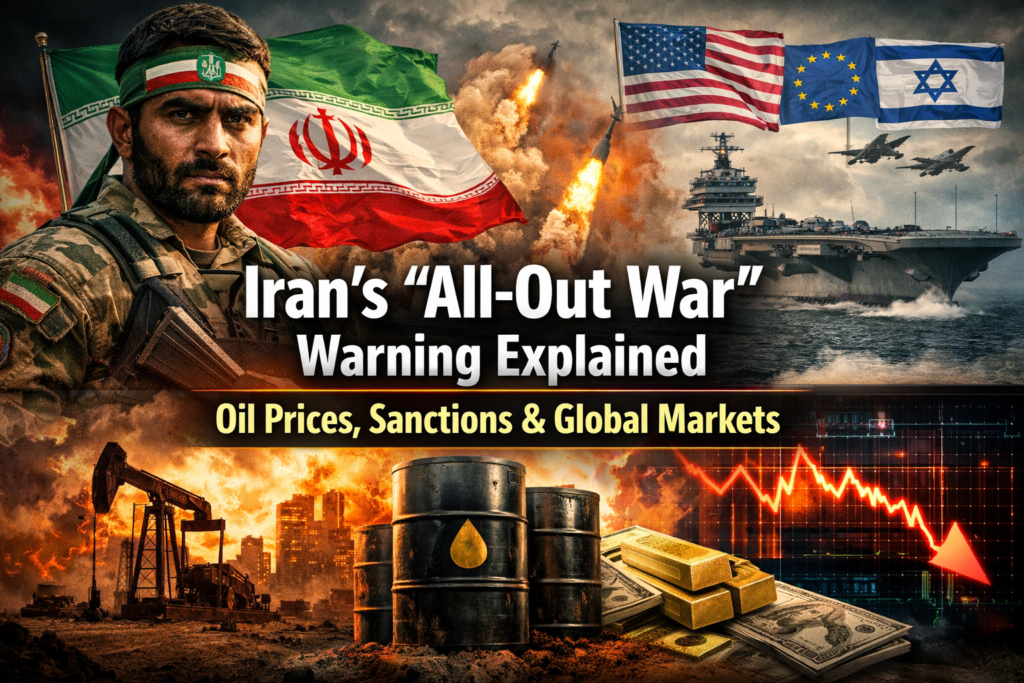
Iran has made a sharp and serious statement that caught global attention. President Masoud Pezeshkian said Iran is in an “all-out war” with the United States, Europe, and Israel. This does not mean tanks are rolling across borders today. Instead, Iran is saying it feels under total pressure — military, economic, diplomatic, and psychological — all at once.
This matters to ordinary people far beyond the Middle East. Any serious escalation involving Iran can affect oil prices, shipping routes, inflation, stock markets, and even food prices. In today’s global economy, one major conflict can quickly reach everyone’s pocket.
2️⃣ What “all-out war” means in Iran’s language — and what it does not
When Iran uses the phrase “all-out war,” it is not declaring a classic battlefield war like World War II. Instead, it is describing a full-spectrum conflict.
First is economic war. Iran has lived under heavy sanctions for years. These sanctions limit its banking access, block trade, weaken its currency, and make daily life harder for ordinary citizens.
Second is security pressure. Iran faces constant military threats, covert attacks, cyber operations, and proxy conflicts across the Middle East.
Third is diplomatic isolation. Nuclear talks are stalled, trust is broken, and red lines on uranium enrichment remain firm.
The key point is clarity: Iran is saying it feels attacked from all directions at once. It is not automatically announcing a direct military war tomorrow, but it is warning that pressure has reached a dangerous level.
3️⃣ How we reached this point: a short timeline
The current crisis did not appear overnight. Over the past few years, tensions have steadily grown.
Iran’s nuclear programme became more advanced after earlier agreements collapsed. Sanctions were tightened and enforcement became stricter. Regional conflicts involving Iran’s allies and rivals increased pressure on all sides.
In mid-2025, tensions spiked again after new diplomatic failures and regional security incidents. Nuclear monitoring reports raised fresh concerns. Oil flows and shipping routes came under scrutiny.
Finally, President Pezeshkian’s statement brought all these threads together into one message: Iran believes it is already under attack — just not in a traditional military form.
4️⃣ Iran’s economy under pressure: the money reality
Behind Iran’s strong language lies a very stressed economy. According to the International Monetary Fund, Iran’s inflation in 2025 is projected at around 42%, one of the highest rates in the world. Economic growth is expected to be just about 0.6%, meaning living standards are barely improving.
For ordinary Iranian families, this means food, rent, and fuel are getting more expensive while incomes stay weak. The currency has lost value, savings have shrunk, and imported goods are harder to afford.
This economic pain matters geopolitically. High inflation and low growth reduce the government’s room to compromise. Leaders under domestic pressure often take harder positions abroad to show strength at home.
5️⃣ Oil and sanctions: the real battlefield
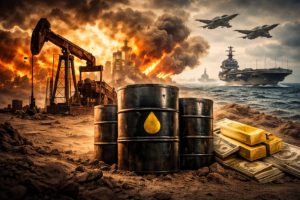
Iran’s biggest leverage is energy. Despite sanctions, Iran continues to export oil through complex routes. Some tracking estimates suggest Iran was exporting around 2.15 million barrels per day in late 2025, using indirect shipping, ship-to-ship transfers, and re-labelled cargoes.
Sanctions are meant to stop this, but history shows enforcement is difficult. After 2022, Russia used similar methods to keep selling oil despite price caps. The lesson is simple: sanctions raise costs and risks, but they rarely stop flows completely.
For global markets, the danger is not just Iran’s oil exports. It is the risk to shipping lanes, especially near the Strait of Hormuz. Even a small disruption there can push oil prices sharply higher within days.
6️⃣ The nuclear issue: why talks are stuck and markets worry
Iran’s nuclear programme remains the most sensitive issue. The International Atomic Energy Agency has reported that Iran has produced uranium enriched up to 60% purity. This is far above civilian levels, though still below weapons-grade.
In simple terms, higher enrichment means Iran is technically closer to being able to build a weapon if it chooses to — even if it has not done so. Markets react strongly to this because nuclear risk raises the chance of military action.
Iran says it wants sanctions relief and security guarantees. The US and European powers want strict limits, inspections, and long-term verification. Both sides distrust each other, and that mistrust keeps talks frozen.
7️⃣ Why Europe is named alongside the United States
Some readers may ask: why does Iran include Europe in its “all-out war” claim? The answer lies in politics and energy.
European countries — especially the UK, France, and Germany — generally align with the US on Iran’s nuclear file and sanctions policy. Europe also remembers how energy shocks after the Ukraine war hurt its economy. Any Middle East disruption directly threatens Europe’s energy security.
From Iran’s perspective, Europe is not neutral. By supporting sanctions and pressure, Europe becomes part of the same system Iran believes is strangling its economy.
8️⃣ Israel: red lines and escalation risks
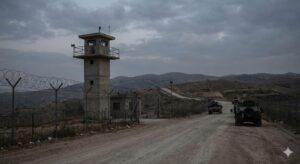
Israel is a central factor in this crisis. Israel has repeatedly said it will not allow Iran to acquire nuclear weapons. That creates clear red lines.
There are several possible paths ahead. One is limited tit-for-tat, involving cyber attacks, proxy clashes, or maritime incidents. Another is direct escalation, where a single strike leads to retaliation and rapid escalation. A third path is de-escalation, using back-channel talks to prevent miscalculation.
History offers warnings. In 2019, attacks on oil tankers briefly shook global markets. Even small incidents can have big economic effects if nerves are already stretched.
9️⃣ Global market impact: oil, gold, shipping, inflation
Markets hate uncertainty. Any hint of conflict involving Iran usually adds a risk premium to oil prices. Higher oil prices feed into transport costs, food prices, and inflation worldwide.
Shipping insurance costs rise quickly during Middle East tensions, hurting exporters and importers alike. Asia and Europe feel this first because of trade routes.
Gold often benefits as investors look for safety. Currencies of emerging markets can weaken as global investors move money into safer assets.
🔟 Why this matters for India
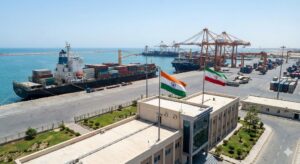
For India, this crisis is not distant. India imports most of its oil, so even a small price rise increases the import bill and inflation. Millions of Indians work in West Asia, and regional instability can affect jobs and remittances.
India also follows a policy of strategic autonomy. It maintains ties with the US, Israel, Europe, and Iran. Any escalation makes this balancing act harder. Connectivity projects and regional trade routes also become riskier when tensions rise.
1️⃣1️⃣ What each side can realistically do next
Iran has several choices. It can escalate pressure through proxies and maritime actions, or it can offer limited nuclear restraint in exchange for partial sanctions relief. It can also focus on domestic economic stabilisation to reduce internal pressure.
The US and Europe can tighten sanctions further, offer limited relief tied to strict verification, or increase diplomatic engagement while signalling security strength.
Israel can rely on deterrence, intelligence operations, and alliances while pushing its red lines clearly to avoid misunderstanding.
1️⃣2️⃣ Conclusion: three takeaways and what to watch next
First, Iran’s “all-out war” statement reflects pressure, not confidence. Economic stress and isolation shape its posture.
Second, energy and nuclear issues remain tightly linked. Oil markets react not to words, but to perceived risk.
Third, miscalculation is the biggest danger. History shows crises often escalate by accident, not design.
What to watch next week and beyond: statements from the IAEA, any new sanctions announcements, shipping incidents near key routes, and sudden moves in oil prices. These signals will show whether this crisis is cooling — or heading toward something much worse.
To visit the official website of
Ministry of Foreign Affairs of the Islamic Republic of Iran click here
❓ Frequently Asked Questions (FAQ)
1️⃣ What does Iran mean by “all-out war” with the US, Europe and Israel?
Iran is not announcing a traditional military war. By “all-out war,” Iran means it is facing pressure on all fronts at the same time — sanctions, economic stress, military threats, diplomatic isolation, cyber operations, and regional conflicts. It is a way of saying Iran feels fully cornered, not that a full battlefield war has already begun.
2️⃣ Is Iran actually fighting the US or Israel right now?
No direct large-scale war is happening at this moment. However, tensions are very high. Iran and Israel are involved in indirect conflicts through regional groups, cyber activity, and intelligence operations. The risk lies in miscalculation — a small incident could quickly escalate.
3️⃣ Why are sanctions such a big issue for Iran?
Sanctions hit Iran’s economy hard. They limit oil sales, block access to global banking, weaken the currency, and increase inflation. Ordinary people feel the impact through higher prices and fewer job opportunities. This economic pressure is a major reason behind Iran’s aggressive political language.
4️⃣ How could this Iran crisis affect oil prices?
Iran sits near key global oil routes. Any threat to oil production or shipping — especially near the Strait of Hormuz — can push oil prices higher. Even without actual disruption, fear alone can raise prices, which then increases fuel and food costs worldwide.
5️⃣ Why does the nuclear issue keep coming back?
Iran’s nuclear programme is linked to trust and security. Iran wants sanctions lifted and guarantees it won’t be attacked. The US and Europe want strict limits and inspections to ensure Iran cannot build nuclear weapons. Because both sides distrust each other, talks often stall and tensions return.
6️⃣ What role does Europe play in this conflict?
Europe supports sanctions and nuclear restrictions alongside the US. It also worries about energy security because Middle East instability can cause fuel shortages and higher prices. From Iran’s view, Europe is part of the same pressure system, not a neutral actor.
7️⃣ Why is Israel so central to this issue?
Israel sees Iran’s nuclear capability as an existential threat. Israel has repeatedly said it will not allow Iran to get nuclear weapons. This creates clear red lines, making the situation more dangerous because military action becomes more likely if those lines are crossed.
8️⃣ How does this situation impact global markets?
Geopolitical tension increases uncertainty. Oil prices rise, shipping costs go up, stock markets become volatile, and investors move money into safer assets like gold. Emerging markets often feel the impact first through currency weakness and inflation.
9️⃣ Why should India care about Iran’s warning?
India imports most of its oil, so higher crude prices hurt inflation and government finances. Many Indians work in West Asia, and instability affects jobs and remittances. India also maintains relations with all sides, making regional tensions a diplomatic challenge.
🔟 Is a full-scale war inevitable?
No. History shows that even severe crises can cool down through diplomacy and back-channel talks. However, the risk of escalation is real, especially if an accident or misreading of intentions occurs. What happens next depends on restraint, communication, and political choices.
To visit the official website of Ministry of Foreign Affairs {Israel} click here
🔎 People Also Ask (PAA)
🔹 Is Iran officially at war with the US and Israel?
No. Iran is not officially in a declared military war. The phrase “all-out war” is used to describe economic sanctions, military pressure, diplomatic isolation, and regional tensions happening at the same time.
🔹 What triggered Iran’s “all-out war” statement?
Iran’s statement comes after rising sanctions, stalled nuclear talks, regional conflicts involving Israel, and increasing economic stress inside Iran. The government believes pressure has reached a breaking point.
🔹 Can Iran block the Strait of Hormuz?
Iran has the capability to disrupt shipping near the Strait of Hormuz, but doing so would risk a major global conflict. Even threats or limited actions in this area can sharply raise oil prices worldwide.
🔹 Will oil prices rise because of Iran tensions?
Oil prices often rise during Middle East tensions. Even without physical disruption, fear of supply problems can push prices higher, affecting fuel, transport, and food costs globally.
🔹 How strong is Iran’s military compared to the US?
Iran’s military is strong regionally but cannot match the US in direct conventional warfare. Iran relies more on missiles, drones, cyber operations, and allied groups rather than head-on conflict.
🔹 Is Iran close to making a nuclear weapon?
Iran has enriched uranium to high levels, but having enriched material is not the same as building a nuclear weapon. Weaponisation requires additional technical steps and political decisions.
🔹 Why are nuclear talks between Iran and the West failing?
Both sides distrust each other. Iran wants sanctions removed first, while the US and Europe want strict limits and inspections first. This deadlock keeps talks frozen.
🔹 How does this crisis affect global inflation?
Higher oil prices increase transport and production costs. These costs pass on to consumers, raising inflation in many countries, especially those that import energy.
🔹 What is Europe’s biggest concern in this conflict?
Europe fears energy supply shocks and wider regional instability. Past energy crises have made Europe very sensitive to disruptions from the Middle East.
🔹 Could this situation lead to World War-like conflict?
A global war is unlikely, but regional escalation is possible. Most major powers prefer to avoid direct war, but accidents, miscalculations, or sudden attacks could still trigger a serious crisis.
🔹 How long can this Iran crisis last?
Such geopolitical standoffs can last months or even years. They often move in cycles — tension, negotiation, pause, and then renewed pressure.
Thailand–Cambodia Ceasefire Explained: Why This Border Conflict Matters for Asia’s Power Balance