
Iran Israel USA War: The End of America’s Global Empire Explained

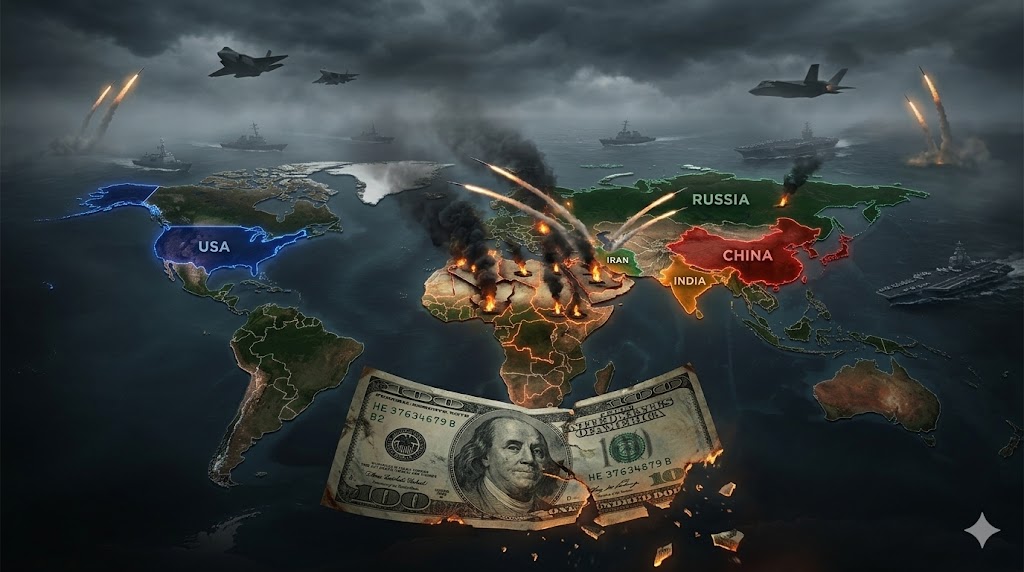
Something historic is unfolding right now. The Iran-Israel-USA war that exploded on February 28, 2026 is not just another Middle East conflict. It is the beginning of the end of America’s role as the world’s single superpower — and the birth of a new multipolar world where India, China, Russia, and the USA will each hold their own piece of global power.
In this post, we break it all down — the war, the money, the dollar, the military bases, and the four new superpowers — with real facts and figures. By the end, you will see the big picture clearly.
How the Iran-Israel-USA War Actually Started
To understand the Iran Israel USA war result, you need to know how we got here.
It did not happen overnight. The chain of events goes back to October 7, 2023 — the Hamas attack on Israel that triggered the Gaza war. That war slowly pulled in Iran’s entire network of allies — Hezbollah in Lebanon, the Houthis in Yemen, and militias in Iraq and Syria. By 2024, Iran and Israel were exchanging direct missile strikes for the first time in decades.
Then came the Twelve-Day War in June 2025. Israel bombed Iran’s nuclear facilities, air defenses, and military sites. The US joined in, striking three underground nuclear sites. Iran fired over 550 ballistic missiles and more than 1,000 drones at Israel. A ceasefire was reached, but the damage was done.
By late 2025, Iran’s economy was collapsing. The Iranian rial went into freefall. Massive protests broke out in December 2025 — the largest since the 1979 revolution. The government responded with shocking violence. Depending on the source you read, somewhere between 3,000 and 32,000 protesters were killed.
Negotiations in February 2026 failed. On February 28, 2026, the US and Israel launched a full-scale war. Supreme Leader Ali Khamenei was killed. Iran’s defense minister, the commander of the Revolutionary Guard, and dozens of senior officials were wiped out in the opening strikes.
Iran fought back hard. It launched hundreds of missiles and thousands of drones — not just at Israel, but at US military bases across the entire region. Bahrain, Saudi Arabia, Kuwait, Qatar, the UAE, Iraq, Jordan, and Azerbaijan were all struck. The US Navy’s 5th Fleet headquarters in Bahrain was hit multiple times. The IRGC launched attacks on at least 27 bases where US troops were deployed.
For the first time in modern history, America’s entire Middle East military presence was under simultaneous attack.
The Real Cost Nobody Is Talking About — America’s Broken Finances
Here is the part that connects the Iran Israel USA war result to the long-term decline of American power: the money.
The US spent $997 billion on defense in 2024 — more than the next nine countries combined. In the same year, the US paid $882 billion just in interest on its national debt. Think about that. America is nearly spending as much paying bank interest on borrowed money as it spends on its entire military.
The US national debt crossed $37.9 trillion in 2025 and grows by approximately $25 billion every single day. The US government borrows money by selling Treasury bonds to foreign governments and investors. But foreign ownership of US Treasury bonds has fallen to just 30% in early 2025, down from a peak of over 50% during the 2008 financial crisis, according to J.P. Morgan Research.
The US also maintains approximately 750 military bases across 80 foreign countries at a cost of at least $55 billion per year. The ongoing war is pushing these costs through the roof. Several Gulf states blocked the US from using their bases and airspace for offensive strikes on Iran. Some did it to avoid being targeted — but Iran struck them anyway.
The US closed embassies across the region, evacuated thousands of civilians, and repositioned naval assets. All of this costs money that America increasingly cannot print.
For decades, America could print dollars and the world would accept them. That era is ending.
Why the US Dollar Is Not as Powerful as It Used to Be
The Iran Israel USA war result cannot be fully understood without understanding what is happening to the US dollar.
The dollar’s share of global foreign exchange reserves has dropped from 85% in the 1970s to around 54–59% by 2025, according to IMF data. That is a massive decline. The dollar is still dominant — but it is no longer unchallenged.
The turning point came in February 2022, when the US and Europe froze Russia’s $300 billion in foreign exchange reserves after the Ukraine invasion. Every country in the world — from India to Saudi Arabia to Brazil — saw that and thought: if we ever have a conflict with Washington, our entire national savings could be frozen overnight. That fear accelerated what economists call “de-dollarization.”
Key facts on de-dollarization right now:
- The dollar’s share in global reserves has slid to a two-decade low, with gold’s share in global foreign reserves rising from 13% in 2017 to roughly 30% as of late 2025
- China has cut its US Treasury holdings by more than 27% since 2022
- Central banks worldwide have been buying over 1,000 tonnes of gold annually since 2022 as part of reserve diversification
- BRICS nations — now including Brazil, Russia, India, China, South Africa, Indonesia, Egypt, Ethiopia, UAE, and others — represent nearly 40% of global GDP by purchasing power
- The BRICS Pay digital payment platform is being developed to allow international trade without touching the dollar
- Russia and China now settle nearly all their bilateral trade in rubles and yuan, completely bypassing the dollar
The dollar still dominates. But it dominates less with each passing year. And without the ability to freely print money that the world will accept, maintaining a global military empire becomes mathematically impossible.
Iran Strikes 27 US Bases — The Military Math Has Changed
During the 2026 war, Iran demonstrated something the world had long suspected but never seen proven so dramatically: the US military presence across the entire Middle East region can be targeted simultaneously.
Iran launched attacks on at least 27 US military bases spread across Bahrain, Kuwait, Qatar, the UAE, Saudi Arabia, Iraq, Jordan, and Azerbaijan. The US was forced to sail its warships out of Bahrain’s port before the attacks began and reduce the 5th Fleet headquarters to fewer than 100 mission-critical staff. The US Embassy in Kuwait was struck. Hotels and civilian infrastructure were also targeted.
As of mid-2025, approximately 40,000 to 50,000 US soldiers were stationed in the Middle East across large permanent bases and smaller forward sites. Every single one of those soldiers and every one of those bases is now a potential target in any future confrontation with Iran.
Critically, Gulf states — America’s partners who have hosted US bases for decades — are reconsidering this arrangement. Hosting a US military base used to be a security guarantee. Now it has become a reason to be bombed. Saudi Arabia, the UAE, and Qatar were all struck. Their governments are watching this and doing the math.
China, meanwhile, brokered the Saudi-Iran diplomatic normalization in 2023 without firing a single shot. Saudi Arabia now settles some oil trade with China in yuan. The petrodollar arrangement — in place since 1974 — is quietly cracking.
The Gulf States Are Quietly Turning Away from America
Something quietly historic happened that the mainstream news buried in the war coverage: Gulf states blocked the US from using their bases for offensive strikes on Iran.
Fox News and The Wall Street Journal both reported this. Saudi Arabia and the UAE told the US it could not launch offensive missions from their soil. They feared Iranian retaliation — which came anyway, killing civilians and striking commercial districts in Bahrain and Saudi Arabia.
The message is clear: hosting American bases is no longer a free security guarantee for Gulf states. It is a liability. And China is positioning itself as the alternative partner — the stable economic player who trades, invests, builds infrastructure, and does not start wars on your doorstep.
Afghanistan Was Just the Beginning — America’s Long Retreat
History is the best guide here.
After spending an estimated $8 trillion on post-9/11 wars in Afghanistan and Iraq (including veterans’ care and interest costs, per Brown University’s Costs of War project), the US left Afghanistan in August 2021 in chaos. The Taliban retook Kabul in days. After 20 years and trillions of dollars, the outcome was the same as if the US had never gone.
That moment changed something in the American public psyche. Voters across both parties are increasingly asking: “Why are we spending trillions maintaining bases in 80 countries when we have unaffordable healthcare and crumbling roads at home?”
The Iran war will deepen that question, not resolve it. Every American soldier killed in the Gulf, every billion spent on replacing destroyed military equipment, every hospital back home that doesn’t get funded — all of it adds to the pressure to pull back.
This is not weakness. It is arithmetic. Even the British Empire — once the largest in human history — eventually made the same calculation. After World War II, Britain withdrew from India (1947), then from East of Suez (1968), then from Hong Kong (1997). Not because Britain stopped caring about the world, but because it could no longer afford to run it.
America is approaching the same crossroads.
The Four Superpowers of the New World: India, China, USA, Russia
So what replaces the unipolar world? The answer taking shape is a multipolar world with four main centers of power.
The United States remains the world’s most powerful military and technology nation. But it is becoming more selective. Its debt burden, political divisions, and failed military adventures are pushing it toward a more restrained global role. It will not disappear from the world stage — it will simply share it.
China is the world’s second-largest economy and the largest trading nation on earth. It spent $314 billion on defense in 2024 — still far less than the US, but growing. Its Belt and Road Initiative has built economic influence across Africa, Asia, and Latin America. China’s strategy is patient, economic, and long-term. It doesn’t start wars. It writes trade deals.
Russia is economically damaged but still the world’s largest nuclear power by deployed warheads. It controls vast energy resources and has pivoted toward Asia and the Global South. Russia is no longer a global superpower in the Soviet sense, but it is a major regional force in Eurasia with the power to veto outcomes it doesn’t like.
India is perhaps the most important and underappreciated story. It is the world’s most populous country, the fifth-largest economy, and a rapidly growing military and technology power. India’s foreign policy doctrine is “strategic autonomy” — it refuses to fully align with any bloc. It buys weapons from both Russia and the US. It trades with both. It refused to condemn Russia over Ukraine, and it refused to join Western sanctions. The 2026 BRICS Summit is being hosted in India.
India is not a Chinese ally. It is not an American ally. It is India’s ally. And that independent posture makes it one of the defining players in the multipolar era.
These four powers will compete, negotiate, and occasionally cooperate. None of them will dominate the whole world the way the US did after 1991. The result will be a world of multiple power centers, regional spheres of influence, and negotiated balances.
What a Multipolar World Means for You
The shift to a multipolar world will not be smooth or fast. History tells us that transitional periods between global orders are often unstable. The late 19th and early 20th century — the last multipolar era — ended in two world wars.
But it also means a world where no single country can impose its financial system, its military presence, or its foreign policy on everyone else. BRICS nations want the right to trade in their own currencies. Gulf states want security without dependence. European nations want strategic independence. Developing countries want to borrow from institutions that don’t impose political conditions.
All of these forces are pulling the world away from American unipolarity — not out of hatred for America, but out of self-interest. That is how history always works.
The Bottom Line: The Iran Israel USA War Is a Turning Point
The Iran Israel USA war result is bigger than who wins the military battles. It is accelerating a transformation that was already underway — America’s retreat from its role as the world’s sole superpower, the dollar’s gradual decline as the only global currency, and the rise of a multipolar world anchored by four great powers.
This transition will take years, probably decades. But the direction is set.
The world is moving from a unipolar order, where one country wrote the rules, to a multipolar one, where four powers — the US, China, India, and Russia — each hold significant weight and must negotiate with each other to achieve their goals.
Understanding this shift now, while it is still happening, is the most important thing any informed citizen can do.
Frequently Asked Questions (FAQs)
What is the result of the Iran Israel USA war 2026? The war began on February 28, 2026 when the US and Israel struck Iran. Iran retaliated by attacking 27 US military bases across the Middle East, striking all six Gulf states. The financial and diplomatic consequences are accelerating America’s retreat from regional dominance and pushing the world toward a multipolar order.
Will the USA withdraw from Middle East military bases? Growing pressure — financial, military, and diplomatic — is making the current level of US presence unsustainable. With $37.9 trillion in debt, $882 billion in annual interest payments, and Gulf states reconsidering their hosting arrangements, a gradual withdrawal is increasingly likely.
Is the US dollar losing its reserve currency status? Yes, gradually. The dollar’s share of global reserves has fallen from 85% in the 1970s to around 54–59% in 2025. BRICS nations are building alternative payment systems, and foreign ownership of US Treasury bonds has dropped to just 30%.
Which four countries will be future superpowers? Most geopolitical analysts point to India, China, the USA, and Russia as the four major poles of the emerging multipolar world, each dominating their own region while competing globally.
What is de-dollarization and why does it matter? De-dollarization is the process of reducing the world’s dependence on the US dollar for trade and reserves. It matters because the dollar’s dominance is what allowed the US to print money and fund its global empire. As that privilege erodes, America must either cut spending or borrow at much higher costs.
Data sources: Britannica, Wikipedia, J.P. Morgan Research, IMF, SIPRI, Brown University Costs of War Project, Al Jazeera, CFR Global Conflict Tracker, UK House of Commons Library, Chicago Policy Review, US News & World Report.
❓ FAQ
Q1: What is the result of the Iran Israel USA war 2026? The 2026 Iran-Israel-USA war began on February 28, 2026. The US and Israel struck Iran, killing Supreme Leader Khamenei. Iran retaliated by attacking US military bases across all six Gulf states. The result is massive financial strain on the US, diplomatic damage in the Middle East, and an accelerated shift toward a multipolar world order.
Q2: Will the USA withdraw from its military bases in the Middle East? The pressure to withdraw is growing significantly. Iran struck 27 US military bases across the region during the 2026 war. The US has already evacuated non-essential staff from embassies. Financially, with a $37.9 trillion debt and $882 billion in annual interest payments, maintaining 750+ global bases is becoming unsustainable.
Q3: Is the US dollar losing its reserve currency status? Yes, gradually. The dollar’s share of global foreign reserves has dropped from 85% in the 1970s to around 54–59% by 2025, according to IMF data. BRICS nations are building alternative payment systems, and foreign ownership of US Treasury bonds has fallen to just 30% — down from over 50% at its peak.
Q4: What is a multipolar world and why is it forming now? A multipolar world means multiple countries share global power instead of one dominant superpower. It is forming because the US can no longer afford to police the entire world financially, China has become the world’s largest trading nation, India is rising as the fifth-largest economy, and Russia retains its nuclear and energy power. These four nations will define 21st-century geopolitics.
Q5: Which countries will be superpowers in the future? Most geopolitical analysts project four major powers by 2035–2040: the United States, China, India, and Russia. India is especially notable — it is the world’s most populous country, the fifth-largest economy, and pursuing “strategic autonomy” rather than aligning with any single bloc.
Q6: What happens if the US leaves its military bases worldwide? If the US withdraws from its global military footprint, regional powers like China, Russia, Turkey, and India will fill the vacuum in different parts of the world. Trade routes, energy supply lines, and diplomatic alliances will all be renegotiated. It will not be a safer world immediately, but it may lead to a more balanced long-term order.
Q7: How does de-dollarization affect ordinary people? If the dollar loses its reserve status, the US will have to pay higher interest rates to borrow money, inflation inside the US could rise, and the government will need to cut spending on either military or social programs. For the rest of the world, it means more freedom to trade in their own currencies without fear of US sanctions.

About Anant Jha
Anant Jha is the Editor-in-Chief of SRVISHWA.com, where he writes on geopolitics, geoeconomics, and global financial trends. As a geopolitical and geoeconomic analyst (and continuous learner), he focuses on decoding global power shifts, currency dynamics, and economic strategies shaping the modern world.He is also a stock market fundamental analyst and learner, exploring how macroeconomic events influence businesses and long-term investment opportunities. Through his work, he aims to simplify complex global issues and connect them with real-world economic impact for readers.