1. The Executive Summary (The Macro Hook)
Ipca Laboratories has delivered one of its most balanced quarters in recent years. In Q3 FY26, the company reported a consolidated net profit of ₹326 crore, marking a strong 31.5% year-on-year growth compared to ₹248 crore in the same quarter last year. At first glance, this looks like just another pharma earnings beat. But if you look deeper, this quarter signals something more important — operational maturity.
Revenue from operations grew 6.6% to ₹2,393 crore. Now, 6–7% revenue growth may not sound very exciting in a market where some companies chase double-digit top-line expansion. However, what truly stands out is the quality of growth. The profit growth of 31% far outpaced revenue growth. That tells us one simple thing: margins expanded. And in today’s environment of input cost volatility and global pharma pricing pressure, margin expansion is not easy.
For years, Ipca was known as the “Anti-Malaria King,” dominating Hydroxychloroquine (HCQ) exports during the pandemic years. But today, the story is different. The company is no longer dependent on a single molecule or a temporary global demand cycle. It has built a stable domestic branded franchise in pain management and rheumatology. This is now acting as a cash engine while the company carefully integrates Unichem Laboratories to strengthen its US presence.
In short, this is not a flashy quarter. It is a disciplined quarter. And disciplined growth is what long-term investors should pay attention to.
Ipca Laboratories Q3 FY26 earnings release
2. Financial Dashboard: The Operating Leverage Story
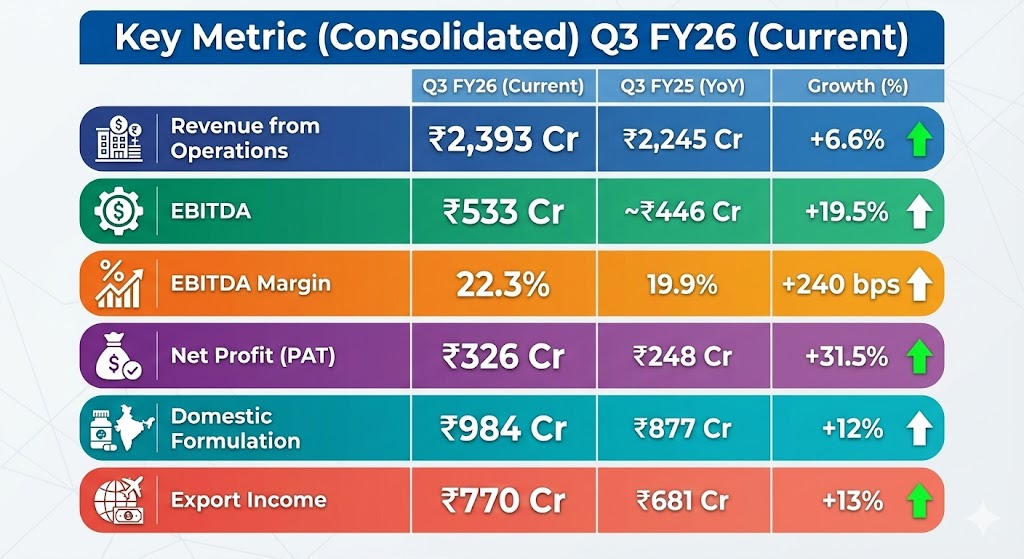
Let us look at the numbers more closely.
Revenue from operations stood at ₹2,393 crore compared to ₹2,245 crore last year, a growth of 6.6%. EBITDA came in at ₹533 crore, rising nearly 19.5% from approximately ₹446 crore last year. The EBITDA margin improved significantly from 19.9% to 22.3%, an expansion of 240 basis points. Net profit grew 31.5% to ₹326 crore.
This gap between revenue growth and profit growth clearly shows operating leverage at play. When margins expand faster than sales, it means either cost control has improved or the product mix has shifted toward higher-margin segments. In Ipca’s case, both factors played a role.
Domestic formulation revenue rose to ₹984 crore, up 12% year-on-year. Export income increased to ₹770 crore, up 13%. However, within exports, the mix changed — and that is critical to understand.
The improvement in EBITDA margin in a quarter where raw material prices and logistics costs remain volatile indicates strong pricing power and disciplined expense management. Many pharma companies are struggling with US price erosion. Ipca seems to be cushioning itself through its domestic branded strength.
Ipca Laboratories quarterly results filing
3. Fundamental Breakdown: The Domestic Moat
A. The “Zerodol” Economy
Ipca’s domestic formulation business is its strongest pillar. The domestic segment grew 12%, which is higher than the Indian Pharma Market growth rate of roughly 9–10% in recent quarters. That means Ipca is gaining market share.
The key reason behind this is its dominance in pain management and rheumatology. The Zerodol franchise, which includes Aceclofenac-based products, has strong brand recall among doctors. In chronic pain management, doctors are reluctant to switch brands frequently. Once trust is built, prescriptions become sticky.
This stickiness is extremely valuable. It allows Ipca to pass on small price increases to distributors and pharmacies without losing significant volume. In a quarter where inflationary pressure exists on packaging materials and solvents, this pricing power becomes a defensive shield.
You can compare this to a consumer staple brand. Just like customers keep buying a trusted toothpaste brand despite small price increases, doctors continue prescribing trusted pain brands. This is why we can call Ipca’s domestic business a “consumer staple in disguise.”
Indian Pharma Market growth data
B. The Unichem Integration: The US Puzzle
The US generic market is tough. Price erosion is constant. Competition is intense. Many Indian pharma companies have seen margins shrink due to falling US prices.
Instead of aggressively expanding its own US front-end, Ipca acquired Unichem Laboratories. This move was strategic. Unichem already had a pipeline and presence in the US market. Rather than reinvent the wheel, Ipca chose to integrate.
In January 2026, Ipca completed the sale of Bayshore Pharmaceuticals, its US subsidiary. This was a cleanup move. The idea is clear: consolidate US operations under Unichem, reduce duplication, and improve cost efficiency.
This quarter’s margin expansion suggests that early integration benefits are starting to show. The company is focusing on operational efficiency instead of reckless expansion.
The US remains a “call option” for Ipca. If regulatory clearances improve and the pipeline strengthens, the upside can be significant. But the domestic business ensures stability even if the US recovery takes time.
USFDA import alert guidelines
C. Export Mix Shift: Quality Over Quantity
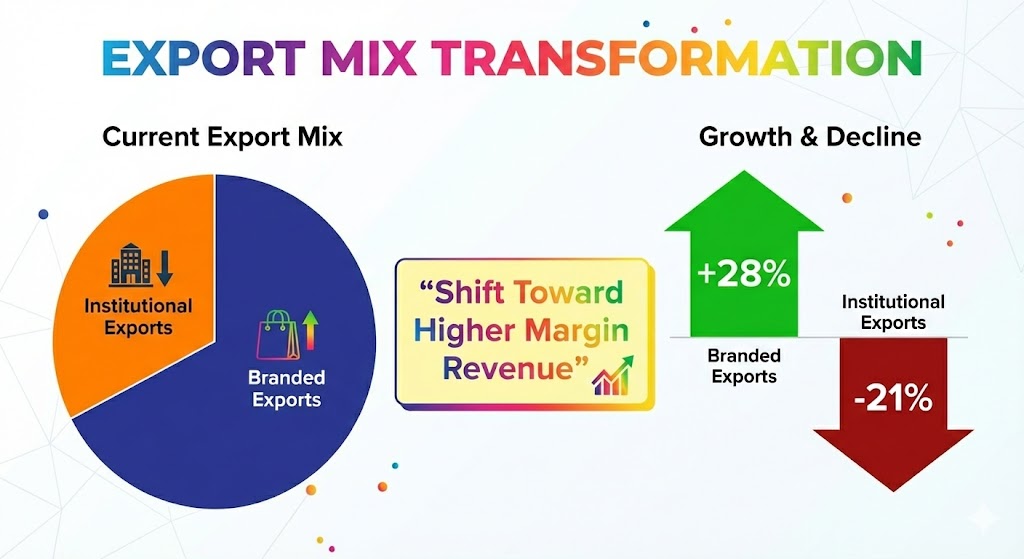
Exports grew 13%, but the internal composition matters. Branded exports grew 28%, while institutional exports (such as WHO and Global Fund tenders) declined 21%.
At first glance, falling institutional exports might look negative. But institutional sales are low-margin and volatile. Branded exports to regions like Russia, CIS countries, and Africa carry higher margins and better pricing stability.
This mix shift is one of the reasons net profit grew 31% despite revenue growing only 7%. It shows that Ipca is consciously improving the quality of its revenue rather than just chasing volume.
4. Geopolitics & Policy: The API Security Advantage
India has been actively pushing for pharmaceutical self-reliance under the Production Linked Incentive (PLI) scheme. One of the major risks in the pharma industry is dependence on China for Active Pharmaceutical Ingredients (APIs).
Ipca is among the few Indian companies with strong backward integration. It manufactures many of its own APIs, including Atenolol and Hydroxychloroquine. This vertical integration protects margins during supply chain disruptions.
When solvent prices rise or global shipping costs fluctuate, companies dependent on imports feel the pressure. Ipca, because of its integrated model, absorbs shocks better.
Another important factor is Russia and CIS exposure. Despite geopolitical tensions and sanctions, pharmaceuticals remain part of humanitarian supply channels. Demand for essential medicines does not stop because of political conflicts. This provides stability in export revenue.
Production Linked Incentive scheme for pharmaceuticals
5. Risk Factors: The Ratlam Shadow
No investment is without risk. Ipca has faced USFDA regulatory challenges in the past, especially at its Ratlam and Pithampur facilities.
If these plants do not receive full regulatory clearance, Ipca cannot launch new products in the US from those facilities. That limits upside potential.
Currently, the company relies on Unichem’s sites for US supply. If any compliance issue arises at those sites, it could affect both integration benefits and revenue growth.
Another risk is currency volatility. Ipca has strong exposure to emerging markets. If currencies in Africa or CIS regions depreciate sharply, realized revenue in Indian rupees may decline.
However, compared to pure US-focused generic players, Ipca’s diversified revenue base reduces overall risk.
6. Conclusion: A Defensive Compounder
Ipca Laboratories today looks very different from its pandemic-era profile. It is no longer a one-molecule story. It is no longer overly dependent on institutional export tenders.
The 31.5% profit growth in Q3 FY26 is driven primarily by domestic branded strength and better margin management. This makes the growth more sustainable.
At around 30x FY27 estimated earnings, the stock is not cheap. But it is also not excessively expensive compared to multinational pharma peers.
For investors, the strategy is simple: buy for the India domestic growth story and hold for US optionality.
In uncertain global markets, defensive stocks with stable cash flows become attractive. People will continue to need pain management medicines regardless of global interest rates, elections, or geopolitical noise.
Ipca’s Q3 FY26 results suggest that the company has entered a phase of operational maturity. It may not deliver explosive revenue growth every quarter. But it is building something more important — predictable profitability.
And in investing, predictability often commands a premium.
✅ FAQ
1. How much profit did Ipca Laboratories report in Q3 FY26?
Ipca reported a consolidated net profit of ₹326 crore, up 31.5% year-on-year.
2. What drove Ipca’s profit growth in Q3 FY26?
Margin expansion in domestic branded formulations and improved export mix drove profit growth.
3. How did Ipca’s EBITDA margin change?
EBITDA margin expanded to 22.3% from 19.9% last year.
4. How is the Unichem acquisition impacting Ipca?
Unichem strengthens Ipca’s US generics pipeline and reduces operational duplication, aiding margins.
5. What are the risks for Ipca stock?
USFDA compliance risks, currency volatility, and US generic pricing pressure remain key risks.
6. Is Ipca Laboratories a defensive stock?
Yes, due to strong domestic branded revenue and stable cash flows, it is considered relatively defensive.
7. What is Ipca’s exposure to exports?
Ipca earns significant revenue from branded exports to CIS, Africa, and emerging markets.