1. Introduction: The ₹14 Lakh Crore Festive Wave
India’s Q3 FY2026 turned out to be a surprise package for many observers of the consumption economy. At a time when gold prices were making headlines for all the wrong reasons—touching nearly ₹1.39–1.40 lakh per 10 grams in early January 2026—one would normally expect demand destruction. Instead, the opposite happened. Jewellery companies reported some of their best quarterly numbers in years.
According to industry estimates, India’s festive season consumption in 2025 stood between ₹12 lakh crore and ₹14 lakh crore, covering Diwali, Dhanteras, weddings, and year-end gifting. What stood out was that jewellery did not just participate in this spending wave; it led it. The sector converted a price shock into a revenue opportunity.
The deeper story here is not just about selling more gold. It is about a structural shift in consumer behaviour. Indian households increasingly see gold jewellery as both emotional consumption and a safe-haven financial asset. Q3 FY26 earnings reflect this dual role very clearly.
2. Titan’s Strategic Play: ASP Over Volume
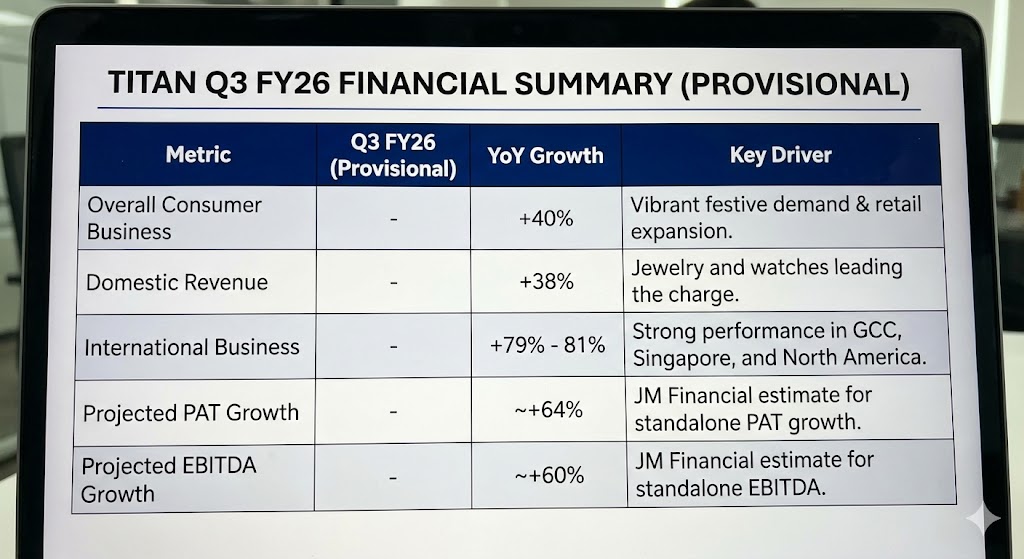
The biggest headline-grabber this quarter was Titan Company. In its Q3 FY26 update, Titan reported a stunning 40% year-on-year growth in standalone revenue, a number that immediately caught investor attention.
The real engine of this growth was Titan’s jewellery business—Tanishq, Mia, and Zoya—which grew 41% YoY and contributed nearly 85% of the company’s total revenue. This is a powerful signal. It shows that Titan is no longer just a diversified lifestyle company; it is fundamentally a jewellery-led consumption play.
What makes this growth interesting is the “High ASP paradox.” Buyer growth during the quarter was relatively flat. Yet revenues surged. The reason lies in the sharp jump in Average Selling Price (ASP). With gold prices at record highs, each transaction value increased significantly. Consumers may have bought fewer pieces, but they spent more per purchase.
. Titan Company – Investor Relations
Titan’s diversification strategy also supported overall performance.
Watches grew 13%, with analog watches leading at 17%, showing that premium timepieces are back in fashion.
Eyecare grew 16%, reflecting steady urban demand.
Emerging lifestyle categories like women’s bags recorded an eye-catching 111% growth, albeit from a smaller base.
Another underappreciated factor was Titan’s international push. Overseas revenue jumped 79% YoY, driven by expansion in the GCC and North America, where Indian diaspora demand for trusted jewellery brands remains strong.
India Bullion and Jewellers Association (IBJA) – Gold Prices
3. Kalyan Jewellers: Digital Momentum and Market Share Gains
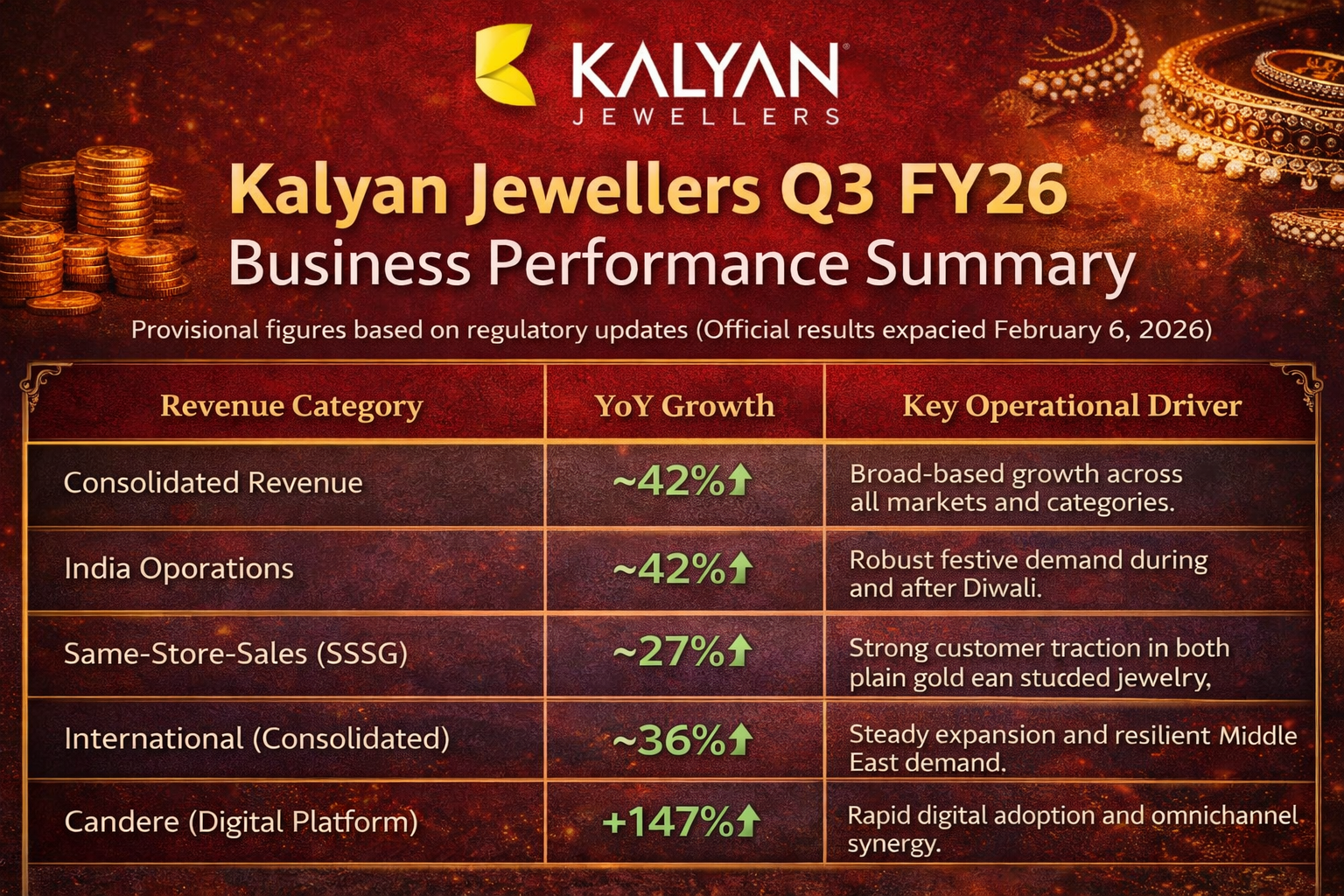
If Titan represented premium dominance, Kalyan Jewellers showcased the power of scale and digital integration. The company reported 42% year-on-year growth in consolidated revenue for Q3 FY26, reinforcing its position as one of India’s fastest-growing jewellery retailers.
A key metric to watch here is Same-Store Sales (SSS) growth. Kalyan posted a healthy 27% SSS growth, which means existing stores were selling much more without relying heavily on new store additions. This points to strong brand trust and repeat customer behaviour, even in a high-price environment.
The real breakout story, however, came from Candere, Kalyan’s digital-first jewellery platform. Candere’s revenue surged by a massive 147% YoY. This is a strong indicator that Indian consumers are becoming comfortable buying high-value items online, provided the brand is trusted and pricing is transparent.
On the physical front, Kalyan expanded its network to 469 showrooms globally, including 318 stores in India. This omnichannel approach—strong physical presence combined with aggressive digital growth—is allowing Kalyan to steadily take market share from smaller, unorganised jewellers.
4. Supporting Acts: Senco Gold and PNG Jewellers
The consumption boom was not limited to the top two players. Mid-sized and regional brands also reported blockbuster numbers, confirming that the trend was sector-wide.
Senco Gold reported a remarkable 51% year-on-year revenue growth in Q3 FY26. The market reaction was swift, with the stock jumping nearly 14% intraday after the earnings update. Senco’s management highlighted strong traction in studded jewellery and festive buying across eastern and southern India.
Similarly, PNG Jewellers posted 46% growth in retail revenue, with Diwali sales alone rising 74% compared to last year. This shows that even regional players with strong local recall benefited from the festive surge.
A common theme across all players was investment demand. Sales of gold coins and bars nearly doubled in many stores. This clearly shows that consumers are not just buying jewellery for weddings or gifting; they are also parking savings in physical gold as a hedge against inflation and global uncertainty.
World Gold Council – India Gold Demand & Jewellery Trends
5. Geoeconomic Triggers: What Is Powering the Purse?
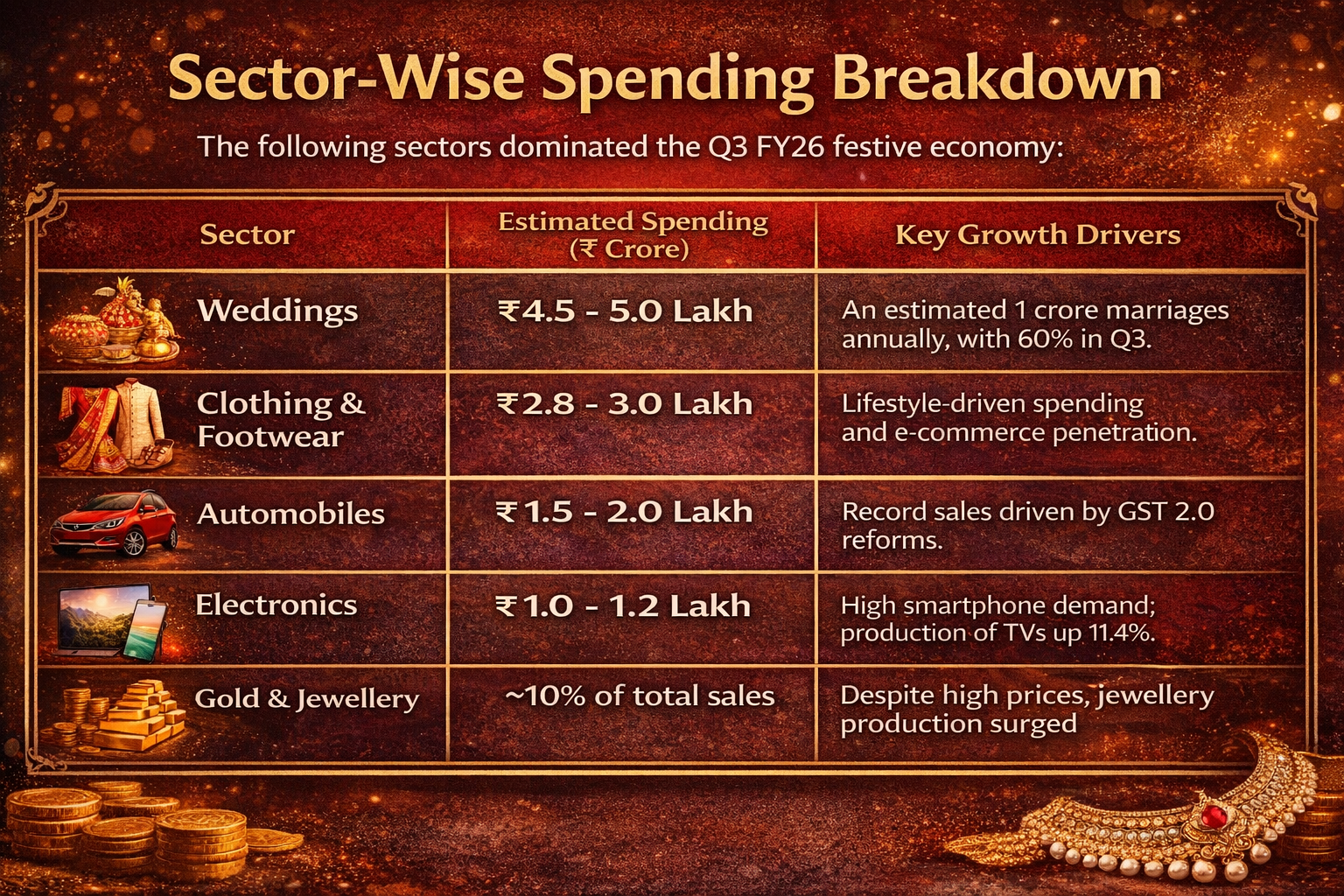
Several macro and structural factors explain why high gold prices failed to dent demand.
First, the so-called “wedding recession” simply did not happen. Estimates suggest around 46 lakh weddings took place during the season. Weddings create non-negotiable demand for gold jewellery, especially in India, where gold is deeply linked to social status and financial security.
Second, there is a clear shift from unorganised to organised retail. GST compliance, hallmarking rules, and transparent pricing have made it harder for small, informal jewellers to compete. Large players also ran aggressive gold exchange programs, where old jewellery could be exchanged at attractive rates, reducing the effective cost for buyers.
Third, lab-grown diamonds (LGDs) are emerging as a strategic growth driver. Titan’s launch of ‘beYon’, its LGD-focused brand, and Senco’s push into high-margin studded jewellery (growing in the mid-20% range) show how brands are balancing affordability with design and margins.
Finally, the broader geoeconomic environment matters. With global uncertainty, volatile equity markets, and inflation worries, Indian households continue to treat gold as a store of value, not just a luxury item.
Ministry of Statistics & Programme Implementation (MoSPI), India
6. Conclusion: Is the Sparkle Sustainable for 2026?
Looking ahead, most jewellery retailers are optimistic about FY26 growth staying above 25%, supported by steady rural recovery and strong urban premiumisation. While valuations are no longer cheap—Titan recently touched a fresh 52-week high near ₹4,300—the sector remains a powerful proxy for India’s domestic consumption story.
For investors, the key takeaway is simple. Jewellery stocks are no longer just cyclical plays on gold prices. They represent brand strength, formalisation of the economy, and rising middle-class purchasing power. As long as these structural trends remain intact, the sparkle in India’s jewellery sector is likely to continue well beyond FY26.
📌 Frequently Asked Questions (FAQ)
Why did jewellery companies perform so well in Q3 FY26 despite record gold prices?
Jewellery companies performed strongly because demand remained robust during the festive and wedding season. Higher gold prices increased the average selling price (ASP) per transaction, allowing revenues to grow even if volumes stayed stable.
How high did gold prices go during Q3 FY26 in India?
Gold prices touched nearly ₹1.39–1.40 lakh per 10 grams in early January 2026, marking one of the highest levels ever recorded in India.
Which jewellery companies reported the strongest growth in Q3 FY26?
Major players like Titan, Kalyan Jewellers, Senco Gold, and PNG Jewellers reported 40–50% year-on-year revenue growth, driven by festive demand, weddings, and premium product mix.
What role did weddings play in boosting jewellery sales?
Weddings played a crucial role. An estimated 46 lakh weddings during the season created non-discretionary demand for bridal jewellery, which remains a cultural and financial necessity in India.
What is driving the shift from unorganised to organised jewellery retailers?
Factors such as GST compliance, mandatory hallmarking, transparent pricing, and gold exchange schemes are pushing consumers toward organised retailers and away from small unorganised jewellers.
Why are consumers buying gold jewellery as an investment?
In an environment of global uncertainty and inflation, Indian households view gold as a safe store of value. Sales of gold coins and bars nearly doubled, showing that jewellery is being used as both consumption and savings.
How important is digital jewellery sales in Q3 FY26?
Digital sales are becoming increasingly important. Platforms like Candere recorded over 140% growth, indicating growing trust in online purchases of high-value jewellery.
What is the role of international markets in jewellery companies’ growth?
International markets contributed significantly. Overseas revenue grew 79–81%, led by strong demand in the GCC, Singapore, and North America, especially among the Indian diaspora.
What do projected PAT and EBITDA growth numbers indicate?
Brokerage estimates suggest ~64% growth in PAT and ~60% growth in EBITDA, indicating strong operating leverage and margin stability despite high input costs.
Are lab-grown diamonds impacting the jewellery market?
Yes. Lab-grown diamonds are gaining popularity due to lower prices and modern designs. Brands are using them to attract younger buyers and improve margins in studded jewellery.
Is this jewellery consumption boom sustainable in FY26?
Most industry leaders expect 25%+ growth to continue in FY26, supported by steady rural demand, urban premiumisation, and ongoing formalisation of the sector.
Are jewellery stocks still attractive for investors after this rally?
While valuations are higher, jewellery stocks remain a strong proxy for India’s domestic consumption story, benefiting from brand strength, scale, and long-term demand for gold.