Introduction: India’s Strong GDP Growth Becomes Global Headline
India’s economy delivered one of its strongest quarterly performances in recent years as the National Statistical Office (NSO) announced that India’s GDP grew by 8.2% in Q2 of FY 2025–26. This impressive growth has positioned India once again as the fastest-growing major economy in the world, especially at a time when several advanced countries are struggling with slowdowns or stagnation.
The quarter from July to September 2025 saw a powerful combination of rising manufacturing output, a booming services sector, strong public expenditure, and improved business activity. For students, analysts, investors, and policymakers, the Q2 GDP figure is a key indicator of India’s economic direction in 2025 and beyond.
In this detailed analysis, we explain what GDP means, how it is calculated, who publishes it in India, reasons behind this strong growth, global comparison, sustainability analysis, and the final takeaway.
What Is GDP? A Simple Explanation
GDP stands for Gross Domestic Product. It measures the total value of all goods and services produced within a country during a specific period. Think of it as the economic report card of a nation.
A rising GDP means:
More production
More jobs
More income
More economic activity
A falling GDP indicates:
Slowdown in business
Reduced jobs
Low consumption
How GDP Is Calculated (3 Methods)
India follows global standards (UN’s SNA 2008) and calculates GDP in three ways:
1. Production Method
Adds the value created by all sectors like:
Agriculture
Manufacturing
Construction
Services

2. Expenditure Method
Adds total spending by:
Consumers
Businesses
Government
Net exports (Exports – Imports)
Formula:
GDP = C + I + G + (X – M)
3. Income Method
Adds the income earned by people and companies:
Wages
Profits
Rent
Interest
India mainly uses the Production Method for quarterly GDP figures.
Who Publishes GDP Data in India?
India’s official GDP data is released by the National Statistical Office (NSO), which comes under the Ministry of Statistics and Programme Implementation (MoSPI).
Key Functions of NSO:
Collects sector-wise national data
Compiles GDP, GVA, inflation and national accounts
Publishes quarterly and annual GDP numbers
Maintains accuracy and transparency
Follows international standards for comparability
Within the NSO, the National Accounts Division (NAD) handles GDP and GVA computation.
This structure ensures that the GDP data is credible, consistent, and globally recognized.
India’s Q2 FY 2025–26 GDP Growth Rate: The Official Numbers
The NSO’s data for the quarter shows:
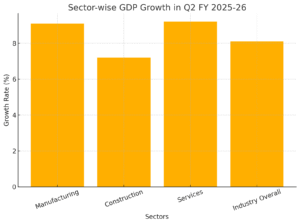
Real GDP Growth: 8.2%
Nominal GDP Growth: 8.7%
Manufacturing Growth: 9.1%
Construction Growth: 7.2%
Services Sector Growth: 9.2%
Industry Sector Growth: 8.1%
Gross Value Added (GVA): Strong growth across sectors
These numbers clearly show broad-based economic expansion, not just growth driven by one or two sectors.
Why Did India’s GDP Grow So Fast in Q2?
1. Strong Manufacturing Activity (+9.1%)
Higher production of:
Automobiles
Electronics
Engineering goods
Chemicals
Support from PLI schemes and strong domestic demand helped manufacturing output.
2. Services Sector Boom (+9.2%)
This includes:
IT and digital services
Banking and financial services
Hotels, tourism, and transport
Communication services
With rising urban consumption and a rebound in travel, services contributed heavily to GDP.
3. Infrastructure & Construction Boost (+7.2%)
Government pushed capital expenditure in:
Highways
Railways
Airports
Urban metro systems
This increased demand for cement, steel, machinery, and labour.
4. Improved Consumer Spending
Lower inflation and stable prices boosted household purchasing power. Urban demand remained strong in:
Automobiles
Electronics
Real estate
E-commerce
5. Strong Credit Growth
Banks recorded high credit growth across:
Retail loans
Home loans
MSME loans
Corporate loans
More borrowing means more spending and more investment.
6. Government Capex Push
Government infrastructure spending played a major role in supporting economic expansion. Public investment remains a core pillar of India’s current growth phase.
What Does This Growth Tell Us About India’s Economy?
The 8.2% growth rate reflects confidence, stability, and strong fundamentals.
1. Strength of Domestic Demand
India relies heavily on internal consumption, making the economy more stable compared to export-dependent nations.
2. Diversification of the Economy
Both manufacturing and services showed strong growth. This reduces dependence on a single sector like agriculture.
3. Improved Business Sentiment
More companies are expanding capacities and investing in new projects.
4. Demographic Advantage
India’s young population is fueling demand across multiple sectors like housing, education, mobility, lifestyle, and digital services.
5. Global Shift Toward India
Companies moving out of China due to geopolitical tensions have increased interest in the Indian market (China+1 strategy).
India vs The World: Global Comparison of GDP Growth
Comparing India’s performance with major economies:
| Country | Approx. Growth Outlook 2025 | Remarks |
|---|---|---|
| India | 8.2% (Q2 FY26) | Fastest growing major economy |
| China | 4–4.5% | Slowdown due to property crisis |
| US | ~2% | High interest rates impact demand |
| EU | 1–1.5% | Weak industrial output |
| Japan | <1% | Currency pressure, low demand |
International institutions like the IMF and World Bank agree that India will remain the global growth leader for 2025 and 2026.
Can India Maintain This Growth in the Next Two Quarters?
Positive Factors Supporting Growth
Strong festive season demand
Cooling inflation and stable fuel prices
Continued government capital expenditure
Strong manufacturing and services momentum
Challenges to Watch
Volatile global oil prices
Weak global trade environment
Slow export growth
Rural demand slightly uneven
High global interest rates affecting inflows
Growth Prediction
Economists expect India’s GDP to grow between 6.8% and 7.5% over the next two quarters, assuming no major global shock.
Detailed Analysis: What India Should Focus On
To convert this short-term growth into long-term stability, India should strengthen:
1. Rural Consumption
Agriculture productivity and rural income support rural demand.
2. Private Investment
Private sector capex needs to increase to sustain job creation.
3. Export Competitiveness
Lower logistics costs and improved infrastructure can make India a global factory.
4. Skill Development
To match manufacturing expansion, India must upskill its workforce.
Final Takeaway
India’s 8.2% GDP growth in Q2 FY 2025–26 is a powerful signal of its economic strength. The growth was broad-based, supported by manufacturing, services, and infrastructure. At a time when global economies are slowing down, India continues to stand out as a resilient and fast-growing economy.
This quarter’s performance not only boosts investor confidence but also strengthens India’s long-term path toward becoming a $5 trillion economy.
Conclusion
India’s GDP performance in Q2 FY 2025–26 clearly shows that the country is on a strong economic trajectory. With strong domestic demand, a booming services sector, and major infrastructure investments, India has all the ingredients for sustained long-term growth.
While global uncertainties remain, India’s fundamentals look strong, and with continuous reforms, strong governance, and rising global relevance, the economy is well-positioned for robust growth in the coming quarters.